All the Light we Cannot See
Anthony Doerr
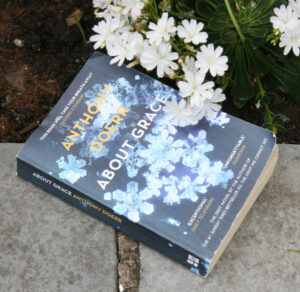
About Grace is a literary novel by Anthony Doerr, author of the acclaimed All the Light We Cannot See. Was it of the same calibre? – that’s the question that drove me to buy a rather battered copy and read it.

It’s impossible to review it without some spoilers so please be warned if you intend to read it yourself. I’ve tried to keep them to a minimum.
David Winkler has always been different. From his youth he’s had presentiments, vivid dream-like experiences where he sees things happen which then come to pass: glass falling and breaking; a man being cut in two by a bus on an icy road; a young woman dropping a magazine in a supermarket.
So fixated is he by the vision of the young woman that he goes to the supermarket to watch her drop the magazine, and ends up marrying her (Sandy) even though she has already been married to Herman for 15 years. That union produced no children because Herman was infertile, so both Sandy and David are delighted when baby Grace is born.
As an hydrologist, David is obsessed by water and snow, and he’s increasingly disturbed by vivid nightmares about floods. His inherent sleepwalking escalates, taking him outside and even into water. But when the nightmares/premonitions are of Grace drowning in his arms as they’re submerged in flood waters, he is torn by indecision.
A fearful storm does indeed hit, and their house is flooded, just as he saw in his dream. Somewhere Grace is crying, just as predicted. As the water rises ever higher he is forced to make a choice; does he go into the house to rescue his daughter and be the instrument of her death as per the dream, or does he walk away and trust Sandy to save her? The tension is palpable. Is it even possible to hoodwink the powers that control our fates?
What if by leaving he had somehow tampered with the order of things, removed a thread and left the fabric snagged and incomplete?
 He does run away and takes ship far away to the Grenadine Islands in the Caribbean, but always at the back of his mind is the gnawing question: is Grace still alive? Sandy wants nothing more to do with him; as far as she’s concerned he’s a deserter; he’s dead. She even returns all his letters. He spirals to rock bottom: alone, destitute and bereft, surviving on what he can scavenge or scratch together by odd jobbing, almost drowning in a desperate attempt to take a ten-foot rowboat over a coral reef in tumultuous seas the night he receives Sandy’s note,
Don’t come back. Don’t even think of it.
But then he befriends a precocious girl with an obsessive interest in marine life, Naaliyah, who becomes something of a substitute for Grace. When he has a premonitory dream about her drowning with her ankle caught in the anchor chains of her boat, he begins to stalk her. In consequence he’s present when the accident does happen and thwarts the future by rescuing her.
Had he … was it possible … that he had changed the course of Grace’s fate too by his actions in much the same way?
And so it is that 25 years on, he sets out for Cleveland, Ohio, where it all happened. By now he’s 59. But his search is fraught with difficulties and eventually he finds himself in the frozen wastes of Camp Nowhere, off grid, in one of the most inhospitable parts of Alaska with Naaliyah. It’s here that Doerr excels; capturing the place, the life, the fight for survival, the power of love, eloquently and movingly.
But his story of one man’s battle with foresight, raises deep questions.
Where does reality begin and end?
Where are the boundaries and definitions – around dreams, nightmares, premonitory glimpses into the future, reality, sleepwalking, sentience …?
Is life preordained or do we have any control over our fate?
What is time? Must it be sequential, can it retreat, recycle?
Are events and meetings and love as prefigured and inevitable as the six sides of a snow crystal are honeycombed into its very atoms?
A literary work it may be, but I could at least understand it!! However, the pace is very measured; the main character is maddeningly slow; so if you’re anything like me you need to choose your moment to tackle this one.
Truth stranger than fiction
Normally I stay clear of religion and politics in my blog, but this week I just can’t ignore the craziness bombarding us. There comes a time when staying within the safe and respectable writerly world, simply won’t do.
We’re rather inured to improbable happenings on our screens in dramas, aren’t we? Professors of neurosurgery who beat the living daylights out of a colleague who taunts them, and then walk straight into theatre and perform some intricate ground-breaking surgery on a patient to widespread acclaim. High ranking detectives who get suspects into quiet corners and extract information by foul means. All without repercussions. You know the kind of thing I’m talking about. And yet, reviewers are wont to criticise authors quite harshly if their characters don’t ring true; a person in that position in those circumstances just wouldn’t behave like this, wouldn’t say that.
Well, if I were to include in my novels some of the real-life activities in the news recently, I’d be accused of writing unbelievable fiction too. Or dubious hyperbole, at the very least. I ask you.
Mature (in years) men, MEPs, indeed, brawling … abroad … when they are supposed to be representing their country …?
High ranking ministers promoting harsh discriminatory ideas completely opposed to views they themselves expressed as their deeply-held beliefs when they were lower down the food chain … ?
A last-lap US presidential nominee, bidding to lead the largest and most powerful free country in the world, who has already openly scorned many minority groups (eg muslims, immigrants), now admitting he has sexually abused women …, seeing them as the entitlement of any ‘alpha male’ … especially ‘a star’ …?
Hugely important questions about Brexit being decided by a tiny cabal with neither MPs or the people having a say …?
Large numbers of high-earning BBC employees being accused of dodging taxes …?
Hmmm. Looking at this list I note they’re all except one about politicians.  OK, I could develop that theme but it could get nasty, so instead I’ll share my thinking about the matter of credulity.
Decent civilised people living in decent civilised communities tend to assume the integrity and honesty of public and professional figures. We want to trust doctors, lawyers, policemen, teachers, clergy, royals, social workers … we want our children to be able to trust them. But coming on top of all the scandals exposed by the media in recent years, these current horrors challenge our credulity. Can this really be happening? How is it possible? The more I thought about this, though, the more I realised that this is the stuff of thrillers. When apparently trustworthy people step outside the boundaries of the acceptable and believable. Unreliable narrators, unscrupulous colleagues, immoral perpetrators.
 For example, this week I watched the film Shutter Island, a disturbing glimpse inside the world of insanity. US marshal, Teddy Daniels (Leonardo diCaprio) is sent to Boston’s high security prison for the criminally insane, on a remote hurricane-blasted island, to investigate the disappearance of a female murderess. Daniels himself has a traumatic past having witnessed the aftermath of the atrocities at Dachau and lived through his wife’s murder. But on the island he is determined to gain access to the ward where the most dangerous patients are housed, a ward in a lighthouse to which the medical team are denying him entry. It’s a film that challenges received wisdom, professional facades, and the limits of humanity. What is believable? Can I trust what I’m seeing and hearing?
Nor is it just thrillers that do this. I’ve also been reading All the Light we Cannot See by Anthony Doerr, a beautifully written, haunting novel about a blind French girl, Marie-Laure, and an orphan German boy, Werner, whose paths cross in occupied France as both try to survive the devastation of World War II. It’s by no means a thriller, but inevitably there are troubling scenes that make us question just how far humans can sink and still retain their humanity. Happenings which Marie-Laure’s great uncle says ‘sound like something a sixth-former would make up.’ In other words, unbelievable. But of course we today know about the atrocities of that era, and much as we might inwardly recoil and think, Surely not, we know these things were real and do/did happen. They become utterly credible in a spine chilling kind of way.
Spine chilling. Now that’s what I’m pondering in my own writing at the moment. I’ve always worked consciously to make my characters believable. For each book I’ve asked a raft of experts as well as discerning readers, to check the manuscript for credibility before it goes for publication. But I’m starting to wonder if any of us can predict how low human beings can sink, or how unlikely any extreme behaviours really are. And now that I’m experimenting with thriller-writing, perhaps I can push the boundaries further in my writing about a young mother who exhibits pathological behaviour, without being condemned by the literary critics. Certainly I need to keep pushing that ‘What if’ button. See how far I can go.