medical ethics
Psychiatric scandals
We’ve probably all heard about the historical barbaric treatments and unauthorised clinical trials and experimentation meted out to psychiatric patients, which led to big inquiries and the radical reshaping of modern medical ethics on issues like informed consent and autonomy.
Vulnerable mentally ill people were systematically destroyed with mind-altering drugs, extreme forms of electro-convulsive treatment, operations on their brains, and horrific research on mind control. Many of these procedures were irreversible; patients were seriously damaged; some died. Unscrupulous clinicians went to extreme lengths to disguise or cover their tracks. Governments were complicit in the name of national security and international competition.
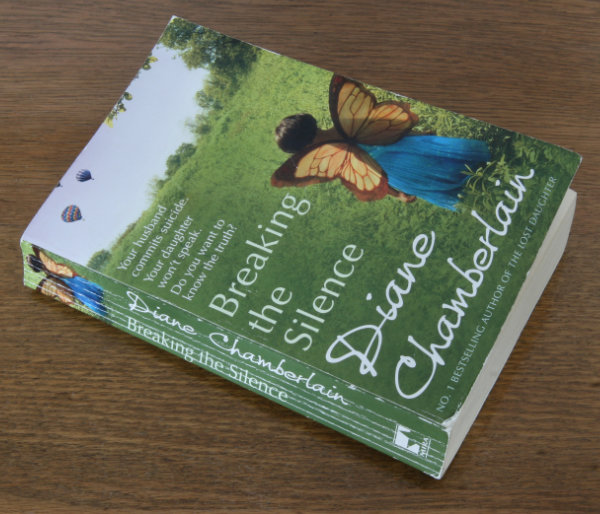
It’s a topic that offers big potential for novelists. Diane Chamberlain is one such. In Breaking the Silence, she’s woven the issue through the eyes of a psychiatric nurse, Sarah, in the 1950s, who finds herself in an advanced facility where the lead clinician has a reputation as a genius offering cutting edge therapy, and conducting innovative research, but who is in fact unscrupulous and maniacal. Alongside this is a present-day tale of a young girl, Emma, who’s in the house alone with her stepfather when he shoots himself dead. The child, believing her chattering made him do it, simply stops speaking, and her mother, Laura, and therapists struggle to unlock the key to her extreme response. When Laura’s father, begs her on his death bed to visit an elderly lady in a retirement home who has Altzheimer’s, the scene is set for these two time-lines to converge.
 Though the story appealed on the grounds that it explores medical ethical issues, from a literary point of view I read it at the wrong time. Successfully dovetailing two stories, two time-frames, requires a deft touch, and it was a shame I read it too soon after Robert Goddard‘s Painting the Darkness. (reviewed last week) His writing is so brilliant and he has woven a first person account into a third person narrative with so much more immediacy and verve, never losing momentum. However, Chamberlain is herself a psychotherapist, so she handles the medical aspects of her storytelling with more assurance and I enjoyed that element of the book.
So much more than a suspense novel
How’s this for an opening sentence:
I am serving the fifth year of a life sentence for murdering my own child.

Harlan Coben is one of those authors whose books I snap up when I see them and then titrate through the year when I’m looking for the indulgence of a sure-fire good read. He has more than eighty million in print worldwide so it’s not difficut! His suspense novel, I Will Find You, was my reward this week for an exceptionally frenetic time juggling lots of demands.
It exceeded expectation. Not only was it the usual juggernaut of tension and conflict, but it strayed into my own field of interest: medical ethics! The ins and outs of infertility treatment to be precise; informed consent; prolonging life v merciful death. Who knew?!
The narrator is David Burroughs. The child in question Matthew, aged 3, found dead in his bedroom, battered so severely that he’s unrecognisable. And the evidence against David is indeed compelling. In the house alone with his son. The worse for drink. Covered in Matthew’s blood. Known to have occasional violent outbursts and sleepwalking. A witness who states under oath that she saw him burying the murder weapon. His fingerprints the only ones on the handle.
When we meet him after five years in prison, Burroughs is reconciled to his fate. He is guilty after all – guilty of not having protected his precious son from whatever happened that night. He isolates himself; refuses to see visitors. Nothing of this horrific experience must further taint those he cares about. He loses touch with what’s happening in the outside world.
But then his sister-in-law, Rachel, insists on seeing him; absolutely insists. She brings with her a photograph taken by a friend at a theme park. The subjects in the foreground are a happy family enjoying innocent amusement, but in the background is a boy … a boy who looks uncannily like Matthew. It can’t be! It’s impossible. But … Against logic, hope stirs in David, and a renewed purpose is kindled. He has to find this boy … his boy … prove his own innocence … But first he has to achieve the impossible: find a way of escaping prison.
The developments that follow keep the reader in a state of high tension, willing him to stay ahead of the authorities, as he searches out those who might lead him to his boy, those who were involved in some way in framing him, and whoever it was who killed the lad lying in that bed that night wearing Matthew’s Marvel-hero-themed pyjamas.
Hitting the headlines
As I mentioned last week, it’s astonishing how frequently medical ethical issues hit the news. Evidence, evidence! I hear you cry. OK. More detail it is. But of course, do bear in mind that the media rely on sensation to sell papers.
I’d prefer to show you the actual headlines, but given the legal issues around copyright, I’ll just list a few recent ones this year alone.
 * Starmer will allow assisted dying vote
* Petition spurs MPs to tackle assisted dying
* France will allow at-home dying for terminally ill
* UK travel to assisted dying clinic falls to 12-year low
*Fears that fertility unit has destroyed embryos
* NHS chiefs accused of covering up clinic’s embryo destruction

* Gender identity is a religion, so why is Scotland legislating on it?
* UK’s only trans judge quits over fears she has politicised the role
* School nurse states not all people who give birth are women
* Caitlyn Jenner: Trans women are not women
* Italian trans man found to be pregnant after mastectomy
* Late-term DIY abortions will rise if law changes
* New late abortion guidance tells health staff to avoid reporting women to police
 * 20,000 prostate cancer cases missed in Covid
* Children still suffering effects of lockdown
* Patients suing NHS over missed cancer diagnoses rise by 50pc
* Hospitals told to drop physician associates
Every one of these issues raises so many questions, and such a range of challenges. Every one indicates the appetite of the public for this kind of information. Every one could easily spark a storyline for another novel in my series. And sometimes indeed fiction is more believable than truth.
Will I? Won’t I? … time will tell!
(Thanks to Shutterstock for the two question images)
Ethical issues: egg freezing
As I’ve mentioned before, it’s rarely that the subject of medical ethics is far from the news. Just in the last couple of weeks we’ve had assisted dying, gender identity, abortion. But the one that jumped out at me was fertility treatment.
 Last month patients at two clinics were told that their embryos might not be viable because a faulty solution was used. Now we learn that a major NHS fertility centre near London has been reported to the police and had their license suspended because of fears that embryos have been destroyed due to potential contamination of processes and equipment. Investigations by police and fertility regulators are underway; new security measures are in place, and affected patients have been contacted.
Given the high degree of control and regulation and safety checks, it’s hard to see how this could have happened on the scale alleged. Given the huge significance of what is being done in the creation of new lives, can there be any more serious breach?
Imagine … going through all the trauma of retrieving eggs, creating embryos, perhaps knowing this is your last ditch hope of ever being a parent, and then finding it has all been in vain. All hope has gone. Because of clinical or human error. And then finding the NHS staff are also accused of a cover up.
Aside from the actual news, there has also been airing of a fascinating BBC programme on the subject: Egg freezing and me.
 As many as one in six women struggle with their fertility in the UK, and egg freezing is one of the fastest growing treatments. Nowadays patients are seeking the procedure for a whole variety of reasons: when they are not ready to become mothers; when there is no suitable partner on the horizon; when their biological click is ticking too fast; when medical conditions mean their fertility is compromised; when they are about to undergo treatment that will render them infertile; when they have transitioned. But simply wanting help is no guarantee that it will be available: access varies. Clinics vary. The accuracy of statistics provided to patients varies. The number of rounds of treatment on offer varies. The cost alone puts the treatment beyond the reach of many.
 There are immensely complex questions relating to this treatment.
Should there be age limits?
Should there be a limit to the number of rounds offered, the number of eggs retrieved or frozen or thawed or used?
Should single parenthood be encouraged?
How honest about efficacy should clinicians be?
Should healthy fertile women be encouraged to keep their options open in this way?
Is it kind to encourage hope when the odds of success are very poor?
Should the service be available to trans men?
How honest should clinicians be when mistakes happen?
The list goes on.
I’m impressed that the BBC tackled this subject, and that a number of women were prepared to share their experiences so openly. These are highly sensitive treatments with life-altering consequences. Society must keep asking the hard questions.
NB. For anyone contemplating fertility treatment the Human Fertilisation and Embryology Authority has issued a statement in response to the BBC programme.
The pace of change
Thirty years ago, when I first started writing novels set in the world of medical ethics, I had an abiding horror of someone else writing on the same theme and publishing before me, or real life medicine coming up with something new that rendered my plotting obsolete – or that made it look as if I’d copied from real life, or the topic simply becoming old hat in some way. In reality the reverse has happened: real life has occasionally mimicked my fiction. And not one of the eleven novels I’ve published has actually gone out of date. Such is the enduring nature of ethical issues.
 This week I’ve been following up an ongoing story in the Isle of Man – a self-governing UK dependency in the Irish Sea between Great Britain and Ireland – where a Bill is going through Parliament designed to legalise assisted dying. The first reading of the Bill was approved by 22 to 2 votes. In the second reading at the end of October, 17 members voted for, 7 against. It now faces three more stages: a clause stage – where each clause is independently scrutinised; a potential committee stage, and a third reading. If it survives these obstacles it goes to the Legislative Council where it could be signed into law and could be available as early as 2025. If it is, the island will be the closest place to mainland Britain where this service is available, although it should be noted, tourists will not be able to take advantage of it.
 It’s fifteen years now since my novel Right to Die was published – hard to believe! But the issues remain the same; the complexities and caveats are still confounding the process of actually enshrining a practical workable solution in legal language; patients and families are still facing horrendous choices. Could it be that an island 426 times smaller than the UK will blaze a trail for its neighbours?
Whatever, the wheels of law turn oh so slowly. I shall not be short of potential material in my lifetime!
Best Interests
Wow! What d’you know! BBC 1 has just aired a remarkable drama all about medical ethics – yep, really – and I’ve been totally gripped. For an hour on four evenings, culminating two days ago, Best Interests tracked the case of a young teenager, Marnie Lloyd, and the struggle to decide whether she should be allowed to die.
Marnie (played by Niamh Moriarty) was born with a form of muscular dystrophy, which means a short life with major disability. Her devoted parents, Andrew (Michael Sheen) and Nicci (Sharon Horgan), are shocked by the diagnosis when she’s just six months old, but do all in their power to give her a happy childhood. Inevitably, though, their family life is an emotional roller coaster, chequered with crises, and spells in hospital, and a fine juggling act with Marnie’s older sister, Katie (Alison Oliver).
Then one day a severe respiratory infection leads to a cardiac arrest, prolonged deprivation of oxygen to the brain, and Marnie goes into an unresponsive state where she only reacts to painful stimuli. She can’t be weaned off the ventilator, and she starts to have seizures. The prognosis is grim.
The doctors caring for her recommend stopping treatment; the cost to Marnie herself is just too high, they say. But Nicci won’t hear of it. She clings to an outside chance that Marnie might smile again if her brain is given time to heal. ‘How can you let go of someone who still laughs?’ she asks – the poignant cry of a mother.
The hospital take advice from the Ethics Committee; they suggest calling in a mediator, but Nicci refuses to be involved in any negotiations; she has no confidence in the impartiality of any process.
When a Christian Pro-life group make contact she clings to the hope they give of support to fight this through the courts. They fuel her sense of injustice by telling her the hospital performs eugenics all the time, and doctors are more concerned with saving money than lives. What’s more, they quote three cases where parents have won against doctors in court – it’s enough for Nicci. And once they have the bit between their teeth, the legal team dig deep. They latch on to one incident in the past where a mistake in Marnie’s care might be used against the consultant physician, showing her to be a fallible person with flawed judgement at times. It speaks volumes that Nicci might even contemplate such a course of action against a dedicated woman who has cared for Marnie so devotedly since she was seven. Or that she might consider seeking experimental treatment from abroad – in spite of Andrew’s scathing ‘there is always some doctor from America or Italy who promises a miracle’.
But Andrew is in a very different place. Devoted though he is to these three women in his life, he simply can’t bear to be in the same house as Nicci in her single-minded battle. He believes the consultant when she says objective signs show Marnie feels pain, and that there is no realistic prospect of any recovery to a meaningful life. So he moves out, leaving elder daughter Katie torn between her loyalties to both of them, and with her own private battles to fight.
It’s a story of love and torment. It’s both heartbreaking and beautiful. It’s brilliantly acted. It feels real with shambolic kitchens and untidy people and chaotic relationships. And it poignantly captures the conflicting emotions, the stress on families, the impossible position of the medical team. It all depends where you’re standing what this looks like. As the judge says in her preliminary statement, the notion of best interests is very complex; everyone in the court room thinks they have Marnie’s best interests at heart, but they’ve come to different conclusions as to how those interests are best served. Even medicine is about opinions not just facts. And throughout the deliberations it’s imperative they all keep the child Marnie Lloyd at the forefront at all times.
I’m sure we can all relate to each member of the family. To Nicci as a mother wanting to hang on to her precious girl. To Andrew who sums up his own struggle to articulate how he feels, loving this child more than he can express, but not wanting her to suffer: he can’t talk about it; he can’t rationalise it; he can only feel it … to the depths of his soul. To Katie, torn by feeling of guilt and regret and impotence as the battle rages around her, and her beloved only sister lies unconscious in a hospital bed. All her life, whenever Marnie has been rushed to hospital, Katie has felt compelled to ask, ‘Is she going to die?’ And now that reality is closer than it has ever been. Each one feels so alone.
But as the judge emphasises, it’s not a competition. Rehearsing the arguments in the controlled atmosphere of a court of law, gives opportunity for everyone to hear and see the case for and against withdrawal of treatment. In reality the experience in the witness box at times feels pretty brutal, with lawyers straying into the realms of disrespectful comments and intrusive questioning, but others are on hand to correct the overload, and to expose unwarranted bias and shaky premises. And the judge in this case shows fairness, grace and understanding.
 If there is a weakness in the film it’s the end scenes where the machines are removed, Marnie dies, and is taken to theatre to have her organs removed for transplantation. But perhaps a bit of artistic licence here is what we all needed after so much raw emotion.
I spent years studying this subject, being with real families facing these horrific decisions, and I was hugely impressed by this moving drama. I salute commissioners, screenwriters, film makers, actors … well, everyone concerned.
Something stirring …
We’re rather used to recognising acting dynasties, identifying young upcoming stars as son/daughter of legendary names, but it’s much less common in the world of literature. So I was rather taken aback by the blurb about the author Christopher Rice which appears on the very first page of The Snow Garden:
 Christopher Rice is the son of Anne Rice, bestselling novelist, and Stan Rice, the poet.
Hmmm. I’d rather stand or fall on my own merits when it comes to writing novels, I think.
Anyway, that aside, this book came under my radar because it includes an ethical dilemma – someone deliberately infecting a number of others knowing he is HIV positive – and I do try to keep tabs on the potential competition!!
Two women dying in suspicious circumstances … a group of undergrads with rampant hormones up to no goo … a professor somehow linked to all of them … several people not who they claim to be – that’s the essence of the storyline. And it took me back to the days when HIV/AIDS was a ‘new’ and much feared incurable disease. I carried out research on the topic and met a large number of young homosexual men and drug users who were dying from it, so I could relate to this book.
But my novels are definitely not in competition with this one. Christopher Rice is himself gay and writes from that perspective. And it’s a far more literary style of work which unravels slowly and is steeped in complex relationships, dubious morality, haunted pasts, convoluted cult religious ideas, academic and personal jealousies. Way beyond my pay-grade! And definitely not my cup of tea.
But, for some obscure reason, what came out of this was a poke into the embers of my own writing fire, hitherto suppressed during the pandemic.

As I tramped along on my morning constitutionals this week, enjoying the blossom and the birdsong, the imagination raced away with ideas which throughout the past year have been vague possibilities for a plot and characters. Feels invigorating. Spring buds emerging in the brain as well as the trees …? Time will tell.

Online presence
Phew, how the weeks fly by! I’ve just noted my tally … well over 600 posts.

So, a moment to pause and ask myself, why do I even have a blog? and why do I continue to write it every week? Initially, of course, it was set up to give me a profile (sounds so grand, doesn’t it?) which people could consult to see who I am, how I operate, why I write my style of novels, what I stand for. Some form of online presence is a prerequisite for authors nowadays, and the advice is: choose the ones with which you feel most comfortable. I’m at ease with this format.
But in my case, it’s more than that.


In my medical ethics novels, I make a point of leaving lots of breathing space for readers to form their own conclusions about the issues that provide the backdrop to each story. They aren’t polemics; they aren’t a vehicle for my opinions; they’re novels … although it’s not uncommon for readers to ask me what my personal views are. If I give nothing away about myself I can come across as a blank canvas. A blog gives me a vehicle to occasionally declare my hand in a controlled kind of way. It may be what I think of a piece of legislation, or a world event, or a book, or what someone has said, or an experience I’ve had. Anything really which has made me think, about which I have something to say. Reading back over some of it, I hardly recognise myself!! Did I actually formulate that argument, or articulate that thought?
Life can be so full, that it’s all too easy to skim read, only half-attend when listening to a programme/lecture/seminar or going to an event/function. But if I know I’m going to print on the topic, it concentrates the mind wonderfully. ‘I write to find out what I think!‘, as Stephen King said. Knowing my thoughts will be shared with others somehow allows me the mental bandwidth to think things through properly and reach a logical conclusion that I’d be prepared to defend. And it’s good for me personally to keep the little grey cells nudging one another.
If you too find what I have to say of interest, that’s a bonus! Thanks for visiting.
Justice, rights, entitlement
 The latest casualty of the coronavirus lockdown in this country is fertility care. As of Wednesday of this week, no new patients will be accepted, and even those in mid-treatment, those for whom this is their last hope, those who will be too old to qualify or stand a chance of success by the end of lockdown, will not now receive the necessary procedures towards which they’ve been working for so long. Yet another tragedy. More heartbreak. More hopelessness.
Which brings my thoughts to the ethical issues around assisted conception …
It’s now fifteen years since I wrote Double Trouble, a book about surrogate pregnancy. Fifteen years! Yoiks. But as with so many ethical dilemmas in medicine, the issues are still relevant today.
I was fascinated then, to watch the serialised BBC1 drama, The Nest, which finished this week, about a very wealthy but childless couple, Glasgow property tycoon Dan and his beautiful pampered wife Emily, who decide to go down this route. Click on the picture for the official trailer.

All attempts at IVF have proved unsuccessful. Dan’s sister has already tried to carry a baby for them but miscarried. They have one precious embryo left. One. Only one more chance. Emily meets the troubled teenage Kaya when she accidentally knocks into her in her car. Kaya sees an opportunity to get out of her impoverished life, and offers to be a surrogate for them in return for £50K. But as the story unravels we find that Kaya has secrets in her past and a very dubious pedigree indeed …; the would-be father Dan is something of a rough diamond too, dealing with a lot of shady characters and skullduggery …; Emily is single-minded about motherhood and what she wants, but privately troubled by the morality of what they are doing – always setting herself up as ‘the principled one‘ according to her sister-in-law. No-one in the UK will implant the last embryo. However, the Dochertys can well afford to go abroad for the simple procedure, and they do so.
On the face of it everyone stands to win. Kaya will be set on her dreamed-of pathway to becoming a successful business woman, able to ‘go on a plane, have one of these pull-along cases‘. The wealthy couple get their hearts’ desire. Better yet, surrogate and intended parents establish a relationship, even friendship. Kaya moves in with the Dochertys and gets a taste of a life of privilege. The baby will not only be much wanted, but will have every advantage money can buy.
Naturally – this is, after all, fiction, drama, a series requiring cliff hangers – things go pear-shaped. Relationships get confused. Loyalties are divided. Dubious and unsavoury motives emerge. But the underlying questions and challenges remain pertinent.
Is parenthood a right?
Is ‘want’ the same as ‘need’ in childbirth terms?
Payment for this service in the UK is forbidden. Should it be?
How binding should a contract between intending parents and surrogate be?
Should private arrangements for surrogacy be permitted?
Does a woman have the right to do whatever she likes with her own body?
What constitutes ‘reasonable expenses’?
Should those with the wherewithal be allowed to circumvent ethical and medical guidelines?
Does using someone far less powerful in this way constitute exploitation?
In the event of a dispute about whose baby it is, whose rights should take precedence, and who should decide?
What if the child is damaged/imperfect/not what was expected? Should the contract still stand? Who should accept responsibility for him/her?
What of the baby’s rights?
How much of its origins should a child be told?
Back to the drama … enter Kaya’s long-estranged mother, who encourages her to renege on the contract, hang on to the baby, become a mother herself, a better mother than she has been. But Dan already loves this child. Even when he finds out she is not his genetically, she’s still his daughter in his heart. The Dochertys call in their lawyer; the case goes to court. It’s left to the judge in the Family Court to put things into perspective – severely castigating their self-serving recklessness, the complete imbalance of power, the undesirable qualities on both sides. But, she says, at the end of the day it’s not a question of how she would judge them; it’s about what is in the baby’s best interests.
Contrary to expectation, there is a happy ending to this story, and both sides demonstrate they’ve learned important lessons about what matters in life. But the drama perfectly illustrates the power of fiction to challenge us to think about what society today should endorse, and how far the law can go in dealing with the fine nuances of moral questions in assisted reproduction. Well done, screenwriter Nicole Taylor.
Future possibilities
There will never be a shortage of subjects for me to write about! I lose tracks of scientific breakthroughs and medical marvels. And today, given the breadth and range of material available, I’m not going to even attempt to link everything I mention to scientific papers – Google the key words and you’ll get the information if you’re interested.
When HIV/AIDS first came to our attention in the 80s there were doomsday predictions of biblical plague proportions and real-life devastating statistics. I was a researcher at the time and saw it, wrote about it, first hand.  Then came huge public awareness campaigns … followed by the development of anti-retroviral wonder drugs … then combination therapies, that could hold the disease at bay. Now here we are, with stories of stem cell donations from people with ‘natural immunity’ rendering patients free from the virus. You could weave a pretty complex plot with that one! And in 2019 my file marked HIV/AIDS looks completely different from the slim wallet of 30 years ago.
 Then there’s the transgender issue. Wow! So many dimensions. About young children wanting to transition. About people wanting to reverse the process; the irreversibility of some therapies. About misleading statistics. Eebie jeebie – how crazily tortuous a plot could you construct in that area. The imagination goes into overdrive. Makes my little sally into that world in Inside of Me, pale into banality.
It’s 41 years since the first test-tube baby, Louise Brown, was created, and infertility was very much top of my pile when it came to choosing subjects for my set of novels. Now despite widespread opposition, criticism, vilification, stigma, as many as 8 million babies have been born by IVF. And the endless thirst for knowledge and understanding, coupled with a bottomless pit of compassion, drives researchers and clinicians in this area to seek more and more solutions to the problems couples have in conceiving, or avoiding perpetuating deadly genetic diseases. There’s mileage for several more books to follow on from Paternity, Double Trouble and Saving Sebastian. 
 Did you know, for example, that the success rate for assisted fertility is way way higher (50%) than for natural conception (25%) … plenty of scope to work up a story-line there, huh? Imagine a gang of 35-year-old career girls going to the freezer to select artificially-created sperm … or genetically screened/modified embryos … ticking selection boxes along the way for green eyes, athletic ability, fiery temperament …? Endless possibilities!
The statistics on abortion reflect changes in society’s mores and values; programmes like Call the Midwife have increased public awareness of how things have developed in a generation. Add in dating apps, modern career paths, cohabitation, social expectation, fertility statistics … I feel an historical reflective story coming on! I well remember, in the 70s/80s soon after the 1967 Abortion Act was introduced, women coming in for a second, perhaps even third, abortion were looked upon askance. Recent Government figures have highlighted that of almost 68000 abortions carried out in 2017, 1049 were undergoing their fifth abortion and 72 their ninth! And there’s a story behind every one.
Then there’s the horrific topic of female genital mutation … don’t get me started! The recent story of the first person to be convicted in Britain briefly reported in the national press was shocking enough – the little girl was three years old; the mother cut the child herself in her London home; indecent images and animal pornography were involved. I absolutely couldn’t go there with fiction. But … should our collective conscience be prodded?
Resources, caps on the cost of medical and social care … I’m somewhat allergic to numbers, but reading about the human consequences of budgetary restrictions brings out the indignant in me. And might just compel me to write about it if I’m around long enough to get to that file.
 Even the topic of assisted dying – a recurring hot potato – has subtly changed since I published my novel on the subject, Right to Die, eleven years ago. The issue’s been described by lawyers for the Royal College of Physicians as ‘one of the most controversial and morally contentious issues in medicine’, but ongoing polls of both medical and public opinion show a definite move towards accepting the need for some change. This might be simply taking a neutral professional stand as against opposing it; or a swing towards legalising some form of assisted suicide in the UK. A novel today could look very different.
Yep, I’m endlessly adding to the possibilities in my files as medicine and science reveal more and more, and society’s tolerances and expectations change. This is just a superficial skim. Anyone out there keen to pick up the gauntlet?