Killing Me Gently
“No One Can Hurt Him Anymore” …
“No One Can Hurt Him Anymore” …
because he’s dead.
At the tender age of 10.
At the hands of someone who should have cared for him.
Under the eyes of officials and authorities charged with protecting him.
In spite of innumerable warnings and reports of cruelty, and clear evidence of abuse.
His name was Andrew J Schwarz aka A.J. He lived in Florida from April 1983 to May 1993.
This was a lad let down on all sides. His short life was one filled with harsh treatment, rejection, degradation, deprivation, at the hands of both his birth mother, Ilene, (and her paramours), and his stepmother, Jessica.
His whole life was a living hell.
A.J.’s story makes harrowing reading and generates a powerful feeling of bewilderment and incomprehension that so many red flags could be ignored or buried. And it’s right that those failures should be exposed in this full account of his life and death. But it’s a hauntingly difficult tale to stay with, especially during the trial where witnesses for the defence blatantly lie, and where protection officials demonstrate horrifying negligence and incompetence. No wonder grown men, professionals with yards of experience, wept. And no wonder the chief prosecutor, Scott Cupp, who co-wrote the book with author Carol J Rothgeb, said Jessica Schwarz was the personification of evil.
 I added this book to my reading list when I was researching parents who deliberately harm their children for my own creative writing pre-pandemic (Killing Me Gently), but have only just ordered a copy and read it. No one would have believed me if I had told this tale.
And indeed publishers were reluctant to take on “No One Can Hurt Him Anymore”. Child abuse – especially on this scale –
is just too painful a subject. Yes, it is. It’s the kind of pain that creeps into your dreams. It’s the kind of pain that makes you weak.
A.J.’s story illustrates the danger of putting undue emphasis on blood/family relationship and the rights of parents/families. Cupp pleads eloquently for more emphasis on the best interests of the child. His hope in writing this book is that A.J.’s tragic and senseless death will help to renew the debate on how to manage cases of child abuse. And in drawing attention to it here I both echo that hope and cry out for some glimmer of justice for that vulnerable little soul.
Sickened and sickening
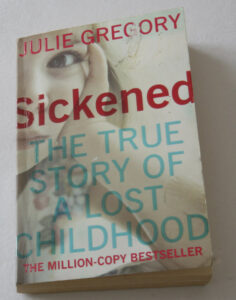
Sickened: The True Story of a Lost Childhood is one of those books that shocks you to the core but is at the same time compelling reading. How can it be that a young and vulnerable child presents to so many professionals and yet behind the scenes endures such appalling misery? And this story is real not fiction.
Julie Gregory was in thrall to her disturbed mother, Sandy. She spent her entire childhood being investigated for symptoms of ill health because Sandy insisted she should do so. Many of the tests were invasive and traumatising. Her mother took her from doctor to doctor looking for ever more serious diagnoses; she even took steps to induce symptoms. And before each professional Julie obeyed Sandy’s instructions, playing her part of the ailing daughter to perfection.
In addition, life at home was chaotic and damaging, with both her parents physically violent, and her mother repeatedly blackmailing the family with claims that she was about to take her own life.
It was only when Julie was 26, had left home, and was attending psychology classes, that she finally understood that her mother had fabricated her illnesses and even induced some of them. She had her own methods of compelling Julie to lie to doctors to substantiate her claims of alarming symptoms. When she was thirteen, Julie did once blurt out to a nurse that her mother had made her ill that time, but she was not believed and they ‘sedated the truth’ out of her. She buried much of what happened deep in her subconsciousness and it took years of therapy and painful work on her part to address the reality and deal with the trauma.
Curiously, for a long time after she’d left home she retained a visceral need to stay in touch with her mother.
I am a half-formed larva without her … I speak to her as if nothing has happened, as if everything is fine. I still try to extract love from her. I still take her suicide calls in the middle of the night and try to talk her out of the gun or the overdose from two thousand miles away. I am the only one who can save her. I could not live with myself if my mother died because I refused to do what she trained me so well for.
She kept quiet. But when she eventually felt able to visit Sandy face to face and saw history repeating itself with an under-nourished 11-year-old relative of her current boyfriend she knew she must act to save this girl succumbing to her mother’s manipulations; from becoming yet another victim of Munchausen’s by Proxy (now known as Fabricated or Induced Illness).
 It’s seven years now since I published my novel on this issue (Killing me Gently) but this real life account of the devastating impact of this condition (Sickened) resurrected some of the emotions I felt trying to get inside the skin of someone who could do such horrific things to an innocent child. Sickened. No wonder it’s been described as one of the world’s most hidden and dangerous forms of child abuse.
A brave and disturbing book.
Carers who kill
I’ve reported on this blog high profile cases of health care professionals suspected, then accused, and then convicted of killing those in their care. Doctors like Harold Shipman, and nurses Beverley Allitt and Lucy Letby, spring instantly to mind. Rare but particularly disturbing, because there’s something uniquely chilling and repugnant about people in the caring professions actually harming those who trust them implicitly – the vulnerable, the frail, the disabled, the elderly.
When I researched material to inform my novel Killing me Gently, which involves someone deliberately and systematically harming a baby, I found it very unsettling to glimpse inside a brain capable of doing such a thing, so alien to every instinct we all feel to protect and safeguard children. So I was curious to see STV were airing a series under the title Nurses who Kill.
But first I’d take issue with the title. Using the term ‘nurses’ is misleading. Only three of the ten killers are actually nurses. The rest are carers – both professional and informal; one is a paramedic. Not nurses. Their methods cover arson, vicious and sustained bludgeoning, using medical skills to kill rather than cure.
Each story is told through the lens of those most closely involved – relatives, acquaintances, detectives, policemen; and a range of experts – lawyers, criminologist, journalists, doctors, forensic psychologist, reporters, researchers, those appointed to safeguard the vulnerable. Giving a well rounded and fair account.
It’s perhaps not surprising that debt and theft feature strongly. Indeed money and greed lie at the root of most of the cases. A forensic psychologist who reviewed all the cases describes immature personalities, narcissism, egocentrism, contributing to their aberrant behaviours. Mercifully most are in no position to do any more harm, and we can only hope the families of the victims have found some consolation in that.
My advice: Choose your moment to view such depressing footage.
Psychological thriller meets family saga
Ever since I decided to write one myself (Killing me Gently) I’ve been fascinated by the structure of, and driving force behind, psychological thrillers. Family sagas tick another of my boxes.  Plus I’ve read Louise Jensen before, so The Fall caught my attention when it came out recently. It’s set against the background of the effects of Brexit, the pandemic, and the current economic instability, which makes it feel real and immediate.
Beth and Kate are 40 years old, and identical twins. They both have 15-year-old daughters who have been inseparable … until a secret drives them apart. Now one of them, Caily, is in a coma in hospital following a fall from a bridge. The police think she was pushed – her cousin’s DNA is under her nails.
But everyone in the family is harbouring a secret. Some of them dread Caily recovering consciousness. What will she remember? What did she know that put her in such danger? Will relationships survive if she regains her memory; if she talks?
Someone is leaving gifts for her. How are they getting in? Why bring her bloodied ballet shoes into hospital?
Where has the handsome farmhand Travis gone so suddenly? Why does he reject Caily’s interest so violently?
Who are these men who lurk in the shadows, and drive Range Rovers, and threaten people in their own homes?
The story is cleverly conceived and skillfully unravelled, and I did like the echo in the first line of each chapter of the last line in the preceding one. Other stylistic choices niggled me somewhat, but hey, this author has had considerable success, so she’s allowed some idiosyncrasies. And she certainly kept me guessing as one after another character came under the spotlight with their guilty secrets and mixed motives and reasons to fear Caily recovering her memory and speech. A page-turner and a salutary tale about the impact of deception and lies on relationships.
Britain’s most prolific baby killer
Big apologies – I promised you a short post this week but shocking events have rather overtaken my good intentions. Sorry. Next time …. hopefully!
Five years ago, knowing nothing of what was actually happening in Cheshire, I sat in a restaurant in the centre of Edinburgh with a friend who was a senior neonatal consultant, discussing ways of inducing medical catastrophes in small children, for a book I was writing on Fabricated or Induced Illness aka Munchausens by proxy: Killing me Gently. We kept our voices low aware of the possible effect on anyone overhearing our plotting. Two clinicians who had spent decades caring for such tiny infants, now contemplating how to harm them – it was so impossibly improbable it was laughable. Chilling now to think the same methods Lucy Letby used appeared on our list. It makes the horror the more acute and the more horrific. How COULD she?
Lucy Letby worked in our world: the world of tiny super-vulnerable infants. Infants who are so fragile that even a syringe-full of extra fluid can kill them. These tiny scraps of humanity inspire in most of us an instinct to protect and respect and treasure, so this case cuts very deep indeed.

How could a fully trained professional nurse, murder 7 such babies and attempt to murder a further 6 – at least (other suspicious cases were unproven, and an investigation is now on-going to track her footprints through two different hospitals prior to 2015 when the known murders began at the Countess of Chester Hospital).
Though speculations have been offered, no-one yet actually knows what prompted this murderous campaign, but for decent right-minded folk this blonde 33-year-old woman seems a wholly unlikely embodiment of the kind of evil that seems to lie behind it. Indeed her friends stoutly maintain they simply won’t believe it to be true unless Letby herself tells them it is. And we shall never know why unless she eventually chooses to explain herself.
But colleagues began to have suspicions when the mortality rate suddenly shot up in their hospital. It was usually 3 deaths per annum in this unit; suddenly they had 3 in a matter of weeks, unexpected, unexplained. Statistics and mortality reviews and interdisciplinary meetings figure large in units like this, especially where collapses are sudden and inexplicable. At first it was an association, which grew into a mounting conviction, when seven medical consultants discovered one common denominator in every case: the presence of Lucy Letby. No member of any neonatal team ever expects or wants to harbour this kind of suspicion. With hindsight they came to regret not having post-mortems carried out in some of the cases, but when toxicology results revealed evidence of synthetic insulin in the bodies of two of the babies, they were forced to contemplate the unthinkable: a malevolent human hand was responsible for this spate of sudden collapses and inexplicable deaths. They raised the alarm with management.
And this is where is becomes incomprehensible to me.
This team of medical experts – senior, highly trained, experienced, authority figures with ultimate responsibility for these patients – asked for an urgent meeting. Management took 3 months to respond.
After two more deaths the consultants asked that Letby be removed from the clinical arena. Management refused. What’s more the managers even demanded the consultants write a formal message of apology to Letby for maligning her! Still no formal investigation, no referral to the police.
Not till three weeks after yet another attempted murder was Letby finally removed from clinical practice and given administrative duties.
Protecting the reputation of the organisation and staffing levels appear to have played a big factor in this whole sorry saga; we know now the cost of management’s failure to act can be measured in the lives of babies, the grief of parents, the ongoing burden carried by colleagues, the regrets. That system which allowed the murderer to continue killing is itself rightly now under close scrutiny and has been publicly condemned.
Another strange phenomenon in this case is that the babies and their parents have been granted lifelong anonymity which makes it hard for the public to understand and appreciate the full facts and circumstances of each case. Each baby has been given a letter to identify them, but this seems to put him or her at one remove from reality. We can only hope that ultimately a clear, independent and transparent review – please please please not another donkey’s years inquiry! – will allow access to and dissemination of accurate relevant facts, no matter how disturbing, in order to uphold the sacred legal principles of open justice for all concerned.
What we do already know is that Lucy Letby began her killing spree in the Countess of Chester neonatal unit in 2015. Twenty-five suspicious incidents were catalogued; she was present on every occasion. A variety of methods were used, carefully disguised to mimic natural occurrences in premature infants: air injected into veins or stomachs, insulin given, fluid overload induced. Neonatal units are busy places with lots of staff and parents around; she managed to carry out a phenomenal number of assaults in plain sight and somehow avoid detection. She was a quiet, ‘beige’, professional health care worker doing what she was trained to do, in the place where she was legitimately employed: looking after babies. Indeed, after the assaults, she comforted the parents, gave the dead babies their last bath, collected mementoes of hair, handprints, footprints, wrote condolence cards.
She was not removed from clinical practice till July 2016, and not finally arrested until 2018. Her trial began in October 2022 and lasted for ten months, culminating this week. The jury were out deliberating for 110 days considering each case separately in order to reach a verdict for each one. There has been only one death in the Countess of Chester unit in the seven years since Lucy left.
Letby herself has refused to be present in court either when the verdicts were delivered last week, or when the parents gave their impact statements and the judge passed sentence on Monday this week. It’s been castigated as the final insult, not standing up to what she has done, facing the families who have been irrevocably damaged, and to society’s condemnation of her actions as expressed through the judge.  A campaign to change the law on this right to be absent will doubtless be given extra traction because of the harrowing evidence in this particular case. But it won’t affect Letby – she will remain in prison for the rest of her life without possibility of release. A whole life tariff is reserved for the most heinous of crimes and Letby becomes only the fourth woman in British history to be handed this sentence, joining notorious criminals Myra Hindley and Rosemary West.
My heart goes out to her parents; what an unimaginable horror to live with. I weep for the parents who came within her orbit and who now live with the loss of their precious babies or the terrible damage done to those who survive with developmental problems and physical and mental deficits. I fear for those staff who worked alongside a child killer and live with the ongoing questions and doubts. The wounds go profoundly deep; some will never heal.
A Room Swept White
 When I was working on my latest novel, Killing Me Gently, I was affected quite profoundly by the emotions of two of my characters who were struggling mentally in different ways. The closer I got to knowing and understanding them, the more tense and edgy I felt.
Imagine that situation in a time of a pandemic such as now! Real and justified anxiety. Widespread uncertainty. Close confinement. A reduction in social contact and support. Distorted perspectives. Suspicion. Less resources for support services. It’s a tinderbox.
And thinking along these lines took me to a psychological thriller I read some weeks ago: A Room Swept White by best-selling writer of crime fiction Sophie Hannah. A psychological thriller set in ‘my’ world, so it ticked all my boxes.

From the outset we’re plunged into a hugely disturbing story, set brilliantly by means of two scenarios: a police briefing in a murder case; and an interview between an investigative journalist cum documentary maker and a middle-class physiotherapist recently released from prison.
We know from the blurb on the back cover that three women have been wrongly accused of murdering children, that all three are subsequently freed, and that Dr Judith Duffy, a paediatric pathologist and prime expert witness in their cases, is under investigation for misconduct. Then one of the three women is found shot dead in her own home.
TV producer, Fliss Benson, is suddenly and unexpectedly promoted to work on a documentary about miscarriages of justice, and on the same day receives an anonymous card with sixteen numbers arranged in four rows of four figures. But she has her own private and personal reasons for not wanting to work in this area. The card has to be significant; of that she’s sure, even though her boss dismisses it out of hand. The murder victim had a card with sixteen numbers on it arranged in four rows of four, in her pocket. And one by one other significant women are singled out for similar cards all penned by the same hand, all on expensive paper.
Then CID strongly advises Fliss to cease all work on the cot-death murders documentary. She knows it’s what she ought to do; she also knows she can’t do it. It’s nothing to do with justice, it’s her only way of fixing whatever it is that’s eating away at her and her self-identity.
So many factors in this story rang bells and gave me a strong sense of déjà vu. The pathological details in the cases of the babies who died – suffocation, smothering, shaking, salt poisoning … Professionals damned if they intervene, damned if they don’t … One social worker driven to suicide because of his failure to safeguard a vulnerable child .. Munchausens-by-proxy … Witnesses changing their minds, swayed by so-called experts. Jurors confused by the conflicting convictions and arguments … Court testimony distorted, coloured, changing … everywhere doubt, suspicion. And it’s so skillfully written, I was kept in confusion and suspense to the very end.
So why did it ring so many bells? Not just because it explores similar ground to my Killing me Gently … ahhhh, yes, … of course … it’s there in the acknowledgements at the end of the book. Hannah took her inspiration from three real-life cases of women wrongly convicted, whose stories I followed closely at the time, and indeed mentioned in a post on this very blog – Sally Clark, Angela Cannings, Trupti Patel. Three human there-but-for-the-grace-of-God tragedies.
So, an excellent read, but perhaps not for vulnerable new mothers at this time of global tension and fear for the future.
Stay safe out there, everyone, and I hope you can find the space for reading those books you never normally seem to get round to!
The Couple Next Door
Did you know it’s World Book Day today – Thursday 5 March? Yep; a celebration of writing and reading. Hurrah!!
So which of the hundreds of books I have on my shelves shall I share with you on this auspicious day? Ahah. Time methinks to confess.
I am officially at odds with the establishment. That was confirmed when I read a highly acclaimed novel which I sent for on the grounds that a) it’s billed as a gripping thriller and b) it sounds very like my own latest novel, Killing me Gently. Indeed, the similarities were too striking to miss:
the genre: domestic thriller
a baby missing
a marriage in trouble
the mum struggling to cope
readers finding it unputdownable.
All comments applied to Shari Lapena‘s book, The Couple Next Door, which predates my (apparently) similar tale by three years, but which I’ve only just discovered. I had to check it out, then! A couple of train journeys this week gave me the perfect opportunity to savour it without too many distractions.
 The basic storyline goes roughly like this. Anne Conti is struggling to cope with her new baby, Cora. She’s not going out to work so the confines of home and constant exposure to Cora’s fussing, grind her down. Her parents are fabulously wealthy. They disapproved of her marriage to impecunious Marco, but to allow their daughter to live in style, they initially gave him money to buy a beautiful house and start up his own business. Father and son-in-law frankly hate each other. Marco has recently suggested to Anne mortgaging their home to allow him to expand the enterprise.
Living next door is seductive Cynthia Stillwell and mousey husband Graham. They invite the Conti’s for a dinner party to celebrate Graham’s milestone birthday, but at the last minute the babysitter cancels. Cynthia is adamant: no babies at her parties. Anne says, OK, she won’t go then. But against her better judgement, Marco persuades her to leave Cora asleep in her own cot, taking a monitor with them so they can hear if she wakes, and taking it in turns to pop across every half an hour to check on her physically. Shortly after 1 o’clock they return together … to find the front door ajar, the security light unscrewed … and the baby missing.
Shades of the disappearance of Madeleine McCann way back in 2007 evoked, huh? Layers of guilt and reproach and suspicion.
As the facts of their lives unravel, it’s clear that Baby Cora, barely six months old, blonde hair, blue eyes, weighing about 16 pounds, is alone in being entirely above suspicion. Everyone else is harbouring murky secrets and hidden lives: Mum, Dad, Granny, Grandpa, the couple next door! Who can you trust? Nobody is telling the full truth here. Detective Rasbach has his work cut out. Fortunately he’s nobody’s fool.
 There are plenty of glowing testimonials for The Couple Next Door from well respected writers and publications. It was a Richard and Judy Book Club pick. It bears the sticker: The most talked-about thriller of the year. It has attracted over 6500 comments on Amazon. Wow! Success by anyone’s measure. However, in the safety of my personal blog, I have to confess to personal reservations … seriously big ones at that.
Fair enough, the slow release of information casting doubt on the honesty of everyone, is a page-turning tactic. The intriguing technique of the unreliable narrator keeps the adrenaline flowing. The principal characters are not very likeable or sympathetic or three dimensional, but at least we’re rooting for that little baby … and the detective. However, for me the style of writing really did not appeal. It reminds me of the audio description that provides information in a television programme for the benefit of visually impaired people – wooden, staccato, clunky. Points of view shift and we’re told bluntly what characters are thinking. All markers for ‘telling’ instead of more subtle and intriguing ‘showing’. I’m frankly astonished it has achieved such status.
So, though I can envy the author her success, I don’t wish I’d written her book. And I’m relieved that Killing me Gently could certainly not be suspected of being a re-hash of The Couple Next Door. Phew!
But let’s hear it for good books everywhere on this special day. Long may they bewitch and inform and console and nourish us.
Harming children: Truth v fiction
Well, I must confess I had a real sense of deja vu this week.
 Six months ago, my eleventh novel, Killing me Gently, was published. It centres on a young mum who struggles to care for her little girl and comes under suspicion of deliberately harming her. Health workers, social workers, the Child Protection team, the police, all get involved. And in spite of all the vigilance, all the protestations of innocence, the baby is still being harmed. Should the professionals take her away from her parents for her own safety? Or should they give her the benefit of the doubt? Either way there are huge risks.
Now here we are, in real time, in real life, listening to a mother from the west of Scotland who was falsely accused of harming her disabled daughter. She alleges she became suicidal and doesn’t want something as horrific as this to happen to another family, so she’s pursuing her grievances through the courts to highlight the issues.
I have no inside knowledge of this case, but the facts as I understand them from the media and an interview with the mum are:
PARENTS: Kirsteen and Craig Cooper.
CHILDREN: Three daughters.
YOUNGEST: Baillie, has cerebral palsy, uses a wheelchair and is tube-fed.
HISTORY: Baillie was admitted to the Children’s Hospital in Glasgow in December 2016.
The child suffered repeated infections which raised concerns for her parents, and they registered a complaint related to poor hygiene in the hospital.
A member of staff suspected Kirsteen was deliberately inducing illness in her daughter.
PROFESSIONAL SUSPICIONS: The mother was causing infections; cutting feeding tube; stealing blood to induce anaemia. Suspected diagnosis? Fictitious or Induced Illness.
CHARGES: A charge of attempted murder was brought in July 2017. Kirsteen was put in a cell overnight.
CONSEQUENCES: Baillie had to go and live with her aunt and grandmother; Kirsteen was allowed only very limited access to the child, and that only under supervision.
OUTCOME: Charges were suddenly dropped after a few months.
CURRENTLY: Kirsteen is preparing a legal case against NHS Greater Glasgow & Clyde.
ADDITIONAL INFORMATION: The Queen Elizabeth University Hospital of which the Children’s Hospital is a part, is currently the focus of a public inquiry over safety fears and patient deaths from infection. It’s under special measures.
It felt decidedly spooky listening to and reading details of a situation with significant echoes of the plot which preoccupied me for a couple of years. I have huge sympathy fpr any parent whose baby is taken away from them, but … yep, there’s sure to be a but! … I’m forcibly reminded that most of this account comes from one source, viz. the mum. The whole scenario can look very different according to where you stand, but professional and legal etiquette denies the healthcare professionals a voice. My heart goes out to all those in authority who are required to safeguard the interests of the children in their care. Damned if they act, damned if they don’t. I made myself walk in the shoes of the nurses, the doctors, the protection people, as well as the parents and grandparents when I wrote Killing me Gently. It was not comfortable walking in any of their footsteps.
From a purely selfish angle, I’m profoundly glad my book came out before this case hit the headlines! At least I can’t be accused of stealing their story.
Out of left field
Well, this was a first, and it taught me a useful lesson.
I’m a great believer in thorough preparation. Whatever the occasion. Could be a sign of insecurity … or obsessive tendencies … or whatever, I don’t know. But I need to feel in command of the situation, in order to relax into the actual event. When it comes to speaking appointments, I do my homework, try to be totally to grips with my material, have a clear structure and aim in my head, blend humour into serious material, and make sure I’m respecting the parameters of the commission. Even so, mishaps do happen. I remember once, years ago, being unable to use my slides at a big conference because the feet on their carousel had melted! Ever after I carried my own. And another occasion where a lady in the audience became unconscious and caused a major incident. But this week a very different unexpected event came out of left field.
As part of Book Week Scotland, I’d been invited to our local library to talk about my writing life and latest publication. Our local librarians are lovely enthusiastic people, so thank you, I should enjoy doing that. I love the fact that libraries use my work in their bookclubs. And it should be a breeze – if I hadn’t got that information at my fingertips, I was in the wrong job! Well, it should have been …
 First hiccup – a streaming cold out of the blue two days before it. I went into overdrive with medicaments and positive thinking, snatched sleep and distraction therapies. I’d protect my throat by keeping silent most of the day beforehand. I’d take the car to the library instead of irritating my fragile chest with cold air. So, when I stood up to speak, no one would have suspected the battle I’d had to reach that point.
 Next hiccup – a mere five minutes in, the fire alarms started up. Speaking above that level of decibels would strain the hardiest of vocal chords! But the librarian indicated to continue, it’d just be a false alarm, and went out to investigate … only to return with the instruction the building was to be evacuated, the fire brigade were on their way. Freezing temperatures outside, chatting in the icy air … I could feel my raw throat and chest palpably tightening. It took a further twenty minutes for the fire crew to arrive, pin down the problem, and let us back in. Twenty minutes to outwardly respond to conversation with all those hardy souls prepared to wait and not abandon ship (all of them!), whilst inwardly revising the structure and content of my talk. Mercifully it was completely without notes or slides so there was no need to do anything physical, and since no one else knew what I’d planned to cover, they were quite unaware of the mental gymnastics to accommodate the changed time frame.

A salutary lesson for me: you can never be totally prepared for all eventualities; accept vicissitudes with good grace. And useful reinforcement of a piece of advice given to me very early on in my speaking career: ‘if you’re feeling out of your depth, at least look the part!’
Publication at last!
 Wahey! It’s finally finally between covers and published and available. Phew! My eleventh novel.
As you know Killing Me Gently is something of a departure for me – a psychological thriller, and I have no idea if my regular readers will be pleased or nonplussed by the change. Several people have got in touch to say they’ve immediately ordered a copy because they ‘love thrillers’ … hmmm, but do they include this kind of thriller, I wonder? I’m hoping for lots of feedback – the honest variety, no holds barred, of course.
The story centres around a young career woman, Anya Morgan, who has it all – beauty, brains, dream home, handsome husband. And now to complete the picture, a new baby, Gypsy Lysette … except Gypsy hasn’t read the textbooks; she doesn’t conform to Anya’s standards of perfection.
Leon Morgan is torn between supporting his paranoid wife and the demands of his job. Increasingly stressed, he starts to make mistakes, big mistakes, threatening the future of the family firm, jeopardising his marriage and his relationship with his brother.
Tiffany Corrigan to the rescue; qualified nurse, mother of three, a fount of practical wisdom. She’s a shoulder to lean on when the crises escalate … when Gypsy is admitted to hospital … when the fingers start pointing … when suspicion and jealousy widen the rift between Anya and Leon …
Then inexplicable things start to happen. Frightening things. Baby Gypsy’s life as well as Anya’s sanity are under threat. Who is responsible? The social workers and the protection team are caught on the horns of a dilemma, damned if they intervene, damned if they don’t. Will they act in time to save this family from devastating loss?
I’ve already had some lovely comments on Tom Bee’s super-special cover. That’s always a good start.