thriller writing
13 hours locked in a psychiatric unit
When I was about 20 I was faced with a choice of rotation: obstetrics or psychiatry. It was a no-brainer for me; I was only too aware of the fine dividing line between mental health and mental illness. My vivid imagination played into this decision too.
I grew up in the country in Cornwall not far from the River Tamar. On the other side of the river, on Dartmoor in Devon, was a prison, and very occasionally one of the inmates would escape. I was convinced every owl hoot was them sending signals to their co-conspirators! I couldn’t scuttle the mile home along an unlit path in the gloomy light fast enough. I lay quivering under the bedcovers at night. And I’ve had wierd inexplicable experiences that hover in a twilight zone on and off ever since.
During my decades of clinical practice, I encountered real patients with real mental illness, and visited good friends who needed inpatient treatment for a time. Effective management has changed dramatically over the years, but there’s still for me a scary element of there-but-for-the-grace-of-God … The margins feel all too fragile.
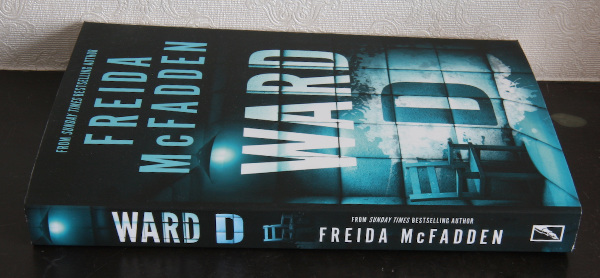
So, last week I picked up a thriller, Ward D, about a psychiatric unit, with a degree of trepidation. Should I get it … should I not? My curiosity overcame my demons and not only did I buy it, but I deliberately put it on the top of my tbr pile. Better not keep procrastinating or I might never dare to open it!
The author, Freida McFadden, is herself a physician specialising in brain injury; her father a practising psychiatrist. She’s a very successful novelist too with accolades in the world of thriller writing, so her credentials are excellent. This should at least be authentic … or is it?
Ward D is a primary locked psychiatric unit. Medical student Amy Brenner is currently rotated to psychiatrics, although she knows she’ll never choose that specialty. Never. Ever. Like me, she’s acutely conscious of the fine line. Almost ten years before, her best friend had been an inpatient there and Amy came face to face with the fragility of the human mind. Hers included. Most especially hers. Because she’d started to hallucinate and hear a voice telling her to do bad things.
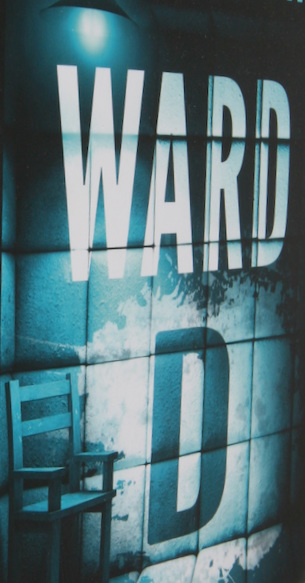 She’s already completed the outpatient bit of her rotation but now she’s scheduled to do one 13-hour night shift in Ward D. Just one night. One night. But for 13 hours she’ll be locked in with seriously disturbed patients and a skeleton staff. She’s frankly terrified, and that feeling only increases when she’s told that two rooms are reserved for the most dangerous patients, one of which is occupied. On no account must she unlock that door. The noises that emanate from behind it are bloodcurdling enough.
The story is written with two time frames. One takes us back eight years to Amy’s friendship at school with Jade, a girl from a troubled home, who develops mental illness sufficiently serious to need incarceration in Ward D for a time. The other, set in the present, counts down the 13 hours of Amy’s night shift as inexplicable things start to happen, terror mounts, and she begins to doubt everyone and everything. The patients have histories of violence but roam around the unit at will, some of them warning her she will be killed that night. A fellow medical student suddenly vanishes from the unit. Even the experienced doctor and nurse she’s working with seem suspect. Who can she trust? But not only is she locked in with them, she has no means of connecting with the outside world, and when a patient manages to damage the electrics, not even a code to allow her to get out.
What actually happens is so extreme I could detach myself from the action for much of the time; it’s inconceivable that this could actually happen. But it was still a tense read.
I did finish it – honestly I did! But perhaps the most sobering message I took from it was that, no matter the severity of the illness or the crimes such patients might commit, they are nevertheless human beings first.
Literary genius
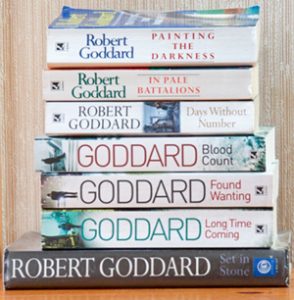 One of my most favourite novels is Past Caring by Robert Goddard, and since reading it I’ve collected a goodly number of his books on my shelves. They’re lengthy and intricate and absorbing though, so I only select them when I have the luxury of enough time to opt out of other commitments, or when I want a literary treat, or escape from reality.
The weather cancelled a couple of diary engagements recently so I seized the opportunity to indulge in a Goddard feast.
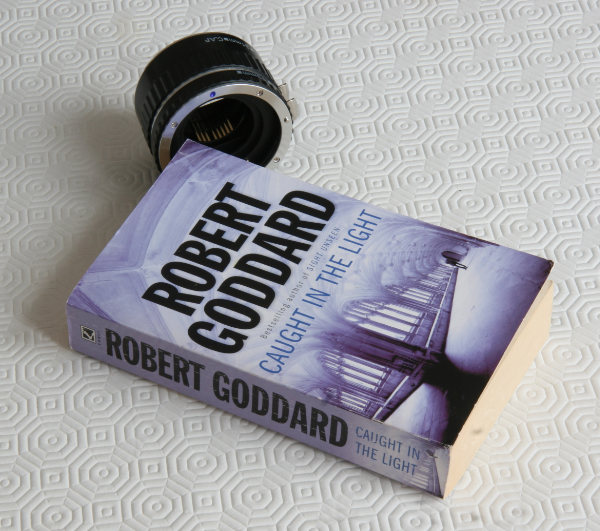 This time it was Caught in the Light … and I’m instantly captivated. He manages to convey an atmosphere of period brilliantly, moving effortlessly between the seventeenth century and the present. His plotting is spellbinding, layer upon layer of intrigue, and whether it’s a sinister menace, or a romantic interlude, or a psychological minefield, he grabs your attention and compels you to keep those 445 pages turning. A truly superb storyteller.
 Photographer Ian Jarrett is in Vienna for a few days on an assignment when he meets and falls in love with a stranger in a red coat standing against a snowy background: Marian Esguard. So utterly captivated is he that he returns to London, leaves his wife, tells his daughter, and goes to meet Marian. But she never appears. She seems to have completely vanished. What’s more the six films of photographs he took are blank. What is going on?
So fixated is he that he vows not to take another picture until he can photograph Marian again. So, not only has he lost his wife and home, and his lover, and his dreams, now he is without a job. His single-minded search for her takes him back into history, and into a dangerous world of unscrupulous men and dabblers in the darkness of a disordered mind.
I became a ghost, hunting a ghost, haunted by a past I couldn’t forget and a future I couldn’t give up.
 He is joined in his search by a Harley Street psychotherapist, Daphne Sanger, who is looking for the same woman, a client who spun her a very different story. Given the circumstances she agrees to breach her ethical code of conduct and share a vivid account of what this missing woman is enduring. Lies and deceit and betrayals abound. Everything swirls dangerously out of control. A man is strangled. Jarrett is caught up in this web of deception, trapped between the enigmas of the part and the greed and revenge of the present.
As the real truth unravels, and his existence is reduced to the narrowing circle of his search for his missing obsession, he becomes increasingly cagey.
There was secrecy bedded in my soul now, a furtiveness about my every word and thought.
And just when you begin to believe he’s about to realise his dream, the entire picture blows up in his face, and he has to acknowledge that he’s a mere puppet in an elaborate plot, his whole life being demolished around him. No one seems to be who they claim to be, yet he is the one who seems pathologically paranoid and deluded … except that he knows for sure he’s not, and he’s utterly determined to call the chief tormentor to account. And to save his sixteen-year-old daughter. But he’s at the mercy of a ruthless enemy who will stop at nothing to exact revenge. Murder, kidnap, suicide: it just keeps getting worse.
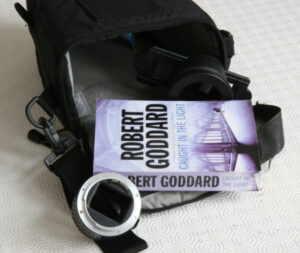 I’d love to reveal the amazing detail of what is really going on, but I absolutely can’t risk spoiling your enjoyment of this incredibly complex story. It’s a masterclass in writing. And whether its the origins of photography, or 17th century historical detail, or the medical facts around haemophilia, or the underpinnings of psychological derangement, the author writes with authority and assurance, never flaunting his research, but weaving fact and fiction together seamlessly with a sure hand.
As critics have already said, when it comes to duplicity and intrigue, Goddard is second to none. He’s a master of manipulation … hypnotic … unputdownable … spellbinding. Genius.
Just One Look
Both life and literature are throwing rather a lot of angst my way at this moment so I’m going to share something positive without baggage this week.
It’s possible to find solace in a beautifully crafted piece of fiction, even when the subject matter is not exactly sweetness and light. I can get lost in the work of a master-craftsman and emerge feeling soothed and ready to face the fray. Literature as therapy.
And for me, Harlan Coben is a past master at creating plots within plots that unravel one after the other, keeping the reader guessing until the very end. I defy anyone to guess the final twist in Just One Look.
 US Attorney Scott Duncan’s speciality is prosecuting corrupt politicians in the Garden State of New Jersey. Eebie jeebie. How many are there?! Enough to keep a team of hotshot lawyers in work? So why, after resolutely refusing to talk to anyone since his arrest, has an assassin for hire, real name unknown, who has killed an estimated one hundred people, asked to see him specifically?
The prisoner leans forward: What I am about to tell you will change your entire life.
And that information? That he was the one who had killed Scott’s sister, Geri, aged just 21, fifteen years ago. That’s the prologue so I’m not spoiling the tale for you.
Thereafter the story line splits in several directions.
Grace and Jack Lawson are a happily married couple with two children whose sense of security is suddenly threatened when a photo from Jack’s past appears in a bundle of newly developed pictures. The young woman with Jack has a giant cross across her face. Then Jack is tailed … is felled and abducted … and is now missing. Given a complete lack of interest from the police, Grace sets about trying to find him, and discovers secrets and a past about which she knew nothing. We have to wait 200 pages to see what their connection is to the Scott Duncan of the prologue.
Eric Wu is a devilishly clever killer who will stop at nothing to stay free after a life of crime and prison. Via his multiple online presences he uses vulnerable people to further his own ends, and now he has Jack and Grace in his crosshairs.
Jimmy X – real name James Xavier Farmington – is a faded rock singer who’s looking for some kind of forgiveness from the parents of 18 children who died in a stampede at a concert – known as the Boston Massacre. Grace was herself seriously injured in the crush and still bears the scars, but she has next to no memory of the event. However, she does remember the singer visiting her in hospital. The Jimmy X Band broke up after the tragedy, but Jimmy himself has now reappeared in a minor role. What is his connection to Jack Lawson?
Coben has the knack of carving a potted biography of each character, and we know everyone is hiding something. I found myself trusting no one. But the ending still took the rug from under my feet.
There are two clever passages that I must share:
The kid working – Grace’s use of the term working being overly generous here – behind the counter had a white fuzz pellet under his chin, hair dyed a color that’d intimidate Crayola, and enough piercings to double as a wind instrument.
The office, if you could call it that, had that Early American Hurricane look going for it.
Another rollocking read by a master storyteller. Try as I might to analyse his technique, I remain in awe of his skill. But just the wondering is a welcome distraction from reality. Therapeutic indeed.
Learning from the master storytellers
Every now and then I like to read a book by an accomplished writer and analyse what makes it tick. It doesn’t have to be in my favoured genres; I don’t need to like the story; it just has to be well written. It acts as a kind of masterclass.
Cold Hit by Linda Fairstein falls into that category. I’ve read Fairstein’s novels featuring Alexandra Cooper before and know she has brilliant credentials for writing from the perspective of an Assistant District Attorney; she herself is a former prosecutor and America’s foremost expert on sex crimes. I’m instantly inclined towards someone who really knows what they’re talking about. Safe hands.
As her narrator puts it:
… this is the most fascinating job in the world. How many people get up in the morning and look forward to going to work? You and I have never had two days that have been at all predictable in our entire careers, and no two that have been even remotely alike. And on top of it, you do a little bit of good for somebody else in the mix.
So one of the factors behind her success is authority.
And because she is who she is, I’m trusting her to be diligent in her background research. In this case that includes, not just the world of crime and law and forensic medicine, but famous artists and works of art. She drops enough specifics I do know about, for me to trust her in the rest.
Then there’s the meticulous plotting. So intricately woven is it, indeed, that a third of the way in I was wishing I’d kept a written note of who fitted where and how events knitted together. The author seems to have the kind of brilliant mind that can juggle umpteen balls, and know which is which all the time. But I guess, being able to hold details of many clinical cases in your head, and work simultaneously and effectively for all those victims, requires that kind of brain. I think I’d be emotionally swallowed up by just one of them.
Her characterisation is excellent too – each person rounded out and distinctive in their own way. I can see the author’s own professional and analytical eye observing, deducing, calculating, in her day job as well as in the penning of her novels.
Although we might justifiably take exception to some of the politically incorrect comments and attitudes, the dialogue is sharp, witty and appropriate to each person.
Then there’s the clever dropping of actual facts – eg. about art and artists, historical details, real live celebrities. It provides a ring of authenticity and credibility. Makes the whole thing more believable.
It’s a great exercise in unpacking some of the key elements that make writing great. But you’ll probably be asking, what’s the story about? In a nutshell, the corpse of a young woman in expensive silk clothing is pulled from the water strapped to a weighted ladder. Assistant District Attorney Alex Cooper, and her colleagues in the police force, hunt for the killer through luxurious apartments, famous auction houses and avant-guarde galleries. A string of deaths follow. What common factor can link the murders of a rich ex-wife, a convicted blackmailer and a famous art restorer? Big money, priceless paintings, rub shoulders with serious scams and bid-rigging and false death certificates. And now someone wants Alex herself dead.
Cold Hit has all the ingredients of a gripping thriller: high drama, chases, terror, corpses aplenty, police camaraderie, blind alleys. And even the title speaks of a supremely confident writer:
Cold hit = slang term used by scientists to describe what happens when a computer makes a successful comparison between DNA samples, linking a piece of forensic evidence with an actual human being.
Ticks in so many boxes!
The perfect thriller …?
 Regular visitors will know I wrote a thriller myself pre-pandemic, and both before and since I’ve been fascinated by the structure of books in that genre. Maybe that makes me super-critical; I’m not sure. Maybe simply being a writer makes one extra-analytical.
But when I saw one labelled ‘the perfect thriller’ with yards of superlatives attached, it did at least warrant a second look. And that led to a purchase.
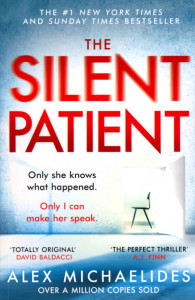 The Silent Patient by British-Cypriot author, Alex Michaelides, is the book in question.
Looking deeper I can vouch for the fact that it has certainly attracted accolades from famous names:
… totally original, spellbinding psychological mystery
… masterfully plotted and brilliantly paced
… the definition of a page turner
… a real sucker punch of a twist
… an absolute jaw-dropper of an ending.
And it has won many prestigious awards. OK, I’m intrigued …
Alicia Berenson is 33 years old and her life is seemingly perfect: a famous painter married for seven years to an in-demand fashion photographer, living in a beautiful house in London. One evening her husband, Gabriel, 44, returns home late from a fashion shoot, and Alicia shoots him five times pointblank in the face, using his own rifle. After which she never speaks another word.
Because of her new, more macabre notoriety, the price of her art skyrockets, but she herself is hidden away from the tabloids and the public, in a secure forensic psychiatric unit in North London, known as The Grove. She has been there now for six years.
Theo Faber, 42, and a forensic psychotherapist with plenty of emotional baggage of his own, is fascinated by her story to the point of obsession. He waits a long time for the opportunity to work with Alicia, but eventually gets a post in The Grove, and becomes her psychotherapist. He wants to understand what drove her; something in her past must explain that moment of murderous rage. Was it her mother’s violent death in a car accident? Was it her father’s suicide? Was it her husband’s behaviour? Or what? It’s crucial that Theo understands what her life was like as a child, what happened to shape her, and he explores ancient classical Greek literature, works of art, literary allusion, seeking enlightenment. He begins to investigate her family, her colleagues, her friends. He is assaulted, attacked, the subject of official complaints … nevertheless he continues doggedly, unravelling a string of inconsistencies between the ‘official’ story and the facts he’s discovering.
The search is all-consuming, but alongside all this obsession with his patient’s history and fantasies, Theo is also dealing with the discovery that the wife he adores, Kathy, is being unfaithful to him. He is tortured by the awareness, but driven to continue seeking answers for his professional responsibility towards Alicia. Gradually, imperceptibly, the boundaries become blurred. We too are sucked into the dark spaces that allow horror to grow, where no one is what they appear to be, everyone seems to harbour sinister intent. Where disorder reigns. Where perceptions are distorted. Where lies cover truth.
When all Theo’s attempts at therapy draw a blank, he’s forced to abandon the mission. But then, out of the blue, Alicia hands him a lifeline. Her secret journal – her honest account this time. Now he has something concrete to work with. Now he has the respect of his colleagues who earlier doubted his methods.
The ending has been described as a sucker-punch. It is. Oh yes, indeed it is. And it’s only when you get there that you can truly appreciate the cleverness of the whole story. It’s a masterly twist indeed.
Hold your Breath
Having written a thriller myself, I’m always now intrigued by their structure and component parts. One attribute is a capacity to make you suspend your breathing, just willing the protagonist to escape whatever horror lies in store. So Hold your Breath seems such an appropriate title for a book in this genre.

This one is by Barnaby Walter who dives into the disturbing world of mental illness – a world where things spin out of control, and people are scarily unpredictable. One key ‘character’ in this tale is the setting: a spooky forest, backdrop to shady night-time happenings.

Dark elements of child neglect and exorcism and witchcraft and disordered minds pile on the shivers. With the main action removed from the safety and scrutiny of suburban civilisation, events feel even more sinister, and the truth more elusive.
We know from early on that something dreadful happens, but so much is unknown and unknowable or half-understood because it’s synthesised through the young impressionable mind of the protagonist, Kitty Carlson. Adults are concealing the truth from her; she herself witnesses incomprehensible behaviours; we cannot be sure where fantasy ends and grown-up reality begins. As her mother’s mental health regresses we feel the approach of something dreadful, we hold our breath, fearful as to what form it will take.
Kitty is only 10 when the tragedy happens, but she’s already traumatised beyond her years. She knows that her family has secrets; they’ve always been different. It’s why her father took them to live in the woods during the half term holiday. It’s why unmentionable things are done in the haunted rental house, and why she’s sent to wander alone amongst the trees when the Catholic Father arrives.
As a young child she just buries her experiences.
She knows …
that her mother ‘gets upset’ and ‘makes scenes’, that her paintings have become disturbing, that she says and does violent things, that she needs to be handled with care, that she needs psychiatric help.
She knows …
that her father has become more like a dictatorial school teacher than a loving parent, that he is liable to ‘flamin’ rages’, that he is involved with another woman.
She knows …
that she herself is mesmerised by small living creatures, that she resents having her innocent enquiries deflected, that she has learned early on to be self-sufficient, that she is a loner.
It’s only when she grows up that she starts to ask the most difficult questions, and delve into painful memories. The past has been buried for a reason. Eventually she’s driven to write a book, crafting something definite, something physical, out of her dreams, her nightmares, her memories. ‘It was probably the fusion of catharsis and hate that did it. Working through my issues by putting them onto the page, only to shoot them through with a strong dose of anger and resentment.’ She has a story crying out to be told.
Although Kitty insists it’s fictional, there’s enough fact in it to identify people, places and events, and the book triggers powerful reactions. Her father and his new wife are incensed by the revelations. Her stepmother takes actions that have massive consequences. And 33 years after the tragedy, Kitty is summonsed to Newcastle to a police station. She is under caution, not yet arrest. But what she has to say could change all that.
Walter captures the perspective of a young girl sufficiently authentically for me to be taken in. I believed her account of what happened … the narrative that found expression in Kitty’s book. Writing it was ‘an act of self-therapy’; it blows demons right out into open view. Kitty herself knows she couldn’t cope with the attention a true-to-life memoir would attract, but nor can she relinquish her personal take on events and injustices. As a young girl she attributed human emotions to spiders and beetles; her mind has been altered by the things she’s seen in her childhood, by the emotions she’s suppressed. Small wonder that her own behaviours and reactions fall outside the box of normality.
The ending is rather too neat for my personal taste, but I was relieved that Kitty survived the re-living of her past. I cared about the child turned woman, and that’s another key element in the success of this book.
The Vanishing Year
Well, I can’t imagine many people will have been sorry to see 2020 vanish into the mists of history; some indeed are willing 2021 away now, given the dire statistics and predictions. A thousand deaths each day in the UK; a total now exceeding 80,000 – the worst statistics in Europe; 2 million lives lost worldwide. Our NHS struggling to cope; long term problems accruing with the overall health of the nation. 
Watching this horror emerging, we’ve all had to find ways of keeping hope alive and maintaining mental well-being. Icy conditions make even outdoor exercise treacherous, another lockdown forces us to stay at home … Eeh dear! Not surprisingly, for me – as well as countless others – books have played a major part in this struggle. It’s well recognised they offer escape and a way of making sense of the world and our place in it. Indeed, several people who took advantage of our pandemic bookcase went so far as to say books had saved their sanity.
Not surprising then, that one novel should pop into my head as we watched 2020 disappear in our rear view mirrors: this thriller, The Vanishing Year by Kate Moretti. Apposite title, but nothing to do with the pandemic, so forgive the tenuous link.

‘Sometimes I feel as if I am made up almost entirely of secrets.‘ That pretty much sums up the main protagonist, Zoe Whittaker.
Outwardly, Zoe has an enviable life – not yet thirty, a fabulous Manhattan home, a rich and charming husband, influence, looks, wealth, connections. But untethered, with too little to do. She feels like a marble in a huge jar, suffocating under the sense that she is accomplishing nothing. Useless, apart from her charity work supporting orphaned and disadvantaged children.
What’s more, in spite of her privileged life, she is haunted by her past, living in fear of being recognised. Because five years ago, Zoe wasn’t Zoe at all. And even her husband Henry doesn’t know her real name. Nor that she was penniless, unable to afford to bury her own mother, until that is, she became a drug dealer, addicted herself to pills and drink, peddling her wares in the presence of children. Until she confessed all to the police, testifying against two human traffickers to a grand jury. Before vanishing.
And now an attempt has been made on the life of the reinvented Zoe. Her home has been ransacked. Her credit card is missing. Someone from her past has come back for her. Threats are being made.
The old classic trademarks are there – control, manipulation, layers of issues, rags-to-riches, fear for life. And the plotting is so devious that, once you know the truth, you want to go back and read it again to see all the clues you missed first time around. An excellent diversion. And a good illustration of how books can give us respite from the stresses of real life, transport us into a different world and time and place – an invaluable bonus during this time of national crisis and mental fragility.
Speaking of a different world and being transported … this opportunity to tramp in a winter wonderland does wonders for my own mental health, too. And yep, it’s well within the current rules of staying local!

Misery: Learning from a master storyteller
OK, I know, I know, the one thing we don’t need when life is so out of kilter during a pandemic, is depressing literature. Certainly none of my ‘death’ and ‘tragic options’ stuff – you’ll have noted I’ve been steering well clear. But long before we’d even heard of Covid-19, back in those halcyon days when there was nothing to prevent me poring over psychological thrillers, searching for the magic ingredients that keep you turning the pages long into the night, I read a cleverly constructed thriller that impressed me. Now I think about it, it puts a whole different perspective on lockdown; imagine not just being isolated and captive in a remote place, but being incarcerated with a violent maniac! So I thought I’d share its merits with you today, not just because it has parallels with our present situation, but because it’s the product of an exceptional mind and an impressive facility with words.
 REPORTED MISSING: Paul Sheldon, 42. Novelist best known for his series of romances about sexy, bubbleheaded, unsinkable Misery Chastain; by his agent, Bryce Bell. ‘I think he’s fine, Bell said, ‘but I wish he’d get in touch and ease my mind. And his ex-wives wish he’d get in touch and ease their bank accounts.’ Sheldon was last seen in Boulder, Colorado where he had gone to finish a novel.’
Paul Sheldon is a writer of novels of two kinds, good ones and best-sellers. Annie Wilkes is his number-one fan. When he’s involved in a car accident during a violent storm, he comes to after being unconscious and delirious with the agonising pain of two shattered – no, pulverised – legs, and a horribly damaged pelvis, to find it was Annie who dragged him from the wreckage of his car, and took him to her remote mountain home in Sidewinder, Colorado. Having crudely splinted his legs, she is caring for him with large amounts of pain killers which have the side-effect of suppressing his breathing, necessitating occasional mouth-to-mouth resuscitation.
About ten days after regaining consciousness he discovers a number of things about his ‘nurse’. She is in possession of a great many drugs of a dubious nature; she has already managed to render him addicted to one of them, Novril. She is dangerously crazy. Everything she says comes out in the wrong key. She’s also given to frequent episodes where her mind goes blank. She has a volatile temper; she is a woman full of tornadoes waiting to happen. She has previously had to take the stand for some major crime in a Denver court of law …
And she has told no one he is in her house.
As Sheldon discovers the hard way, Annie is seriously mentally ill – hovering on the murky borderline between ‘the Sovereign State of Reality and the People’s Republic of Paranoia.’ What’s more, she is much more than his carer; she’s a stern critic of his work. When she discovers he has killed off her favourite character, Misery Chastain, heroine of a string of romantic bestsellers … that he has then gone on to write a story full of profanities, 190,000 words of it … she exacts a terrible penalty. And Sheldon can only lie immobilised, his vivid imagination in overdrive, his present reality and his future destiny growing daily more horrific.
Misery is the perfect title – shared by the principal character in Sheldon’s book, a pig on Annie’s farm, and the total experience of Sheldon’s captivity and torture.
Master storyteller Stephen King has created a terrifyingly grotesque character in Annie Wilkes, and devised a fearful form of entrapment for his hero, Sheldon. Both are so brilliantly realised they inhabit the pages and suck us into their reality. And having experienced the lengths to which Annie will go to punish him, we live in constant fear of still more appalling things happening to Sheldon. We can have no confidence at all that the hero will escape a terrible fate or even survive the story.
I don’t want to spoil the book for you, but I do want to draw attention to a few devilishly clever aspects of the writing.
First the stories within stories. Inside the whole tale of Sheldon’s captivity and Annie’s revenge are mini-tales – what Sheldon’s literary character Misery Chastain is up to; what Annie’s Memory Lane scrapbook reveals of her former life.
When Annie ratchets up the torture, Sheldon realises he is doubly cursed. Not only are his sensitivities acutely tuned to pain, but his writer’s mind is destined to remember every tiny detail of the horrors inflicted on him. And in his analysing, he reveals technical tips about creative writing – some in response to his lived experience, some through his writing. He’s acutely aware too that his captor understands certain truths about what writers can and cannot do, even though she is unable to enunciate them in writerly jargon. A few examples will suffice:
… resigned to the fact that he could not read stories as he had when he was a kid; by becoming a writer of them himself, he had condemned himself to a life of dissection.
… not being sure of things ... was a charmless corner of purgatory reserved for writers who were driving fast with no idea at all where they were going.
a gothic novel … more dependent on plot than on situation.
The reason authors almost always put a dedication on a book, Annie, is because their selfishness even horrifies themselves in the end.
He felt as he always did when he finished a book – queerly empty, let down, aware that for each little success he had paid a toll of absurdity.
It gives an extra dimension of reality to what could be a totally unbelievable tale. Except that in the hands of Stephen King you believe it could actually happen.

An ancient manual typewriter is central to this book and indeed features on the front cover of my version. King’s description is wonderfully evocative: It was an office model from an era when such things are electric typewriters, color TVs, and touch-tone telephones were only science fiction. It was as black and as proper as a pair of high-button shoes. Glass panels were set into the sides, revealing the machine’s levers, springs, ratchets, and rods. A steel return lever, dull with disuse, jutted to one side like a hitchhiker’s thumb. The roller was dusty, its hard rubber scarred and pitted. The letters ROYAL ran across the front of the machine in a semicircle … it already looked like trouble. The ribbon was a faded two-tone, red over black … A real antique … with a missing n … the missing striker like a missing molar in a mouthful of teeth worn but otherwise complete.
And there are 26 pages of the text of a new book Paul writes on that same typewriter with the n strangely skewed where it’s been inserted ‘by hand‘, reproduced in the book, giving a very clever ring of authenticity. And later, when the machine loses its t, that too is inserted by hand. T: the second-most-common-letter in the English alphabet. Imagine the labour involved. Imagine the implications even for someone writing this novel on a modern computer!! When the key hammer for e eventually falls off, there is nothing for it but to resort to longhand. An exercise that rendered Sheldon’s hand almost useless, so the last few pages are typed on the hated machine with ns, ts and es all filled in ‘by hand’. It’s a masterly touch.

It’s a brilliantly conceived and realised horrifying thriller, but I must confess I found the closing few pages which constitute Part Four disappointing. Indeed I read them twice, thinking I must have been too tired, too distracted, or missed the point. And of course, that realisation – when it’s found in a work by one of the best selling names in the world – teaches me something in itself. Which is what my endless reading is all about.
Three-a-Penny
Almost exactly 121 years ago to the day, February 1899, Lucy Beatrice Malleson was born in Victorian London. Better known as Anthony Gilbert or Anne Meredith, her two pseudonyms, she was prolific in her literary output but received limited sales and acclaim. It’s a refreshing change to read an autobiography that concentrates on ‘failure’. Even at the height of her success, when she slept with a glowing tribute from her publisher under her pillow, she mourned: ‘I was one of those unhappy authors who can please everyone except the public.’
 Her memoir, Three-a-Penny, is like no other. And her motivation seems to be captured in Dorothy Sayers’ comment to her: ‘You must remember, Anthony Gilbert, that although authors are three-a-penny to us, they are quite exciting to other people.‘ Exciting enough, indeed, to justify a factual account of her life and ambition, but the author seemingly apologetic about her ‘mediocrity’.
From an early age Malleson made up stories. She began publishing articles and poems whilst still a teenager, and brought out her first crime novel aged just 28. In all, she went on to produce over 70 novels, as well as a number of plays for the BBC, before she died in 1973 aged 74. And yet, she never achieved the status of others of her generation. Nevertheless, she remained an incorrigible optimist;
‘… if you know in your heart of hearts that Providence intended you for a success and your main desire in life is to assist Providence to this end, why then you will never see a book with your name on the spine without the eager thought, “This may be it. This probably is.” And when the book sells no more copies than its predecessor, well, by that time you’re always neck-deep in another one, and this one, without doubt, will bring you that elusive fame and financial security that glimmer like distant stars on the far, far horizon.’ And I suspect her gritty determination to plough on despite modest sales, will strike a chord with us lesser writers far more than the success stories of the star-studded celebrity authors.
The beginning section of Three-a-Penny is the best, in my view. It might well be another novel! Her vivid snapshots of her childhood precocity and innocence, in particular, are utterly beguiling, not least because she refers to herself quaintly throughout as ‘one’ instead of ‘I’.
For example, she had her own clear and trusted theories about God. He was not above taking care of an unhemmed tablecloth, but he also kept an enormous ledger like the butcher’s. ‘God presented His bill when you died, and if you had done wrong you went to hell for ever. Hell was like a glorified nursery grate on which people lay, always, in imagination’s eye, decorously dressed in outdoor clothes, perpetually burning yet never consumed.’
 Where babies came from exercised her for a long time. ‘One knew. They came in a doctor’s bag, each with a label round its neck. The doctor’s house resembled the giants’ larders of nursery days, crowds of infants in long clothes hanging on hooks awaiting delivery.’ When her own baby sister was imminent she was deeply troubled by the huge potential for the family to be given the wrong child.
On one occasion her mother insisted the nurse take her and baby outside to get fresh air in terribly inclement weather. Freezing cold, Lucy cried piteously and remorselessly, attracting the sympathy of ladies in fur. But not Nurse.
‘Nurse pushed the pram as though she were a machine. When we reached the Park she anchored it by some railings and went into a little house marked Ladies. She told me to come in too. My tears momentarily ceased. I had never been inside one of these little houses. But once there Nurse seated herself squarely on the wooden seat, plucked me over her knee, and went through the familiar ritual of lifting clothes and undoing buttons. Smack! Smack! Snack!
‘I’ll give you something to cry for, my lady,’ said Nurse.
I stopped crying in sheer astonishment. I had never realised they built little houses in public parks just for this. I was so much surprised I made the rest of the journey in awed and crestfallen silence.’
Again and again Grown-Ups let her down. ‘You couldn’t believe them; they had a different truth from yours.’ She was forced to work out her own understanding of the world.
 She was a precocious child, reading avidly, and romping home with full marks for her essays – her ‘only distinction‘. There was never any career other than writing in her sights and, aged 14, she applied to her father for £10 for a correspondence course to equip her to write for the press – for money. ‘Write! Under my roof! Never!‘ was his implacable response.
When the war started she was forced to a stark realisation. And by now the whole tone of the memoir changes to something much more prosaic and factual. One’s aunts became nurses; one’s menfolk did important war work. ‘… nobody thought it was proper to write novels and one was a little ashamed of reading them.’ Instead she went off to secretarial college and became an unpopular but diligent student, determined to make something of her life. Her first job was a sobering one, with the Red Cross, dealing with relatives searching for information about their missing sons and fathers. Against the nightmare of such raw emotion, a letter from the Family Herald accepting her poems came like a beacon in a dark world. Together with a postal order for three and sixpence. Success! But … ‘I hadn’t imagined I should ever be paid with anything less than a cheque’.
Work in a Government Department, increased her growing awareness that the war had robbed her, as well as the returning soldiers, of youth. She wrote regular columns and articles, subtly concealing political and sociological and economic ‘pills’ in a ‘lot of feminine jam’. She also sold some of her verse to august publications like Punch, the Sunday Times, the Observer, and certain literary weeklies. Buoyed up by this success she progressed to experimenting with novel writing, even taking time out from paid employment to do so.
Early efforts proved unsuccessful but two publishers eventually saw her potential. ‘One day you will write a good novel, but this is not it.’ ‘You have the makings of a novelist, but you haven’t quite rung the bell this time.’ Those were the days when publishers gave feedback and Malleson benefited from their insights and advice. So, when a crime novel was accepted by Collins, she was wild with excitement. When it proved to be ‘a complete flop‘, failing to earn even the paltry advance offered to an unknown writer, she was devastated. To make matters worse, Collins subsequently declined to publish her next book, leaving her feeling permanently discredited by this double failure. ‘I no longer wanted to talk about books.’
Back to office life she went. The work was way beneath her skills and when she was alone she would cry with humiliation. ‘But I was like a dipsomaniac who cannot forsake his bottle. I began a new detective story …’
This time she decided to use a male pseudonym: Anthony Gilbert, and the book was comparatively well received, helped in some measure by the secrecy and speculation surrounding the author’s true identity.
During the next seven years she published no less than fourteen novels, many short stories, and a few poems. American contracts, second rights, and translation into six different languages followed. She felt sufficiently confident and socially conscious, to allow condemnation of the lack of support for the under-classes, to creep into the underpinnings of her writing: ‘What an opportunity they offered to a novelist!’ But she was not a fulfilled person. ‘I was never more financially secure … but I was lonelier than I had ever been in my life.’ So much so, indeed, that when she found herself invited to join the Hiawatha Club for Women she couldn’t think of a single distinguished name to offer for a reference. ‘The women I know are all pure, home-loving people who don’t seek the limelight.’
When The Slump knocked the bottom out of the American market for English novels, Malleson’s agent recommended she concentrate on young romance as the most sure-fire bestseller. ‘That avenue being closed‘, she turned her mind to thriller-writing, naively believing there to be ‘no rules‘ and no need to pay attention to ‘psychology, probability, King’s English or logic‘. She allowed herself three weeks to complete the first one. But she soon realised she was sacrificing art on the altar of filthy lucre and abandoned this supposed shortcut to wealth. Instead she wrote and re-wrote and refined a new manuscript, a crime novel, and submitted it under the name of Anne Meredith. This one eventually appeared in 1933 where it attracted considerable interest and mixed reviews but reignited the interest of the Americans. And it brought her an invitation from Dorothy Sayers herself to join the elite Detection Club. Conditions for entry were exceedingly rigid; in no circumstances could a thriller-writer be admitted for instance! At the swearing-in ceremony, the candidates were reminded of the solemnity of their oaths: ‘… if you fail to keep your promises, may other writers anticipate your plots, may your Publishers do you down in your contracts, may Total Strangers sue you for Libel, may your pages swarm with misprints and your Sales continually Diminish’. Only a writer could, I suspect, feel the full power of such a curse!
 Writing was an obsession with Lucy Malleson regardless of her public profile: ‘When I’m not writing, I am not more than half-alive. I am miserable, hopeful and dejected by turns. Then someone slowly emerges out of this mental fog …’ And this new character would quickly assume a full identity and drive her onwards again.
It was The Coward – about a man who accidentally commits a murder, the character with whom Malleson most identified – that precipitated her into the limelight amongst the literati. She had felt writing this story to be pure self-indulgence; no one would want to read it, but she couldn’t bear the thought of dying in an accident next day without finishing the one book she was most desirous of writing. To her utter astonishment it received rave reviews from the critics and fellow authors. But sadly, poor sales. It seemed she simply could not please the public.
It’s her very honesty that endears her to me. Her experience resonates.
‘… so many authors admittedly have these overwhelming qualms of self-distrust and a sense of their own futility’.
‘ … one reason why writing is such fun – it’s so chancy. And I wouldn’t exchange my one-chance-in-a-million for anybody else’s security.’
Rejection slips, poor sales figures, challenges to one’s sense of self-worth – these bedevil almost all of us; it’s how you react to them that matters. And Lucy Malleson shines through as humbly aware, doggedly determined, delightfully perceptive, entirely without pretension. The kind of person I should like to be placed next to at a dinner party.
Stephen King, master thriller-writer
Yep, I’m sure regular followers of this blog will have been wondering, when will she ever get to the king of thrillers! ‘America’s greatest living novelist‘! ‘When it comes to grabbing an audience by the throat and giving them no choice but to keep reading, King has no equal.‘
Well, I can confess, in the safety of my own blog pages, that my first experience of Stephen King proved decidedly underwhelming. Under the Dome simply wasn’t for me. Too far fetched. Too long-winded. A ‘so-what’ kind of book. So I deliberately gave myself time to distance from that before returning to give him a second chance.
 Mr Mercedes is a very different kind of tale, billed as an ‘expertly crafted example of the classic race-against-the-clock thriller’. And I’m wanting the very best examples to hone my own skills. So, bring it on. A masterclass would be very helpful.
It starts off with a massacre. A twelve-cylinder Mercedes is driven through thick fog into a concentrated crowd of desperate people all queuing at a job fair. The driver is still at large. But shortly after his retirement, Kermit William Hodges, lead detective on the case, receives a letter from the man responsible, taunting him. And we have the kernel of the story, the cat and mouse chase, each goading the other, a race to prevent another mass killing.
And yes,now I could quite understand what makes Stephen King a giant among thriller writers. It’s the whole package really, but it might be helpful if I single out a few features.
The first stroke of genius is in the first chapter. King introduces three of the victims of the Mercedes massacre in the last few hours of their lives. In a few pages he makes us care about the young cash-strapped mum Janice Cray, and her croupy baby Patti, and the kindly stranger called August who lends them his sleeping bag while they wait for the job fair to open. It puts a human face on the tragedy. We’re shocked when these three lives are obliterated by the grey Mercedes careering into them. We want justice for them.
 Then there are his main characters. With simple but deft strokes he fleshes them out, unlikely heroes and psychopathic killer alike, little by little letting us see into their past, follow their present, dread their future. No overload, no long-winded description, but four dimensional.
He’s also a past master at dropping in a sinister or significant fact without padding or fanfare, so the picture builds subtly and contributes exponentially to the spine-tingling tension. He doesn’t even hide the identity of Mr Mercedes from us. In Chapter 11, Brady Hartsfield is exposed in his natural habitat, selling ice-cream to innocent kids, solving computer glitches for naive technophobes.
 And amidst all the sordid facts and coarse language and accumulating horror, King even drops occasional pearls of literary delight.
She has the bright, inquisitive gaze of a crow with its eye on a freshly squashed chipmunk.
… an apartment … with rooms as big as a political candidate’s promises
She frowns, transforming her face into a walnut shell with eyes
They’re wondering if I’m riding into the Kingdom of Dementia on the Alzheimer’s Express
… she sits hunched in her bar of sun, a human parenthesis in a fuzzy blue robe
And I love the delicious irony of Retired Detective Hodges considering the possibility that Mr Mercedes is actually a woman. ‘He supposes it’s technically possible, and it would make a neat solution for an Agatha Christie novel, but this is real life.’
Unputdownable indeed. I could never aspire to his heights but I can learn from his skills.