clobber passages
Religion, rights and rejection
 One of the ethical questions that’s been exercising my mind for some time now is: Is it ever right for religious beliefs to trump respect for other people’s rights? Can adherence to a set of doctrines be sufficient grounds for people to behave towards others in ways that a caring compassionate society would deem wrong?
I’m thinking of things like not allowing women, or homosexuals, or divorcees, the same rights accorded to their male, heterosexual, married counterparts, for example. Practical issues that have pretty serious consequences for real people. As you’ll no doubt have seen in the news, both mainstream and minority religious denominations have long grappled with these matters, and significant divisions are even now threatening the stability of many churches.
For me personally, I have a deep concern about the damage done by those – albeit often well-intentioned – who pass judgement on others who don’t espouse the same views, or live life by the same principles, or in the same manner, as they do. By way of illustration, let’s look at just one issue which is a hot potato right now: the way some Christians weaponise the Bible to exclude LGBTQ+ people from the church. So we’re talking about two groups of people here: on the one hand, those who are lesbian, gay, bisexual or transgender or queer, who want to be members of a church, and who may or may not be seeking validation of their union with same sex partners; and on the other hand, members of that same church who are refusing to accept them. Real live stuff!
Let’s face it, within faith communities, moral questions, matters of conscience, exist which are very difficult to figure out, so in an attempt to sift through the facts and arrive at a logical sustainable viewpoint for myself, I’ve listened carefully to both sides of the arguments; I’ve had discussions and exchanged viewpoints with many people; 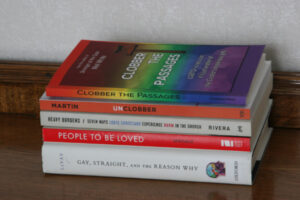 and I’ve read many books. Most helpful to date have probably been …
Gay, Straight and the Reason Why by Simon leVay
Unclobber by Colby Martin
People to be Loved by Preston Sprinkle
Clobber the Passages by Mel White
Heavy Burdens by Bridget Rivera.
And the more I delve, the more utterly appalled I am by the heartbreak that the church is responsible for – including the suicide of thousands of people.
Here’s how I see it at the moment (I’m not done yet researching this topic):
• Stalwart Christians who are determined to uphold exclusion of LGBTQ+ from their church, base their opinions on their understanding of the Bible, and feel this is all that is required; it trumps all other arguments. ‘The Bible is clear’ argument. Quoting the ‘clobber passages‘* – a mere 6 out of 31,102 verses in the whole book – to make their case. These passages say to them: homosexuality is a sin unacceptable to God and therefore the church must uphold that view and exclude anyone who is LGBTQ from attendance or membership or ordination or whatever level they draw their lines at.
• Attempting to question the validity of their interpretation on the basis of the meaning of the words and phrases, the context and understanding of the times, and the limitations of translation, can be a fraught exercise, because it is seen as denying the value of the Bible itself.
• I can find no reference anywhere in the Bible to same-sex committed loving relationships. Relying on the scholarship of those who understand Greek and Hebrew, I have to conclude that the clobber passages refer to abusive or exploitative relationships. What’s more, sexual orientation was not understood until the nineteenth century – AD!! – a reality which has to have influenced translators.
• Prejudice, discrimination and bigotry – both ancient and modern – have played a role in maintaining the status quo, resulting in entrenched views which have been ‘permissible’ because of the special protected status of religious freedom/Christian liberty and conscientious objection.
• The statistics relating to LGBTQ+ people being badly treated by the church are truly shocking – in relation to their faith, their mental health, and suicide rates. How can it be right for one person’s freedom and well-being to be denied or harmed because of another person’s zealous belief?
• To my way of thinking, denying the rights of any citizen to love, respect and acceptance, seems to fly in the face of the fundamental principle of true Christianity: viz to love one’s neighbour as oneself; to treat others as we would wish to be treated. Christian love is about how we behave towards each other, not about exactly how we interpret tricky Biblical verses, important though that may be for other reasons.
The more I’ve seen and heard the consequences of these powerful expressions of religious zeal, the more I’ve personally felt the need to put my own head above the parapet and defend those who are oppressed, victimised and shunned. Even killed. And I do this despite knowing full well that anyone who merely comes to their defence also risks ostracisation, rejection and condemnation. Guilt by association. Been there, done that, got the T-shirt.
 So, back to the ethical question … what’s right, what’s wrong, and on what does it depend? As a Christian myself, I have to deal with a mismatch between what I personally believe to be right, and the consequences of religious freedom. I think my (and everyone else’s) right to act in accordance with my (their) beliefs should be upheld in principle; but I have a real problem in according that right to another person if the exercise of it results in the victimisation or ill-treatment of anyone else … and the Universal Declaration of Human Rights would support me in this.
I’m still mulling over my original question and I’m not convinced I’ve answered it satisfactorily. That’s ethical quandaries for you!! But right now, I think the words of Jesus sum up my thinking: ‘You have heard that it was said … but I say ...’ – I prefer to take my moral compass from his words and example of love, rather than from an ancient and debatable text about abomination! Christianity in action for me trumps dubious Biblical exegesis: grace not legalism. This whole issue needs a king-sized application of humility and grace, and a willingness to say, ‘I don’t have all the answers’.
* The ‘clobber passages’ for anyone interested are to be found here:
Genesis 19
Leviticus 18:22 and 20:13
Romans 1:24-32
1 Corinthians 6:9-10
1 Timothy 1:8-10
On a serious note …
You might be forgiven for suspecting I read only fiction. Not so. Alongside the reading I do to hone my skills as a novelist, I also study topics that relate to my ethical interests. And lately that’s been around discrimination on the basis of different-ness. I rarely talk about these books on my blog as they’re unlikely to appeal to most of my readers.

Ethics and religion are often intertwined and I’ve been trying to tease out why devout believers are often very judgemental and apparently blinkered. I’m thinking not so much of the extreme level of torturing and killing young women who refuse to conform to a strict dress code – the kind of ferocity that hits the headlines – or the fierce opposition to clinics helping women grappling with the consequences of an unwanted or unsafe pregnancy, we’ve seen in the USA this year. Rather I’m exploring the rationale behind closing the doors of the church against people who are coming to a different conclusion on topics like LGBTQ+ or gender equality. And I’m not looking in one specific direction; we see it across religions and denominations, amongst the rank and file members, as well as the hierarchy paid to lead their flocks.
I’m particularly perplexed where the Christian religion is concerned. Not just because ours is a nominally Christian country, and it’s the faith community I’ve been a member of all my life, but more because, after all, it’s a religion purporting to be founded on love – for God and one’s fellow-man/woman. Surely the God whom Jesus Christ came to reveal is bigger than the petty details his followers get bogged down in? Surely he can accommodate different-ness? Surely he doesn’t want his people to be uniform clones made in an image designed by a founder of any given specific denomination? The whole of nature is full of infinite variety – just watch a couple of episodes of The Frozen Planet II!
So am I coming from a prejudiced standpoint here? I’m trying not to. And to that end I’m looking at both sides of the argument, as far as it’s humanly and humbly possible, with an open mind. Right now I’m embedded in the issue of same-sex relationships. Talking with people who espouse differing views, engaging in correspondence with those who challenge my own understanding, and reading, reading, reading. Three books give a flavour of where I’ve been – each valuable in their own way.
Gay, Straight, and the Reason Why, by  neuroscientist Simon LeVay, deals with the science of homosexuality from an academic standpoint; a kind of meta-analysis of the huge number of studies that have looked into a range of biological and psychological and social factors that might predispose someone to be gender-nonconformist. It’s fascinating but probably not for the faint-hearted. Suffice to say, it’s a ringing endorsement of the biological and inbuilt nature of same sex attraction on more counts than you would imagine.
 By contrast, Unclobber is a much easier read. It looks at the six so-called ‘clobber passages’ in the Christian Bible that are commonly believed to say that homosexuality is a sin which God hates. Pastor Colby Martin argues that not only have these sections been misunderstood and misused, but that there is a compelling case for the church to welcome everyone regardless of their sexual orientation.
Preston Sprinkle , an academic professor, pastor and ‘ordinary dude’, challenges Christians to look at the LGBTG+ community afresh. His book, People To Be Loved: Why homosexuality is not just an issue, is a model for how to move away from the sometimes hostile confrontational kind of exchange too often seen in the past, and towards a useful balanced discussion on the subject; to see past the distant theoretical arguments and look into the faces of real people with heartbreaking stories of rejection to tell. Like Unclobber, this slim volume seeks to put common assumptions on one side and discover what the Bible actually says about homosexuality, and then to evaluate how we should treat those who make up that divergent group. Though it’s a deeper and more methodical study of the subject, it’s very accessible, and it’s challenging. The author comes to a different conclusion from Colby Martin where the Scriptural passages are concerned (he thinks the Bible tells us that same-sex sex is against God’s will), but nevertheless he advocates the same kind of unconditional grace.
If I had to sum up where these authors take me I might say being homosexual is definitely not a lifestyle choice, it’s inherent. It’s not so much an issue to be solved, it’s more about vulnerable people who need to love and be loved – loved without footnotes, without a background check, without fine print (as Sprinkle puts it). What that looks like might differ according to which side of the fence we come down on. And that’s the crunch point – how to reach out in love.