Euphemia Chalmers Gray
Effie Gray
There are biographies … and then there are biographies. So I was slightly cautious when I saw an excellent plug for Linda Randall‘s biography of Effie Gray: Fair Maid of Perth recently, but I sent off for a copy anyway. And my money was well spent. It’s a beautifully written account of one little Scots girl who went on to marry not just one, but two famous artists of the nineteenth century. Well worth reading.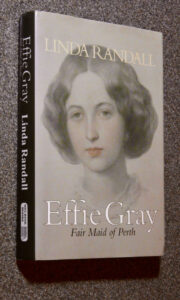
Little Euphemia Chalmers Gray (1828–1897) was the eldest of a large family of 15 children with her mother Margaret ‘relentlessly fertile’. Effie was a clever, vivacious child, hard working and sociable, excelling at her studies. She was sent away from her family home in Perth to boarding school in Stratford on Avon to try to eradicate her Scots accent, but nevertheless retained it all her life. During her first year there, three of her younger sisters died and indeed, she lost seven siblings in eight years. She was devastated when no one sent for her to return home to the family, but going away, staying away, as she did, probably saved her life. However, her own pain and bewilderment was so profound that she grew a protective shell around herself which influenced her behaviour into adulthood. She was only 11 when she first met John Ruskin (her future husband). who was ten years older than her. By the time she married at 19 she still had six siblings at home.
John Ruskin by contrast had a cloistered upbringing; an only child, over-protected by his doting parents, deprived of playmates and many of life’s freedoms. From a young age, his father read poetry to him and his mother the Bible, and he was protectively educated at home. He grew up to be pompous, selfish, erudite and focused, but socially inept. At the age of 18 he went to Oxford but his mother took lodgings nearby and stayed there for the duration of his student life.
The senior Ruskins were not keen on his marrying Effie; they had Sir Walter Scott‘s granddaughter in their sights for him to increase his status in society, and they had seen what a previous unrequited love had done to their delicate son. Besides which, Effie’s father was in dire financial straits by this time, due to his reckless gambling and risk-taking. But John was determined and they eventually consented to the marriage.
Though older, John at that time had much to commend him. He was clever and handsome, famous as a writer, thinker and art critic, kind and wealthy. He and his family gave Effie entree into society and the arts and a life she aspired to. The price she paid was a husband who chose his parents first – he wanted them to go on the honeymoon, share his love letters and their first marital home, and if Effie was away visiting her family he instantly returned to his parents’ home to be cossetted again. He was moreover, a husband who had such a distorted view of the female form and flesh that he was either unwilling or unable to consummate the marriage. Indeed, he was at his most romantic and passionate in letters written to his absent fiancée/wife.
Small wonder then that Effie became severely depressed after a year of marriage: rejected physically by her husband; relegated to a definite second place after his parents; suspecting he loved the romantic thought of her rather than the real Effie; constantly criticised as inadequate by her parents-in-law. Both John and his parents expressed themselves bewildered by Effie’s demeanour and withdrawn behaviour; and in their ignorance and self-obsession, believed she was exaggerating her illnesses. It was high time, the self-obsessed John delared, that his wife outgrew ‘that contemptible dread of interference and petulant resistance of authority which begins in pride … I look for meekness and gentleness in women.’
Away from his parents however, and especially abroad, the couple got on much better, John immersing himself in his research, sketching and writing, Effie out and about in society, flattered and admired, absorbing the culture and fashion of the place. They had money and fame and moved in the highest circles. And Effie was an acknowledged belle of the ball.
John Everett Millais was the youngest of three children in a clever cultured family of well-respected landowners, himself a free spirit who hated any form of restrictions. Largely educated by his gifted mother, his genius was recognised from a very young age, his parents actively encouraging his ambition, and the lad processing rapidly through art schools to the Royal Academy. Tall curly-haired Everett (to differentiate him from the other John) had dazzling good looks and great charm in addition to his extraordinary artistic talent. He moved in a circle of talented fellow artists (including William Holman Hunt and Gabriel Charles Dante Rossetti) and began to develop a style all his own. In time, he and six other like-minded rebellious young men, both artists and poets, discarded the dark, rigid, heavily varnished paintings they’d been taught to emulate and adopted an altogether lighter translucent form. They called themselves the ‘Pre-Raphaelite Brotherhood‘. However, they were ahead of their time and the world was not ready for this new style. Then, just when they were on the point of sucumbing to the harsh criticism, the famous art critic, John Ruskin, came to their defence. And very quickly the Ruskins and Millais struck up a friendship, with John agreeing readily to Effie becoming Everett’s artist’s model. It was the unsociable John himself who invited Everett and his brother William to spend the summer with them, mostly in Scotland.
By this time Effie and John had been married in name only for five years, and, although much sought after and feted at home and abroad, she was increasingly unhappy. The senior Ruskins had taken John back into their suffocating care, he always put them before her, and she was left very much on her own. He began keeping a notebook to record details of any shortcomings in Effie’s behaviour or manner. Determined now not to continue suffering in silence she shared her situation with various people, and her hitherto scrupulously modest behaviour became more provocative.
Seeing the couple at close quarters through several weeks in Scotland, Everett Millais grew to despise John for his coldness, bad temper and subtle bullying of Effie, and his own feelings for her gained traction. She reciprocated and stopped even pretending to be a loving spouse. By now John’s cruelty had included informing her that he was bent on breaking her proud spirit, and that his disgust with her physical body was the reason he has not consummated the marriage. There could be no recovery. And after six years together, Effie took steps to establish her virginity and get the union annulled.
In Victorian times divorce was socially unacceptable and Effie’s actions to end the farce of their marriage came in for their share of criticism although support far outweighed censure. Having moved in the highest circles hitherto, she found some doors now closed to her; one such being the court of Queen Victoria who never again allowed Effie to access those august quarters.
Happily though, Effie found happiness in marriage with Everett Millais who achieved high status as the nation’s favourite painter, and together they had eight children.
The book is illustrated with excellent photographs featuring members of the family and high society whose likenesses were captured by some of the biggest names in the art world. Highly recommended.