freedom of conscience
A Divided Inheritance
It’s always something of a thrill to find a new-to-me author whose writing I enjoy. This time it was historical novelist Deborah Swift.
Before undertaking a Creative Writing Course, Deborah worked as a set and costume designer for theatre and TV, and something of her eye for the artistic and for visual detail shines through her descriptions of dress and settings. She’s thorough in her research too and has put her love of pottering around in archives and museums and old buildings to good use – no mean undertaking given that she’s tackled a considerable number of periods of history in her 19-so-far novels.
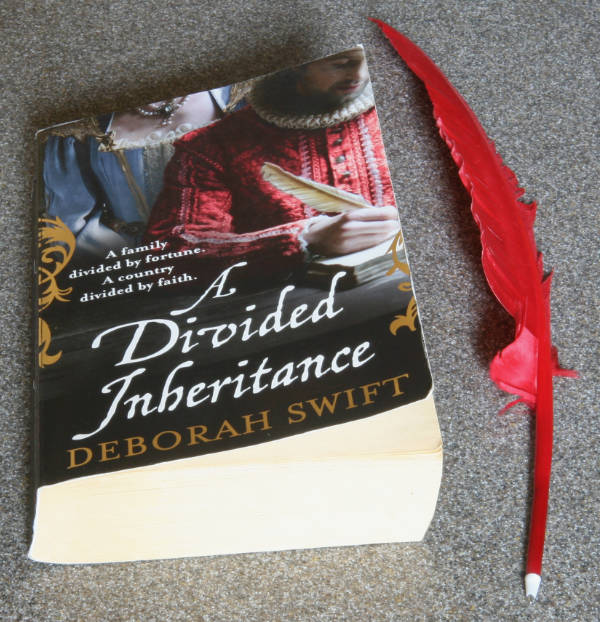
In A Divided Inheritance she’s delved into the 16th–17th century, and chosen a very dark backcloth of history. This was an era when the English king, James 1 (James VI in Scotland), forbade Catholicism and enforced punitive laws against those who refused to attend Anglican services here; whilst in Spain, the monarch Felipe III signed an edict ordering the entire Muslim population to leave his country on pain of death. By 1613, it was estimated, 400,000 people had been forcibly expelled from Spanish territory. Swift colours in the foreground vividly with her capture of the finer qualities of swordsmanship, the elegance of velvet doublets and fur-lined cloaks, the squalour and stench of insanitary housing, the barbarity of the slave trade.
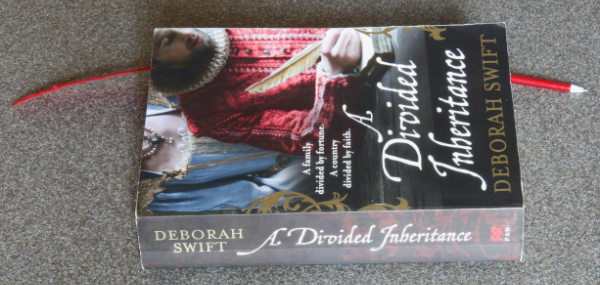
It’s a meaty tome: over 500 pages of tiny text. At its heart is Elspet Leviston, daughter of a lacemaker, who has devoted her life to working for the family business. It’s only when her father’s will is read that she learns the house and half the business go to his bastard son, Zachary Deane, a stranger whom she had thought to be her cousin. Her arranged marriage falls through when her intended husband, a wealthy furrier, discovers she’s not who she purported to be, and now Elspet is facing destitution and homelessness. Zachary has no interest in the lace-making business except for the money it will bring when it’s sold – anticipated revenue he begins to squander in Europe, not improving his education as his father intended, but learning to fence expertly. Desperate, Elspet tracks him down to Seville in Spain and begs for his mercy and help.
Spain opens up a new life to her when she enters the fencing school of Señor Alvarez to await Zachary’s decision, but all her dreams come tumbling down when first the government’s army invade their premises and issue ultimata, and then both the master-swordsman himself and Zachary reveal they are not who they purported to be.
But underlying that tale, is something much more profound. Swift has given her characters emotional depth, subtly exploring the influence on behaviour of role models and affection and belonging, and though the principal antagonists are thwarted of their hearts’ desires, they find a freedom and inner peace independent of their outward circumstances. Somehow more satisfying than a happy-ever-after fairytale ending, and much more fitting given the brutal realities of that era.