Lockerbie
Lockerbie: Our Story
Following on from my post last week about the dramatisation of the Lockerbie disaster, it seems only right to draw attention to the reality for families and friends.
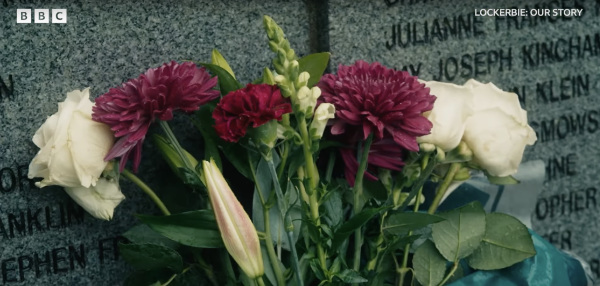 This week BBC2 aired a programme called Lockerbie: Our Story, in which loved ones remember both the incident and the individual people who lost their lives in the UK’s worst terrorist attack. It’s profoundly moving.
The clips come from far and wide, reflecting the diversity of the passengers who occupied the seats on that ill-fated plane. A skeleton picture of the Pan Am 103 flight shows which seats the different people were allocated; bringing to life those innocent men, women and children walking down the aisle, stashing their cases, their Christmas gifts, into overhead lockers, strapping thermselves into those specific seats. And in between the stories that same eerie skeleton 747 is shown roaring into a dark sky unknowingly bound for disaster.
The interviews with parents, siblings, sons, daughters, girlfriends, friends, capture eloquently the devastation for those awaiting their loved ones for Christmas, seeing the 9 o’clock news, or phoning the airline for an update on timings only to be told, ‘That flight will not be landing …’ Even listening second-hand, the stunning horror is palpable. And the ongoing grief and loss since that fateful day over four decades ago is quietly but effectively conveyed, more in the brave acceptance than any overt display of emotion.
Though there is the occasional reference to the politics behind the catastrophe, and to the fact that numerous warnings were received by the authorities that this flight was the target for a terrorist attack, leading those in the know to transfer their tickets to other flights, the overwhelming thrust of the programme is how much the bereaved want their loved one’s memories not to be tainted or overwhelmed by the way they died. They were so much more than the event that killed therm. And those left behind deeply want good to prevail, not evil.
The Bombing of Pan Am 103
It’s indelibly etched on my memory: the night the Pan Am flight 103, en route from Frankfurt, Germany, via London Heathrow to New York City in the USA, came down in Lockerbie, a small town in SW Scotland, on the evening of December 21 1988, killing all 259 men, women and children on board, and 11 residents on the ground. Because we lived it; we knew people connected with those caught up in the horror. Lockerbie is only 70 miles from where we live. We’ve visited the memorial sites since and been profoundly moved by the atmosphere that still clings to them.
The six-part series, The Bombing of Pan Am 103, airing on BBC1, captures aspects of the investigation I was unaware of, however, or knew only sketchily. Like the sheer humanity and dedication of the locals in Lockerbie, who went way beyond the call of duty to care for the passengers of that ill-fated flight, and to cherish their families. Like the dedication of the local police, used to dealing with bike theft, who committed themselves body and soul to this massive and gruelling investigation and to supporting its victims. Like the sheer scale and complexity of the operation.
Although the drama is necessarily truncated, enormous effort has been taken to make it as authentic as possible. It conveys many of the facts that made this one of the worse air disasters of all time and one of the most complex investigations. The debris from the plane was scattered over 850 square miles. 5,000 responders combed the countryside for clues. Investigators traversed the globe interviewing over 10,000 individuals in 16 countries. Enormous quantities of pieces of evidence were painstakingly collected and labelled, enabling the reconstruction of much of the 747, the bodies of the victims, their suitcases and possessions, and the bomb.
Somewhere in the mountain of detritus a tiny fragment was found which led the team to establish that the bomb had been placed inside a Toshiba radio. Another small fragment embedded in a distinctive shirt led to the identification of the timer that triggered the explosion. Following meticulous work by multiple agencies and organisations, police eventually tracked down the person who bought the clothes which were packed around the bomb – in a shop in Malta. This led to the identification and arrest of two Libyan operatives.
Quite how the various international organisations cooperated is unknown but the film does portray battles and tensions and failures in communication that give some indication of the power struggles, tensions and emotional overload. I loved the moment when a slick FBI agent arrives from the USA and finds the headquarters in Scotland are based in a rural primary school!! The Senior Investigating Officer may be a quintessential Scot from a low key force in sprawling Dumfries and Galloway, but he’s well able to retain mastery of the situation, which he does in a delightfully understated way.
This is a powerful and intensely moving portrayal which resurrected a lot of memories for me, and I can’t bring myself to recount some of the most macabre details we heard of. But the knowledge that those families are still grieving the enormous loss and the horror of those sights and sounds, still fighting for justice, stirs deep emotions. The BBC are right to remind us.