Matt Eversmann
Emergency Care nurses
Nurses who work in emercency care settings are always jumping from one crisis to another, and there’s rarely time to process what they’ve just experienced. Although talking helps, they probably never really deal with all they see and do; the mental scars remain.

In ER Nurses: True Stories from the Frontline, by best-selling author James Patterson* and Matt Eversmann, highly skilled and compassionate nurses share a glimpse into their surreal world. It’s bizarre, unique and humbling.
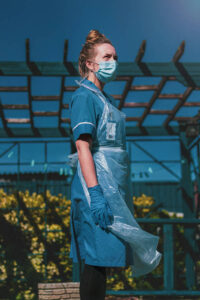
Angela: early on worries that she’s too sensitive, too empathetic, to remain in control of her emotions and preserve the calm rational approach of a professional nurse. Then COVID hits and she’s caring for huge numbers of patients, many young, many of whom die. She is physically and mentally exhausted after giving her all. And at the end of a twelve hour shift she finds herself peeling the skin off her nose with the respirator (mask with a filter) she must wear continuously. When she leaves the hospital, people avoid her, fearing she might be infected. And through it all she realises she does have strength and resilence, gained through hard experience.
Katie: dares to defy convention. She encourages a family to bring his dog into hospital to comfort a dying man; she gives a young wife the chance to help with intimate care of her dying husband, to lie beside him and rest.
Carol: has actually met Dr Kevorkian aka Dr Death who became notorious for helping people to die. She was there when he rolled up to the ER in his rusty old white Volkwagen van with a deceased man inside it. And as she says, she saw far too many things people should never see. Nevertheless, when she retired, she missed the ER and the difference she made, the good she did.
Patrick: begins adult life as a drummer in a touring rockabilly band. He’s drawn to nursing and over time discovers that his uniform acts like a suit of armour, a physical barrier that creates a clinical, matter-of-fact mindset. It enables him repeatedly to see bad things but not dwell on them or get emotional, because he has a job to do, a job that entails endless switching of gears. And sometimes laughter is the only recourse to deal with the enormous stress. Indeed, humour is a key survival skill for an ER nurse.
Devyn: all unknowingly admits a serial murderer called Angel to the ER, a skinny man with tattoos on his face and neck, who repeatedly says he’s not well – and yes, it’s definitely mentally unwell. Devyn stands alone outside the room while Angel strips and dons paper scrubs prior to the necessary psychiatric evaluation. But before he goes in to do the examination, someone rushes up to tell him they’ve found a machete with Angel’s DNA on it is stuffed between the mattress and bedframe he’d been lying on initially. It transpires he has a history of chopping people up and putting them into a suitcase or box.
John: has worked in the ambulance service and law enforcement before becoming an ER nurse. He learns the hard way that it’s okay to be vulnerable. It’s okay to hurt, to cry. It’s okay to feel that loss. You can visit that place; you just can’t live there. You have to share the stress with someone; otherwise it will destroy not only your career, but who you are as a person.
Tara: sums up an important lesson for everyone: I wish people who came into the ER would understand that if we don’t get to you right away, it means you’re stable, that there’s someone sicker than you. If you’re waiting, that’s a good thing. It’s when we all rush in and jump on you that you should worry.
Corina: is haunted by the children who’ve been bused by family members being brought into the burns unit where she works, so she transfers to the ER. She catalogues some of the horrors she encounters there – morbidly obese women needing mattress springs surgically removed from their backs; patients riddled with lice and infested with cockroaches in their orifices; overdoses; violent and abusive patients, some of them armed … She eventually leaves there too: there’s only so much trauma a person can see and take.
Megan: I go, go, go until I crash. I cry, then I pick myself up and start the marathon all over again.
 And so it goes on. Nurses being violently attacked; having feces thrown at them; devalued by their managers; so exhausted and demoralised all they can do on their days off is sleep and cry. In the ER you have absolutely no idea what will come through the doors next, and very little idea what any given patient might do next. Shoot. Stab. Throttle. Have sex. Die. Death is commonplace. And yet every day these nurses have the power to change lives, to make a difference. And that keeps them returning.
Perhaps the most terrifying stories relate to psychiatric patients, both children and adults, who seem to be possessed – scary even reading the accounts never mind living through the real experience. Or the cases of parents high on drugs who leave babies unattended in the bath or put them in the washing machine or deliberately scald them.
One nurse, Rosemary, says you can’t just detach yourself, you have to be a little bit vulnerable to get through to your patients. Another, Karen, uses the sorrow that follows losing a patient to draw on an inner reserve to make her try that much harder, work that much faster, for the next patient, and the next. But, whether they use humour, compartmentalisation, talking therapy, spirituality, or whatever else as a coping strategy, the ability of these nurses to deal day after day with the unspeakable tragedies of life, and their resilience and compassion, shine through.
This book resonated strongly with me as I chose emergency medicine as my specialty five decades ago. Particularly Claire‘s account. I still remember the moral dilemma of having to resuscitate patients who were fished out of the river or picked up at the foot of bridges following suicide attempts. Only to face their demons all over again.
As the blurb puts it: When we’re at our worst, nurses are at their best.