publishers
I Saw a Man
Well, it just goes to show – reading is such a subjective experience.
 I turned to I Saw a Man by Owen Sheers because it’s billed as ‘the most stylish thriller’ … ‘taut’ … ‘suspense almost physically frustrating’ … ‘exemplary thriller, clever, classy, slick’ … ‘extraordinarily tense and powerful’ …all the kinds of accolades we’d all like to receive about our writing, huh? And just the masterclass to help me make my own current writing more taut and unputdownable.
Or not.
What a let down. OK, the essential thread of suspense is there – a bereaved man, a writer, Michael Turner, walking into his neighbours’ house because he sees the back door open and worries that intruders have entered it. Once inside, he’s distracted by a sense of his late wife’s presence which lures him upstairs into hitherto unknown territory. Up there, he unwittingly causes and witnesses a terrible accident, but can’t do anything about it without revealing his own trespass. The knowledge haunts him. Meanwhile his neighbour is also harbouring a massive burden of guilt, lying about his activities. Who will do or say what? Whose secrets will come to light first? What will the repercussions be? And hovering in the background, is the man who pressed the button that resulted in the collateral death of Michael’s wife.
So far, so I-want-to-know-what-happened. But for me, it felt hollow. Far too much description and backstory slowing the pace. The characters spineless and selfish. The ‘crimes’ unworthy of so much weight. Some of the main threads going nowhere. I’m sure these criticisms are in large part a measure of how much I’m currently agonising over the balance in my own domestic thriller, but authors are always critical readers, and I make no apology.
 Although I’d personally take issue with some of the simplistic sentence construction, there are, however, a number of beautifully lyrical passages, commensurate with Sheer’s reputation as a poet.
‘London was blistered under a heatwave. All along South Hill Drive windows hung open, the cars parked on either side hot to the touch, their seams ticking in the sun.’
‘Their flasks of coffee, two hours cold, stood on a shelf …’
And he weaves in some occasional surprisingly insightful wisdom. Not surprising maybe in a book about how men cope with grief.
On the effect of sudden brutal loss:
‘Caroline was dead and he’d been left holding the shell of the truth, bereft not only of her, but also the man she’d been making him.’
On the symbiosis of reading and writing:
‘Is a story half-cooked,’ he asked her, ‘if it’s only been written but not read?’
‘Absolutely!’
He laughed, thinking she was joking, but then saw that she wasn’t.
‘Without the reader it’s just thoughts on a page,’ she said. ‘Imagination in ink. A printed tautology.’
‘Tautology? How?’
‘Well, a repetition, then. Of what was in the writer’s mind when they wrote it. But when it’s read …’
‘Yes?’
‘Well, then the words gather a new imagery, don’t they? The meaning gathers new association. It’s like a chemical reaction. It all depends on how they react with the reader, their life, their mind.’
And that’s where I part company from the gushing critics. My chemical reaction with this book fizzled rapidly like a damp squib. Sorry, Mr Sheers. Your credentials may put you way beyond my reach, but your idea of tension and suspense is vastly different from mine.
One of the things agents often say to writers is, “I didn’t love your story enough to fight for it.’ Would an agent have loved I Saw a Man enough if an unknown author had submitted it? Hmmm, I doubt it very much. But I’m not reading it as an agent, and it’s given me a different and helpful perspective and yardstick for my own book, so that’s a bonus. No reading is wasted on a writer.
Back to my own novel. And I am relishing the terrific help of my experts. A lead paediatrician in Child Protection, and two accountants, and one of my long-suffering literary critics, have all given me invaluable guidance and feedback. I’m galloping along surrounded by all this evidence of their support and friendship and life experience.
Editor-speak
 We’re probably all familiar with the kind of language estate agents use to beef up the attributes of a house/flat/hovel in order to sell it.
For ‘bijou/cosy’ read ‘cramped’.
‘Excellent transport links’ translates as ‘there’s a motorway and/or busy railway line right next to it‘.
‘An ideal purchase as your first three-bedroom home‘ is agent-speak for ‘the second bedroom will take a single bed at a squeeze; the third one will only fit a z-bed on the diagonal in a crisis‘. You know the kind of thing.
 But did you know there’s also a dictionary of kindly words used by editors who are dropping our precious manuscripts into the nearest bin? Thanks to author of 90 novels, Cynthia Harrod-Eagles, who claims to have a world-class collection of rejection letters herself, for the following handy guide.
sincere – dull
frank – embarrassing
heartfelt – dull and embarrassing
ambitious – far too long
epigrammatic – short and senseless
gnomic – even shorter, and still senseless
robust – too much sex
cerebral – too little sex
niche interest – incomprehensible to normal people
authoritative – see niche interest
well-observed – autobiographical
lovingly observed – tediously autobiographical
well-written – over-written
richly detailed – horribly over-written
broad-brush – full of careless mistakes
authentically voiced – writer has no grasp of grammar
original – writer has no grasp of grammar or syntax
energetically original – writer has no grasp of grammar or syntax, vocabulary, plot, pace, dialogue or character
not what we are looking for – unpublishable
didn’t quite work for us – don’t give up the day job
Maybe after all there’s something to be said for the agents and publishers who simply state: ‘If you don’t hear back from us within six months you should assume your manuscript does not fit with our lists. We wish you success elsewhere.’ You don’t hear anything; you make excuses for the deficiencies of Royal Mail. Ten weeks after the deadline date you finally succumb to a terrible sense of failure. You even picture the said gurus scoffing to colleagues in their superior way about the drivel submitted in the name of literature which they are obliged to lift out of the slush pile and at least cursorily scan. You maybe throw a minor hissy fit. Or go into a spiral of depression and hopelessness. You maybe pack away your pens and paper for ever.
But truth be told, the people who issue these horrible but carefully-honed rejection letters have their own cross to bear. They live in daily dread of a) overlooking a masterpiece or b) utterly crushing the spirit of a writer whom they have never met or c) incurring the wrath of an agent who has the power to unleash the most beautifully crafted diatribe against the editor’s entire empire.
I’ve had a glimpse inside this world. Occasionally a writer lower down the pecking order even than me will request that I look over their precious text and give ‘honest’ feedback. The worse it is the more I personally agonise long and hard over what to say to them. I was so stressed and in dread of one persistent person’s reactions that I spent an hour calming myself in our local cathedral before meeting up with her.
 So next time you get a coded letter from a publisher or agent just visualise the sweet revenge of your brilliant work going on to win the Orange Prize for fiction … the Man Booker … the Nobel Prize for Literature. After all, you know from my previous posts that a surprising number of famous bestsellers have been rejected many a time and oft. It could be you. All you have to do to prove it is pen a masterpiece and find a brilliant publicity team. That’s all.
The Crabbit Old Bat
I spent a lot of time during the Festival waiting in queues for events, or in the Square between sessions, and as you know, I’m not the most patient idler! So, on my first day there, off I beetled to the Book Tent and bought Nicola Morgan‘s book Write to be Published. It’s the sort of reading that’s best broken up into digestible bites, leaving time to mull over the advice, hence an ideal choice to tuck into my bag for all those ‘between’ hours.
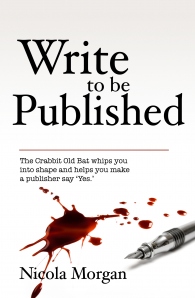 Essentially it’s about how to get published.
I first met Nicola when she was Chair of the Society of Authors in Scotland – the kind of dynamic and generous Chair who makes it her business to know every author by name, but who hobnobs regularly with the great and the good in order to effect change for ‘her’ members. She’s a delightfully no-nonsense and entertaining wordsmith – written and spoken variety – so I had high expectations.
Listen to the biography in Write to be Published: it’s so Nicola: Nicola Morgan was born in a boy’s boarding school and has recovered remarkably well, while retaining the ability to do press-ups. After a painful struggle, she grew up to be the author of around ninety books, including category bestsellers and award-winners. She has been Chair of the Society of Authors in Scotland, an English teacher, dyslexia specialist, entrepreneur, professional cook, pillow-case repairer and trainee turkey-plucker (failed). Thanks to her blog, Help! I need a publisher! she dominates the Google rankings for her phrase Crabbit Old Bat, a fact of which she is unappealingly proud. She lives in Edinburgh and on chocolate.
The book follows the content of her blog but it’s ‘neater, better organised, more coherent and you can curl up with it. You can throw it at the wall when the truth hurts too much … It’s more polite, well-behaved, and controlled. It’s still me, but it’s me in a gorgeous evening dress. And stunning shoes, naturally.’
And it’s packed with sound advice about how to get a publisher to say, Yes! It’s about how to write a book that captures what a particular category of readers want. It’s about accepting that some books don’t deserve to be published but are, just as some people don’t deserve to win lotteries or earn large salaries or be successful, but do and are. It’s about knowing that there’s no shame or ridicule in low earnings. It’s about creating the right book in the right way at the right time.
It’s full of humour … ‘Adverbs, used lazily, are an immature writer’s stock in trade. Yes, they roll off the tongue, but so does dribble.‘
Vivid prose … ‘Showing can be more powerful (than telling). For example, you might tell me that Fred is cruel; but if you show me Fred ripping the legs off spiders and making a collage with them for his sister’s birthday card, it’s much stronger and I know exactly what you mean by cruel.‘
Wry good sense … ‘Only if a book is glitteringly brilliant from start to finish can you afford mistakes at submission stage. (Unless you are a celebrity, in which case you can write a load of drivel and not only get away with it but be lauded for it and have the plastic bits of your body photographed in silly magazines.)‘
The obvious delivered kindly … ‘Follow (submission guidelines) closely, unless you really think that although they said they wanted the submission emailed, they really wanted it delivered on a white horse at dawn, with a trombone serenade and three bags of Werther’s Originals.‘
Style … ‘One trouble with synopses is that they reduce your beautiful words to something plainer. They are your glorious self undressed and made to stand in front of the cameras in a Victorian swimming-costume under bright lights with no make-up. Well, in that situation, you would make sure you looked as good as possible, wouldn’t you? You wouldn’t slouch there, letting your abdominal muscles slide earthwards – you’d hold them in, put your shoulders back, chin up. You’d try to show that if you had clothes and make-up and corsetry on you’d look sensational. A synopsis, being your story undressed, needs to do this.’
It’s also immensely reassuring. Having got her readers raring to go on and publish, she issues a typical Morgan warning: ‘I feel duty-bound to warn you about what lies ahead if you succeed. If you think published writers sit around eating chocolate, occasionally speaking a few languid words into a voice recorder, watching their assistant demi-under-publicists order another bottle of champagne or saying mwah, darling to famous people, think again. Here’s why:
- You will suffer insecurity. We all do. Or most of us. And we hate the secure ones. How wouldn’t we be insecure, when people tell us we’re rubbish? And if anyone says nice things, they’re often a) paid to, b) our parents or c) deluded (which includes our parents).
- Not only do we feel insecure, we are. Being published once means that dire sales figures can prevent book two being accepted.The secure author is incredibly rare and it certainly doesn’t include me.
- People will ask you annoying questions and you won’t be able to explain why your face just twisted up. If your face twisted up and you don’t give a smiling response, they will call you arrogant.
- The money is usually rubbish and the hours are long.
- You will go into bookshops and not find your books there. Then you will have to listen to a friend say, “I went into the bookshop in Upper Auchtermuchty and your book wasn’t there. Why not?”
- Your publisher will blame you for poor sales and dump you. This is like being made redundant but without the money. On the other hand, writing is often like working but without the money.
- Your work will at some point be reviewed negatively and this will be on the internet for ever. People will go online and spout unpleasantness. The fact that these people should be asleep instead of spewing out their dislike of your book at three in the morning, and that they can’t spell, doesn’t make it hurt less.
This is why we eat chocolate.‘
(NB. If you aren’t smiling by now, consider a funny-bone-transplant.)
It’s her clever blend of practical commonsense, unvarnished truth, authority and humour that makes this book such a gem. She tackles all aspects of getting published with the same bracing candour – how to behave towards agents and publishers, what makes a book right, how to write (suspense, dialogue, pace, narrative thrust, voice, setting, the lot), how to submit your work, coping with rejection – it’s all there. Highly recommended whether you’re thinking you might try to get published or if you’ve already had some success but worry about future attempts.
I can only look on with admiration at Nicola’s energy, drive and success. She’s a voice worth listening to.
Olympic tasks
Well, the Olympic torch has certainly caused a stir throughout Scotland. It passed through our town on Thursday and as I waited in glorious sunshine (yes, really!), one amongst hundreds, I found myself contemplating its symbolism. Not only is the flame travelling through the country, honouring those who have made a significant contribution to their community or nation in some way, drawing crowds wherever it goes, but other disciplines – businesses, churches, teachers – have capitalised on the occasion.
Wayside pulpits quote: ‘Your word is a lamp to my feet and a light for my path.’ Ministers have told parables of the importance of training, striving for perfection, persevering, of goals and objectives, prizes and medals. School teachers have taught their students similar lessons for life, bringing them out onto the streets to witness this historical spectacle.
My mind though has also been drawing parallels with writing. The flame carrier (author) is the focus of attention, but just look at the team running alongside (the editor, the publisher, the bookseller.) They display stamina, endurance and athleticism too, often with precious little recognition. How many cheered them? How many even noticed them? Even the torch bearer’s moment in the limelight is short lived (books rarely last long on the bestselling list).
 The excitement and encouragement of the public (readers) are both invigorating and confirming for the principal players. The atmosphere of friendly support amongst the police (critics), waving and chatting to the crowds …
 and the energetic endorsement from the sponsors (reviewers) …
 demonstrates that they too are human, applauding and enjoying the whole enterprise, caught up in the prevailing enthusiasm.
And the success or otherwise of the total process (publication and distribution) depends on careful pacing and precise timing. If the public aren’t well informed (marketing) they won’t know when or where the torch is coming to their area. There will be no cheering crowds (buyers).
 My own reaction to this Olympic phenomenon has surprised me. The history, the pageantry, the atmosphere, have been unexpectedly stirring and moving. And for me a particularly poignant moment was when a lady who received a new kidney sixteen years ago, carried the torch up onto Edinburgh Castle’s esplanade on Wednesday evening and lit the Olympic cauldron. Lesley Forrest, MBE, who has won a number of medals in both the British and World Transplant Games, spoke simply but powerfully of the remarkable gift of life she’d been given, and of how she is committed to making every day count – particularly timely and relevant for me at the moment with my current novel being about organ donation. I only hope that when it comes out, my message too will echo her words: this is a special gift; it can transform lives. And that more people sign up.
Here endeth the lesson!