William Shakespeare
Shakespeare’s stamping ground
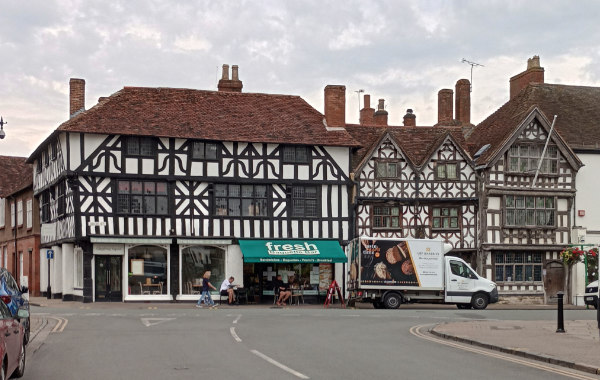 It’s over two years since I visited Stratford upon Avon for the first time, out of season and briefly, so I was thrilled to go again last week and stay for three days, time enough to explore the town and its significant sites.
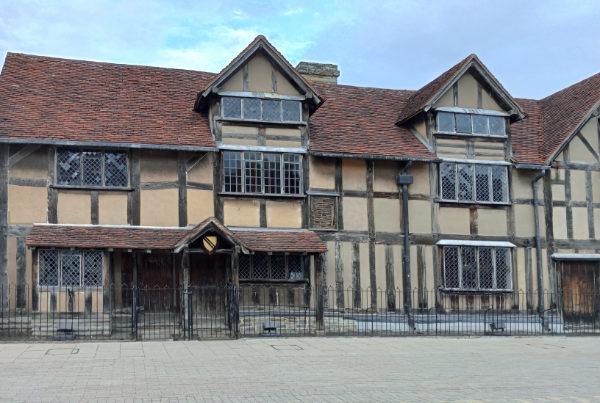
I’ve come away hugely impressed by the preservation of so many ancient places, the excellence of the guides, the sympathetic exhibitions, and the imaginative ideas which bring Shakespeare alive for the masses. For once health and safety concerns have not put barriers between us and history.
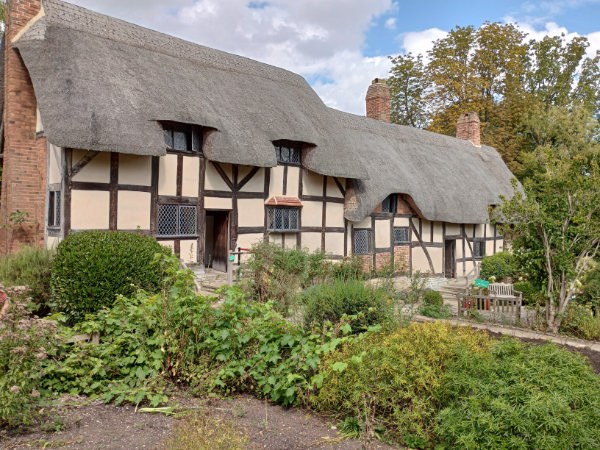
It’s eight centuries since William Shakespeare (1564-1616) trod the streets of the town of his birth and yet we can still wander through the rooms he played in as a child, pace the actual stone floor where he and Anne Hathaway spent their courting days, and stand on the site of the huge house he bought for his growing family. Some of the roofs look decidedly iffy; you can see daylight through floorboards, staircases are very uneven; some ceilings are low and walls uneven; but you can explore the houses and touch the very wood and stone the great man would have touched 800 years ago.

On all sides there are references to Stratford’s most famous son. Streets, pubs, shops, public buildings, boats, bear the names of his family or his characters. The world renowned Royal Shakespeare Company regularly puts on his plays in the iconic theatre.  For the more faint-hearted mini sketches are played out against the backdrop of his birthplace. Statues of the writer himself and his fictional characters abound. And all against the beautiful architecture and pretty river scenes that make up Stratford itself.
I learned so much about the man and his family, even though a surprising number of facts remain unknown.
Did you know, for example, that a phenomenal number of current sayings came from his pen, including rude insults?
Did you know he actually invented a large number of words that are still current today?
Did you know that his family line died out with his grandchildren?
Did you know that he needed a special licence to wed his pregnant fiancee because he was only 18?
Did you know that his son-in-law, Dr John Hall, would have held frogs over the open mouths of patients with sore throats – the creatures emitted a juice with antibiotic properties (discovered scientifically many many years later)? Hence ‘frog in the throat’!


It’s magical and evocative and fascinating and highly recommended.
The Seven Ages of Death
For reasons I won’t go into at this stage I’m back to thinking about death. (I can hear my children groan – they maintained it was my obsession when they were growing up because my research focused on it for many years.) Anyway, in the process I’m hovering up books on all sorts of aspects of the subject.

The first one I want to share with you is The Seven Ages of Death by Richard Shepherd.
I’m instantly intrigued. It starts with that classic speech from Shakespeare‘s As you Like it:
All the world’s a stage … through to Sans teeth, sans eyes, sans taste, sans everything,
and the author uses it as his framework for a vast amount of material accrued from years of clinical experience as a forensic pathologist. It takes us through each of the seven stage of life, from infancy to extreme old age, by means of cases he has investigated, liberally fleshing the facts out with biological and medical explanations alongside personal thoughts and experiences. Delightfully engaging and readable. Well, for me at least (but I suspect my medical background helped here).
 His is a fascinating profession working alongside the dead and their grieving relatives.
Death is my life.
Here is the spirit of compassion and scientific discovery.
Grief walking into my office is a familiar sight, but still it never fails to affect me. The office is a place where paperclips and lists and calendars are devoted to the smooth running of our daily lives and yet here is an emotion so immense that it mocks the most carefully planned filing system.
It’s certainly a case of ‘in at the deep end’. Even the most hardened detectives quail at the prospect of entering the mortuary and seeing a tiny scrap of humanity lying on the stark metal bench, minus any soft comforting wraps or toys. What’s more, everyone knows the victim had no say, no choice, in what happened to him. And indeed, there can be a frightening tension between the rights and interests of the parents and those of the baby. This is vividly conveyed by the case of a father who had a deep distrust of conventional medicine, but who failed to recognise a metabolic disorder that would have been picked up on routine tests. The child died at just 6 months of age with nothing more telling externally than a severe case of nappy rash. The collision between the father’s right to reject medicine and the baby’s right to survive is brutal in this case.
We see this conflict too in examples of older children who are the subject of accident or murder by parents who lack the resources or skills to cope. And there’s often a fine line between an accident and murder as Shepherd vividly illustrates with a case of a seven-year-old girl who was reported to have run away from home, and been found in a park apparently strangled by her necklace. But why were her tiny trainers free from mud? And why was her bag neatly packed with grown-up essentials? Because her mother set the scene to cover her crime.
 A similar fine line separates the deaths of two teenagers who were camping in a tent. They apparently dragged the smouldering remnants of a cheap barbecue into the tent to warm themselves. The girl’s body showed the clear signs of carbon monoxide poisoning but the boy’s body was found at the foot of cliffs a distance away, with a much lower level of carbon monoxide in the blood. Was it deliberate or a tragic accident? Shepherd takes each tiny piece of evidence and painstakingly pieces a story together. That’s his job. And he must remain calm and resolute in the face of all the other professionals wanting precise and rapid results yesterday. And in the face of the powerful reactions and grief of the bereaved families.
It’s his eagle eye that sees beyond an accusation that a young man pushed his older brother off a wall resulting in a fatal head injury. Never mind the witnesses who corroborated the ‘pushing’ story, Shepherd noticed something odd about the victim’s legs. There was something much more sinister behind this fall than anyone had ever contemplated; something which had far-reaching consequences for this bereaved family – an inherited disorder carried by the mothers and biding its time in the sons.
When it comes to the thirties apparently it’s very often extreme behaviour that kills this cohort. Shepherd introduces a high-profile case to illustrate this; that of Gareth Williams –the so-called ‘Spy in the Bag’. Shepherd was the third pathologist to examine Gareth’s body – already badly decomposed when it was discovered squeezed into a padlocked hold-all in a very hot bathroom in his flat, with the keys to the padlock beneath him inside the bag. At this point a different kind of post-mortem examination comes into play: a psychological one. The victim was found to have spent thousands on women’s designer dresses, shoes and wigs, to have been into bondage and being restrained in tight places. Shepherd meticulously weighed up the evidence to form his considered judgement and presents a compelling argument for auto-asphyxiation in spite of the conspiracy theories abounding in this front-page case.
 Such was his reputation that Dr Shepherd was also consulted in the case of the scientist Dr David Kelly, a UK expert in weapons, who was found dead shortly after being publicly humiliated in the matter of the missing Weapons of Mass Destruction in Iraq during Tony Blair’s time as prime minister. The detailed records of what Dr Kelly’s wife said, and the evidence of severe psychological stress Dr Kelly was under, are harrowing and extremely powerful, illustrating the compassionate understanding of humanity alongside impressive medical knowledge that characterise the author’s own modus operandi.
But he is also refreshingly and bruisingly honest in his reflections about his own mistakes and personal issues – drinking, smoking, weight-gain, and he admits to both his own limitations and those of forensic medicine itself. As he gets older he’s also quite brutal about the effects on health and wellbeing which accompany the ageing process. He gave me biological permission to be less than I was, and not to beat myself up about it! I liked that!!

I’m a fan of the BBC series Silent Witness and Forensics: The Real CSI, both based around forensic pathology, and this book took me through the same process of deeply insightful detective work to reveal the lives as well as the deaths of those who end up on the post mortem table.
Hamnet
 Having just been to Stratford upon Avon, this seemed like the perfect time to read Maggie O’Farrell‘s award-winning novel, Hamnet, based on the lives and tragedies of the Shakespeare family. Though I’ve heard the author talk about it at various events, and read reviews, the book was not at all what I was expecting.
 Knowing the names of the real-life family members, I was discombobulated by the pseudonyms they’re given in this story. Hamnet is synonymous with Hamlet – OK, I can cope with that. But Anne Hathaway, renamed Agnes? Though I understand the logic behind it, I’m still not entirely convinced by this strategy. And given that the chapters dot between time-frames, it took a while to be confident of which generation we were dealing with.
Will Shakespeare himself is never named; he’s variously the Latin tutor, son, husband, father. He’s an educated grammar school/oratory boy, well used to brutality, subject to dark moods, who only finds his real inner self and fulfilment in play-writing and acting in London.
The central figure is his wife – unschooled but with a wisdom beyond formal education. She’s portrayed as an other-wordly soul with special powers, strange inexplicable insights and foreknowledge, an affinity with nature, a frail veil between her and the world of the dead. A sorceress, a forest sprite, of another world, not quite belonging in this one.
When Shakespeare first catches sight of her with a falcon on her arm, he mistakes her for a boy, and instantly we see shadows of the famous strategies the real playwright wove into his plots. Seen again in their twins, Judith and Hamnet, who have a unique bond – changing places and clothes, hoodwinking people into thinking each is the other, even in death.
The depiction of the plague is shiveringly realistic. The terror striking into the hearts of families with the gruesome beak-masked physicians, the telltale buboes, the death toll, the unknown elements echoing in our own pandemic five centuries later. But back then with recourse to nothing better than herbal remedies or dried toads!
However, for me, the greatest strength is in O’Farrell’s poignant depiction of a mother’s grief. The unfathomable despair and guilt. The impossibility of folding the sheet over Hamnet’s lifeless body, closing him off for ever from her sight. The isolation that separates parents, alienates relatives, preys on the lives of siblings, changes irrevocably what is important in life. Brilliantly written.
Indeed the whole book is a delight to read, but hauntingly sad, bringing to life a hitherto-unknown young lad whose early death was the inspiration for one of the most well known plays in English Literature.
PS. Just so I don’t leave you on a downbeat, how about this fun description:
… the headless pheasant on the table, scaled legs fastidiously drawn up, as if the bird is worried about getting its feet muddy, even though it happens to be decapitated and very much dead.
Better still …!
Last week I shared the tribute to Sir Walter Scott in Edinburgh. I wonder how many of you instantly thought of Stratford upon Avon – a whole town devoted to the memory of William Shakespeare. I’ve recently had the delight of visiting it and wandering around in the March sunshine savouring the memorials to his life and work. Fascinating!
There are the buildings where he was born (sadly closed to visitors that day because of an imminent week-long event) …
 the cottage where his-wife-to-be, Anne Hathaway, lived (they married when he was 18, she 26) …
the family home …

 the church where he’s buried …
 the theatre where his plays are still put on all these years later.


His fictional characters are depicted in enduring form.


 Indeed, he is remembered here, there, and everywhere …

 even in games etched into the pathways!
 It’s a special feeling just wandering in his footsteps.


And seeing his work still enduring. Imagine seeing one of his classics performed here! Perchance to dream …

In it together
In a week where the fallibility of the UK government has reached a new low, I’ve been revelling in the human face of celebrity.

What a fabulous opportunity! I’ve been at the virtual Hay Book Festival – one of the most famous literary events in the world. Outside the dreaded virus might be lurking, political storm clouds may be gathering, but I was squirrelled away in my study, with no one to irritate me or distract me, before me a parade of authors and orators and experts, speaking from their own homes, to an international audience of hundreds.
And not unnaturally, frequent mentions of Covid-19, the very thing that has made it impossible to hold the real event in its normal location in Wales. Indeed, many of the events were specifically about the virus.
 Regurgitating the science or philosophy would send you to sleep, but what struck me was that, against the background of their natural habitats, the speakers seemed more real, more authentic; they shared intimacies about their families, their lives, which somehow brought them closer to us.
So, for example, best-selling novelist, Maggie O’Farrell, was talking about her latest book, Hamnet, a fictionalised story woven around the life and death and memory of William Shakespeare‘s son of that name, who died probably/possibly of the Black Death (the most deadly epidemic in recorded human history), aged just 11. Obviously parallels with our situation today, and Maggie confessed she related very much to Anne Hathaway, Shakespeare’s wife. She had needed to wait until her own son passed the age of 11, before completing the scenes of Anne sitting at Hamnet’s bedside, watching him die, laying him out for burial, mourning him for the rest of her life. Knowing that at any moment Maggie’s own children might erupt into the room, gave her responses both piquancy and urgency. And I loved the picture of her hiding in the Wendy House in the garden for a couple of hours to get some work done during lockdown.
 Former Chief Medical Officer for England, Dame Sally Davies, with yards of qualifications and distinctions, gave the special John Maddox lecture about anti microbial resistance. It could have been way above the heads of most people, but she came across as warm and understanding, with a lovely sense of humour. She shared her palatial study with us, but took all the pretentiousness out of it by showing how her husband had hacked off more of her hair than she’d requested. And her slogan: ‘work together and wash your hands’ – had a ring of truth and realism that the official messages from the Downing Street podiums often lack.
 A message from this pandemic which came across clearly was: work together towards a kinder fairer world. I came away with a sense of a shared strategy, a world-wide community, that no mere political aide flouting the rules could dent.