Arthur Shawcross
Psychopaths, Savages and Monsters
Last week I dipped into the world of carers who kill, and wondered what possesses someone to savagely murder those in their care for apparently base motives. It seems incomprehensible. 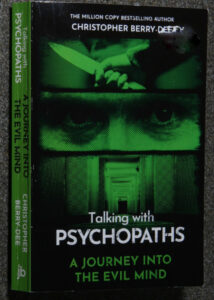 So when I saw Talking with Psychopaths: A Journey into the Evil Mind I bought it, hoping to get a better understanding.
And indeed this book is … a road trip into the deeply disturbing and darkest recesses, the abyss of the minds of psychopaths and savages … alongside a criminologist, Christopher Berry-Dee. Berry-Dee has spent decades interviewing and corresponding with some of the most notorious psychopaths of our time, and written a string of books on the topic. He agrees that it’s a bizarre, scarcely credible world where elephants fly, lead balls bounce and fairies reign supreme.
So what does he reveal about psychopathology?
There are specific psychological assessment tools which can determine whether someone is a psychopath or not. Although it’s important to bear in mind that not all psychopaths go on to commit terrible crimes – many indeed become quite successful in life because of their glibness and charm and willingness to ride roughshod over the people in their way.
Berry-Dee includes these characteristics as diagnostic:
over-inflated egos and exaggerated feelings of self-importance
narcissistic, pumped full of self-esteem
excessively dependent on admiration from others
cold, remote, indifferent to the plight of others, hostile even
cunning, manipulative
pathological liar
no conscience
(Relevant to last week’s post, he says Narcissistic Personality Disorder is inextricably linked to psychopathy.)
Because a psychopath is defined by clinical concepts it could be argued that he/she is suffering from a condition that is beyond his overall control. The savage has no such excuse.
It is only those who combine brutal violence with an animalistic disregard for any rules of human behaviour who can be called savages.
The author writes about both together, and the catalogue of murderers he includes seems to warrant this link: Oscar Pistorius (paralympian who shot his girlfriend), Harold Shipman (family doctor who killed at least 215 patients), Kenneth Alessio Bianchi (aka the Hillside Strangler, who kidnapped, raped, tortured, and murdered 10 girls and young women), Peter Sutcliffe (aka the Yorkshire Ripper, who murdered 13 women) to name but four well known to us.
The accounts highlight the ability of these dangerous criminals to manipulate and hoodwink and cleverly manipulate people and events to serve their own ends, often evading detection or capture for years. And it’s utterly chilling to see this cleverness sometimes resulting in release from custody, only for the monster to kill again. In one case indeed, Arthur Shawcross – reckoned amongst correctional officers to be a highly dangerous and formidable killing machine – was nevertheless released 10 years before his full 25-year-tariff had been served, only to go on and murder at least nine other women in the space of 21 months. Kenneth McDuff killed again just three days after his release following 23 years in jail for sadistically murdering three teenagers.
One conclusion that I found seriously disturbing is that experts in the field often disagree on fundamental points, and yet their assessments are used to inform decisions about just what should be done with these highly dangerous psychopaths. Indeed, both psychiatry and criminology seem to be very imprecise sciences. For every theory posited, someone else knocks it down. The author of this book demolishes many a case made by his professional colleagues. So, though the theories offered seem plausible, for me the jury remain out on many points. I’m simply not in a position to discern for myself.
It must change a normal person to spend long hours over many years with such depraved men, and that might well explain the tone and language of this book. But I personally found it distasteful to have the author blowing his own trumpet quite so often, repeatedly promoting his own books. And the rather unprofessional sarcasm, flippancy, colourful derogatory language, or snide slights in places.
But as he says himself: entering into the mind of a fully emerged psychopath – it’s not a good place to be. And when all’s said and done, it can’t be easy knowing that one can use all of the psychopath tests ever invented but one cannot spot a psychopath until – most especially in the cases of homicidal psychopaths – it is far too late. That awareness, coupled with all the horrific cases that hit the headlines after the event, must leave their mark. It’s not a world I would want to frequent. I was relieved to close this book and shelve it.