serial killers
Psychopaths, Savages and Monsters
Last week I dipped into the world of carers who kill, and wondered what possesses someone to savagely murder those in their care for apparently base motives. It seems incomprehensible. 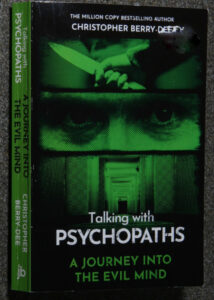 So when I saw Talking with Psychopaths: A Journey into the Evil Mind I bought it, hoping to get a better understanding.
And indeed this book is … a road trip into the deeply disturbing and darkest recesses, the abyss of the minds of psychopaths and savages … alongside a criminologist, Christopher Berry-Dee. Berry-Dee has spent decades interviewing and corresponding with some of the most notorious psychopaths of our time, and written a string of books on the topic. He agrees that it’s a bizarre, scarcely credible world where elephants fly, lead balls bounce and fairies reign supreme.
So what does he reveal about psychopathology?
There are specific psychological assessment tools which can determine whether someone is a psychopath or not. Although it’s important to bear in mind that not all psychopaths go on to commit terrible crimes – many indeed become quite successful in life because of their glibness and charm and willingness to ride roughshod over the people in their way.
Berry-Dee includes these characteristics as diagnostic:
over-inflated egos and exaggerated feelings of self-importance
narcissistic, pumped full of self-esteem
excessively dependent on admiration from others
cold, remote, indifferent to the plight of others, hostile even
cunning, manipulative
pathological liar
no conscience
(Relevant to last week’s post, he says Narcissistic Personality Disorder is inextricably linked to psychopathy.)
Because a psychopath is defined by clinical concepts it could be argued that he/she is suffering from a condition that is beyond his overall control. The savage has no such excuse.
It is only those who combine brutal violence with an animalistic disregard for any rules of human behaviour who can be called savages.
The author writes about both together, and the catalogue of murderers he includes seems to warrant this link: Oscar Pistorius (paralympian who shot his girlfriend), Harold Shipman (family doctor who killed at least 215 patients), Kenneth Alessio Bianchi (aka the Hillside Strangler, who kidnapped, raped, tortured, and murdered 10 girls and young women), Peter Sutcliffe (aka the Yorkshire Ripper, who murdered 13 women) to name but four well known to us.
The accounts highlight the ability of these dangerous criminals to manipulate and hoodwink and cleverly manipulate people and events to serve their own ends, often evading detection or capture for years. And it’s utterly chilling to see this cleverness sometimes resulting in release from custody, only for the monster to kill again. In one case indeed, Arthur Shawcross – reckoned amongst correctional officers to be a highly dangerous and formidable killing machine – was nevertheless released 10 years before his full 25-year-tariff had been served, only to go on and murder at least nine other women in the space of 21 months. Kenneth McDuff killed again just three days after his release following 23 years in jail for sadistically murdering three teenagers.

One conclusion that I found seriously disturbing is that experts in the field often disagree on fundamental points, and yet their assessments are used to inform decisions about just what should be done with these highly dangerous psychopaths. Indeed, both psychiatry and criminology seem to be very imprecise sciences. For every theory posited, someone else knocks it down. The author of this book demolishes many a case made by his professional colleagues. So, though the theories offered seem plausible, for me the jury remain out on many points. I’m simply not in a position to discern for myself.
It must change a normal person to spend long hours over many years with such depraved men, and that might well explain the tone and language of this book. But I personally found it distasteful to have the author blowing his own trumpet quite so often, repeatedly promoting his own books. And the rather unprofessional sarcasm, flippancy, colourful derogatory language, or snide slights in places.
But as he says himself: entering into the mind of a fully emerged psychopath – it’s not a good place to be. And when all’s said and done, it can’t be easy knowing that one can use all of the psychopath tests ever invented but one cannot spot a psychopath until – most especially in the cases of homicidal psychopaths – it is far too late. That awareness, coupled with all the horrific cases that hit the headlines after the event, must leave their mark. It’s not a world I would want to frequent. I was relieved to close this book and shelve it.
Talking with Serial Killers
During my decades as a researcher I spent some years carrying out profoundly draining interviews with respondents who were grappling with deeply emotional issues relating to loss and grief, so  I know a little of the personal cost to the listener of engaging with great damage and disturbance. Even so, I can only imagine the trauma of sitting opposite serial murderers who have repeatedly carried out the most sadistic and barbaric crimes against innocent victims. Christopher Berry-Dee, a world-renowned investigative journalist, has interviewed at length over 30 of the world’s most notorious killers, and recorded some of their stories in Talking with Serial Killers.
His modus operandi involves building up a relationship with a killer over many years of correspondence until they begin to trust him, researching their history, and meeting with as many people as he can who know/knew the offender. With dangerous individuals such as these, this inevitably means negotiating a path through a lot of red tape.
For each case, I take an in-depth approach, spending an enormous amount of time getting to know the unique qualities of each individual, rather than depersonalising them with generalities based on their crimes. While I develop an empathy for my subject, I always take care not actually to sympathise to the extent that their dramas start playing in the theatre of my own mind. It is a constant balancing act between identification and analysis.
His analysis evokes strong responses. It’s deeply disturbing to read of police inability to track these criminals despite a trail of numerous assaults and murders, or their failure to follow up on inconsistencies and blatant lies. The unscrupulous standards and incompetence of some officers or lawyers took my breath away. It was equally chilling to hear about young women and girls hitch-hiking and accepting lifts from strangers, of naive and vulnerable learning-disabled young people being caught in the nets of these murderers, and perhaps worst of all, to read of serial murderers being released to kill again … and again … and again.
The detail is sickening and certainly not for the faint-hearted.
One rather feels that even Stephen King could not better that scene in one of his horror novels.

Each killer has a chapter devoted to them, relating the background and relationships which were instrumental in forming their characters. Their crimes are recorded from multiple sources including their own descriptions and admissions, but particularly fascinating for me were the sections giving psychiatric, medical and forensic explanations for why these murderers performed in certain ways.
So, who were these villians, and what singles them out as exceptional amongst killers – the world’s most evil murderers as the strapline has it? A few basic details must suffice for this post.
Arthur John Shawcross took the lives of 53 human beings; Henry Lee Lucas confessed to at least 190, although it’s commonly agreed that he exaggerated the number.
John Martin Scripps travelled internationally, and with cold-blooded efficiency, killed innocent strangers using butchering techniques learned in prison to dispose of their bodies, and then went on shopping sprees using their credit cards. He was only 36 when he was executed in Singapore.

When Michael Bruce Ross was convicted after 11 brutal sexual assualts and 6 murders, all carried out before his 28th birthday, the state had to debate the relative merits of consecutive life sentences versus execution by electric chair, because the latter would involve costly repair work on the long disused chair itself, and redecoration of the witness viewing area and death house suite!
The multiplicity of errors and lies and unethical/illegal behaviours amongst the police, lawyers and legal fraternity in the case of Ronald Joseph DeFeo Jr, accused of killing 6 members of his family, makes for such confusing reading that, despite the author’s analytical reporting, I was unclear in the end just who had done what. And yet a man’s life is at stake here.

Similarly there seem to be serious flaws in the case against Daniel Clark, accused of killing a number of prostitutes more correctly attributable to his co-accused Carol Bundy. Witnesses and attorneys were bribed or coerced; statements and evidence tampered with or withheld or ‘lost’; alibis ignored. Bundy, herself totally untruthful and most certainly guilty, was given a deal to testify against Clark in return for her own life.
It was somehow particularly difficult to read the story of a woman, Aileen Carol Wuornos. Only about 2% of the USA’s felons who have been condemned to death are females. Abandoned as a baby, abused as a child, regularly beaten with a studded belt, a mother at 14, married to a man 49 years her senior, Wuornos was given to fits of uncontrollable rage. In just over a year she scattered a trail of middle-aged male corpses (at least six) across the main highways of central Florida, shooting each of them several times, leaving their naked bodies many miles away from their abandoned cars, robbing them of all their possessions. It was loyalty to her lesbian lover that made her finally confess.

Kenneth Allen McDuff didn’t just kill over 15 victims; he savaged them in unspeakable ways – savagery that turned the stomachs of even veteran police officers.
And so it goes on. Tales beyond imagining, minds depraved way beyond our comprehension. Collosal sums of money are needed to ensure these ultra-dangerous individuals are securely detained and safe from harm by themselves or other inmates. The average stay on Death Row is 11.3 years. In California alone there are up to 500 inmates awaiting execution at any one time; in Texas that figure is over 450.

A disturbing and challenging book by any standard.
Death row drama
Fast-paced … action packed … unputdownable … chilling … compelling … well crafted … the reviews give Last Witness by Jillianne Hoffman plenty of hype.
 Plus, the author has impeccable credentials for writing a book about criminal trials and police investigations. She was herself an Assistant State Attorney between 1991 and 1996, and a Legal Advisor for the Florida Department of Law Enforcement until 2001, so she knows what she’s talking about. I set out with high hopes. But as I read, a little voice niggled. Is she perhaps rather too anxious to ensure the reader knows how everything works, what everything means. I was personally criticised for letting my academic background show through the mesh early on in my metamorphosis into novelist, so it’s something I’m specially attuned to.
Having said that, the book is centred on a fascinating premise: just how far should a person go to ensure justice is done? Is it ever justifiable to lie in the interests of the greater good, to protect innocent people? My kind of ethical challenges, huh? And Hoffman creates enough bad apples to make one suspicious of everyone in this story! She also challenges the reader to ask, What would I have done in these circumstances? Could I live with a guilty conscience? OK, I’m listening.
A summary of the story:
Three years ago a serial rapist, William Bantling, was sent to death row by Florida’s Assistant State Attorney, CJ Townsend, for the torture and murder of eleven young woman.
Now three policemen closely involved in Bantling’s conviction have been brutally murdered in ritualistic killings conveying a powerful message. No gruesome details are spared in the telling! CJ knew all three victims. She also knows the shocking secret they took to their graves. Now she is the last witness to what they all conspired in.
Someone out there knows the truth and will stop at nothing to prevent it being revealed. Will she be the next to die? Who exactly is this second monster and what motive could he possibly have for such barbarity?
As new facts emerge, serious doubts are being raised about the safety of Bantling’s conviction, enough to demand he be brought from death row to the very court that convicted him, to face again the young woman who sent him to his death. A woman he once raped, terrorised and left for dead. He’s a man with scores to settle and allies in dark places. She’s a woman haunted day and night by the past and the future.
 It’s a dark barbaric tale scraping the barrel of human depravity and psychological manipulation. Maybe it was because I read it during a ten-hour train journey, but I found it rather weighed down with technical detail which slowed the momentum of the story for someone not familiar with the American judiciary system.
In places too, I found the style of writing rather repetitive, and hampered by the density of the material. For me it needed space to breathe. But I loved the description of criminal defense attorney, Lester Franklin Barquet who ‘was old school himself, dressed to the nines in southern manners and a three-piece suit.’
It’s a thriller and part of my ongoing education in how to achieve suspense and tension, but this one doesn’t make it into my exemplar section.