child abuse
“No One Can Hurt Him Anymore” …
“No One Can Hurt Him Anymore” …
because he’s dead.
At the tender age of 10.
At the hands of someone who should have cared for him.
Under the eyes of officials and authorities charged with protecting him.
In spite of innumerable warnings and reports of cruelty, and clear evidence of abuse.
His name was Andrew J Schwarz aka A.J. He lived in Florida from April 1983 to May 1993.
This was a lad let down on all sides. His short life was one filled with harsh treatment, rejection, degradation, deprivation, at the hands of both his birth mother, Ilene, (and her paramours), and his stepmother, Jessica.
His whole life was a living hell.
A.J.’s story makes harrowing reading and generates a powerful feeling of bewilderment and incomprehension that so many red flags could be ignored or buried. And it’s right that those failures should be exposed in this full account of his life and death. But it’s a hauntingly difficult tale to stay with, especially during the trial where witnesses for the defence blatantly lie, and where protection officials demonstrate horrifying negligence and incompetence. No wonder grown men, professionals with yards of experience, wept. And no wonder the chief prosecutor, Scott Cupp, who co-wrote the book with author Carol J Rothgeb, said Jessica Schwarz was the personification of evil.
 I added this book to my reading list when I was researching parents who deliberately harm their children for my own creative writing pre-pandemic (Killing Me Gently), but have only just ordered a copy and read it. No one would have believed me if I had told this tale.
And indeed publishers were reluctant to take on “No One Can Hurt Him Anymore”. Child abuse – especially on this scale –
is just too painful a subject. Yes, it is. It’s the kind of pain that creeps into your dreams. It’s the kind of pain that makes you weak.
A.J.’s story illustrates the danger of putting undue emphasis on blood/family relationship and the rights of parents/families. Cupp pleads eloquently for more emphasis on the best interests of the child. His hope in writing this book is that A.J.’s tragic and senseless death will help to renew the debate on how to manage cases of child abuse. And in drawing attention to it here I both echo that hope and cry out for some glimmer of justice for that vulnerable little soul.
Sickened and sickening
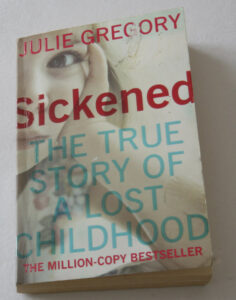
Sickened: The True Story of a Lost Childhood is one of those books that shocks you to the core but is at the same time compelling reading. How can it be that a young and vulnerable child presents to so many professionals and yet behind the scenes endures such appalling misery? And this story is real not fiction.
Julie Gregory was in thrall to her disturbed mother, Sandy. She spent her entire childhood being investigated for symptoms of ill health because Sandy insisted she should do so. Many of the tests were invasive and traumatising. Her mother took her from doctor to doctor looking for ever more serious diagnoses; she even took steps to induce symptoms. And before each professional Julie obeyed Sandy’s instructions, playing her part of the ailing daughter to perfection.
In addition, life at home was chaotic and damaging, with both her parents physically violent, and her mother repeatedly blackmailing the family with claims that she was about to take her own life.
It was only when Julie was 26, had left home, and was attending psychology classes, that she finally understood that her mother had fabricated her illnesses and even induced some of them. She had her own methods of compelling Julie to lie to doctors to substantiate her claims of alarming symptoms. When she was thirteen, Julie did once blurt out to a nurse that her mother had made her ill that time, but she was not believed and they ‘sedated the truth’ out of her. She buried much of what happened deep in her subconsciousness and it took years of therapy and painful work on her part to address the reality and deal with the trauma.
Curiously, for a long time after she’d left home she retained a visceral need to stay in touch with her mother.
I am a half-formed larva without her … I speak to her as if nothing has happened, as if everything is fine. I still try to extract love from her. I still take her suicide calls in the middle of the night and try to talk her out of the gun or the overdose from two thousand miles away. I am the only one who can save her. I could not live with myself if my mother died because I refused to do what she trained me so well for.
She kept quiet. But when she eventually felt able to visit Sandy face to face and saw history repeating itself with an under-nourished 11-year-old relative of her current boyfriend she knew she must act to save this girl succumbing to her mother’s manipulations; from becoming yet another victim of Munchausen’s by Proxy (now known as Fabricated or Induced Illness).
 It’s seven years now since I published my novel on this issue (Killing me Gently) but this real life account of the devastating impact of this condition (Sickened) resurrected some of the emotions I felt trying to get inside the skin of someone who could do such horrific things to an innocent child. Sickened. No wonder it’s been described as one of the world’s most hidden and dangerous forms of child abuse.
A brave and disturbing book.
The darkest side of life
Hello, my name is Shy Keenan, I was born and broken in Birkenhead, and was abused from infancy by a network of every kind of pervert … I entered the world unwanted and was beaten, sold, swapped, photographed, filmed, left for dead, betrayed, ignored and booted into adulthood; at which point I was branded the problem and left completely on my own.
 This book, Broken, has to be one of the most difficult reads I’ve ever encountered. To learn about horrific and ongoing sexual exploitation of young children through the eyes of one not old enough to have the vocabulary to describe her ordeals, wrenches something deep inside from its sockets, and gives it a painful twist for good measure. Then to find she is repeatedly and catastrophically let down by the authorities stirs something primitive and dark.
Trouble began for Karen/Shy long before she was even conceived. Her immature birth parents were so badly behaved and out of control that they were both sent away to a special mixed boarding school for maladjusted children in Sussex –- where they met. Theirs was a volatile relationship essentially bonded by their common love of stealing. After a shotgun wedding and just 14 months after her first child (by a different boy) was born and then taken away from her, Jennifer, gave birth to Karen/Shy, in 1963. Their life of crime continued unabated and the baby was frequently left alone in the squalid flat. It was there that her aunt found her: a red-raw and emaciated baby in a rancid cot.
Despite numerous attempts to shore up this dysfunctional and chaotic family, the marriage failed and her future stepfather, Stanley Claridge, came on the scene, 17 years older than Jennifer, the product of a depraved childhood in care, emerging as a drunken, violent and abusive adult. And extremely keen to become a ‘daddy’ to Jennifer’s young girls.
The sexual abuse, not only by Stanley, but also by other men, started when Karen was about three years of age, and her sister Denise a year younger, made the more appalling by extreme physical abuse from both adults. Frequent severe beatings rendered Karen partially deaf and with poor eyesight before she even went to school. But – and this is an incredible aspect of this extraordinary story – somehow Stanley managed to persuade the authorities it was Karen who was the problem; a recurring theme.
 Efforts were made to ‘treat’ her so-called promiscuity but she rebelled against the injustices and eventually, at the age of 9, she was sent to stay with Nanny and Grandpa Wallbridge (he was a retired Quaker reverend minister) in order to cure the precocious sexual proclivities Stanley alleged she had. Under their strict but fair rules her true personality emerged, trust blossomed, and at last someone believed in her innocence. It was an idyllic time in her life.
Sadly though, the reprieve was all too short, and after almost a year her mother, though she thoroughly disliked her eldest daughter, managed to manipulate the situation to get Karen back in the family home in order to claim extra benefits. The perverted behaviour began all over again. By the time she was 14 she had suffered three miscarriages and been in intensive care with a venereal disease.
It seems absurd to think that no one would question why an 11-year-old should have an STD, but no one seemed unduly concerned.
Then Stanley somehow contrived to get her sent to a psychiatric ward where she was started on powerful sedative drugs, which in turn then gave him more control of her. He began to arrange for men to come to the house to rape her; he took her to the docks where she was filmed with multiple strangers doing all sorts of sickening things to her, and the pictures sold on the black market. When the situation began to slip out of his control again, he contrived to get her taken back into psychiatric care on a trumped up charge.
 There followed a series of spells in assorted care homes, but far from helping her, they were the scenes for further abuse, both physical and sexual. Having been labelled by Social Services as a sexual tease, assumptions were made each time she reported abuse, and she was never believed – not even when Stanley admitted to his crimes in his letters to her. The distraught child repeatedly ran away seeking refuge from the horrific abuse and organisational failures. And one place ended up becoming her true haven: the stream where Grandpa Wallbridge had once taught her to wash away her troubles.
When Shy’s mother became disabled by a stroke, Stanley soon became disillusioned with caring for her and helped her to die. Shy grieved sorely in spite of her mother hating her. all her life. Then her sister Denise turned against her. Bereaved and feeling totally alone, Shy fled to London and, entirely without means or shelter, began a life of crime, sleeping on the streets. Initially she simply stole to survive, but gradually her personal moral code was eroded and she became both ‘greedy’ and ‘arrogant’. Forging signatures bought her untold wealth and for a time she became a social chameleon, hobnobbing with the uber-rich, living a life of luxury. No one knew her real name, age, or history; she had effectively reinvented herself. The high life lasted several months before she was caught, identified as a juvenile, and returned to care.
Throughout her childhood, every time she tried to tell her story, her Social Services report was raked up to turn the blame onto her: she was an attention seeking, sexually promiscuous liar with now a long history of criminal behaviour. Having escaped from a padded cell in a care home, at her lowest ebb yet, with nowhere to go, desperate and alone, she found herself on top of a 15-storey block of flats, ready to end it all. It was a turning point. When she was talked down by a scared young police officer, she mentally said goodbye to the old Karen and consciously turned her face towards a better way of life.
But the authorities hadn’t finished with her yet. She was charged for all her stealing offences in London, remanded in a Liverpool prison, before being sent to Holloway in London. At her trial, she was sentenced to up to two years at a different prison in Essex – a hell all of its own.
In spite of her good intentions, her life was simply a struggle to survive. At the age of 17, in desperation, she married a man she hardly knew, and moved to Germany with him. But after a year she was back in London on her own.
I was like another person, trapped inside the shattered remains of an old human being, trying to make all the broken parts work and survive day to day. I was like a human ghost ship drifting on a wild and treacherous sea, with the hull ripped away and nothing left inside of it.
 After a lifetime of being betrayed and abused and let down, it was very hard for her to learn to trust anyone. So, she did what she could to start again: she hid her identity, and began living a law-abiding life, avoiding any contact with the authorities. But the years of being drugged and sexually attacked took their toll; something snapped and she sank into a very deep depression. From absolute rock bottom, she took life one tiny step at a time through her twenties and early thirties gradually finding enjoyment through music and her motorbike, with help from MIND (the mental health charity), all the time protecting her identity fiercely.
As the years passed she eventually, little by little, came out the other side and became a new, happier, grounded person, going on to be a wife, a mother, a songwriter, and a fierce advocate for abused victims.
But there remained the matter of Stanley – now in his 70s and still abusing children, some of them still in nappies. Incredibly, though armed with incontrovertible evidence, when Shy contacted every agency and organisation she could, from care homes through to the House of Lords, no one responded to her plea for something to be done to stop this monster and his gang of paedophiles. So, as a last resort, she sought support from a victim support charity, One in Four, who helped her contact the media. It came at a heavy price. Going public meant she could kiss goodbye to her musical ambitions, but she simply could not abandon those innocent children.
The prestigious BBC programme Newsnight took up the story; so moved were the team that an unprecedented 60-minute special was created. It was the catalyst for finally, finally getting action for the child victims of sexual abuse.
It was not until 2002 that Shy finally had her day in court at the trial of the paedophiles who had made her own childhood so broken and frightening. And it was there that she found that at last she was believed.
With the massive support her case generated and the awards the story attracted, she changed her plans entirely. She put all she had learned towards forging a new career, launching Phoenixsurvivors.com to stop paedophiles and help their victims. She qualified as a private investigator and studied criminal psychology, building a team of dedicated child protection advocates backed up by a support network. Together with Sara Payne, mother of murdered Sarah, she established the first ever centre of excellence in this field and the first ever Phoenix victim support retreat. And she became something of a celebrity.
But sadly her success as the CEO of a flourishing organisation was not the happy ending we might wish for this traumatised woman. Still more tragedy followed. Her 14 year old son took his own life. Then, during the pandemic, she had three bleeds on her brain and had to fight her way back to some level of independence. Just how much horror can one person bear? And yet she can still say:
I am a Phoenix, rising from the ashes of a broken life, an ongoing survival in progress.
When children vanish …
It’s hard to imagine anything more devastating than a child being abducted, not knowing where they are, if they are even alive. Didn’t we all shudder in our beds when Madeleine McCann vanished while on holiday in Portugal back in 2007? Imagining … Fearing … Would you ever stop searching every face, every place?
But … imagine finding out that your kidnapped child has been systematically abused, tortured, degraded … Doesn’t bear thinking about, does it? I could only approach this topic from the safe distance of a writer’s analytical perspective. I’m pretty sure I wouldn’t have the courage to let myself creep inside the head of such a parent in order to write from their point of view, so I’m intrigued by authors who do dare such a thing.
SB Caves is one such.
 In his debut publication, I know Where She Is, Francine Cooper’s daughter Autumn has been missing for ten years. Francine has been bombarded with crank calls and cruel bogus contacts, and has eventually moved house to escape, putting herself beyond the reach of all except her ex-husband and work colleagues. Or so she hoped. Then, out of the blue, she gets an anonymous note containing just five words ‘scrawled in jagged chicken scratch’: I KNOW WHERE SHE IS. She’s ready to dismiss it as yet another cruel hoax by a twisted mind, a sick creep who gets a thrill out of torturing vulnerable people. But then a young girl appears, encrusted in dirt, stinking, claiming to have sent it, and knowing things that only Autumn would know – a favourite lullaby, family names, a photo.
If you thought entering the world of Francine’s grief would be harrowing, you might well baulk at the prospect of hearing the full horror of what this ragamuffin child has to tell her. Behind the expansive opulence of wildly expensive mansions and gated communities and celebrity adulation, the truth is laden with such depths of human depravity it’s nauseating to read, never mind consider possible.
Without delivering spoilers, it’s fair to say this shocking tale falls somewhere between the reality of Jimmy Savile‘s reign of terror and the dystopian horrors of the Republic of Gilead in The Handmaid’s Tale. And the ending leaves so many questions unanswered. Definitely not a book for the faint-hearted or insomniacs. And not a scenario I’ll be including in any of my own books, I’m quite sure of that.
To act or not to act
Remember last week I mentioned the cases of child abuse or mistreatment that go to court? That got me thinking.
I’ve been creeping uncomfortably close to this area in my current novel, Killing me Gently – the delicate relationship being built up in the early weeks and months following the birth of a new baby and mysterious things happening which perplex the professionals responsible for ensuring everyone’s safety. We know that some children can be very difficult to love; some appear to reject overtures of maternal affection; some parents struggle to bond with their child for assorted reasons; some parents actually harm and even kill their children. Cruelty and rejection can come in many guises (as I’ve had brought home to me recently in the experiences foster carer Cathy Glass recounts), but so sensitive and nuanced is this whole topic that primary care teams and social services can be unsure of how best to support such families, when to intervene, when indeed to remove the child from the biological family.
 Perhaps it was this preoccupation in my writing life that reminded me of a recent news report that I filed away for reference purposes. At the beginning of August a serious case review found that professionals had missed a series of opportunities to save the life of a little girl, Elsie Scully-Hicks, in Cardiff. Pause for a moment and just look at that gorgeous little smiling face … And then take in the fact that this precious life was snuffed out before she even saw her second birthday.
Elsie had been placed with fitness instructor, Matthew Scully-Hicks, and his husband, Craig, at the age of 10 months, and following due process, formally adopted by them just two weeks before her death aged 18 months. The couple were described as well educated and articulate, and highly regarded by each of the involved agencies as good positive parents. They’d already successfully adopted an older child. Indeed, such was their standing that a catalogue of significant bruises and fractures were dismissed as normal childhood accidents (as Elsie’s adopted father alleged). There was indeed a conspicuous lack of professional curiosity about each of her many injuries.
In reality the stay-at-home dad was struggling with her care – he described her as ‘Satan in a babygro’. And when she was just 18 months old, he shook her so violently before throwing her to the floor, that he killed her. Last year he was jailed for life after being convicted of murder at Cardiff Crown Court.
The agencies concerned have promised to learn lessons from this review, but of course, nothing can bring little Elsie back. No one involved in this case will ever forget her. I rather suspect some professionals will never forgive themselves. I shudder to think what it’s like to live with these weighty responsibilities; just getting inside the skin of health visitors and social workers grappling with such judgements in my fictional world is more than enough for me – and I know the outcome! Pause for a moment and think of all those courageous people engaged in making these momentous decisions every day. And living with the consequences. I salute them.
Understanding alternative lives
In my former life as a university researcher, I had the amazing privilege of delving deep into the lives of people grappling with major problems and dilemmas related to their medical care, understanding their responses, exploring their opinions. I sat for hours and hours (the record being five and a quarter at one sitting!) with parents who had faced the terrible ordeal of losing beloved babies. I spent days in a hospice devoted to the care of patients with full blown AIDS at the height of the HIV crisis, watching helplessly as young men wasted away and died agonising deaths. I’ve sat in wards and clinics variously with infertile couples, prostitutes, terrified new mothers. Not only has my life been enriched by all these encounters, but I like to hope I’ve become more insightful and empathetic as a result.
And I’ve taken that same kind of philosophy into my current work. With each new novel my eyes, ears and antennae are tuned to anything that will give me deeper awareness and understanding. Along the way I’ve met and listened to the experience and opinions and inner thinking of organ donors and recipients; people who’ve changed gender; families traumatised by illness, death and dementia; patients themselves suffering slow degenerative illnesses; campaigners struggling to achieve justice and equality for the disadvantaged and neglected. Humbling and revealing.

At the moment I’m trying to get inside the skin of families and individuals who struggle behind closed doors, where relationships are fraught. A surprisingly large number of books on my shelves take me inside those facades, and three in particular have made painful reading recently, opening my eyes to the horrors some children endure and sometimes transcend.
 The Little Prisoner by Jane Elliott reveals the seventeen years of horrific abuse one girl suffered at the hands of her depraved stepfather. She spent her entire childhood in fear and dread, controlled by threat and violence. Even when she did eventually find the courage to report him, even when he was locked up, he still managed to wreak fearful retribution on her via his relatives. Writing about her life, she was obliged to use pseudonyms to avoid worse. And her mother – her biological MOTHER! – was complicit in all this.
 Behind Closed Doors by Jenny Tomlin tells the story of a young girl who also endured appalling abuse – physical, emotional and sexual – at the hands of her sadistic and depraved father. Again, a significant family member in a position of trust. Again the biological mother knew and turned a blind eye. In Jenny’s case the child grew up in a filthy flat forced to witness her mother being beaten and raped on a daily basis, her young sisters being sexually abused, her whole family being humiliated and ostracised. And yet a strong resilient woman emerged from this chaos, determined to foster love and trust and decency in her own children (one of whom is the singer actress Martine McCutcheon).
 I Choose to Live (mentioned last week) is an amazingly frank account of Belgian Sabine Dardenne’s life during her kidnap ordeal. Her abuser was not a parent, he was a stranger, but she endured the agonies of feeling she had been abandoned by her family, and her relationships afterwards were significantly altered by the experiences, distortions and reactions everyone suffered.
To an extent we’ve all been exposed to the fact of child abuse. Most recently, simply hearing about the case of little Poppi Worthington, almost certainly sexually abused to death at the tender age of 13 months by her father, made the blood run cold. Evil of such magnitude, masquerading in an everyday disguise, is as hard to comprehend as that which leads dictators to massacre thousands in acts of ethnic cleansing. The images haunt our screens and thoughts – especially where the authorities can’t or don’t exact any form of justice. The chilling reality of these intimate tragedies is captured in these three books, revealed bravely by three women who endured such relentless nightmares. I felt hugely sad and sobered, despairing at times, simply listening to them.
‘Bullies can only operate when other people are too frightened, ashamed or embarrassed to talk about what is being done to them.‘ Jane Elliott
Evil is unspectacular and always human, and shares our bed and eats at our table. WH Auden
Will I have the courage and fortitude to see my own current novel to its end? Not that the subject matter is anything like as horrific as that described in these books, but any child suffering has the capacity to cut to the heart. Time will tell.
Children in trouble
Eh dear, why did I decide to write about pathological parenting? It’s causing me a fair few troubled nights, I can tell you. I’m currently trying to get inside the skin of children … parents … professionals … involved in these disturbing situations. And boy, is it harrowing!i There’s a heavy cloud hanging over me just reading about these traumatic experiences.
With all this in mind I was instantly drawn to three novels by Susan Lewis which I discovered in a charity shop quite by chance on my way to a hospital appointment. I zipped through the first two chapters while I waited to be called.

I’ve always marvelled at the ability of social workers to bear the burden of troubled families where parents may not be the best people to look after their offspring. Deciding when that line is crossed, taking them away … dealing with criticism whichever way they go, threats, physical harm … I’m not made of that kind of courage and stamina, that’s for sure.  So it was profoundly disturbing to walk alongside overworked and under-appreciated Alex Lake as she lurches from problem family to problem family in No Child of Mine.
Alex is a social worker, passionate about protecting children from those who mean them harm. In No Child of Mine, there’s a veritable A-Z of toxic situations: abandonment, alcoholism, broken relationships, desertion, drug addiction, Fabricated or Induced Illness by Carers, mental illness, murder, paedophilia, physical abuse, sexual violation …! Yoiks! How do social workers ever manage to switch off? How do they preserve professional barriers? If they don’t care, are they in the right job? If they do care, what price do they pay for emotional connection? How do they cope with being principal scapegoats for the press and public? If, on top of that, they carry the additional burden of an horrific history of their own, as Alex does, what then?
Challenging tales to say the least. Taut, sinister, intense. I wanted to wrap Alex herself up in a comfort blanket and smuggle her away to a safe place, never mind the children! Small wonder that Susan Lewis found this one of the hardest stories to tell (… caution there for me!). And we’re left wondering if the fragile solution at the end can possibly hold. Which is why the author chose to continue the story in a sequel: Don’t Let Me Go.  Since both books are a door-stopping 580+ pages long, I guess it’s lucky for us she split the story into two parts!
By now Alex has reinvented herself as Charlotte Nicholls and moved to the other side of the world. Life in New Zealand in a new family helps to heal deep wounds, but then suddenly, dramatically, her entire world is blown apart. Do pure motives ever excuse illegal actions? Should a vulnerable child become a victim all over again just to ensure the paperwork is all shipshape? What price is too high in the search for justice? I was on tenterhooks to find out the fate of a terrified and traumatised four-year-old. How would she react to being ripped from the heart of a family who loved her so deeply? And handed to a series of strangers, strangers who held none of the keys to the doors that protected her from her own private hell? And how would the law deal with a professional who had knowingly flouted its diktats? I’m relieved that we got to hear how the situation was resolved, although it’s sobering to realise that neither Chloe/Ottilie nor Charlotte/Alex can ever erase the traumas of their early lives.
I might well quibble about some dubious elements of this story – there are issues with time frames and professional boundaries – but such is the compelling nature of the storyline that I found myself well able to suspend disbelief in order to focus on the underlying messages. And as a result I have even more respect for the brave souls who spend their lives working for the good of these vulnerable children, too often unseen and unsung – like our emergency services dealing with this terrible spate of atrocities and tragedies. And for authors like Susan Lewis who help us to understand in our hearts as well as our brains.

NB. The third book, Stolen, didn’t resonate in the same way and I found the story line too far fetched to be plausible. But since the subject matter is less relevant to my own character development or research, nothing lost there.
Autobiography of abuse
It’s not often I review an autobiography on this blog but I’ve just finished reading one which forms part of my research for novel number 11 (working title Killing me Gently).
Since Altar Boy was published in 2003 the world has moved on, we know so much more now about child abuse, cover-ups, and human psychology. Who hasn’t heard of Jimmy Savile’s crimes now? Or the widespread abuse of children at the hands of priests, foster parents, sportsmen, politicians, celebrities? Indeed major inquiries are currently ongoing into these issues and regularly crop up in the news; police forces are stretched beyond capacity dealing with cases of sexual abuse alone. But I found it useful to nudge a little closer to the mind and heart of a child at the centre of such activities, a child subjected to the unwelcome attentions of a trusted or revered adult.
 Altar Boy tells the story of Andrew Madden, an Irish lad whose burning ambition is to become a priest in the Roman Catholic Church. As an altar boy he has behind-the-scenes access to the life of a religious, and he’s thrilled when his favourite priest, Father Ivan Payne, takes a particular interest in him, singling him out for special responsibilities and privileges. But, when Andrew is 11/12 years old (his uncertainty), that support turns into sexual abuse, molestations occurring weekly and continuing over a period of three years.
For those who have never suffered in this way, it’s hard to understand why Andrew tolerated the situation for so long. Why didn’t he simply stay out of harm’s way? How could he continue to idolise his abuser? Why didn’t he tell someone? His explanation is at once disturbing and sad:
Unless you have been abused it may seem odd that I could not stop Father Payne for three years, but I just couldn’t. True, he was never violent and never threatened me but control comes in many forms. I was an altar boy and in my little world the Church was everything. Priests were the most important, respected and powerful people I knew. I was also sexually naive and totally innocent. All I could understand, especially in the early stages, was that what was going on was wrong and that despite myself I was in the middle of it. It took until I was almost doing my Inter before I could eventually get away.
And for most of those three years I spent a lot of time telling myself that nothing was really going on. Even on those Saturday afternoons I just concentrated on the television. I was so determined to keep the abuse from myself that there was no way I would have been capable of telling anyone else.
Being a paedophile, Father Payne would have known that. He would have known that my silence was not based on consent but on fear and shame. He would have known that I couldn’t tell anyone what he was doing. I wasn’t a child he’d abducted from the playground; I was part of his world. He gave me lifts in his car. He visited my home and had tea with my mother. He had me serving him on the altar as he said Mass for my family and neighbours. He knew he was safe. That is the nature of the child abuser.
The impact of what had happened goes on and on long after Father Payne has moved elsewhere. Andrew’s long-cherished dream to join the priesthood is thwarted. He loses direction, his life spiralling out of control. He seeks consolation in drink and casual relationships. He loses the capacity to have loving sex or to trust partners. He’s wracked by self-doubt, insecurity and a sense of worthlessness that several times drives him close to suicide.
At a time when my whole personality, my emotional, intellectual and sexual self, was developing, he made me think that sexual activity and sexual abuse are one and the same thing. As an adult it has been very difficult to undo that.
It takes an enormous effort and many false starts to finally win through. Years later Andrew finally finds the courage to confide in others the extent of his hurt and betrayal, to name his abuser, to challenge the Church. He becomes the first Irish victim of child abuse at the hands of a priest to go public. The texts of several significant letters written to and by various bishops and politicians are included in the appendix.
Candid, bleak, challenging, as his story is, Andrew’s own account is a triumph of hope and humanity emerging out of tragedy. This troubled and damaged young man demonstrates that victims don’t have to remain victims.
I’ve done something about it. I’ve turned it around.
Altar Boy is no literary masterpiece. Neither is it a text on the psychology of abuse. Nor even the most insightful of autobiographies. But it did remind me that adult wisdom and knowledge and hindsight can cloud our understanding of a child’s perspective. Even perhaps doubt and diminish the horror. A useful angle for my own current writing. It’s not comfortable creeping inside the skin of a character in such circumstances, but it’s what I need to do if I’m to capture the real essence of him and write with truth and authenticity.
April Jones and other children
WARNING. Today’s blog is wall-to-wall serious stuff. If you’re feeling a bit low or weepy probably best to leave it for another day. Apologies.
I’ve been much exercised this week by the abduction of little April Jones. You too? Five years old. Still missing. Said to have been murdered. As the police say, every parent’s worst nightmare. Made more poignant by the fact that she was allowed out later than usual to play as a treat because her parents had just had a glowing report of her progress at school.
Preoccupation with this tragedy has taken my thoughts to stories that have similarly gripped my attention in the past.
Since there’s a possibility I might – repeat might – one day write a novel about the deliberate harming of children, I’ve been collecting information on the subject for years. The file includes some harrowing stories, particularly those involving miscarriages of justice.
D’you remember the high profile cases of Sally Clark, Trupti Patel, Angela Cannings; all suspected of harming their own children; all later exonerated? And the scary discoveries that discredited the forensic evidence against them given by the renowned expert witness, Professor Sir Roy Meadows? They’re certainly engraved on my memory.
Try as we may to keep an open mind and reflect on all these cases involving children in a measured and reasoned way, inevitably media coverage influences reactions. Vulnerable youngsters suffering at the hands of those who should be their principal protectors and advocates … happy children being taken away by social services … innocent parents being accused of abuse … miscarriages of justice … Stirs profound and troubling emotions, doesn’t it? And that’s from a safe distance. How do the wider families of these victims cope in such circumstances? How do they live with such knowledge, whether or not the accusations are true?
And then there’s the recent spate of cases where children have been found murdered by a parent – suffocated, stabbed, shot, burned, thrown. Beyond imagination.
But in the midst of all this stark reality in my file is a most unusual snippet relating to one of these incomprehensible crimes – something that impressed me greatly. It’s a letter that was reproduced in several newspapers a couple of months ago (in mid July), written by a grieving grandfather. This man’s son-in-law, Ceri Fuller, is believed to have driven his three children, Sam, 12, Rebecca, 8, and Charlotte, 7, to a secluded woodland 75 miles from their home, where he stabbed them to death before jumping 65ft to his own death. To date the motive remains unclear although salacious snippets of information have been offered as ammunition for speculators.
Whatever the rationale, whatever the turmoil in this man’s head, the fact remains that the mother, Ruth, and grandparents have lost three children in brutal circumstances. And yet Ruth’s father, Ron Tocknell, an artist and illustrator from Gloucestershire, has insisted there were ‘no villains, only victims‘.
He wrote an open 1,800-word letter to his local paper which is so moving and thought-provoking that I’m going to reproduce some of it here and leave it as its own testimony.
‘Perhaps some of you feel anger toward him. You know him only as the man who did this.
I know him as the man who fell in love with my daughter. I know him as the man who worked tirelessly to support the family he worshipped. I know him as the man who, together with my daughter, raised my beautiful grandchildren in an environment of love and joy and laughter …
When he had to address misbehaviour he did so with reason and never with punishment.
Perhaps we will never understand the torment in Ceri’s mind that drove him to such an act but I know that this is not an act of malice or spite. I weep for my daughter’s pain. I weep for the loss of my grandchildren and I weep for Ceri’s pain and confusion in equal measure. There are no villains in this dreadful episode.
There are only victims. He will always remain the man I am proud to have called my son-in-law …
We cannot dictate the random paths our lives take. I would ask you all to suspend judgment and find compassion for all.’
Puts a very different complexion on things, doesn’t it? And a salutary reminder that the stories that reach us are only partial pictures.
Sobering, lowering, troubling stuff. Just thinking of these children and their families makes me wonder if in reality I could bear to write a book on the subject. And if I did, if anyone would ever want to read it. Probably not.