Fabricated or Induced Illness
Sickened and sickening
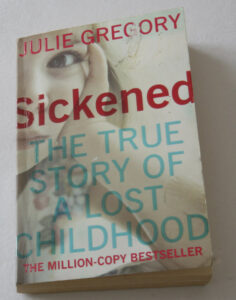
Sickened: The True Story of a Lost Childhood is one of those books that shocks you to the core but is at the same time compelling reading. How can it be that a young and vulnerable child presents to so many professionals and yet behind the scenes endures such appalling misery? And this story is real not fiction.
Julie Gregory was in thrall to her disturbed mother, Sandy. She spent her entire childhood being investigated for symptoms of ill health because Sandy insisted she should do so. Many of the tests were invasive and traumatising. Her mother took her from doctor to doctor looking for ever more serious diagnoses; she even took steps to induce symptoms. And before each professional Julie obeyed Sandy’s instructions, playing her part of the ailing daughter to perfection.
In addition, life at home was chaotic and damaging, with both her parents physically violent, and her mother repeatedly blackmailing the family with claims that she was about to take her own life.
It was only when Julie was 26, had left home, and was attending psychology classes, that she finally understood that her mother had fabricated her illnesses and even induced some of them. She had her own methods of compelling Julie to lie to doctors to substantiate her claims of alarming symptoms. When she was thirteen, Julie did once blurt out to a nurse that her mother had made her ill that time, but she was not believed and they ‘sedated the truth’ out of her. She buried much of what happened deep in her subconsciousness and it took years of therapy and painful work on her part to address the reality and deal with the trauma.
Curiously, for a long time after she’d left home she retained a visceral need to stay in touch with her mother.
I am a half-formed larva without her … I speak to her as if nothing has happened, as if everything is fine. I still try to extract love from her. I still take her suicide calls in the middle of the night and try to talk her out of the gun or the overdose from two thousand miles away. I am the only one who can save her. I could not live with myself if my mother died because I refused to do what she trained me so well for.
She kept quiet. But when she eventually felt able to visit Sandy face to face and saw history repeating itself with an under-nourished 11-year-old relative of her current boyfriend she knew she must act to save this girl succumbing to her mother’s manipulations; from becoming yet another victim of Munchausen’s by Proxy (now known as Fabricated or Induced Illness).
 It’s seven years now since I published my novel on this issue (Killing me Gently) but this real life account of the devastating impact of this condition (Sickened) resurrected some of the emotions I felt trying to get inside the skin of someone who could do such horrific things to an innocent child. Sickened. No wonder it’s been described as one of the world’s most hidden and dangerous forms of child abuse.
A brave and disturbing book.
Britain’s most prolific baby killer
Big apologies – I promised you a short post this week but shocking events have rather overtaken my good intentions. Sorry. Next time …. hopefully!
Five years ago, knowing nothing of what was actually happening in Cheshire, I sat in a restaurant in the centre of Edinburgh with a friend who was a senior neonatal consultant, discussing ways of inducing medical catastrophes in small children, for a book I was writing on Fabricated or Induced Illness aka Munchausens by proxy: Killing me Gently. We kept our voices low aware of the possible effect on anyone overhearing our plotting. Two clinicians who had spent decades caring for such tiny infants, now contemplating how to harm them – it was so impossibly improbable it was laughable. Chilling now to think the same methods Lucy Letby used appeared on our list. It makes the horror the more acute and the more horrific. How COULD she?
Lucy Letby worked in our world: the world of tiny super-vulnerable infants. Infants who are so fragile that even a syringe-full of extra fluid can kill them. These tiny scraps of humanity inspire in most of us an instinct to protect and respect and treasure, so this case cuts very deep indeed.

How could a fully trained professional nurse, murder 7 such babies and attempt to murder a further 6 – at least (other suspicious cases were unproven, and an investigation is now on-going to track her footprints through two different hospitals prior to 2015 when the known murders began at the Countess of Chester Hospital).
Though speculations have been offered, no-one yet actually knows what prompted this murderous campaign, but for decent right-minded folk this blonde 33-year-old woman seems a wholly unlikely embodiment of the kind of evil that seems to lie behind it. Indeed her friends stoutly maintain they simply won’t believe it to be true unless Letby herself tells them it is. And we shall never know why unless she eventually chooses to explain herself.
But colleagues began to have suspicions when the mortality rate suddenly shot up in their hospital. It was usually 3 deaths per annum in this unit; suddenly they had 3 in a matter of weeks, unexpected, unexplained. Statistics and mortality reviews and interdisciplinary meetings figure large in units like this, especially where collapses are sudden and inexplicable. At first it was an association, which grew into a mounting conviction, when seven medical consultants discovered one common denominator in every case: the presence of Lucy Letby. No member of any neonatal team ever expects or wants to harbour this kind of suspicion. With hindsight they came to regret not having post-mortems carried out in some of the cases, but when toxicology results revealed evidence of synthetic insulin in the bodies of two of the babies, they were forced to contemplate the unthinkable: a malevolent human hand was responsible for this spate of sudden collapses and inexplicable deaths. They raised the alarm with management.
And this is where is becomes incomprehensible to me.
This team of medical experts – senior, highly trained, experienced, authority figures with ultimate responsibility for these patients – asked for an urgent meeting. Management took 3 months to respond.
After two more deaths the consultants asked that Letby be removed from the clinical arena. Management refused. What’s more the managers even demanded the consultants write a formal message of apology to Letby for maligning her! Still no formal investigation, no referral to the police.
Not till three weeks after yet another attempted murder was Letby finally removed from clinical practice and given administrative duties.
Protecting the reputation of the organisation and staffing levels appear to have played a big factor in this whole sorry saga; we know now the cost of management’s failure to act can be measured in the lives of babies, the grief of parents, the ongoing burden carried by colleagues, the regrets. That system which allowed the murderer to continue killing is itself rightly now under close scrutiny and has been publicly condemned.
Another strange phenomenon in this case is that the babies and their parents have been granted lifelong anonymity which makes it hard for the public to understand and appreciate the full facts and circumstances of each case. Each baby has been given a letter to identify them, but this seems to put him or her at one remove from reality. We can only hope that ultimately a clear, independent and transparent review – please please please not another donkey’s years inquiry! – will allow access to and dissemination of accurate relevant facts, no matter how disturbing, in order to uphold the sacred legal principles of open justice for all concerned.
What we do already know is that Lucy Letby began her killing spree in the Countess of Chester neonatal unit in 2015. Twenty-five suspicious incidents were catalogued; she was present on every occasion. A variety of methods were used, carefully disguised to mimic natural occurrences in premature infants: air injected into veins or stomachs, insulin given, fluid overload induced. Neonatal units are busy places with lots of staff and parents around; she managed to carry out a phenomenal number of assaults in plain sight and somehow avoid detection. She was a quiet, ‘beige’, professional health care worker doing what she was trained to do, in the place where she was legitimately employed: looking after babies. Indeed, after the assaults, she comforted the parents, gave the dead babies their last bath, collected mementoes of hair, handprints, footprints, wrote condolence cards.
She was not removed from clinical practice till July 2016, and not finally arrested until 2018. Her trial began in October 2022 and lasted for ten months, culminating this week. The jury were out deliberating for 110 days considering each case separately in order to reach a verdict for each one. There has been only one death in the Countess of Chester unit in the seven years since Lucy left.
Letby herself has refused to be present in court either when the verdicts were delivered last week, or when the parents gave their impact statements and the judge passed sentence on Monday this week. It’s been castigated as the final insult, not standing up to what she has done, facing the families who have been irrevocably damaged, and to society’s condemnation of her actions as expressed through the judge.  A campaign to change the law on this right to be absent will doubtless be given extra traction because of the harrowing evidence in this particular case. But it won’t affect Letby – she will remain in prison for the rest of her life without possibility of release. A whole life tariff is reserved for the most heinous of crimes and Letby becomes only the fourth woman in British history to be handed this sentence, joining notorious criminals Myra Hindley and Rosemary West.
My heart goes out to her parents; what an unimaginable horror to live with. I weep for the parents who came within her orbit and who now live with the loss of their precious babies or the terrible damage done to those who survive with developmental problems and physical and mental deficits. I fear for those staff who worked alongside a child killer and live with the ongoing questions and doubts. The wounds go profoundly deep; some will never heal.