crime fiction
Peter May – author extraordinaire
On Friday, bestselling Scottish author Peter May died suddenly at his home in the South of France, aged just 74. He’d already decided to retire after writing his last novel: Island of the Dead, due to be published early next year, after which he’d planned a farewell tour promoting it.
Strange that I should have been thinking of him so much during the past week, but so it was. The reason? I’d been travelling through the country as far down as Somerset visiting National Trust properties and their secondhand bookshops. And amongst the collection of books I purchased were no less than three by this well-loved crime writer.
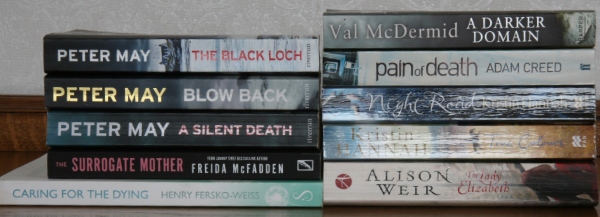
I shall now savour each one with a greater sense of respect and gratitude. His was indeed a prodigious talent.
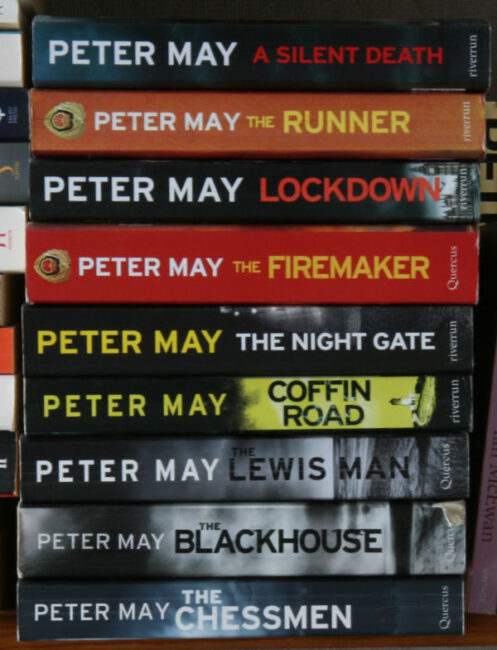 On my own bookshelves I already have nine of his works. And given the huge number of followers he attracted – over 15 million books sold – his memory will live on far and wide.
Thank you, Peter … if I May!!
Persisting against the odds
As I said last week, no reading is totally wasted on a writer. And it’s on that basis and in that spirit that I’m sharing a couple of books which I haven’t particularly enjoyed, but which taught me something, including respect for extremely talented authors who know just how to create and maintain suspense and conflict. Perhaps at this point I should come clean and admit that I’m not a fan of violence or torture in fiction, which definitely colours my reactions to certain genres of writing, but I’m also very aware that I can’t afford to be naive and stick my head in the sand.

I’ve written positively about James Patterson‘s psychological thrillers in the past, especially his series featuring Alex Cross, a psychologist and police detective – the why of it all intrigues me. So Target (Alex Cross) jumped out at me. It features the death of a female President of the USA, closely followed by the assassination of a whole raft of Senators and other politicians who are in line to take over running the country, not to mention a few other bodies who might loosely be described as collateral damage. Hmm, the advice ‘suspend disbelief ‘comes to mind!
It’s incredibly complicated plotting, simultaneously following a number of different assassins as well as assorted investigative agents and teams struggling to connect the dots and track down both the perpetrators and their masters. The deaths are gruesome, the cold detached disregard for life chilling, but I could respect the mind behind the tale, holding together so many threads, weaving in so much technical detail, and even slipping in a tug at the heartstrings when one couple become assassins to make enough money to take their dying son abroad for cutting-edge therapy. Though I found aspects of the book barely credible, I have to recognise this as story-telling at a high level of complexity and skill.

Harder to stomach though, was In Too Deep by Lee Child and Andrew Child. Lee Child’s protagonist, Jack Reacher, was known to me by name but I hadn’t made his acquaintance, so I fished In Too Deep out of a tub of discounted books in a charity shop, to fill that gap. Well, I needed all my wits about me for this one, and I still floundered at times.
The story begins with Reacher himself suffering serious injuries in a car accident – broken wrist, concussion, severe headaches and blurred vision. Not, you might suppose, in any fit state to be solving complex crimes or chasing dangerous armed criminals. The first half of the book is told with parallel stories in sections within chapters: one stream about Reacher defying the odds despite his injuries, trying to outwit a ruthless gang of crooks, some of whom remain unnamed just to further complicate identification; the other stream following the crooks trying to pull off a major heist, outwit the authorities, and threaten world peace and safety, all with backstabbing a-plenty to confuse me still further. Oh, and goodies and baddies are apt to change sides. Fries my brain! But overall, I guess its biggest value was in identifying the things I don’t like in fiction.
Hey, I persevered, and softened the experience by keeping the needles flying with the Christmas knitting as I read.
Richard Osman’s meteoric rise
OK. I give in. I’ve resisted buying his books for long enough. But Richard Osman is hitting all sorts of award lists and records these days so I might as well see what all the fuss is about. It was this kind of resigned approach I took to JK Rowling back in the pre-Harry-Potter-worldwide-crazy days … and look what happened there!
From what I’ve read and seen about Osman’s debut series, it has shades of Alexander McCall Smith‘s gentle humour. Poking fun at life’s idiosyncrasies without malice, but revealing a keen understanding of the human psyche and behaviour. It follows a group of elderly amateur sleuths in a sleepy retirement village in rural Kent who form a club to investigate unsolved murders.
 In his first novel, The Thursday Murder Club, a rich but unscrupulous local builder cum property developer, Tony Curran, is actually bludgeoned to death in his own vast kitchen in real time on their doorstep. A photograph of three men is left on the work surface nearby. The intrepid TTMC gang use every wile known to them, and a few new ones too, to infiltrate the police squad dealing with this crime. And then someone else is killed with an injection of fentanyl in full view of many people – including TTMC – during a sit-down protest against the digging up of graves in which nuns are buried in The Garden of Eternal Rest. This time the victim is someone no one likes – Ian Ventham – a unscrupulous avaricious man bent on owning the land on which the graves are situated.
Much as he rather begrudgingly likes them, the elderly sleuths stretch the patience of Inspector Chris Hudson when they keep quiet about the discovery of a skeleton buried illegally in the nuns’ cemetery; and again when they send bones away for forensic analysis. They take risks, interview people they suspect, gain information by nefarious means. All under the guise of naive innocence and old age.
Though the intrepid quartet have an air of elderly eccentricity, even scattiness, in reality they represent a combined force to be reckoned with and seem to find an answer to everything. Somehow they manage to get information often before the professionals are asking the questions. But they are essentially engaging and friendly and beautifully hospitable and friendly. One can’t help but root for them.
One example from the brightest spark in the gang, Elizabeth, a former MI5 agent, gives a flavour:
‘You don’t know who dug up the body and you won’t hear the answer from any of us,’ continues Elizabeth. ‘You don’t know who took the bones away for analysis and you won’t hear that from us either. At the end of the evening you might try and explain to the CPS that four people in their seventies and eighties have failed to report digging up a body. For what reason? With what evidence, other than the inadmissible confession you’ve taken from us this evening? And with four suspects, all of whom are quite happy to go to court, smile happily and pretend to mistake the judge for their granddaughter and ask why she doesn’t visit often enough. The whole process is difficult, costly and time-consuming, and achieves nothing. No one is going to prison, no one is getting a fine, no one’s even going to be picking litter by the roadside.’
The prose is witty, charming, quirky. Pure escapism and just what I needed. And the plot unravels satisfactorily through many a twist and perfectly civilised shenanigan.
Richard Osman’s background as a comedian as well as TV presenter, is not far from the surface, and I could well imagine him chortling as he conjured up these crazy scenes and endearing characters. What I didn’t know is that he has such poor eyesight that he has to learn his scripts off by heart because it’s too difficult to read the autocue. But his stellar career belies his diagnosis and I so admire his determination and spirit launching into yet another successful career change.
Escape
Every now and then there comes a patch in life where a complete break away feels imperative. One reason after another (all legitimate and unavoidable) has prevented escape for me up till now, but this past week a snatched few days away helped to recharge the batteries.
What to take in the way of books? – well, reading has to feature in recuperation, doesn’t it? Something undemanding that might well incidentally teach me things about writing, but the real aim is to lose myself effortlessly in a fictional world. Escapist indulgence, pure and simple.
 The answer came in a special deal of three books by Harlan Coben in a local bargain store: Back Spin, Fade Away and Drop Shot, lumped together I suspect because they’re all sport-related: golf, basketball and tennis respectively. I’ve got a fair collection of (some still unread) books by this American crime writer, acquired since I read and was impressed by Tell No One. He’s easy reading, fast paced, witty, clever with his plots, entertaining without too much hard work, with a nice line in self-deprecation and sarcasm. In his acknowledgements, he ascribes all errors to those who helped him! – so a guy with a nice line in humour then; someone who doesn’t take himself too seriously. Just the kind of chap to help me de-stress.
And indeed these three novels served the purpose very nicely. Something I could just pick up and put down at will, without needing to analyse technique or remember detail. Coben has the confidence and street-cred to break plenty of writing-course rules, but somehow it all adds immediacy and appeal. The pages just kept turning; the twists just kept coming till the very end.
I’ve returned to ‘normal’ life refreshed and unwound. Not just from reading, but from wandering through intriguing mansions and fabulous gardens too (a little glimpse below). A real get-away-from-it-all break. Just what the doctor ordered.


Time to read …
‘If you don’t have time to read you don’t have the time (or tools) to write. Simple as that,’ says Stephen King.
So I felt totally vindicated taking a whole day off from writing and to lose myself in a gripping book. What a tonic! Just the inspiration I needed to help me sharpen up my own current scribblings.
It’s vintage Coben. All the trademark ingredients are there: clever dialogue, legal shenanigans, sinister happenings, flawed characters, convoluted plots, switchback thrills, a smattering of homespun psychology, and of course, a thought-provoking moral in the tale. Brilliant.
The book? Caught by Harlan Coben.

This one includes a missing teenager; discredited cops; an entrapment; vigilantes bent on revenge; scandals and sackings; broken marriages; tragic histories; conspiracies; trumped up charges and ruinous accusations. And it keeps you guessing till the very end. The usual vast cast includes a high percentage of damaged people with colourful back-stories and fascinating peccadilloes. Enough brilliance to make us lesser mortals decide to give up the unequal struggle!
And of course, Coben’s mastery of engaging dialogue and deft outlines make it a joy to read. Who else would capture the essence of characters, the feel of a moment, with such joyous economy, originality and humour?
How about this for a lawyer?
Flair Hickory, celebrity counsel for the defense … wore his customary gray suit with thick pink stripes, pink shirt, pink tie. He crossed the room in a way that might be modestly described as ‘theatrical,’ but it was more like something Liberace might have done if Liberace had the courage to be really flamboyant …
He strolled across the courtroom as though it were a catwalk in Milan …
His voice not only dripped sarcasm but seemed to have spent days marinated in it …
He took flamboyant and brought it to a whole new level. But now, on the other side of these questions, she could truly see how flamboyance could be close bedfellows with ruthlessness.
He’s only in the frame for a few pages but his larger than life presence lingers in the imagination, his peacock posturing, razor tongue, mocking innuendos and penetrating cross-questioning. We’re as much in awe of him as the cringing witness.
Or what about this for a teenager’s room?
Her room, like Ryan’s, looked as if someone had strategically placed a stick of dynamite in the drawers, blowing them open; some clothes sprawled dead on the floor, others lay wounded midway, clinging to the armoire like the fallen on a barricade before the French Revolution.
Resonates with us all, doesn’t it?
‘Uniquely portable magic,’ to quote Stephen King again. Enjoyed the more for coinciding with the advent of summer after a long hard winter – 5C to 21C almost overnight! I read half of Caught in the garden and felt doubly invigorated for that.
Metaphors and parallels and flying needles
Wow! One in the eye for the sniffy literary snobs who look down their noses at crime fiction and psychological thrillers, eh?! In the main BBC news just yesterday morning, it was reported that such novels are more popular than any other genre for the first time. Why? Apparently TV dramatic adaptations have had a major influence, but some commentators say that crime stories ‘humanise’ stressful situations, the kind of issues that trouble people in today’s perplexing and turbulent climate. They’re looking for ‘truth, justice and redemption’, and books help to provide all three. Hopefully my own current novel will contribute to this reservoir of wisdom and understanding.
The novel itself? Well, it’s positively galloping along, and I think it’s the stronger for not preoccupying every waking moment – a deliberate strategy. I’m balancing the writing with various other activities, and I want to use this blog to tell you about just one of these pursuits because it’s not only a great stress-reducer, but it’s also curiously similar to the thriller-writing process.
Almost twenty years ago I had to go to the Shetland Islands to carry out interviews with bereaved parents as part of a major research study I was undertaking. In my free time I had the amazing experience of visiting a building that housed a huge array of exquisite fair isle garments made by a group of local knitters using natural wools and dyes from the islands. Fabulous. It was like an Aladdin’s Cave to a lifelong knitter like me. I was so impressed by their work that I commissioned a couple of articles to be made to my specific requirements. They remain prized possessions, and as good as the day they were purchased.

In a moment of ambitious zeal, I also bought a couple of books of patterns and the Shetland wool to make two garments myself. One I made soon after that trip. It took me months and months to complete!

The other one I’ve just started this week; using fifteen soft colours (with glorious evocative names like bracken and sphagnum and osprey and crowberry and mauve mist), in 2ply 100% Shetland wool.
Shetland knitting is different from any other kind. You knit in a complete circle, continuously, always working from the right side, to ensure tension is perfectly even and you can check the complicated patterns as you go. This creates a tube, which you then cut up through (half way between eight stitches which form a special edge called the steek) to make the holes which allow you to add sleeves, neckbands, button borders, etc. It’s nerve wracking putting scissors to the finished work that you’ve slaved over for months, let me tell you! I had nightmares the first time, fully expecting my entire garment to unravel instantly.
So why am I telling you this? Because creating this cardigan is remarkably like the process of writing my thriller. First I needed a pattern for the finished product, carefully worked out and charted – in the case of the jacket, 70 lines long, divided into five different bands; for the novel, something like 60 sections long, divided into chapters, three different points of view.

On the outside what you see is the smooth finish, the clear pattern, logical and lovely to behold. The colours/narrative threads must complement each other, be perfectly balanced, light and shade, working harmoniously together to form a single whole entity. The finished product must be satisfying and pleasing to the senses.

But behind the scenes are the workings; all the threads must be kept taut and separate, no tangling, no confusion, no nasty knots or uneven breaks. Invisible to other people but the hallmarks of a sound piece of work.

No one else will ever know the hours and hours of painstaking work that went into the making of the final product, the anxious moments, the corrections, the endless checking. Both cardigan and book will hopefully look professional and effortless, desirable commodities.
And joy of joys I’ve been able to let my brain work on the two stories I’m currently writing while my fingers worked on the knitting. Efficient or what? The ideas and pattern for Killing me Gently are entirely my own; I’m grateful to the multi-talented Alice Starmore for the inspiration behind my Shetland cardigan.
Stocktaking
As one year ends and an unknown year opens up in front of us, it’s a good time to take stock, isn’t it? But it’s all too easy to get things out of perspective.
 Now, you (probably) and I (definitely) both know that self doubt and angst are a recognised occupational hazard for writers – well, accumulated humiliations and rejections of various kinds, and multiple petty blows to the ego, don’t exactly put one in the party spirit, do they? So it maybe won’t come as any surprise to you when I confess that I was feeling rather despondent recently about the constant struggle to achieve sales targets and get the latest book noticed.
 But then I found Melissa Benn‘s article: Survival of the fittest, in Mslexia. What a tonic. She knows personally all about the agonies of tiny queues for signings, poor reviews, miniscule audiences, patronising jibes, totally negative feedback, being ignored by the marketing department, the demise of the mid-list author, diminishment … her list is pretty exhaustive. Merely seeing these negative experiences acknowledged as commonplace takes some of the sting out of them. And her encouraging tips on how to survive were balm to my soul. As she says: ‘the most significant difference between a writer and a would-be-writer is simple bloody-minded persistence.’ Persistence? Yep, that I can do.
 I was also chastened. I haven’t actually suffered any public abuse or vitriol such as some of the authors she quotes have endured (not yet at any rate!) so I’m instantly berating myself for allowing lesser things to bring my spirits low. I have no right or cause to wallow in self pity. Shoulders back, head high, woman!
And then there was an interview with crimewriter, Ian Rankin. He’s in his early 50s, lives in Edinburgh, and has sold over 20 million books. He’s a success. He’s a rich man. Readers queue twice around the block to hear him speak or get his signature. Our paths cross occasionally but he’s in a completely different league from me. He certainly wouldn’t recognise me if we met in the street, I’m sure. However, it took him a good 14 years before ‘money became a happy factor‘ in his writing career. And behind his present fame and fortune lies private tragedy. He says he’d give all the money he has so that his second son, Kit, didn’t have the severe disability he has (Angelman Syndrome).
 This little story puts my anxieties about book-related issues into a much healthier context. Do sales figures really matter in the bigger scheme of things? Does anyone suffer because I overlooked a typo? Who benefits if I lose sleep anticipating possible criticism or a vanishing audience? I recall Alison Baverstock saying, think in terms of gaining one reader at a time and appreciate each book sold, rather than feeling crushed by grandiose expectations. By now my mental shake is having an effect.
 And then some lovely people booked me for various author appearances. Thank you, guys! Flagging morale significantly boosted. See, it doesn’t take much to reverse the trend.
Besides, it being a new year, I’ve resolved not to try not to get myself ridiculously overloaded with busyness, anyway. As Ruby Wax (who, don’t you know, holds an MA in mindfulness-based cognitive therapy from Oxford and knows a thing or two about mental health) said in an end of December interview for the Telegraph on the secret to a happy new year: ‘happiness is not a shiny 2014 diary already clogged with meetings, phone catch-ups and must-do errands‘: we’re happier when we’re calmer and taking life steadier. That’s a pretty good idea to hang onto as we launch into a new year, I reckon. Me more than most.
So here’s to 2014 … and more peace and giving and understanding and loving in the world. I hope it’s a terrific year for you: healthy, happy, productive and contented.