mystery
Research continues
In amongst all the other things punctuating life, the serious study on prayer continues quietly and unseen. It’s actually quite useful that I have mundane responsibilities keeping me out of the study for lengthy periods – gives the material I’m ingesting time to simmer and diffuse and settle.

That process has actually been helped by a friend who’s going through a very diffuclt time in his life questioning me about pain and suffering. Having to marshall my thoughts in order to give a semi-coherent response to his deep questions helps me sort out the theory from what I can accept or even believe. My own personal experience doesn’t bear out some of the most pious ideas, and I’m seriously allergic to platitudes.
Though I still have a lot of my own issues for which I can offer no satisfactory answer, I am gradually drawing up a workable framework within which to hang them. It’s a start. And I doubt very much if I will ever reach a comprehensive conclusion that covers everything. Some things may just have to be relegated to the category of ‘Mystery’ – which, when you’re considering the interface between heaven and earth, is just as it should be.
Next week I’m introducing the subject to a couple of quite different audiences and inviting their thoughts and reactions so that should help to refine my thinking too.
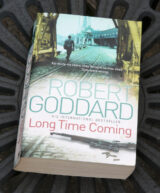
Long Time Coming
It’s bonanza time this month! I’ve been indulging in a second Robert Goddard mystery. Why? Well, I’m recovering from a fall and damaged jaw, and somehow the other two authors I tried simply didn’t have the power to deflect attention away from the pain and awkwardness of my situation.

Long Time Coming worked that magic.
As always with Goddard, it’s intricately plotted with a background of historical accuracy – this time the Irish situation and conflicts in the 1940s – plenty of false trails, deceit, betrayal and skullduggery. Throughout the novel, two different timeframes alternate: 1940 and 1976, with a flashback to 1922 and a forward projection to 2008 at the end to bookend the narrative.
We’ve poked a stick in an anthill, you and I. Stand still too long and we could get badly bitten.
Stephen Swan is a geologist working in the USA in the oil industry. When he returns to Paignton in Devon to check how his morther is coping, two years after his father’s death, he’s told his uncle Eldritch Swan is not dead as he’d always been told, but alive, just out of Portlaoise Prison in Ireland after 36 years, and currently staying in his mother’s guesthouse! His crime seems to be shrouded in mystery, but by accepting release from political internment, which implies renouncing principles which were once held dear and firm, he becomes a pariah to the men he’s served and fought alongside.
Now assorted people – an Irish journalist, a solicitor, an unknown client – are hinting at a lucrative deal if Eldritch will tell his story, but he’s adamant he will not.
Stephen is appalled to discover from his uncle that slave labour in Congolese diamond mines long before he was born had indirectly furnished his father with the unexpectedly large inheritance that had allowed him to buy the Paignton guesthouse and live in comfort. Stephen feels tainted by association with those long ago decades of oppression and exploitation, massacres and mutilations. And now his uncle is asking him to become involved in searching for proof that some famous stolen artwork painted by Picasso belongs to the daughter of Eldritch’s old boss.
I loved the description of Picasso’s work:
… nudes twisted out of shape; portraits with dismantled features; still lifes in which nothing was still; collage-like assemblies of disparate objects; colourful explosions of form and figure.
It’s then that Eldritch shares enough of his past to show Stephen an audacious and sophisticated plot/crime committed as Europe went into the war in the early 40s, that had remained undetected and was quite unrelated to the accusations that put him in prison unjustly. Only trouble is, Stephen quickly sees that he can’t actually rely on anything his uncle says.
 As the story unravels, Stephen begins to piece together the truth, and as his own position is compromised and threatened, and his emotions engaged, he discovers that there are circumstances where expedience must take precedence over justice. That Governments and diplomats and the IRA work to different rules from normal civilised society. That lives and freedoms are sometimes deemed expendable. That silence is sometimes a price worth paying. And his uncle has been, and still is, a victim of them all.
As ever Goddard’s skill as a storyteller blows my mind. Not only is he a master of language, but the way in which he keeps so many threads, all anchored by history, interwoven and overlapping, coherent and sound, is astounding. And alongside all the dark elements he even incorporates a gentle romance. When it comes to duplicity and intrigue, he is indeed in a class of his own.
Time to read …
‘If you don’t have time to read you don’t have the time (or tools) to write. Simple as that,’ says Stephen King.
So I felt totally vindicated taking a whole day off from writing and to lose myself in a gripping book. What a tonic! Just the inspiration I needed to help me sharpen up my own current scribblings.
It’s vintage Coben. All the trademark ingredients are there: clever dialogue, legal shenanigans, sinister happenings, flawed characters, convoluted plots, switchback thrills, a smattering of homespun psychology, and of course, a thought-provoking moral in the tale. Brilliant.
The book? Caught by Harlan Coben.

This one includes a missing teenager; discredited cops; an entrapment; vigilantes bent on revenge; scandals and sackings; broken marriages; tragic histories; conspiracies; trumped up charges and ruinous accusations. And it keeps you guessing till the very end. The usual vast cast includes a high percentage of damaged people with colourful back-stories and fascinating peccadilloes. Enough brilliance to make us lesser mortals decide to give up the unequal struggle!
And of course, Coben’s mastery of engaging dialogue and deft outlines make it a joy to read. Who else would capture the essence of characters, the feel of a moment, with such joyous economy, originality and humour?
How about this for a lawyer?
Flair Hickory, celebrity counsel for the defense … wore his customary gray suit with thick pink stripes, pink shirt, pink tie. He crossed the room in a way that might be modestly described as ‘theatrical,’ but it was more like something Liberace might have done if Liberace had the courage to be really flamboyant …
He strolled across the courtroom as though it were a catwalk in Milan …
His voice not only dripped sarcasm but seemed to have spent days marinated in it …
He took flamboyant and brought it to a whole new level. But now, on the other side of these questions, she could truly see how flamboyance could be close bedfellows with ruthlessness.
He’s only in the frame for a few pages but his larger than life presence lingers in the imagination, his peacock posturing, razor tongue, mocking innuendos and penetrating cross-questioning. We’re as much in awe of him as the cringing witness.
Or what about this for a teenager’s room?
Her room, like Ryan’s, looked as if someone had strategically placed a stick of dynamite in the drawers, blowing them open; some clothes sprawled dead on the floor, others lay wounded midway, clinging to the armoire like the fallen on a barricade before the French Revolution.
Resonates with us all, doesn’t it?
‘Uniquely portable magic,’ to quote Stephen King again. Enjoyed the more for coinciding with the advent of summer after a long hard winter – 5C to 21C almost overnight! I read half of Caught in the garden and felt doubly invigorated for that.