historical fiction
The Glassmaker
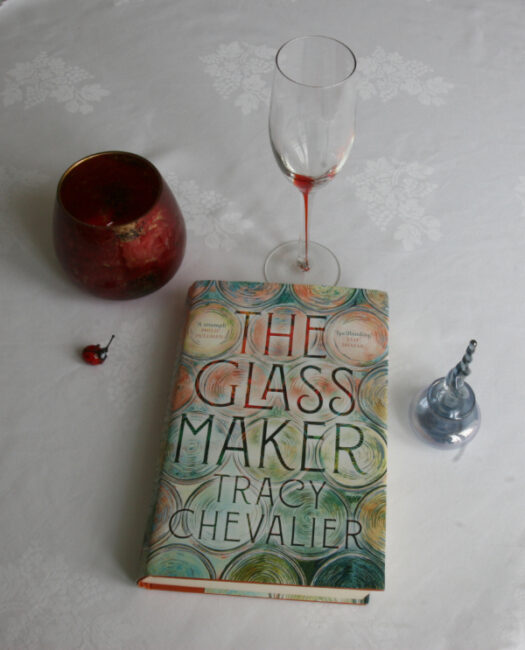 OK, cards on the table at the outset: I loved this book – The Glassmaker by Tracy Chevalier – but I also had reservations about it.
The story is set in Venice and Murano, both places I’ve visited and enjoyed, and Chevalier’s descriptions of the waterways and gondoliers and bridges and campaniles and Caffè Florian and floods and masks evoke their unique flavour beautifully and resonate strongly with me. I also love exquisite glassware (I’ve even tried my hand at glassblowing!), so I’m genuinely in awe of the skills involved, most ably captured in this book. I was predisposed, then, to romp through this tale.

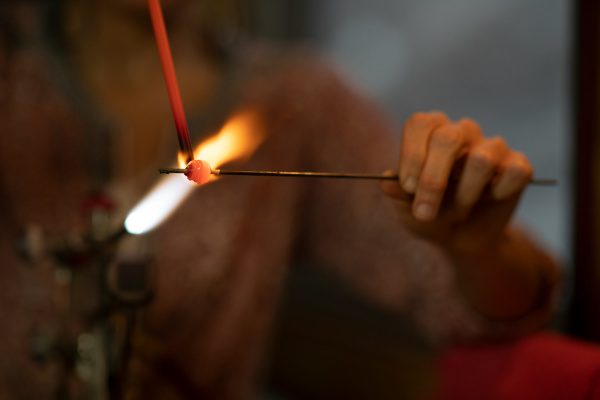
The central character is Orsola Rosso, daughter of a long line of glassmakers, who’s forbidden from entering the profession because of her gender. But she hates the endless cycle of domesticity which becomes her lot, and flouts convention by turning to the creation of glass beads under the tutelage of a famous female beadmaker, Marietta Barovier (who really existed). She may not be allowed in the main workshop alongside the men and furnaces, but she can work with her own blowtorch and bellows equipment on a kitchen table in solitary peace. She has an outlet for her pent-up creativity.
Since the death of their father in a freak accident, her oldest brother, Marco, has become maestro in the creative workshop with its male hierarchy and immensely complicated designs and generations-long reputation. The siblings have always clashed, and Marco is characteristically scornful of his sister’s bead work, but Orsola persists, knowing that her income will help everyone in the lean times when the bigger goblets and mirrors and candlesticks are not selling as they once did.
Beads fill the spaces between things. They don’t get in the way. They are inconsequential, and women can make them because of that.
 The story traces her life from 6 to 60s, a vital part of a large family all struggling to deal with the fickle world of commerce, the loves and rivalries and loyalties of domestic life, the competition and successes and failures that accompany creative art forms. She herself loses the love of her life and marries a man who can never match up to his memory; she suffers numerous miscarriages; her glass work is variously lauded and dismissed. An indomitable soul who is forced to forgo her own passions in order to practically and emotionally support her family and fit in in a culture that limits her potential.

Thus far it ticked all my boxes. But what causes me to tone down my superlatives is the structure of the book. Alongside Orsola’s story we have the history of glassmaking in Murano and Venice through the centuries, starting in 1486 (when they were the epicentre of this artform) and ending in this century (with countries like Bohemia and China taking over production). This larger picture is portrayed at the beginning of each new chapter as a flat stone skimming the surface of the water of the Venetian Lagoon between the two places. Each time it dips into the water (about every 80 years) we have a résumé of significant historical events happening in the world at that time, but the characters have aged much more slowly. So their personal stories are continuous but they are grappling with quite different problems in the bigger world – plagues, floods, wars, unifications, technology … even Covid and climate change!
I’m hugely impressed by the meticulous research behind this work, with fascinating detail relating to glassmaking and life in Italy across the centuries. The writing is a joy to read, and grips the attention effortlessly. So perhaps it’s due to my own deficiency that I felt a glitch each time that stone touched the sparkling aquamarine waters of the Venetian Lagoon and we leapt forward almost a century – a sophistication too far for the brains of simple readers like me, maybe?
But I’d still heartily recommend the book.
The Lady of the Rivers
I’m sure Philippa Gregory needs no introduction: historian and mistress of fiction securely anchored by her meticulous research. She’s perhaps best known for her novels set in Tudor times, but she has also turned her attention to the powerful family who preceded the Tudors, the Plantagenets, and I’ve been completely absorbed in one of these: The Lady of the Rivers.
 As usual the central character is a woman, Jacquetta, first lady of Luxembourg, about whom very little is known from the records which tell history through the lives of prominent men.
It’s the fifteenth century, the dangerous times of the Wars of the Roses, where rivalries between families in England and with France, are raging. Reputations, honours, lives, are won and lost upon a whim. Monarchs rise and fall, loyalties and titles fluctuate with them, and religion, spiritualism and magic play a central part in the lives of these medieval people.
From a young age Jacquetta is inspired by the family legend of their ancestor Melusina, the water goddess. She is aware herself of having mysterious other-worldly sensations and glimpses into the future, although as she says, these things are too thin for speech. Only time can demonstrate how accurate such predictions were, and throughout her life she identifies events which she foresaw in her youth. But the penalties for alchemy and witchcraft are severe, and she is at pains to downplay her gift and always to use it for good, never ill.
Knowledge is just another thing to conceal, these days.
These are brutal times and she’s only fourteen when she’s forced to stand with her aunt, calmly watching Joan of Arc being burned at the stake, a girl with whom she had established a close rapport, and who shared her experience of visions.
We stand hand-clasped, our faces quite blank, as if this were not a nightmare that tells me, as clearly as if it were written in letters of fire, what ending a girl may expect if she defies the rules of men and thinks she can make her own destiny. I am here not only to witness what happens to a heretic. I am here to witness what happens to a woman who thinks she knows more than men.
 Then at seventeen she is required to marry the very man who ordered the burning to death of the Maid, Joan: the newly widowed John, Duke of Bedford, now in his forties, Regent in France, son of Henry IV. This alliance makes Jacquetta an English duchess, the first lady after the king’s mother in England; the first lady bar none in France.
On the eve of her wedding she learns that it will be her duty to retain the friendship of all his allies who don’t support this rapid marriage, but whom he needs to fight alongside him. But it’s not until the morning after the wedding that she learns that the Duke hasn’t chosen her for any reason other than her gift of forseeing. He wants her to help him create a new rich and peaceable world; to manufacture gold and silver, even life itself. And for this purpose he is going to keep her a virgin. Their marriage lasts two years until he dies.
However, Jacquetta, deprived of love and passion, has been falling in love with her husband’s handsome right hand man, Richard Woodville, and they marry in secret less than a year after she is widowed, before she can be betrothed to someone not of her choosing. This rebellious act results in her fall from grace and the forfeiture of her wealth and property, but the couple are blissfully happy. They quickly produce their first daughter, Elizabeth, to be followed by thirteen other children.
Before long the young king forgives them and they are summoned back to court. But the trial and burning at the stake of the very woman who taught Jacquetta all she knows about herbs and provided the potion to help her conceive – a herbalist now declared a witch –strikes dread into their souls. Now everyone who has been studying the stars or reading books or testing metals is under suspicion and the Woodvilles slink back to the country and their children for safety.
But then Jacquetta is chosen to go to France to bring back the fifteen year old Margaret of Anjou to be married to the timid ultra-religious twenty-three year old king Henry VI. Jacquetta quickly becomes chief confidante and most favoured lady in waiting and true friend to the new young queen of England. It’s not an easy role. The weak king and his more dominant queen are inexperienced, spoilt and badly advised. They make serious mistakes. Both Jacquetta and Richard long to be free of all the intrigue and fear and suspicions of court, but feel protective of their young monarchs who so badly need sound advice.
They make enemies every time they address parliament. The queen rides through the streets of London as if she hates the very cobbles.
Things deteriorate still further when the king develops a mental illness that renders him incapable of making decisions or even acknowledging Margaret’s only son Edward as his heir. The people start to riot. Law and order are overturned. Again and again Richard is rewarded for loyalty, bravery and leadership, rising through the ranks of titles and prestigious commands, but the Woodvilles pay a high price for their allegiance, and in the end when the Lancasters are thoroughly routed in a fearsomely bloody battle in the snow, they surrender to a new king, Edward of York.
The book ends with the Woodvilles being reduced to the level of a country squire and his wife, but history tells us that Jacquetta rose again to become a leading lady at the royal court following the marriage of her eldest (widowed) daughter Elizabeth to King Edward IV.
It’s a brilliant novel, beautifully conceived, intriguingly told.
Historical fiction par excellence
 The year is 1785. The place is the centre of Paris. Unusually heavy spring rain causes the bank of the cemetery of les Innocents, crammed full of bodies from the plague and the years since, to give way. The neighbours are overwhelmed by the stench and the effluent washing through their cellars. It’s poisoning the very air of the city.
A young engineer from Normandy, Jean-Baptiste Baratte, is called in. The church and the burial ground must be destroyed, he is told; everything must be made sweet again, the poisonous influence of the past must be eradicated. So says no less a personage than the king! Baratte sets about amassing a rag-tag workforce and equipment to achieve this objective, and the macabre task begins. Before long the skeletons become visible … the depths of the many plots are plumbed … a steady procession of horse-drawn carts carries the disinterred bones, under velvet drapes, accompanied by chanting priests, to a newly sanctified quarry for their last resting place … the church and its precious organ are dismantled piece by piece. And gradually, almost imperceptibly, the terrible smell lifts, beautiful flowers begin to grow in the new sanitised soil. But it comes at a price.
It’s a year of
bones, grave-dirt, relentless work. Of mummified corpses and chanting priests. … A year of rape, suicide, sudden death. Of desire. Of love …
The cemetery has been at the heart of life in the area for many people. Their very breath smells of it. Some indeed perceive themselves as its guardians. So what does this clearance mean for them?
There’s pretty Emilie Monnard aka Ziguette, daughter of a prosperous shop owner, whose window overlooks the cemetery. She’s watched burials there for years. Long after the mourners have left, she’s continued to keep watch over the dead like a sister or an angel. Now the man who is to destroy all she holds dear is lodging in her family home, and she will go to any lengths to save her precious heritage.
Then there’s the sweet auburn-haired emissary of death, Jeanne, teenage granddaughter of the aged sexton, who knows the cemetery intimately, and regards herself as custodian of its inmates, her vast extended family. Her affiliation to the dead moves her to be protective of what the project unearths. But her naivety, her dreams, end in smithereens when she’s rejected and then ruined.
Jean-Baptiste, however, from the moment he glimpses her, is unaccountably obsessed by the mysterious Austrian, Héloïs Godard – otherwise known as the town’s whore, nothing to do with the cemetery. No one is more disconcerted than he when she agrees to move in with him in his lodgings.
An unlikely setting for a novel you might think: a rank burial ground; it’s destruction. Especially in an age when justice, mercy, honour, sanitation and medicine are crude concepts. But somehow, the very unlikeliness of the backdrop gives additional heft to the story.

Pure, by Andrew Miller, is beautifully rendered with exquisite turns of phrase, and similies, and descriptions, which are pitch-perfect for the era they capture.
… riding out of the rags of last night’s mist
… the kitchen – that scrubbed and orderly world where even the light seems to lie like lengths of rinsed muslin …
Somewhere between very late and very early, some deep velvet-lined pocket of a winter’s night.
He has a candle in his head, all the light he needs, and he begins to play a Couperin trio from memory, his spine and neck arched slightly backwards as though the organ was a coach-and-six and he was hurtling through the centre of les Halles, scattering geese and cabbages and old women.
I was mesmerised – read it in a sitting!
Living breathing history!
14th November 1553
It is over. My trial has ended, and I am back in the Tower of London, this place that was once my palace and is now my prison.
 What a fab opening paragraph; dramatic, intriguing, suspenseful. And credible. Here is a 16-year-old girl surrounded by ambition, scheming, greed and treachery: ‘I am to die when I have hardly begun to live.’ And we know it to be true. That’s the thing with historical fiction about famous figures. We know the basic plot, we even know a lot about the characters, but Alison Weir brings them totally alive. And because she’s an authority on the historical detail, she weaves in so much real life, that we can easily believe the fiction too. We’re in extremely safe hands. Some parts of this book may indeed seem far-fetched, the author concedes, but they are the parts most likely to be based on fact.
A word then, about this remarkable author. Alison Weir is the biggest-selling female historian (and the fifth best-selling historian) in the UK since records began in 1997. She has published twenty-three titles and sold more than 3 million books. Her biography makes fascinating reading in itself.
Having published ten factual history books, she moved into fiction, ‘which is something serious historians attempt only at their peril‘, as she says herself. But it gave her ‘a heady sense of freedom’, allowing her imagination free reign, trying to penetrate the minds of her characters. In telling the shocking stories of life in one of the bloodiest and dangerous times in history, her aim is to enthrall and appall in equal measure. And indeed she achieves that aim.
Her writing is masterly. We can smell those fetid, hot, dark, fearful birthing rooms; sense the backbiting and treachery behind the obeisance; fear each fickle regal mood change and caprice; despair at the restrictions and inequalities of court and diplomatic etiquette, class and gender; tremble with the naive maidens, pawns in their destiny as obedient and virtuous brood mares; cringe at the barbarity of religious fanaticism. Weir weaves together a massive cast of characters, intricate contextual detail, politics, religion, romance, with consummate skill.
 Innocent Traitor is the first of two books set in Tudor times, telling the tragic story of Lady Jane Grey from her birth to her death through, not just her eyes, but those around her.
Lady Jane Grey is the granddaughter of Henry VII, great-niece of Henry VIII; cousin of Edward VI, Mary I and Elizabeth I. Precious Tudor blood runs in her veins. From the moment of her birth, she is in direct line to the throne, and destined for great things. As a growing child she is bright and articulate, extremely well educated and articulate and a devout Protestant. Unwanted daughter of a ruthless mother and a scheming father, she nevertheless becomes a pawn in their dynastic power games. They set her up to be Queen of England, a reign which lasts a mere 9 days from 10th to 19 July 1553.
These are the times when a sovereign could command a whole country to espouse his/her preferred religion. With a change of monarch or a regal whim the people are required to swing from Catholicism to Protestantism … and back again. Protesters are put to death as heretics. Following Lady Jane’s brief reign, Queen Mary demands a return to the Catholic faith. Initially she is keen to show leniency and give people time to change, but unscrupulous schemers (including Jane’s father) take advantage of her gentleness and plot to overthrown her. She is forced to accept the dangers of giving them a foothold – heresy, revolt, treason – and concludes: ‘I have thought long on this, and prayed for guidance and I have decided to revive the old statute against heresy, and root it out, for it is like a canker that gnaws away at the very vitals of the Church. Those who do not recant will be burned at the stake. If my people will not come to salvation by gentler means, then they must be constrained to it, for the safety of their souls.‘ As the French Ambassador puts it: ‘…a foretaste of hell-fire on Earth wonderfully concentrates the mind, and can bring about the conversion of the most stubborn heart.‘ Gibbets are placed at every street corner to help the people ‘learn that it is no light thing to rebel against their lawful sovereign.‘ And Weir doesn’t spare us the horror of what burning at the stake, beheading, drawing and quartering, mean. The people of the time thronged to watch the spectacle; she drags us into the crowd, forces us to watch with them. But looking on through the eyes of a 16-year-old innocent girl counting down the days to her own beheading, walking to that feared block, kneeling, praying for the last time … it’s powerful, harrowing stuff and definitely not for the faint-hearted. As a reviewer from The Times says: ‘If you don’t cry at the end, you have a heart of stone.’
Faced with the burden of consigning that innocent girl to death, Queen Mary says: ‘I am discovering that it is no easy thing to be a queen, and not for the first time I find myself wishing that I were a simple country goodwife with a houseful of children instead.’ I suspect there are royals closer to our time who might embrace the same sentiments at times!