Jesus of Nazareth
The Greatest Story
I guess most of us know Edward Michael Grylls, aka “Bear” Grylls, as an intrepid adventurer, TV presenter, and the youngest ever Chief Scout.
But did you also know that last year he released a book called The Greatest Story Ever Told: An Eyewitness Account? 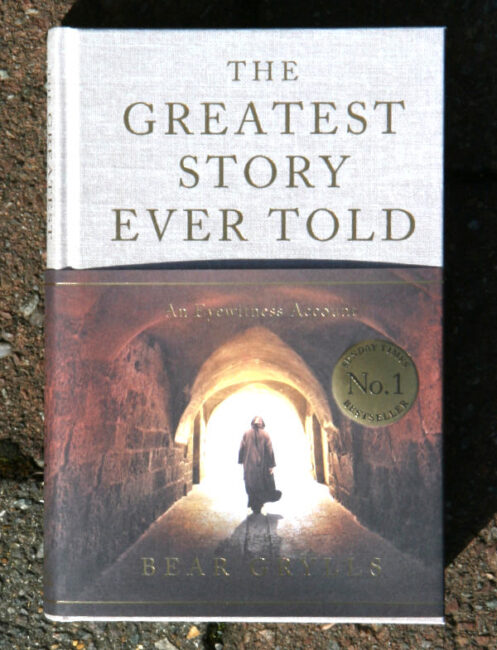 Nor did I until our local church gave copies out at their Christmas Midnight Service – beautifully bound copies what’s more. And because this didn’t seem to fit with the profile of this man of extreme action, Bear Grylls, I was the more intrigued. (That probably says more about my preconceptions than about him.) But he says himself, this is the hardest thing he’s ever done, and the best. He has spent a lifetime unravelling the truth about Christianity and is still on that journey, but his faith is the backbone and source of strength in all his escapades and in his everyday reality.
It’s a tale of an impoverished Middle Eastern child of the first century becoming a renegade teacher in the Roman Empire. The familiar stories of Jesus of Nazareth’s birth, life and death are told imaginatively through the eyes of five prominent eye-witnesses: his mother Mary, disciples Thomas, Simon and John, and Mary of Magdala.
I say familiar stories, but there are also intriguing alternative viewpoints offered. For example, I’d never thought of Mary being wracked with guilt because she’d taken her own baby boy out of the reach of Herod’s merciless slaughter of boys under two years of age, leaving all her friends and contemporaries’ precious children to be murdered instead. Or her maternal anxiety when her beloved grown-up son vanishes into the wilderness for forty days after his baptism. She knows it’s a bleak inhospitable place; has he succumbed to starvation and the elements?
And the details bring certain events and emotions into sharp relief – the real grief Jesus felt at the execution of his closest cousin and friend John the Baptist; the sheer brutality of Roman punishment prior to crucifixion (very hard to read); the terrible burden of guilt the disciples probably carried for not showing the love Jesus had taught them when he needed them most, for denying him, for betraying him. Sobering stuff that challenges the present-day reader to think again – the cynic and the angry, the impulsive and the lost, alike. Their stories, all our stories, are wrapped up in Jesus’ story, as Gryll’s puts it.
The Historic Jesus
Early in the year I shared with you that I’ve set myself a challenge for 2025 to try to get to grips with who Jesus of Nazareth was in the historic context of his time and place. I ploughed through the first seven books in my pile with relative ease. NT Wright and Marcus Borg‘s The Meaning of Jesus gave me a harder run for my money, as I reported at the time.
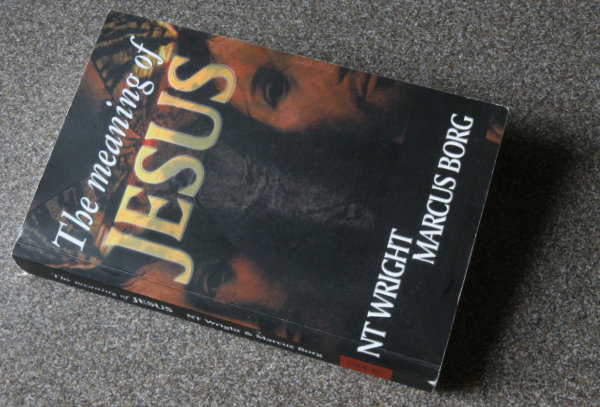
Now it’s the turn of Kenneth Bailey. Wow! I’m sitting at the feet of a master of Middle Eastern culture with impeccable credentials; a man who grew up in, as well as lived and worked in the area much of his life (1930-2016), not only a prolific author and lecturer in Middle Eastern Studies, but also an ordained Presbyterian minister to boot!
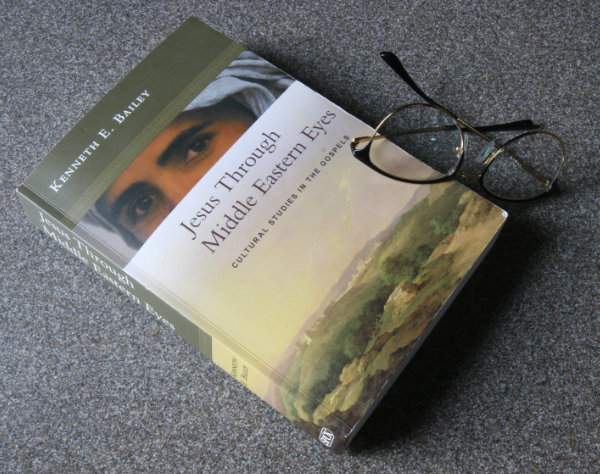
Jesus through Middle Eastern Eyes – which I’ve just finished reading – is in a league of its own, I suspect. Bailey begins rather provocatively by taking apart the ever-popular oh-so-familiar Christmas stories of Jesus’ birth. If you’ve swallowed the old traditions from your youth up – donkeys and inn-keepers and precipitate births etc – prepare to have the rug unceremoniously whipped from beneath your feet. It’s a clever way of grabbing our full attention without doing too much damage. Though I’d heard many different challenges to the birth stories before, somehow I found Bailey’s perspective put me in the mood to have all my preconceived ideas on other topics and my supposed knowledge challenged. I could see from the outset that Western eyes and minds in general have obscured important aspects of Jesus’ life and ministry – for most of us. But if we’re to understand who Jesus really was, and what he was all about, we need to take off those Western glasses and get the dust of the Middle East in our eyes. And boy, he’s the man to guide is through that journey.
He writes beautifully and so compellingy. Everything is clearly organised and laid out. And though there’s plenty of evidence of scholarship and wide reading in the references and footnotes, he doesn’t allow his great learning to bog down the text. Instead he focuses on one topic at a time, drawing out clear points of biblical exegesis and the significance of what these ancient books have to tell us. He’s selective: covering Jesus’ birth, the Beautitudes, the Lord’s Prayer, dramatic actions of Jesus, and his relationship to women, with more than half the book devoted to the parables.
I found it both fascinating and illuminating. How could I ever have assumed we Westerners could adequately interpret these books without insider reference to the ancient and foreign culture in which it was all enacted? With his own extraordinary background, this author has the skill to understand Middle Eastern texts and interpreters that very few other scholars could attempt, and in his hands the stories come alive and assume proportions and details and meaning hitherto unseen. The book seems to me to end rather abruptly but perhaps that simply leaves the reader looking for more.
The serious challenge for 2025
I might have mentioned before that each year, alongside all my other reading, I try to tackle one big issue in an effort to better understand the foundations of Christianity, and to challenge the beliefs and notions I’ve inherited or picked up in my long life. Topics to date include things like inspiration; the place of doubt versus certainty; questions about homosexuality; the role of women in the church. It’s been a sobering and humbling experience, and driven a coach and horses through some cherished ideas along the way. But I like to think I’m now more honest and humble about what I believe and how I live/ought to live.

So, this year my thinking has led me to explore who the real Jesus was, and why it matters. Many things suggest to me that the church has developed its own pictures and stories, and each culture and generation and new wave of scholars has overlaid them with yet more layers of interpretation. But who was the person known as Jesus of Nazareth in the Middle East in the first century AD, and what was he like, and is he indeed someone I want to follow, and if so, what should that look like? And as before, I’m very very aware that what I discover might require me to change my personal world-view and religious stance. And might indeed upset some people who have certain expectations of me.
Three weeks in and I’m feeling somewhat overwhelmed by the sheer volume of literature on the subject, ranging from the way-out bizarre, through the well-worth-delving-into, to the totally-out-of-my-depth-erudite! So, in an effort to save my sanity I’ve drawn up a plan for all the different aspects of Jesus’ life I want to examine, and marshalled the stack of books I want to read on the topic into some kind of order (sample shown above).
Back to it!