kidnap
Wild child
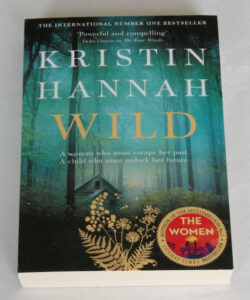 Wild is another tale from the international best-selling author Kristin Hannah. A remarkable story about resilience and human compassion.
Her own early years made Dr Julia Cates an exceptional child psychiatrist; she remembered every nuance of her pain. The odd one out, the geek, always in the shadow of her gregarious larger-than-life family, she’d always felt marginalised, unloved, unimportant. Now her profession has filled the frightened place inside her with joy. She is both accepted and needed.
But her burgeoning career is suddenly and seriously compromised following an incident where one of her long-term patients, Amber Zuniga, kills four children and then takes her own life. For three years Julia had spent two hours a week listening to Amber’s problems, so why hadn’t she recognised the girl was becoming increasingly violent and depressed? The modern world no longer believes in senseless tragedy: someone has to pay, and Julia certainly pays dearly in this case – the press expose her as incompetent; her clients leave her; her confidence is undermined and she’s left alone and aimless.
Then Julia’s sister, Police Chief Ellen Barton, is in serious need of help. Just as a powerful thunderstorm ends, a scrawny, spindly-limbed girl of about 6 with filthy matted hair and eerie blue-green eyes is discovered hiding in a maple tree in the town square of Rain Valley on the edge of a massive but largely-unexplored rain forest, a snarling wolf puppy cradled in her arms. She’s seriously malnourished and dehydrated, with old scars from ligatures round her ankles where she’s been tethered, knife wounds and evidence of whippings. Ellen is under pressure to call in the big guns, but she’s sure she can handle one lost girl – or at least she knows someone who can. Julia.

Julia has specialised in interpersonal dynamics but old personal hostilities and insecurities emerge now she’s back with her sister, and revisiting her childhood haunts. She has a true gift for dealing with traumatised children but she can’t get so much as a word out of this undersized creature who fell out of a tree. Nonetheless she’s intrigued by a child who behaves more like a wild animal than a human, who can communicate with birds and wolves though not with her own species. It’s clear she is locked in a prison of unimaginable fear and isolation. It’s undeniably a big challenge, but Julia has the time and the skill, so why not see what she can do to help this little person through her trauma, and discover how to unlock her mind and voice?
Julia becomes the lost child’s official foster parent, and makes her a full time project. She sleeps in the same room as her, spends all day every day with her, and gradually, almost imperceptibly, the waif – whom she names Alice – begins to respond to her and to trust her.
Meanwhile Police Chief Ellie is working too to find out the girl’s identity and keep the press engaged with the case. It’s only wide-spread publicity that will give them a chance to find her family and prevent her being taken into the detached care of the authorities. But publicity is not Julia’s friend: the press and public are still baying for her blood because of the case that ended her previous career. It takes enormous courage to put Alice’s need above her own.
It’s a tender story weaving together personal heartbreak and altruistic love. I wasn’t personally persuaded that there needed to be quite so many romantic threads, nor did it seem credible that the child, Alice, would still be using single disjointed words after such intensive therapy, but the flawed characters of the adults gave depth to their backstories and purpose to their actions. An unusual and enjoyable break from the serious study.
Terrifying history as fiction
Before We Were Yours by Lisa Wingate is a bestselling 2017 novel, at once sobering and compelling, based on a notorious true-life scandal. A tale of children – real live babies and young girls and boys – being traded for money.

From 1920s to 1950 a social worker called Georgia Tann facilitated the adoption of thousands of children. But this was no regular professional procedure in the course of her work; she orchestrated the abduction of these infants and youngsters from poor families, kidnapping often in broad daylight, gave them new names (to help prevent birth families tracing them), and sold them to celebrities and people with political influence. And she charged exorbitant fees for doing so, adding extra for deliveries out of state.
 Whilst in the so-called ‘care’ of orphanages belonging to the Tennessee Children’s Home Society those little people were kept in terrible conditions, abused, terrified, half-starved. They were tied to beds and chairs, beaten, locked in cold dark cupboards, molested. But on special days they were bathed, dressed in proper clothes, fed good food, and paraded before potential parents. Entirely fictitious background stories were spun about them, stories of their exceptional pedigrees and privileged background. And all the while they were on display, they were under dire threats as to what would happen if they dared misbehave or tell tales about their real identities or conditions in the home. That fear remained with them and kept them silent even after their adoptions.
 Miss Tann also duped women in maternity wards into signing surrender papers while they were still under sedation. She told parents their babies had died when they hadn’t. And in addition, she headed up a network that under her watch allowed or intentionally caused the deaths of as many as 500 children and infants.
How did she get away with it, and for so long? Well, it has transpired that she had law enforcement agencies and family court judges in her pocket. She seemed untouchable. And in the end, she died of cancer before she could be brought to answer the charges against her.
This much is true.
 But Lisa Wingate has used fictional characters to bring the horror of this scandal to life.
The Foss children and the Arcadia were formed from the dust of imagination and the muddy waters of the Mississippi river. Though Rill and her sisters exist only in these pages, their experiences mirror those reported by children who were taken from their families from the 1920s through 1950.
The year is 1939. The poor but close-knit Floss family live a magical life on the Mississippi on a shantyboat built by her father Briny. Queenie is her mother. When Queenie is taken to hospital during an extremely difficult birth of twins, the children are left unattended on the boat, and it’s then they are all abducted by the river police and taken to Memphis to a children’s home.  Rill Foss is 12, and feels ultimately responsible for her three younger sisters and a brother, but she is powerless to prevent them being split up and either given to different families or disposed of. All except one of them have their mother’s blonde curly hair and blue eyes putting them much in demand. Their story (told by Rill) fills alternate chapters and is told with immediacy and the brutal clarity and honesty of a child wise beyond her years.
Woven alongside her account, is the present day story of Avery Stafford, a federal prosecutor in Maryland, and her growing awareness of the attrocities perpetrated decades before and the lifelong legacy borne by its victims. Her father is a well known senator and all her privileged life has been spent surrounded by wealth and fame. She has recently come home to support her father while he receives treatment for cancer. His mother, Grandma Judy, to whom Avery feels very close, is losing her grip on reality and now lives in a very upmarket care home. But there are ugly protests swirling about inequality, threatening the standing of the Stafford family, so they redouble their efforts to stay in touch with the less-advantaged. In the course of visiting a more mediocre care home, Avery is accosted by a woman, May Crandall, who appears to think Avery is someone she knows. And on her bedside table is a photograph of four laughing women, one of whom looks remarkably like Grandma Judy.
For my part I should have preferred the links to become apparent much later; it’s obvious from very early on who these old ladies are. However, hats off to the award-winning author, herself a former journalist, for giving us a harrowing glimpse inside this scandalous period of American history. But it leaves one wondering, scared even, about what other terrible crimes have been, or indeed are, being perpetrated in plain sight. And what if anything we are doing about them. What, for example, about the ongoing reports of the Ukranian children – many blonde, blue-eyed – who have been forcibly abducted by Russian troops, standing at over 20,000 according to one source? 20,000 innocent children!
What are we doing about it? What should we do?
Broadmoor
 Broadmoor. The very word carried a deeply chilling resonance. The most infamous high security hospital in the world. Makes me think of spine-chilling names like Peter Sutcliffe, Ronnie Kray, Charles Bronson … serial killing, cannibalism, paedophilia, arson, and the like heinous crimes. Or the horrific occasion in 1977, when two inmates trapped a third in a locked area in Broadmoor, and tortured him to death, skinning him alive, ramming a spoon into his brain, before garotting him. What kind of a mind could conceive of, and calculatedly carry out, such barbaric acts? I still remember the shivery sense of profound relief when these men were locked away in this maximum security psychiatric hospital facility for the criminally insane. Little public sympathy for them; widespread fear should they ever be released; a general ‘throw away the key’ mentality! ‘Monsters’, ‘evil incarnate’, ‘irredeemable’. ‘The more whole-life sentences running sequentially the better.’
 But TV journalist Jonathan Levi, and cultural historian Emma French, have uncovered a much more nuanced picture of this notorious place. In their book: Inside Broadmoor, (published in 2019 but written before the new hospital was opened in the December of that year) they bring together their observations based on nearly ten years observing and interviewing staff, experts and the patients themselves, and they find that the staff really believe in redemption and rehabilitation – at least in most cases. No matter what they’ve done these men deserve to be treated humanely, and they aim to give them the best chance of a future.
This generosity of spirit from the staff comes in spite of the fact that the threat of violence is ever present. There are on average five physical assaults on staff members each week, but violence is seen as intrinsic to some of the medical conditions these patients suffer from, so it’s viewed more compassionately here than by the public at large.
The authors asked why did the men commit such dastardly deeds? Might they do it again? Can clinicians unravel the mysteries of their brain chemistry and render them safe? Are any conditions untreatable? Is there such a thing as pure evil? What can we do with those who are beyond help? What draws people to this work: 8-900 staff at any given time, all sworn not to reveal any information outside the hospital? If the inmates are themselves the victims of appalling histories, does society owe them anything in compensation?
 It’s hard to believe that 200 of Britain’s most dangerous men can be housed here together, maximum unrelenting security measures notwithstanding, some of them day in day out with no reprieve of any kind for decades. Each one suffering from a serious mental disorder rendering every man a grave and immediate risk to the public, not to mention their combined threat.
There is a popular misconception that, when someone goes to Broadmoor, they are there for life; in reality only a very few high-profile criminally insane individuals remain there for decades. Over the years a lot of work has gone into de-stigmatising and altering perception of severe mental illness, with great emphasis on intensive programmes of drug and psychological therapies. The old prison mentality and ethos has largely gone. As a result, nowadays, the average stay for a Broadmoor patient is less than 6 years, and there is a notably lower reoffending rate than in the UK prison population overall. This is not to say the men all go free into the community – depending on their diagnosis and progress they may be sent to a variety of other less high security institutions.
The demographics of today’s patients have changed radically over the last 150 years. Religious and ethnic factors play a significant part in this, and the authors concluded that, It is tragically clear that work needs to be done urgently to address these inequalities.
What really emerges is the vulnerability of these men alongside their criminal insanity.
It is nothing short of chilling that … the fate of many Broadmoor patients was fixed from early childhood. Critically, theirs was a childhood not just of deprivation and economic hardship, but of abuse too … Childhood experiences, often shocking and sickening beyond belief, seal the fate of many patients very early on.
One illustrative case is Dillon, born into a ‘satanic’ family. Father broke his bones, sexually abused him, and raped and beat his mother. From birth, mother rejected Dillon, convinced he was evil. She sexually abused him and tried to kill him repeatedly. He was kept locked up in the attic, not allowed to talk to his brothers, or tethered naked to a post and made to eat food off the floor like a dog. By the age of 5 he was an arsonist. From the age of 7 he went into care but became arsonist, kidnapper, violent offender, out of control alcoholic. What chance did this boy have in life? And yet most of us don’t see beyond the violent, criminally insane adult. The staff in Broadmoor do.
One consequence of receiving effective medication, therapy and healing, is that patients can arrive at a deeply vulnerable moment; they begin to have consciousness of the crime that brought them to the hospital in the first place. This is a point of profound fragility. In some cases it’s more than they can handle and proves lethal; they take their own lives. Suicide is rendered possible in the lower risk areas, especially in Victorian buildings where ligature points, such as bars at the windows, have remained because of a shortage of funding to make the necessary alterations.
Hmm, a shortage of funding … Maintaining these dangerous men in secure units under constant surveillance is horrendously expensive. It costs upwards of £300,000 per annum to keep each patient in Broadmoor – five times the cost of a prison stay. Peter Sutcliffe’s 32 year stay in Broadmoor cost the taxpayer in the region of £10 million. In just one of a number of rooftop protests, Charles Bronson did £250,000 of damage.
I found this book profoundly challenging – challenging my preconceptions, my prejudices, my lack of real understanding: the barbed wire around my own reactions. I commend it to you.

Nadia’s Song
The keening of the women was deafening, painful, the high-pitched mourning ululation of the Middle East rising from a half-million throats. The corniche was a river of black, hiding the sea beyond.
What an evocative opening paragraph! The book? Nadia’s Song by Soheir Khashoggi.  This tale of forbidden love and divided loyalties is set against the colourful history of Egypt’s conflicts and cultures. The events of the 1940s in the Middle East especially, add a depth of historical accuracy and credibility to the story.
The mourning ululation from a half-million throats is for renowned Egyptian singer, Karima Ismail, known as ‘The Nightingale’, dead at fifty-three. The country is in mourning, and Karima’s daughter Gabriella is utterly devastated by this sudden unheralded bereavement of a second mother. She can find no closure, no comfort. Something is gnawing away at her: how could it be that her mother had taken drugs, died of an overdose, when she never touched the stuff? As a reporter, as a daughter, she needs answers.
Unravel back to the 1940s when Karima is a young girl, a servant, learning about the ways of the world. A major war is raging in Europe, stretching it’s invading fingers into the homes of rich and poor alike even in at-that-time-neutral Egypt. There are spies and collaborators everywhere, disguised and unremarkable. Watching, listening, liaising, accusing.
But for Karima and her childhood friend, Charles, son of her master, major changes are at work at a much more intimate and personal level. So much divides them in this hierarchical culture. Theirs is a forbidden love – spanning class and race; a love that could not be. Tragedy separates them, but not before a child is conceived. Following the death of Charles, she pours all her raw emotion into her singing.
The code of honour governing behaviour in their culture is strict and rigid. Karima has disgraced her family. Her brother Omar is beyond outraged. He exacts terrible extended revenge. But, desperate to salvage something from the wreckage, he nevertheless finds her a good husband, Munir, more than twice her age, who in turn sees her potential and introduces her to influential people who can nourish her beautiful and exceptional voice. She becomes ‘The Nightingale’. But the greater her success, the harder Omar presses her for money.
 Munir however falls more and more in love with his beautiful young wife and gladly accepts the baby Nadia as his own. But happiness is short lived. Nadia is just two years old when a night of rioting and violence tears her away from her parents. In the same fire, Munir suffers a serious heart attack, leaving him a shadow of his former self. Karima devotes herself to caring for him, but when demands increase for her to return to singing, he urges her to do so. She eventually relents, promising Munir she will, provided he gets better. The promise extracted he can die happy, knowing she will not waste her God-given talent.
Karima has now lost both daughter and husband, and the crushing sorrow adds even more pathos to her singing. Her fame escalates and she is in great demand professionally.
In reality, and unknown to her mother, the child Nadia has escaped from the burning building, and is found and rescued by a childless couple, Dr Tarik Misry and his wife Celine, who take her into their lives and hearts. They rename her Gabriella, and devote themselves to her happiness. Discovering she is not their biological child has a profound effect on Gabriella, and sets her off on a mission to discover her true parentage, and the reality of what really happened to her famous mother.
SPOILER ALERT
The truth is sordid and despicable. Gabriella’s uncle, Omar, from an early age mired in a dark world of drugs and debt and gambling and whoring, is jealous of his sister Karima’s success. He convinces himself that it was he who saved her by finding her a respectable husband; she owes him, big time. He leans on her heavily for money … time after time. For years, she does indeed bail him out, living modestly herself while funding his dissolute and reckless life, but there comes a day, after Gabriella has been reunited with her, when she finally holds firm against his entreaties. Her beloved daughter who was lost is now found, and she must concentrate her resources on being a good mother.
Incensed by her refusal, Omar exacts a fearful revenge: he drops hints about her being a spy, and fabricates a story of her undercover work that leads to her untimely and brutal death, disguised as suicide. Under Egyptian law, two thirds of her great wealth goes to her brother; Omar accepts it with little regret. Years pass.
But now Gabriella is a highly regarded reporter, probing for the truth, aided and abetted by her Irish boyfriend and Karima’s devoted friend and admirer, Farid Hamza, a high-ranking army Colonel. Between them they tighten the net.
However, Omar is not about to roll over and confess. He hatches a plot to abduct Gabriella, gain a king’s ransom in money, and then kill her anyway. Victory went to those who dared, he told himself. And he had always dared. The strong thrill of the plot drives him onwards.
There are just two and a half pages left to reveal the end result! You didn’t think I was going to spoil the finale, did you?!
It was fascinating to learn more of Middle Eastern history through the eyes of those living in that volatile part of the world. Sobering too, to be reminded of the rigid rules and double standards of the day and place.