mystery novels
More Georgette Heyer
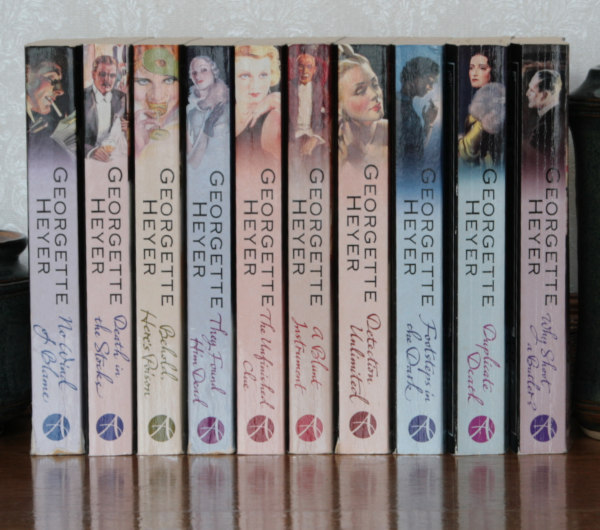
Remember what I said a few weeks ago about wanting to read Georgette Heyer‘s mystery novels? Well, as if by magic, here they are – all except one. A treat in store. Well, one shouldn’t judge such an author by a single book.
All we’ve got is a bunch of classy people, all moving in the best circles, all to be handled carefully, and only one of them known to the police.
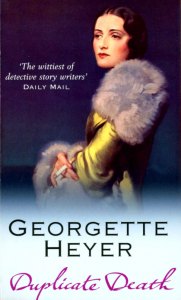 So says one of the lead policemen in Duplicate Death, my second dip into this series.
Daniel Seaton-Carew is called to the phone in his hostess’s boudoir shortly after 11pm, there are 43 people in the building, playing bridge. When he doesn’t reappear, the lady of the house, Mrs Haddington, sends Sir Roderick Vickerstown to remind him that the card players are waiting for him. He discovers the man has been murdered, strangled with a tourniquet of picture-wire there at the telephone table – wire bought that very morning by the secretary, Miss Beulah Birtley, at Mrs Haddington’s instigation, in order to secure some unruly flowers.
The said secretary was the one to take the call in the first place so it’s not surprising her finger prints are on the telephone. Only two people from the party had opportunity to kill him:
the hostess, Mrs Haddington
and one guest, Sydney Butterwick.
Ah, well, no … two other men left the room briefly:
Mr Godfrey Poulton
and Mr Timothy Harte.
Oh, and of the servants, the butler and the parlourmaid are unaccounted for. The list lengthens; the plot thickens.
Three people are known to have had angry exchanges with Seaton-Carew earlier in the evening:
Mrs Haddington – because he was openly flirting with her exquisitely lovely daughter, Cynthia.
Mr Sydney Butterwick – always jealous of Seaton-Carew (the object of his own affections) paying attention to other men or women.
And Miss Beulah Birtley, who has her own dark secrets.
When a duplicate murder takes place shortly afterwards, the police are quick to note that it’s only a carbon copy on the surface. Mrs Haddington was strangled elsewhere and then dragged into a position resembling her late paramour’s ugly end. This time too, there are hostile exchanges between the victim and three other people before the murder. The most recent visitors to Mrs Haddington’s boudoir are instantly in the frame:
Mr Godfrey Poulton
Mr Sydney Butterwick
Lord Lance Guisborough
Miss Beulah Birtley.
The plotting is such that the reader could never solve it faster than the police since certain facts are withheld, but it’s an entertaining tale and the dialogue is both amusing and of its time. Though I live in Scotland, I personally found the Gaelic littering Inspector Grant’s dialogue impenetrable, and his accent unconvincing and irritating. Lawyer Timothy Harte has a nice line in sardonic banter but his endearments, like ‘ducky’, ‘my child’, for his sweetheart, don’t ring true today. And, as with the first one I read, I seriously take issue with ‘he expostulated’, ‘ejaculated’, etc, instead of a simple undistracting ‘he said’ or ‘he replied’. Oh, and to the excessive use of exclamation marks. Which all goes to show that the rules of writing may change over time, but a story can be enduring in spite of it. And I’d forgive this author much, purely on the grounds that she was a hero of my youth … or should that be ‘youth!’? …?!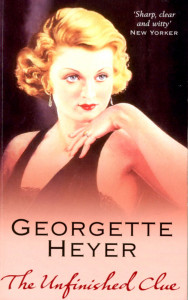
To date the most enjoyable read has been The Unfinished Clue. The murder victim is a thoroughly unpleasant man; the characters are plausible suspects; the actual murderer invites sympathy. And best of all, there are fewer irritating foibles in the style of writing.
A Scottish mystery
OK, duty done! I duly persisted to the end of Georgette Heyer’s mighty tome on Lord John of Bedford. So I’ve earned the pleasure of reading the book I was itching to get into: The Woman who Walked into the Sea, bought in the Outer Hebrides last month. And memories of those endless golden beaches, turquoise seas, alluring bays, came flooding back.

The author, Mark Douglas-Home, – yep, he is indeed the nephew of the former prime-minister, Alec Douglas-Home – is a journalist turned author, with an interesting career start: as a student he edited a University anti-apartheid newspaper in South Africa and got himself deported! Now there’s tale to tell!! He now lives more quietly in Edinburgh and this is his second novel.
 The story’s set on the North West coast of Scotland where, on 9 September 1983, a heavily pregnant Megan Bates walked across the sands of a remote beach into the cold Atlantic sea, and kept on walking. She was 33 years old and was wearing a loose white dress and a raffia hat with a broad red ribbon round it. Or so it was said. But the day before the sighting of Megan walking to her death, a baby girl was abandoned at the main door of Raigmore Hospital, Inverness, just before midnight, in a cardboard box, wrapped only in towels. There was no note, nothing to identify her apart from an envelope taped to the side of the box containing a brooch featuring violets, pinned to a small rectangular section cut from a green woollen cardigan. Could this have been Megan’s illegitimate child? Because of the brooch, the staff named the baby Violet.
26 years later, following a tip off from a social worker from Inverness, Violet Wells is searching for clues as to her biological mother’s life and intentions. Her journey takes her to the island where Megan lived and died. But the good people of Poltown give her a strange reception: there’s a local beach-combing farmer who says he loved Megan but who was accused by the police of killing her; a bitter elderly lady who was in service but has been soured by her treatment since the death of her employer; a stranger who attempts to abduct her. It seems the whole community is conspiring to keep its secrets buried and nothing is what it seems. Even Orasaigh Cottage, Megan’s rented home, is stripped of personality and bereft of any trace of her existence. And yet her possessions are preserved in a room in the ramshackle building belonging to a boy/man who believes her still alive.
Cal McGill is a private investigator and oceanographer brought in to locate things and people lost at sea, and currently not at all sure he does families any favours by doing so. He’s intrigued by this young woman who has suddenly left her flat in Glasgow and her four year old daughter, Anna, and come to this far corner, obsessed by her personal quest, reticent about sharing her own story. His knowledge of tides and flotsam makes him question the newspaper and police accounts of that time a quarter of a century ago. But his interest in this woman and her strange history soon leads to his personal safety being threatened as well as Violet’s.
Subtly, little by little, local characters let slip details and together Violet and Cal piece together a fragmented account – a tale of greed and jealousy, cover up and lies – until the pieces of the jigsaw fall into place and the ugly truth is revealed.
It’s been likened to a Ruth Rendell mystery. I wouldn’t personally rank it in that school of writing but I enjoyed the unravelling and of course, the exploration of the parent-child bond as well as the importance of knowing one’s roots; both slot neatly into my own current preoccupations.
A relaxing diversion before getting back into my own novel which is now on the downward slope to a conclusion. Very exciting to be counting down.