Painting the Darkness
Psychiatric scandals
We’ve probably all heard about the historical barbaric treatments and unauthorised clinical trials and experimentation meted out to psychiatric patients, which led to big inquiries and the radical reshaping of modern medical ethics on issues like informed consent and autonomy.
Vulnerable mentally ill people were systematically destroyed with mind-altering drugs, extreme forms of electro-convulsive treatment, operations on their brains, and horrific research on mind control. Many of these procedures were irreversible; patients were seriously damaged; some died. Unscrupulous clinicians went to extreme lengths to disguise or cover their tracks. Governments were complicit in the name of national security and international competition.

It’s a topic that offers big potential for novelists. Diane Chamberlain is one such. In Breaking the Silence, she’s woven the issue through the eyes of a psychiatric nurse, Sarah, in the 1950s, who finds herself in an advanced facility where the lead clinician has a reputation as a genius offering cutting edge therapy, and conducting innovative research, but who is in fact unscrupulous and maniacal. Alongside this is a present-day tale of a young girl, Emma, who’s in the house alone with her stepfather when he shoots himself dead. The child, believing her chattering made him do it, simply stops speaking, and her mother, Laura, and therapists struggle to unlock the key to her extreme response. When Laura’s father, begs her on his death bed to visit an elderly lady in a retirement home who has Altzheimer’s, the scene is set for these two time-lines to converge.
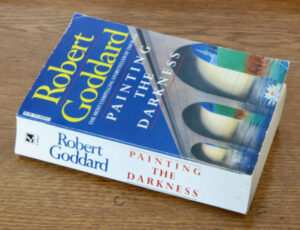 Though the story appealed on the grounds that it explores medical ethical issues, from a literary point of view I read it at the wrong time. Successfully dovetailing two stories, two time-frames, requires a deft touch, and it was a shame I read it too soon after Robert Goddard‘s Painting the Darkness. (reviewed last week) His writing is so brilliant and he has woven a first person account into a third person narrative with so much more immediacy and verve, never losing momentum. However, Chamberlain is herself a psychotherapist, so she handles the medical aspects of her storytelling with more assurance and I enjoyed that element of the book.
Painting the Darkness
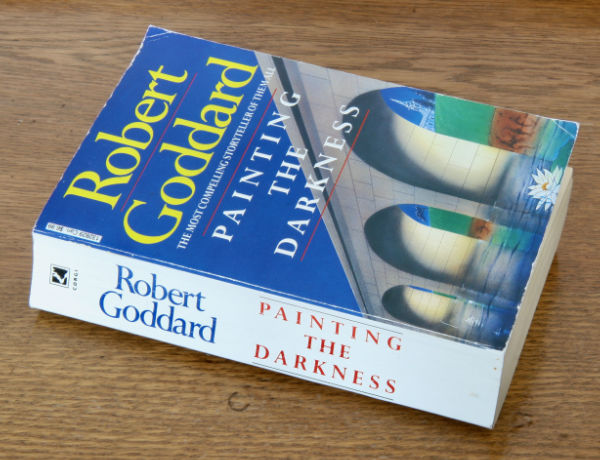 Robert Goddard is a master of language and of intricate historical skulduggery. In Painting the Darkness he’s drawing on the tried and tested theme of a stranger turning up claiming to be the long-vanished heir to a baronetcy and an estate in the nineteenth century, but boy, there’s nothing hackneyed about his take on this storyline! It’s 577 pages of unflagging engrossing suspense.
The year is 1882. William Trenchard is sitting smoking his pipe in the autumnal garden of his family home, on a Sunday afternoon, when the garden gate creaks open to admit a tall slim stranger. He has no idea of the impact this man will have on his life, but an hour is all it takes to turn the previous ten years of his life upside down, and set in train a path to ruin and destruction.
The man, James Norton, has come to reveal his identity as Sir James Davenall, former fiancé of Trenchard’s own wife Constance, who was thought to have inexplicably taken his own life eleven years ago, mere days before the scheduled wedding, when he was only twenty-three years of age. He also claims to be the rightful heir to the family estates which went to his younger brother Hugo. So determined is he to prove his case that he visits his alleged mother, brother and lawyer cousin, his doctor and old nanny, as well as his former fiancée, seeking confirmation.
In spite of his family resemblance, and his intricate knowledge of their family history and James’ life from boyhood to alleged suicide, all except the nanny initially refute the suggestion this stranger is their long dead relative, and yet … a nagging doubt remains in Constance’s mind. This in turn puts uncertainty into Trenchard’s head: maybe he doesn’t know his wife as well as he thought he did. Now both are harbouring secret thoughts and information unknown to the other. And little by little a rift widens between them; both erode the boundaries of trust.
The alleged James Davenall reveals more of his hand. All the money, all the status and prestige attached to the baronetcy, his own reputation, are as nothing compared with the love of his life. He will stop at nothing, accept no offers or compromises, in his efforts to win her back. But … he would give up every claim if Constance herself asked him to. Selfless devotion? … or a clever and disarming strategy?
As Norton repeatedly out-manoevres him, William Trenchard is driven from simply trying to protect his marriage to a full blown obsession to prove the interloper is an imposter; an obsession that leads to his own incarceration. The family lawyer, also a Davenall, takes up the case … they pursue it through the courts … the repercussions spread through the extended family. Terrible secrets are unearthed; conflicting claims and interests lead to fearful consequences. And the real truth is more shocking than anyone could ever imagine.
It takes a high level of skill to juggle time and place and an ever-evolving plot and a large cast of characters to this level of brilliance, but Goddard never puts a foot wrong, never eases up on the tension. Even when we eventually learn the truth about James Norton/Sir James Davenall we are unprepared for such a devastating unravelling revelation.
And as ever his writing is impeccable. I’ll share just two excerpts by way of illustration, both descriptions of minor characters in the story.
Sir Hardinge Stanley Giffard, Queen’s Counsel, Member of Parliament for Launceston and Solicitor-General in the previous Conservative administration, had about him, both actually and metaphorically, many of the attributes of the bull-terrier. Short and stoutly built, with a pugnacious air that age and a succession of legal triumphs had matured into a menacing certainty of manner, he was, in court, wig and gown and meticulous mastery of a complex brief, an awesome spectacle.
Mr Justice Wimberley had entered the bench from his door behind the throne before the usher had completed his announcement and now squinted querulously around at the rows of awkwardly rising figures. He was a small, orderly, fussy little man with a bobbing, egg-shaped, sharp-nosed head that gave him, in full judicial regalia, something of the appearance of a startled and ill-tempered moorhen. He peered distrustfully at the crowded court, as if to suggest that he had expected – and hoped for – a scantier audience, then took his seat with a resentful tug at his robe.
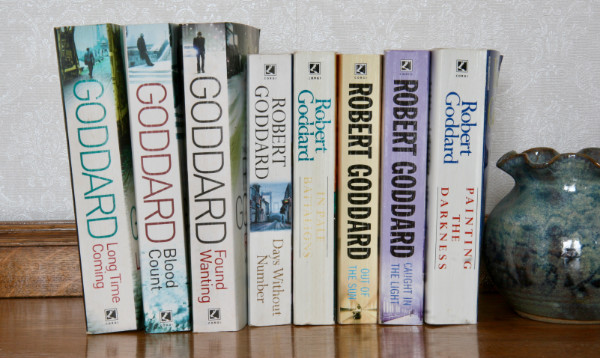
One of Goddard’s very best and most compelling novels in my opinion.