research ethics
Deadly viruses
 It’s Christmas time. A chance to take a break. Or perhaps not …
Oxenford Medical is a small pharmaceutical company doing research on deadly viruses. Security is extremely tight. The vast nineteenth century house in Scotland is nicknamed the Kremlin, because of its double fencing, razor wire, uniformed guards and state-of-the-art electronic security. So when two doses of an experimental drug, an antiviral agent, go missing from a locked refrigerated unit in the maximum security lab, director and security chief Antonio Gallo fears for her career, the company’s reputation, and public safety.
So where is the missing lab technician, absent without leave, pretending his mother is alive long after her death? Why didn’t they know his conscience was troubled by the use of animals in the lab? When they do find him, it’s already too late; he has met with a gruesome death at the hands of a killer haemorrhagic disease. The question now is: how can Toni and her team minimise the damage caused by the virus he released by rescuing an infected rabbit?
With these questions still swirling, and a storm raging, Toni dares to prepare to celebrate Christmas with friends, and unwind after all the tensions and stresses, leaving a skeleton staff to ensure the lab is safe. But first the phones go down. Then a gang of three men and a woman gain entry into the Kremlin, disguised as an emergency crew of workmen come to repair the phones. Their real mission? With a mixture of brutality and skill they manage to steal a large batch of the deadly virus itself.
When the news reaches her, Toni is already frustrated and fully occupied by a change in her personal arrangements because, instead of a restorative spa break with friends, she must unexpectedly care for her mother who has dementia. But catching the thieves, and retrieving the virus, have to take precedence; her mother just has to tag along too.
 A freak blizzard, multiple accidents, and fractured communication make catching the crooks an extra-fraught exercise. A persistent reporter is nosying around, dogging Toni’s steps, sniffing a big story. Her angry ex-partner is bent on thwarting her efforts to deal with the crisis. She needs all her diplomacy and ingenuity to out-manoeuvre everyone standing between her and her end goal.
But who is responsible for this daring heist? It has to be someone with insider knowledge about the electronic security system surely. The chase leads her to the home of the Professor who developed the anti-viral drug, with whom she has recently made an emotional connection. There she finds the crooks holed up and holding his whole family captive. It’s a race against time to prevent the virus getting into the hands of a master-criminal bent on mass destruction.
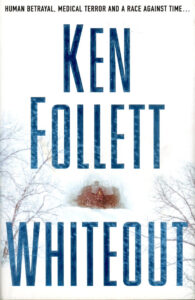 The last time I read a Ken Follett novel I was unimpressed. This one, Whiteout, is a tense thriller with plenty of twists and turns which kept me glued to the pages. And it challenged me to think through the ethical dimensions related to medical research and priorities.
Curiously the author succumbs to some pretty basic errors of writing, which I found irritating, but hey ho, I still enjoyed the tale. In a lesser name they would have attracted criticism, but I guess when you’re a household name you can afford to break the rules.
And after being immersed in a frozen world of snow and ice, it was actually quite pleasant to emerge to July rain and grey skies … and glistening black roads!