Ken Follett
Jackdaws
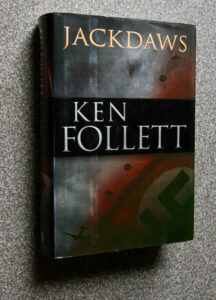 Having enjoyed Ken Follett’s novel Whiteout way more than expected, I raked another one from the back of my shelves: Jackdaws. A hefty 450 page hardback so not for the faint-hearted. It was well worth the effort.
The story is set in the dangerous final days of the Second World War. D-day is approaching and for one of Britain’s most effective operatives in northern France, senior agent Major Felicity (Flick) Clairet, the stakes have never been higher. She’s responsible for sabotage behind enemy lines and is no stranger to fear and danger, but she’s ruthless, clear-thinking, and paranoid about security; one of the survivors.
The centre of the proposed action is a large telephone exchange sited in a beautiful chateau near Reims which the Germans have enlarged to provide connections between the French and German communication systems, and a base for the Gestapo regional headquarters. It’s of enormously significant strategic importance; if it were destroyed, German communications would be crippled.
But when Flick and her husband, Michel – a Resistance leader – try a direct head-on assault, things go horribly wrong. On this occasion the intelligence supplied by MI6, had been inaccurate. Her team is destroyed, lives are lost, her husband is missing, confidence is temporarily shaken. But she remains resolute in her determination not to let the sacrifices be in vain.
Time is not on her side. She assembles a small group of women: a flirt, a murderess, a safe-breaker, a female impersonator, two aristocrats, one awkward, the other entitled – all unprofessional, but each with certain skills Flick needs. Code-named Jackdaws, these six women will attempt a daring infiltration under the very noses of the Germans, impersonating cleaning staff. An agents’ course normally takes three months; Flick has just two days to teach this motley band of women basic security rules: how to parachute, how to use weapons, and how to kill people without making a noise. Then they will be parachuted into France to blow up the telephone exchange.

Terrific tension is created by parallel accounts of the British team preparing to take out the telephone exchange and the German Major Deiter Franck infiltrating the French Resistance, as the countdown days are ticked off one by one. The descriptions of torture techniques, and the brutality of war, are both vivid and sickening, but the enormous courage of those who worked in enemy territory is breathtaking. It’s a shockingly mesmerising and totally gripping tale, bringing with it a fearful awareness of the price that was paid for the peace we take for granted.
Exactly 50 women were sent into France as secret agents during WWII; of these 36 survived. The other 14 gave their lives in service. This book is dedicated to them.
Deadly viruses
 It’s Christmas time. A chance to take a break. Or perhaps not …
Oxenford Medical is a small pharmaceutical company doing research on deadly viruses. Security is extremely tight. The vast nineteenth century house in Scotland is nicknamed the Kremlin, because of its double fencing, razor wire, uniformed guards and state-of-the-art electronic security. So when two doses of an experimental drug, an antiviral agent, go missing from a locked refrigerated unit in the maximum security lab, director and security chief Antonio Gallo fears for her career, the company’s reputation, and public safety.
So where is the missing lab technician, absent without leave, pretending his mother is alive long after her death? Why didn’t they know his conscience was troubled by the use of animals in the lab? When they do find him, it’s already too late; he has met with a gruesome death at the hands of a killer haemorrhagic disease. The question now is: how can Toni and her team minimise the damage caused by the virus he released by rescuing an infected rabbit?
With these questions still swirling, and a storm raging, Toni dares to prepare to celebrate Christmas with friends, and unwind after all the tensions and stresses, leaving a skeleton staff to ensure the lab is safe. But first the phones go down. Then a gang of three men and a woman gain entry into the Kremlin, disguised as an emergency crew of workmen come to repair the phones. Their real mission? With a mixture of brutality and skill they manage to steal a large batch of the deadly virus itself.
When the news reaches her, Toni is already frustrated and fully occupied by a change in her personal arrangements because, instead of a restorative spa break with friends, she must unexpectedly care for her mother who has dementia. But catching the thieves, and retrieving the virus, have to take precedence; her mother just has to tag along too.
 A freak blizzard, multiple accidents, and fractured communication make catching the crooks an extra-fraught exercise. A persistent reporter is nosying around, dogging Toni’s steps, sniffing a big story. Her angry ex-partner is bent on thwarting her efforts to deal with the crisis. She needs all her diplomacy and ingenuity to out-manoeuvre everyone standing between her and her end goal.
But who is responsible for this daring heist? It has to be someone with insider knowledge about the electronic security system surely. The chase leads her to the home of the Professor who developed the anti-viral drug, with whom she has recently made an emotional connection. There she finds the crooks holed up and holding his whole family captive. It’s a race against time to prevent the virus getting into the hands of a master-criminal bent on mass destruction.
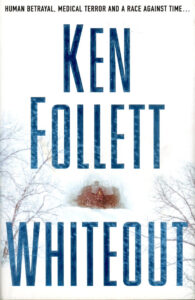 The last time I read a Ken Follett novel I was unimpressed. This one, Whiteout, is a tense thriller with plenty of twists and turns which kept me glued to the pages. And it challenged me to think through the ethical dimensions related to medical research and priorities.
Curiously the author succumbs to some pretty basic errors of writing, which I found irritating, but hey ho, I still enjoyed the tale. In a lesser name they would have attracted criticism, but I guess when you’re a household name you can afford to break the rules.
And after being immersed in a frozen world of snow and ice, it was actually quite pleasant to emerge to July rain and grey skies … and glistening black roads!
Doorstoppers
I’ve been thinking quite a bit about size lately. Not as in personal dimensions – although that’s obviously been a feature of my recent writing; no, I’m referring to books. Doorstoppers in particular.
 Take Hilary Mantel‘s huge tomes for example – excepting her memoir Giving up the Ghost which I sped through in a couple of sittings. Wolf Hall and A Place of Greater Safety have been staring at me reproachfully from my shelves for ages, but I can’t quite bring myself to set aside a large enough block of time to plough through them. I’m not one of these razor sharp people who can have several books on the go at any one time and so afford to have a massive volume on the bedside table to dip into over many months whilst steaming through an alternative pile of quick-reads. I lose track of characters and story-lines far too easily. And books which impinge directly on my own area of expertise/current writing tend always to take precedence.
 Ken Follett‘s sprawling tales – each of these is two inches thick! – are another example from my library. I loved his The Third Twin which I read aeons ago, so I bought these three on the strength of that recommendation. They’ve remained unopened to date. Same reasons.
Likewise Penny Vincenzi and … but I won’t bore you with a list.
An exception though, has been Matthew Thomas‘ debut novel, We Are Not Ourselves. (An inch and a half thick, if you’re interested.) For purely pragmatic reasons it rose instantly to the top of my pile: it’s in my ball park and a friend gave it to me for that reason; but I feel a degree of urgency to read and return it because I know her husband is next in line for it. So I’ve persevered doggedly to the bitter end and not allowed myself to be deflected.
 It’s a sprawling tale about the Leary family spanning sixty years, tracking a college professor’s descent into Alzheimer’s and the effect on his wife and only son. It even has a chapter where the son is rehearsing for a debate on euthanasia! So yes indeedy, my kind of subject. But really! Does any fiction merit 620 pages of tiny text? It took Thomas ten years to write (in a one bedroom apartment with young twins); my own (impertinent?) judgement is he’d have been well advised to edit it severely and give the story more zing and pace. Comparisons can be odious but Lisa Genova‘s Still Alice accomplishes more in far less time and space.
It’s the massive annual Christian Aid Book Sale in George Street this month, so I’ve decided two things: to bequeath all my unread Follett novels to the cause (along with a boxful of others); and to resolutely set my face against buying more books until I’ve cleared some from my shelves. Snag is, most of the ones still jostling for attention I’m sure I shall love too much to part with even once I’ve read them.