The perfect spot
 There are some moments, some places, that just touch a special button, aren’t there? The library first used by Thomas Anson, First Earl of Lichfield, in the 18th Century, is one such. It’s in Staffordshire – Shugborough Manor, a Palladian mansion house now in the hands of the National Trust and being extensively renovated and developed to excellent effect.
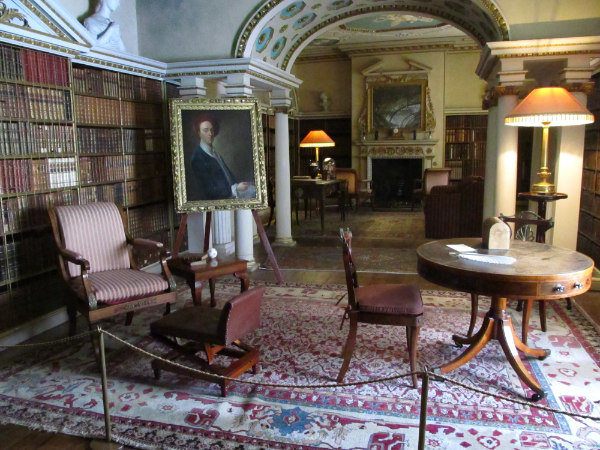
I believe I could scribble away contentedly there for days on end. The little writing table both catches the light and is positioned to give a fabulous view of the garden till the muse strikes. On the opposite side of the room, a lovely upholstered chair with foot rest provides a tranquil spot to recline whilst reading in perfect peace. If chill winds are blowing, two comfy chairs clustered beside a roaring fire invite you into the far end of the room. What more could one ask for?
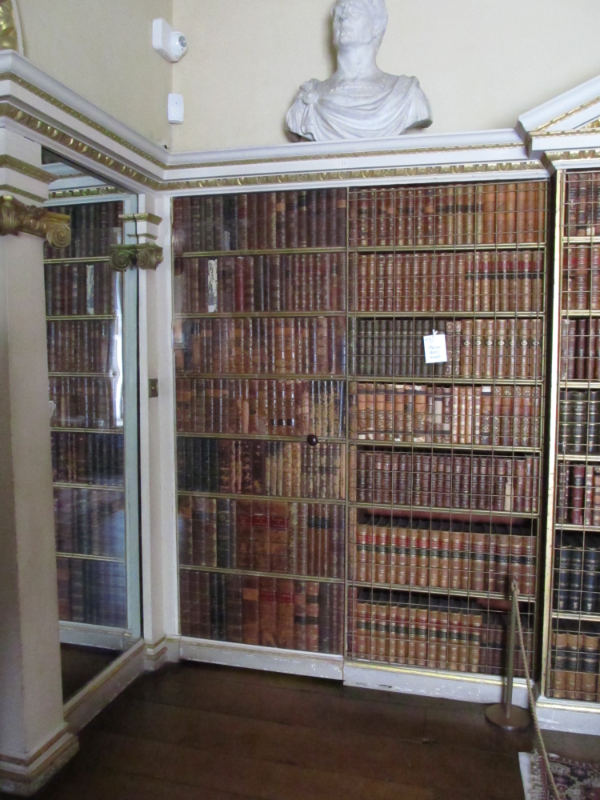
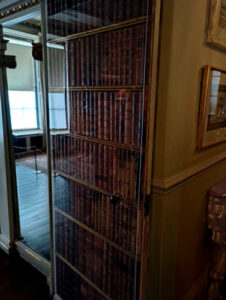 Well, the best and most unusual feature has to be the door to this little sanctum. It’s slimline, with the spines of real books set behind glass. Once it’s shut it creates the illusion of seamless shelving. How cool is that?
And strategically placed mirrors exaggerate the effect of endless shelving.
 Outside this little sanctum, in the cafe in the courtyard, there are several shelves of second hand books and naturally I HAD to support the venture by buying a few. Moments later one of the waitresses came to my table and stopped to stare at me.
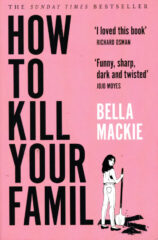 Waitress: I have to have a good look in case your picture is in the paper soon.
Me: I’m sorry?
Waitress: You’ve just bought How to Kill Your Family!
Before I left I called by to reassure her this was all in the course of my work as a novelist. As she moved away I heard her muttering something about what a great job to have, making up stories. Indeedy.

I was doubly glad I’d contributed in some miniscule way when I later visited one of the buildings in the park, The Tower of the Winds, and found that restoration was funded in part (to the tune of £30,000!!!) by the sale of second hand books.
A perfect visit for a writer, huh?
The Stepford Wives
So, to the third novel in my set by Ira Levin…
A ‘Stepford wife’ has become synonymous with a rather vapid but pretty woman who is subservient to her husband and loves domesticity, but when the phrase was coined in The Stepford Wives, it was telling a cautionary tale about gender equality.
 Levin’s writing in the early 70s. Feminism is on the ascendant; women have choices; and other women are the ultimate threat.
The Eberhart family – Mum Joanna, husband Walter, children Pete and Kim, move to Stepford from New York City – the ‘filthy, crowded, crime-ridden, but so-alive city’.
Numbering tennis, near-professional-level photography, politics, women’s lib – especially women’s lib – as her interests, Joanna is disconcerted to find the women who are her new neighbours are completely and compulsively absorbed in their household duties; all looking and behaving like pretty, big-bosomed actresses in commercials for domestic products. She’s rather horrified when Walter decides to join the Men’s Association in order to stay in touch with local issues, but he assures her the best way to effect change is from within.
She sets about discovering why, within months of moving to Stepford, women change so radically. And why for six years there have been no social groups for them. What happened to create this bizarre town? Is it anything to do with chemicals leaking from the industrial plants in the area, or seeping into the water supply from the ground? Or are the husbands – many working in those industrial businesses – concocting something at the Men’s Association with which to brainwash their womenfolk? Or is there something even more sinister going on?
I have to confess this story isn’t my kind of book at all. Totally fantastical and unbelievable. With a highly unsatisfactory ending to boot. So, something of an anticlimax after the promise of A Kiss Before Dying. But at least I’ve discovered that fact by actually reading them for myself before being influenced by other reviews or simply watching someone else’s interpretation. And I’m now done with this author.
Obsession
Prolific author, Jonathan Kellerman, is one of those writers who brings real lived experience to bear on his fictional world. He’s a clinical psychologist with a PhD, as is his most well known sidekick-to-a-cop, Dr Alex Delaware. Obsession is one of the (now 38) Delaware psychological thrillers which has been hiding in the back row of my bookshelves for years but only now come to the front of the queue. I find psychology endlessly fascinating so settled down for an entertaining read.
Patty Bigelow, short, dark eyes, brown mannish haircut, asexual, agnostic, ER nurse, control freak, perfectionist, with OCD, dies at 54 of pancreatic cancer. When she gets her diagnosis and very limited prognosis, she takes control of her own treatment, determined to get ‘all her ducks in a row’. She even stops the morphine to ensure she’s fully aware and functioning rationally. But she has only 25 days from diagnosis to death, and she can only barely convey an urgent final message to her adopted daughter, Tanya: ‘Terrible thing … Killed him. Close by. Know it.’
Tanya Marie is just 3 yr old when her biological mother Lydia, abandons her on her sister Patty’s doorstep. When Lydia dies in a motorcycle accident, Patty adopts the little girl and the two forge a close relationship. But when she’s 5 Tanya starts to manifest signs of OCD, and it’s Dr Delaware who treats her, and is there for her whenever she needs support. She turns to him again when the compulsive habits return following Patty’s death. By now she’s 19 and studying medicine, and she’s alone in the world.
When she reports her mother’s dying words to the psychologist she triggers an investigation that takes Alex and homicide detective Milo Sturgis into some seedy places. How come a nurse could afford the smart duplex Patty has left to her daughter? And who has she killed? And what has she been embroiled in? And how much does Tanya need to know? The underworld brings them up against drug dealers and addicts, porn makers and buyers, murderers and unscrupulous wheeler-dealers, and all manner of accomplices and victims.
I confess I struggled to follow every element of every part of their enquiries and their unique style of banter, but the more I learned of Patty’s compassion and steely determination and good-heartedness, the more I wanted her to be squeaky clean. It’s an intricately woven plot which keeps the threads tightly strung, even till the last page when the knife twists one last time.
Best Interests
Wow! What d’you know! BBC 1 has just aired a remarkable drama all about medical ethics – yep, really – and I’ve been totally gripped. For an hour on four evenings, culminating two days ago, Best Interests tracked the case of a young teenager, Marnie Lloyd, and the struggle to decide whether she should be allowed to die.
Marnie (played by Niamh Moriarty) was born with a form of muscular dystrophy, which means a short life with major disability. Her devoted parents, Andrew (Michael Sheen) and Nicci (Sharon Horgan), are shocked by the diagnosis when she’s just six months old, but do all in their power to give her a happy childhood. Inevitably, though, their family life is an emotional roller coaster, chequered with crises, and spells in hospital, and a fine juggling act with Marnie’s older sister, Katie (Alison Oliver).
Then one day a severe respiratory infection leads to a cardiac arrest, prolonged deprivation of oxygen to the brain, and Marnie goes into an unresponsive state where she only reacts to painful stimuli. She can’t be weaned off the ventilator, and she starts to have seizures. The prognosis is grim.
The doctors caring for her recommend stopping treatment; the cost to Marnie herself is just too high, they say. But Nicci won’t hear of it. She clings to an outside chance that Marnie might smile again if her brain is given time to heal. ‘How can you let go of someone who still laughs?’ she asks – the poignant cry of a mother.
The hospital take advice from the Ethics Committee; they suggest calling in a mediator, but Nicci refuses to be involved in any negotiations; she has no confidence in the impartiality of any process.
When a Christian Pro-life group make contact she clings to the hope they give of support to fight this through the courts. They fuel her sense of injustice by telling her the hospital performs eugenics all the time, and doctors are more concerned with saving money than lives. What’s more, they quote three cases where parents have won against doctors in court – it’s enough for Nicci. And once they have the bit between their teeth, the legal team dig deep. They latch on to one incident in the past where a mistake in Marnie’s care might be used against the consultant physician, showing her to be a fallible person with flawed judgement at times. It speaks volumes that Nicci might even contemplate such a course of action against a dedicated woman who has cared for Marnie so devotedly since she was seven. Or that she might consider seeking experimental treatment from abroad – in spite of Andrew’s scathing ‘there is always some doctor from America or Italy who promises a miracle’.
But Andrew is in a very different place. Devoted though he is to these three women in his life, he simply can’t bear to be in the same house as Nicci in her single-minded battle. He believes the consultant when she says objective signs show Marnie feels pain, and that there is no realistic prospect of any recovery to a meaningful life. So he moves out, leaving elder daughter Katie torn between her loyalties to both of them, and with her own private battles to fight.
It’s a story of love and torment. It’s both heartbreaking and beautiful. It’s brilliantly acted. It feels real with shambolic kitchens and untidy people and chaotic relationships. And it poignantly captures the conflicting emotions, the stress on families, the impossible position of the medical team. It all depends where you’re standing what this looks like. As the judge says in her preliminary statement, the notion of best interests is very complex; everyone in the court room thinks they have Marnie’s best interests at heart, but they’ve come to different conclusions as to how those interests are best served. Even medicine is about opinions not just facts. And throughout the deliberations it’s imperative they all keep the child Marnie Lloyd at the forefront at all times.
I’m sure we can all relate to each member of the family. To Nicci as a mother wanting to hang on to her precious girl. To Andrew who sums up his own struggle to articulate how he feels, loving this child more than he can express, but not wanting her to suffer: he can’t talk about it; he can’t rationalise it; he can only feel it … to the depths of his soul. To Katie, torn by feeling of guilt and regret and impotence as the battle rages around her, and her beloved only sister lies unconscious in a hospital bed. All her life, whenever Marnie has been rushed to hospital, Katie has felt compelled to ask, ‘Is she going to die?’ And now that reality is closer than it has ever been. Each one feels so alone.
But as the judge emphasises, it’s not a competition. Rehearsing the arguments in the controlled atmosphere of a court of law, gives opportunity for everyone to hear and see the case for and against withdrawal of treatment. In reality the experience in the witness box at times feels pretty brutal, with lawyers straying into the realms of disrespectful comments and intrusive questioning, but others are on hand to correct the overload, and to expose unwarranted bias and shaky premises. And the judge in this case shows fairness, grace and understanding.
 If there is a weakness in the film it’s the end scenes where the machines are removed, Marnie dies, and is taken to theatre to have her organs removed for transplantation. But perhaps a bit of artistic licence here is what we all needed after so much raw emotion.
I spent years studying this subject, being with real families facing these horrific decisions, and I was hugely impressed by this moving drama. I salute commissioners, screenwriters, film makers, actors … well, everyone concerned.
Rosemary’s Baby
 Hmm. A second helping of Ira Levin – and an entirely different genre.
Apparently he conceived the dark plot for Rosemary’s Baby by musing that building tension over nine months of pregnancy, with the evil inside the main character, would offer a new and rather frightening kind of terror. And he’s right; it does.
The Bramford nowadays has acquired the prestige of a grand nineteenth century apartment house with gracious dimensions and real character, but in the twenties it was known as Black Bamford because of its associations with the black arts and Satanism, ugly and unsavoury happenings, suicides and murders; sensible people stayed away. Even as recently as 1959 a dead infant was found wrapped in newspaper in the basement and an elevator man met with an unpleasant death.
But that was in the past. Now Rosemary and Guy Woodhouse are thrilled to sign a two year lease on Apartment 7E in this stylish residence, determined to ignore the rumours and stories and warnings. At the end of that same week they are the proud inhabitants of ‘an emptiness of high ceilings and unfamiliar dark.’ Guy becomes increasingly swallowed up in his acting career but Rosemary throws herself into taking ownership of the space, creating her dream home, doing her best to suppress the vague feelings of unease and vivid dreams and strange noises.
Initially Guy resists the idea of a baby, wanting to establish himself as a recognised actor first, but tensions between them ease when he comes round to the idea. Rosemary is overjoyed when a pregnancy is confirmed by obstetrician, Dr Hill, although niggles of concern are raised when he requests a repeat blood test. His reasons don’t add up. But she and Guy vow to start again with a new openness between them.
However, that repeat blood test never takes place. Their new neighbours, Minnie and Roman Castevet, in the adjoining apartment, will hear none of any unknown ‘Dr Hill’ – nothing but the famous obstetrician-to-the-celebrities, Abraham Sapirstein, a personal friend of theirs, will do. They arrange everything. Indeed, from the outset Minnie Castevet takes an active interest in this pregnancy, plying Rosemary with special drinks and herbs, steering her away from the regular supplements recommended to other mothers, smothering her with care. Dr Sapirstein too is unusually solicitous for her welfare; seeing her every week, instructing her to throw away the pregnancy books, and personally reassuring her when she experiences problems – violent pains, strange cravings, loss of weight. No two pregnancies are the same, he soothes, this is all perfectly normal and the pain will pass. But other people express concern for her gaunt appearance and troubling symptoms. Indeed, a close friend is so appalled when he sees her that he questions her more fully, and asks her to meet him away from the house the following day. When he simply doesn’t appear, Rosemary becomes anxious, and she’s shocked to discover he’d suddenly gone into a coma and is lying unresponsive in hospital.
This is a pregnancy like no other, and Rosemary begins to imagine all sorts of scenarios to account for the troubling developments. Her mind goes into over-drive. The doctors do their best to give rational explanations and offer reassurance, but not only does she fear for her baby, but she becomes paranoid about those around her, suspecting some kind of conspiracy … dark arts … witchcraft …. As her mental anguish grows, so does her resistance to Minnie’s ministrations, and she becomes more devious and rebellious. Her misgivings mount exponentially as delivery day draws close and by this time she has convinced herself that even her own husband is in cahoots with a coven of witches. She secretly arranges to see Dr Hill and pours out all her experiences and fears to him. But, hearing her long and unbelievable story, he phones Dr Sapirstein and Guy, and hands her back to them. By this time she is beside herself, and Dr Sapirstein is on the point of sedating her when labour begins in earnest. He gives her an injection that renders her completely unaware of what’s happening.
 She awakens to great pain … and silence. The baby is dead, they tell her; he was in the wrong position and there was no time or facilities to do surgery to save him. Lost and alone in her grief, Rosemary is haunted by what seems to her to be a baby crying in an adjoining room. The neighbours keep a constant vigil with her, helping her draw off the milk that she’s producing, and giving her medication to calm her. But gradually she pieces together an explanation for all that has seemed so inexplicable. I won’t spoil the ending by revealing details, but suffice to say there is dark devilry involved and nine months of mounting tension come to a shocking climax.
Not surprisingly the book attracted mixed reviews and a range of reactions, due to its satanic content and a ‘blasphemous’ subversion of the Christian Christmas story. Levin went to some pains to ensure people were aware that he himself was not a believer in Satan and that this was pure fiction, but decades later he worried that he’d gone too far and even felt somewhat responsible for the burgeoning of a number of fundamentalist groups. He wrote:
Lately, I’ve had a new worry. The success of Rosemary’s Baby inspired Exorcists and Omens and lots of et ceteras. Two generations of youngsters have grown to adulthood watching depictions of Satan as a living reality. Here’s what I worry about now: if I hadn’t pursued an idea for a suspense novel almost forty years ago, would there be quite as many religious fundamentalists around today?
A cautionary tale.
I must admit, I came to this book unaware of any of this. And indeed I only became conscious of the subversions of the Christian story towards the end, by which time I recognised that even the names used are deliberate and significant. It leaves an uncomfortable feeling. But it’s just a novel. A horror film was made from it but I have no desire to watch it.
Ira Levin: another masterclass
I have to confess the closest I’ve got to the American novelist/playwright, Ira Levin, is watching the film of The Stepford Wives during a period of convalescence. But given the stature of the man, I decided I really ought to remedy this and read some of his books for myself.
 He was a mere 23 years of age when, in 1953, his first book, A Kiss before Dying, was published. It was immediately acclaimed as a masterpiece in the crime-thriller genre, winning prizes and selling in eye-watering numbers. And it’s quite short – yeahhh! So that’s the one I decided to tackle first. Tackle? Says a lot about my overall approach, huh?
It was anything but. Accessible, gripping, masterfully plotted and written. And compulsive. Short chapters, and division into three parts, give added momentum. I easily finished it in a day in between wallpapering and weeding and cooking.
The story’s set in a small college campus. In Part 1 we see things from the perspective of the nameless murderer – blond, blue-eyed, handsome, street-wise, charming and a lady-killer in both senses. But also a gold-digger and a psychopath. We know he despises women and only wants them for what they can give him. In the first 84 pages we watch him manipulate and scheme to get rid of Dorothy Kingship aka Dorrie, a girl with a hefty inheritance and a baby on the way, who has dared – yes, dared in a most inconsiderate way – to thwart his plan to get rich quickly. We see him carefully and methodically get rid of her, completely confident the murder will be declared a suicide, and no one will ever know. And the effect is the more clever because we are in on the build up, the increasing threat of violence, but the actual moment of murder is left to our imaginations. So far, so fairly standard plotting.
But then comes the clever bit: a complete change of point of view. Part 2 sees Dorrie’s sister, Ellen Kingship, piecing together aspects of the circumstances that simply don’t add up. She’s convinced Dorrie didn’t take her own life. But how to prove it? She knows the man in question is a blond and handsome student in Dorrie’s cohort at college … but which one? Plenty of young men on the campus fit that description. And how can she trace him without endangering her own life? Approaching each potential blond suspect with a tissue of lies is fraught with peril. Was his the hand that pushed her sister so violently? Was his the smile that watched his ‘problem’ plummet from that 14th storey? As readers we grow increasingly tense as each betraying slip of Ellen’s tongue is detected through blue blue eyes, magnified by a suspicious brain. And who’d have thought torn paper snowflake crafting could be so spine chilling?
The body count increases. The murderer grows ever more audacious, intrepid, and bold. And now, we the readers know who he is.
Part 3 turns its focus on Marion, the third and last Kingship sister – our murderer’s last hope of inheriting a fortune. But there’s one blond handsome man who knew Ellen better, genuinely cared for her, and he is determined to bring this psychopath to justice, and save Marion from his clutches. Meticulously, incrementally, he obtains the evidence, by fair means or foul, and the net closes inch by agonising inch. Levin achieves a finale so tightly coiled and slowly released as to warrant the accolade from no less a personage than Stephen King: ‘the Swiss watchmaker of the suspense novel …. Every novel he has ever written has been a marvel of plotting … he makes what the rest of us do look like those five-dollar watches you can buy in the discount drug store’.
Oh, and even in his debut novel, a mere stripling, Levin had the confidence to describe Ellen running down 14 storeys and through deserted night streets in one long breathless 24-line sentence! Impressive stuff.
Treats in store …
More ethical matters in the news

Last week I was showing a friend from the US the very building (above) where the Church of Scotland General Assembly was in session. A phalanx of eight very friendly policemen waved us into the stone courtyard cheerfully, and we stood admiring the impressive architecture, under the forbidding glare of John Knox‘s statue.
 I couldn’t help feeling the displeasure of this firebrand reformer about what was going on. Because inside, the commissioners were debating serious matters about which he would have had very strong opinions. And indeed, one conclusion has surprised me too. It relates to assisted dying. After vehemently and definitively and consistently opposing it hitherto, this time these august personages openly recognised the range of theological as well as ethical opinions on the subject amongst their members, and in a highly unexpected move, they voted to review the opposition to it. Apparently the dialogue was ‘impassioned’, ‘deep and meaningful’, and took them to ‘a very human place’. So, not an endorsement, but a step further along the continuum to change.
Two years ago the British Medical Association moved to a neutral position on this matter. Last year the Royal College of Nursing announced it was planning to review its stance too. In the last few weeks the Philosphers’ Consortium on Assisted Dying in Scotland (ethics professors from Edinburgh, Glasgow and St Andrews Universities) backed the proposed new bill which would allow competent terminally ill adults to be helped to end their lives.
The majority of the ordinary population are in favour of a change in the law too. So what a long way we’ve travelled since I wrote Right to Die in 2008!
Eccentricity or genius?
Hmmmm. As regular readers know, I periodically steel myself to take on one of the literary works which tend to gather dust on my shelves – for no other reason than because I think I ought to. Just to remind myself of a) what’s out there attracting accolades and b) what’s regarded as the very best of literature; and c) why I often struggle with them.
This time it’s a 1984 title – just shows how far behind the times I am, huh? I read the reviews, acquired the book when I saw it in a second-hand bookshop, and added it to the tbr pile. But then let other more appealing, less-highbrow works jump the queue ahead of it for years – as is my wont.
 The book is Flaubert’s Parrot by Julian Barnes. A quick refresher for those who’d find it useful:
Gustave Flaubert (1821-1880), was an influential French novelist of the realist period, probably best known for his sensational romance Madame Bovary (1857).
Julian Barnes weaves a fiction about him rooted in fact, which always gives a rather compelling edge to a story.
The plotting is clever. Widowed doctor, Geoffrey Braithwaite, is researching the life of this acclaimed French writer, Flaubert, but simultaneously tortured by thoughts of his wife’s suicide. This book records his commentary of where he goes, who he meets, what he discovers, and what it all means.
He finds Flaubert was a sickly child, (not initially expected to live) who went quickly from handsome youth to a 6ft tall ‘paunchy balding burgher’, with green eyes, who suffered from epilepsy, which effectively cut short his legal aspirations and took him into writing. His sexuality is in some doubt – reports vary. He died at the age of 58. Some attribute his decline to syphilis; some to normal 19th century ageing.
Since Flaubert comes from a medical family (father was a head surgeon, brother Achille also a doctor) Dr Braithwaite has a degree of affinity with the family and enjoys browsing in the museums that include medical paraphernalia in the Flaubert sections.
The stuffed parrot which Flaubert borrowed and had sitting on his writing desk, is symbolic of Braithwaite’s questioning of each discovery. Which parrot was the authentic one? And was the fact that parrots also suffer from epilepsy, a significant factor in Flaubert’s choice? After all, he had a tendency to see metaphors and comparisons in everything. Since different biographers give differing stories, he must try to work out the truth for himself.
Alongside the unravelling of the life of this great writer, Braithwaite explores some of the techniques relating to the art of writing good fiction – probably the most useful part of this exercise for me! A few examples to ponder:
– ‘The author in his book must be like God in his universe, everywhere present – nowhere visible.’
– Beware coincidences in fiction!
– Lots of famous writers have errors in their work – don’t be depressed by critics nitpicking! (Flaubert’s description of critics: ‘Eternal mediocrity living off genius …‘)
– Use short, simple, true words where possible: avoid obfuscating euphemisms.
– ‘…perhaps the sweetest moment in writing is the arrival of that idea for a book which never has to be written, which is never sullied with a definite shape, which never needs to be exposed to a less loving gaze than that of its author.’
He would ban novels about
a group of people marooned in an isolated place who revert to nature,
small hitherto forgotten wars in far-flung places
incest
journalists
bestiality
set in abattoirs or Oxford or Cambridge
featuring a narrator identified simply by an initial letter.
O-kaaaay …
However, it seems perfectly reasonable to him to introduce bizarre seemingly completely unconnected-to-anything text.
If I suddenly listed by number a whole lot of information about trains half-way through a novel about a writer’s life …
if I inserted a stack of information about a foreign country, snippets of facts to show I’d done a whole lot of research into the subject …
if I jumbled up a load of information about the subject I’m investigating and details about my own life …
if I devoted a chapter suddenly to a ‘Dictionary of Accepted Ideas’, or to an English examination paper …
I’d be ignored or dismissed as unaware of the basic rules of writing, not to grips with my material, unsure of my purpose or destination.
When Julian Barnes does it, he’s shortlisted for luminous prizes!
That’s literary fiction for you!
I shall probable be struck off some list somewhere for daring to challenge this august writer. But hey, this is my space to be as egocentric as I wish.
Sublime to ridiculous
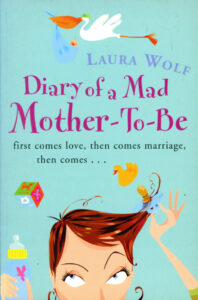
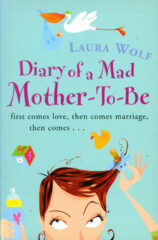 Diary of a Mad Mother-to-Be? Hello?!
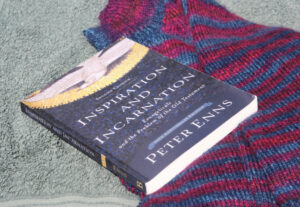 I don’t think I would ever have picked it up had I not been feeling mentally overloaded from some pretty heavy duty research on the subject of inspiration – yep, sorry, I still haven’t got to the bottom of this issue yet. But I have now finished – Yeaaahhh!!! – the pile of books I’d accrued, and I’ve got a pretty daunting set of notes. I’ve also produced a fair old stash of knitting for refugees which helped me stay focused as I read. Next step is to try to make sense of this mass of material – which may or may not be coherent. Time will tell.
 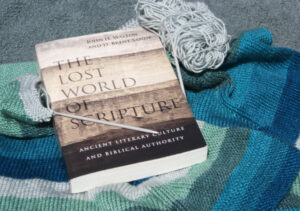 Suffice to say the subject’s not as straightforward as I was led to believe in my youth.
Anyway, I really, really needed some light relief, so Laura Wolf‘s fresh and funny diary of a young woman, Amy, who’s recently taken on a rather third rate job writing high quality drivel promoting some pretty iffy minor celebrities, fitted the bill.
Amy and husband, Stephen, have been happily married for a couple of years. He’s set up a rather unstable computer business and they’re living in a very cramped flat with Amy’s sister camping on the sofa in their living room. So life isn’t exactly plain sailing.
 Then Amy has a eureka moment and decides to have a baby.
Either we’re having a baby or getting a cat. And since our lease says no pets, I guess it’s a baby!
Her world is turned upside down. Even conceiving isn’t the doddle she’s been led to believe it would be – teenagers manage to do it all the time, don’t they?! Not so Amy. She turns to the pregnancy guide Baby How, Baby Now, and starts to chart everything. She’s determined to be a model mum-to-be. As a compulsive list-maker she catalogues the 63 tasks she needs to accomplish before she gives birth. Who knew you needed quite so much equipment? What’s a layette when it’s at home? And what exactly is a Kegel exercise? She acquires information and advice from assorted sources, both welcome and unsolicited, but nothing really prepares her for the reality. Who knew that sushi and aspirin would be off-limits? Who knew that certain smells – broccoli?! – would become acutely obnoxious? Since when did Joe Public feel perfectly entitled to pat pregnant bumps without even seeking permission? She compiles another list of things no one ever warned her about. It grows steadily as the months pass. Assorted colourful friends and relations flit in and out of her pregnancy sending her moods on helter skelters.
It’s fun, it’s light-hearted, it’s feel-good, and it did the trick. Equilibrium restored. I shall return to ‘inspiration’ with renewed energy and hopefully a better grace! Thank you, Laura Wolf.
Headlines
It’s astonishing how often topics relating to medical and social ethics reach the media headlines. These are recent ones …


 And just yesterday, news of the first baby in the UK created using the DNA of three parents. It’s a rich mine of topics for discussion … and material for novels, huh?!