obsession
The Rewrite Man
I know little of the world of writing for screen and stage, apart from a minor dabble during my creative writing course many many moons ago. So I was intrigued by a book written by an actual scriptwriter, narrating a story about a Hollywood scriptwriter who comes to the rescue of a film director stranded in the south of France battling with a third-rate production.
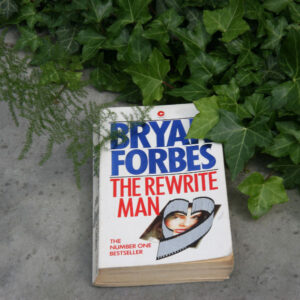 The book is The Rewrite Man, published way back in 1983. I picked it up in the magical National Trust bookshop I told you about a few weeks ago. The author is Brian Forbes who himself had vast experience of every aspect of motion picture production as author, actor, screen director and producer; indeed one of the most respected directors in the world. And married to the famous actress Nanette Newman to boot. We’re in safe hands: this is a man who knows exactly who and what and where and how.
Harvey Burgess is an empathetic man, and his friends use him as their chosen confidant, the laundry basket for all their soiled linen … like some neutered father confessor available for free consultations at any hour of the day or night. We listen over his shoulder to a drunken phone call from France begging him to join the team to rescue a film from certain disaster. As the narrator, he takes us with him as he flies to Europe and becomes immersed in a world that changes his life and priorities for ever. It’s Harvey’s job to re-write the script about the French Revolution, and bring the story to life.
Director, Martin James, is the man who made the fateful call, unwittingly revealing that he’s besotted by one of the young actresses, his protegee, Laura Taylor. He’s a man with a Midas touch for mediocrity, and a would-be Professor Higgins accent, who gives the impression that he had bought a do-it-yourself Rex Harrison kit, but had never quite worked out the instructions. But Martin trusts Harvey to be a safe pair of hands protecting Laura from any competition.
And there’s plenty of competition – Laura is a very beautiful girl. Harvey himself falls under her spell and begins a passionate and obsessive relationship even though he knows Laura has other boyfriends of longer standing. He knows their time together is limited to the duration of the film’s production, but he quickly realises that he’s in deeper than he’s ever been before.
When he’s no longer needed for the film script, and instead accompanies the body of a colleague back to the States, he’s convinced they will stay in touch. But his letters go unanswered; his calls are not returned; her contact points are cut off. Though he does all in his power to track her career and her whereabouts he draws a blank. Until, that is, tragic news arrives from an unexpected source.
Forbes certainly knows how to create vivid characters and lively dialogue. He writes the scenes he clearly sees, weaving a tale of obsession and jealousy with skill and verve. It’s very much of its time, but it’s always useful to read good writing and this was a benign diversion from the pile of books I’m reading on death and dying!
Obsession
Prolific author, Jonathan Kellerman, is one of those writers who brings real lived experience to bear on his fictional world. He’s a clinical psychologist with a PhD, as is his most well known sidekick-to-a-cop, Dr Alex Delaware. Obsession is one of the (now 38) Delaware psychological thrillers which has been hiding in the back row of my bookshelves for years but only now come to the front of the queue. I find psychology endlessly fascinating so settled down for an entertaining read.
Patty Bigelow, short, dark eyes, brown mannish haircut, asexual, agnostic, ER nurse, control freak, perfectionist, with OCD, dies at 54 of pancreatic cancer. When she gets her diagnosis and very limited prognosis, she takes control of her own treatment, determined to get ‘all her ducks in a row’. She even stops the morphine to ensure she’s fully aware and functioning rationally. But she has only 25 days from diagnosis to death, and she can only barely convey an urgent final message to her adopted daughter, Tanya: ‘Terrible thing … Killed him. Close by. Know it.’
Tanya Marie is just 3 yr old when her biological mother Lydia, abandons her on her sister Patty’s doorstep. When Lydia dies in a motorcycle accident, Patty adopts the little girl and the two forge a close relationship. But when she’s 5 Tanya starts to manifest signs of OCD, and it’s Dr Delaware who treats her, and is there for her whenever she needs support. She turns to him again when the compulsive habits return following Patty’s death. By now she’s 19 and studying medicine, and she’s alone in the world.
When she reports her mother’s dying words to the psychologist she triggers an investigation that takes Alex and homicide detective Milo Sturgis into some seedy places. How come a nurse could afford the smart duplex Patty has left to her daughter? And who has she killed? And what has she been embroiled in? And how much does Tanya need to know? The underworld brings them up against drug dealers and addicts, porn makers and buyers, murderers and unscrupulous wheeler-dealers, and all manner of accomplices and victims.
I confess I struggled to follow every element of every part of their enquiries and their unique style of banter, but the more I learned of Patty’s compassion and steely determination and good-heartedness, the more I wanted her to be squeaky clean. It’s an intricately woven plot which keeps the threads tightly strung, even till the last page when the knife twists one last time.
Psychological control
I’ve been spending a fair amount of time on train stations of late, and browsing in the book sections on platforms while I wait … and wait … and wait. This week I was struck by the proportion of books in the top 60 which deal with psychology and crime – not just through fiction (there were several of those), but factual books.
Confessions of a Psychopath by ME Thomas
Stalkers by Rachel Cassidy
Talking with Psychopaths and Savages by Christopher Berry-Dee
Talking with Serial Killers by Christopher Berry-Dee
Unnatural Causes by Dr Richard Shepherd
…
Hmmm. Is this the current trend, d’you suppose/know?
Weirdly enough, I had a book for the journey on Thursday that takes psychological thriller writing to a whole new level. “A wonderful portrayal of psychological obsession at its creepy best’ as one reviewer puts it. The Girl Before by JP Delaney. Creepy serendipity? or just my mind atuned to the subject?
 The setting for The Girl Before is an ultra-minimalist house in South Hendon in London: One Folgate Street. Austere, sterile, disciplined. Serene, calm, beautiful emptiness. A mausoleum of a place. Its award-winning architect and owner, Edward Monkford, insists on a huge number of rules – over 200! – for anyone leasing the property: no flatpack furniture, no cushions or rugs, nothing to be left on the floor at any time, no animals, no handrails, no books! …These rules constitute a restrictive covenant, a legal condition imposed on the property in perpetuity. Potential inhabitants must sign documents, fill in questionnaires, submit to being interviewed, before being selected to move in, and undergo repeated ongoing psychometric measurements grappling with intense ethical dilemmas – we get glimpses of the penetrating questions they’re asked throughout the book. Once in, they must undertake to keep the property completely uncluttered and regimented in line with Edward’s exacting standards. And every tenant so far has been a beautiful red-headed girl with determination and intelligence – facsimiles of Edward’s dead wife. Every one a vulnerable woman who has know grief and loss.
I’m always somewhat fascinated by the concept of the unreliable narrator, but it’s a tricky tactic to adopt in reality. This story follows two of the tenants – Emma and Jane – as they attempt to live up to the expectations of One Folgate Street, as they unravel the tragedies and stories relating to their predecessors. Because, for all its outward perfection, the house’s history is dark and sinister. Three people have died tragically – Edward’s wife and son amongst them. And Edward’s obsessive tendencies spill over into his control of the women sexually as well as mentally. He is looking for a pure relationship, unencumbered by convention, with a sense of simplicity and freedom on both sides. When it’s no longer perfect, each must be ready to move on, without regret.
Well written, cleverly plotted, interesting structure, well researched – and a runaway success. It took the author a decade or so to work out how to write the book, but she has captured something very special. It was well worth the wait.
I don’t pretend to be an expert in obsessive perfectionism, but it rings true. As does Delaney’s description of grief and loss, and the emotions around having a disabled child. Not surprising maybe as the author has herself lost a son, and has another one with a rare medical syndrome.
And the poignancy of this book is enhanced further for me by a report out the very day I finished it, about a five year high in the statistics for deaths relating to domestic violence in the UK. There is something particularly sinister about pathological behaviour behind closed doors. And Delaney has captured the essence of it in The Girl Before.
Countdown
What a week. The brutal murder of MP Jo Cox; Tim Peake‘s return to earth after six months in space; an historic referendum on the UK’s position in Europe; … I’ve counted down to my own author-event at Blackwell’s Bookshop this evening, not just in days-to-the-referendum, but in significant news flashes. And I want to pay my own small tribute to Jo Cox and her family who have epitomised dignity, humanity, unity and compassion. If only her legacy could continue to overrule the vitriol and power-struggling and falsehoods which have characterised this campaign.
So, tonight we launch my latest novel, Inside of Me, into the bigger world, courtesy of Blackwell’s Bookshop in Edinburgh.

I always knew it would be hard to do justice to this one without giving away a surprise but significant element which is only revealed at the end. So I had to explore various angles which might ‘sell’ the book to a live audience without containing spoilers. On this occasion I decided to concentrate on two points: body image and disappearance.
I suspect that only a tiny minority of people go through life perfectly content with their own body image; I’m certainly not among their number. All manner of hang-ups, me. All my life. And sobering statistics for suicide, mental health, eating disorders, self-harm, obsessions and addictions, cosmetic procedures, gender changes, all bear testament to a wider societal dissatisfaction. Small wonder, fueled as we are by the messages, overt and subliminal, from magazines and the internet; from social media; peer pressures; completely unrealistic expectations and cultural ideals. My book fits into this context, exploring what it means to live with unhappiness and troubled thoughts and unachievable goals.
One example will suffice: 15-year-old India Grayson looks in the mirror and perceives a size 3 body as grossly overweight. She aspires to have the courage to binge eat and deliberately vomit. Her mother can only stand on the sidelines, powerless to prevent her beloved daughter, on the very cusp of adulthood, starving herself to the point of collapse, forced to wait for medical intervention until the teenager is at death’s door or at imminent risk of significant deterioration. But India’s not seeking death; she’s seeking control. So how far should she be allowed to go along the path to self-destruction? What right has her mother to intervene?
Disappearance is the second recurring theme I chose to speak about. Three teenage girls vanish one after another. So does India’s beloved dad, leaving a neatly folded pile of clothes on a windy beach. Are these events connected? India’s mother has her niggling suspicions, doubts and fears but she’s suppressed them and certainly hasn’t shared them with a single soul. But now, eight years after his supposed suicide, India is convinced she heard her father’s voice on a crowded London station. She has to find him. The truth when it emerges is not what anyone expected; it challenges their notions of family and relationships, of image and identity. It makes us wonder, to what extent is it right to pursue our own goals and ambitions, when they conflict with the interests of others?
 As part of my thinking about body image, I’ve been reading A Lot like Eve by Joanna Jepson. A newly ordained curate, Jepson came to fame in the early 2000s when she challenged the courts over cases of abortion for nothing more disabling than a hare lip and cleft palate. I remember her well – and her arguments. She was uniquely qualified to adopt this cause having herself been the victim of bullying and humiliation because of a facial disfigurement, and having also witnessed reaction to her brother who has Down’s Syndrome. What I didn’t know is how she has struggled with her faith and calling. This book is a moving exploration of her own battle to find acceptance and peace in her personal as well as her religious life. And who else would see their calling to be chaplain to the fashion industry?