Standing on the shoulders of giants
Who hasn’t heard of Romeo and Juliet?
But did you know that Shakespeare took his inspiration from a 1562 poem The Tragicall Historye of Romeus and Juliet by Arthur Brooke? Or that Brooke borrowed the idea from a 1554 novella by Matteo Bondello? And, of course, writers and film makers and musical directors et al have been refashioning the tale ever since. Because at heart the story has universal and timeless appeal – young love fighting against the odds.

Director and choreographer Sir Matthew Bourne has given this timeless tale yet another twist by setting it in an institution – ?borstal ?prison ?psychiatric hospital ?scene of some brutal social experimentation – aptly named the Verona Institute, paying homage to the setting for Shakespeare’s play. This new production uses a simple but fabulous setting throughout, at once both the famous balcony and evoking the stark metal scaffolding and locked gates so reminiscent of prison. I was privileged to watch it in the Festival Theatre in Edinburgh on Saturday. Photography is not allowed but here’s the official trailer to give you a glimpse (click on).
Many of the classic characters are represented in some way – brilliantly stiff, ambitious pushy Montague parents; a delightfully open-minded slightly scatty minister of religion; an unscrupulous cruel bully – but the focus is on the young people rigidly separated by gender and only allowed to meet under very controlled conditions.  The choreography is stunningly beautiful and athletic, yet manages to convey very dark issues such as mental disturbance, physical and sexual abuse, bullying, knife crime. And of course the ending is tragic and bloody. As Bourne himself puts it: There’s nothing balletically twee about it!’ Indeed there isn’t. Some people actually walked out, but I was lost in admiration for the clever and haunting refashioning of this classic tale. Impeccable performances, full of grace and emotion. Deeply thought-provoking issues. Raw passion – that between Romeo and Juliet is a far cry from the usual chaste kiss of classic ballet, and apparently this cast have created the longest ever continuous kiss in dance history!
Highly recommended.
Vulnerability and creativity
Every now and then I give you a round up of snippets from writing journals. Time for the next one, methinks, but on this occasion with a slight twist, because in three Mslexia issues one theme jumped out at me – vulnerability; so my post centres around that theme.
American writer, researcher, storyteller, Brené Brown, who spent twenty years studying courage, vulnerability, shame and empathy, believes that sharing one’s experiences and intimate fears and feelings is a healthy way to build resilience in the face of adversity. Assorted Mslexia writers have certainly shared their susceptibilities and frailties in these journals, and I commend them all for exposing themselves in this way. Sometimes writing has helped them find a meaning and way through difficulties; sometimes simply sharing their emotions in a safe place has been therapeutic. Whatever their motive, it’s helpful for us readers – and perhaps especially fellow-writers – to learn from their experiences.
I’ll simply catalogue the hurdles these brave women are leaping or facing (no links because most don’t have an online presence).
 Spring issue
Angelina Nizzardi – is parenting a child with ‘autism, ADHD, anxiety, developmental delay, cocooned in a blanket of rare chromosomal complexity’ and finding cracks of time to write.
Sarah Jane Potter – is living with chronic severe pain and unable to sit following a stroke in her 40s, but writing is sufficiently important to her that she often writes standing up.
Katherine Rundell – it was the death of her sister when Katherine was ten that started her career of writing children’s fiction featuring characters who suffer hardships in early life, sharing deep seated emotions in a clever way.
Jennie Agg – had four miscarriages and has written about her personal experience, but using her research as a health journalist to illuminate the issues.
 Summer issue
Amélie Padfield – found creative writing helped her recover from grief overload when a dear friend and her sister died within 3 months of each other.
Yvonne Reddick – the loss of her father inspired much of her poetry, mapping out a geography of grief for both her father and the planet.
Anna Vaught – concluded her series expressly for vulnerable writers, whether they’re dealing with mental health issues, thwarted expectation, or negativity in some shape. As she says: As a vulnerable author you are not alone! Indeed.
Helen McClements – had to find a way through a terrible accident on a mountain on the other side of the world which left her badly injured and her boyfriend dead. Her moving prose makes the reader wonder how much of the prying journalist is in us too.
 Autumn
Lynsey Patterson – suffered brain injury after falling out of a high 4-wheel drive in Australia. She suffered from severe pain, headaches, dizziness and sickness. Writing was part of her life from childhood; now she has to retrain her brain to do what came so naturally before the accident.
Sian Meades Williams – as a freelance writer, she worked absurdly hard, postponed relaxation and rescheduled fun until she burned out. She learned the hard way to prioritise her own wellbeing and bring excitement and confidence and real creativity back into her life.
Academic and cultural commentator Celia Brayfield tells us that it’s well known that writers have more mental health challenges than other artists … hmm, I wasn’t aware of that fact. But reading all these submissions I recognise that authors have a unique opportunity to work at resolving their own traumas as well as comforting and encouraging others dealing with big issues in their live, and I salute all of the above for doing just that.
People, plot, prose and points of view
It’s a tricky question …
Anyone who knows about the craft of writing, knows that it needs a variety of component parts: characters, plot line, setting, narrative method, point(s) of view, conflict. But what is it that really keeps those pages turning?
Intricate clever plotting, where I’m desperate to know what will happen, glues me to a good novel, but needs good writing to sustain it. I don’t want to be distracted and frustrated by mentally editing as I read. On the other hand, if the prose is lyrical and literarily impeccable, I need some sense of caring what happens to the characters to hold my interest and persist. So, for me, I guess it depends whether I’m looking for a gripping read or an educational excursion into fine writing at the time.
Why this question this week? Well, two books sharply contrasted both styles, neither of which tick all the boxes:
The Accidental by Ali Smith – a novel about the ways that seemingly chance encounters irrevocably transform our understanding of ourselves … explores the nature of truth, the role of fate and the power of storytelling.
And
Hidden Killers by Lynda la Plante – the second novel in a series about the crimes tackled by rookie detective Jane Tennison, and her own experience of being a victim when she is set up as a decoy for a serial offender in a spate of sexual assaults against women.
Galloped through one in spite of itching for a red pen; trudged through and (whisper it softly) eventually gave up on the other. Oh dear. Troubles me even to admit it. This is a very recent development – allowing myself to abandon a book before the end, and guilt is swirling even now. I should have given the writer the best possible sporting chance. But really … I’ve come to the conclusion that life’s too short and my bookshelves way too full. But please please don’t be put off Ali Smith’s books by my personal reaction. She’s wreathed in accolades. Besides, as you know, I have a long-standing love-hate relationship with literary prizewinners. Lowbrow, that’s my problem!
How do you see me?
Eeeh, I wonder how secure you really feel …
Have I’ve mentioned before the practice a small number of authors have adopted of offering the opportunity to have a character in a book named after you in exchange for a donation to a charitable cause or some such worthy return? Helps increase circulation as well, of course! Relatives, friends, neighbours, chance acquaintances … Hey, d’you know I’m in a book?!
Anyway, Linda Fairstein is one such writer. As she says: Some are good guys, some are suspects, some are perps – that’s the chance they take.
Would you be equally happy with any identity allocated to you? How robust is your personal sense of self esteem?!
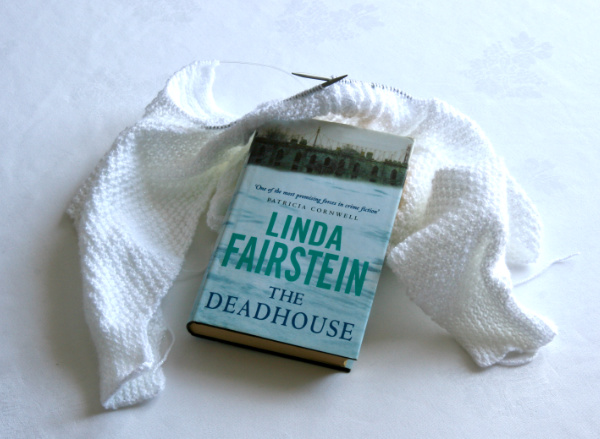 In her novel The Deadhouse, for example, would you want to be cast as
the sleazy academic, or
the workman on the scaffolding peering in windows, or
the student who hangs himself, or
the one who vanishes without a trace?
Would you rejoice seeing your name attached to
the nosey neighbour, or
the paranoid schizophrenic with a history of drug taking, or
the incomprehensible psychiatric patient with learning difficulties, or
the professor found lying at the bottom of a lift shaft?
Would you feel privileged to be identified with
three generations of men, or
the bright spark who solves the crimes?
I kept wondering just what the real owners of all these names would be thinking as the fictional versions got into all kinds of nastinesses. Hmmmmm ….
Thane of Glamis
 You probably already know that Glamis Castle in Angus (childhood home of Elizabeth Bowes Lyon, who later became Queen consort to George VI, best known as Queen Elizabeth the Queen Mother) was the inspiration for Shakespeare‘s Macbeth aka the Thane of Glamis. The bard’s notion of history may have been a little inaccurate but hey, who’s counting?
So, it’s entirely fitting that the woodland in the castle grounds forms the backdrop for the Macbeth trail – seven wooden tableau depicting the principal characters from the play, each with a tasteful scrolled inscription on a plaque.

The three witches. ‘When shall we three meet again in thunder, lightning or in rain? When the hurly burly’s done, when the battle’s lost and won’

King Duncan. ‘There’s no art to find the mind’s construction in the face’
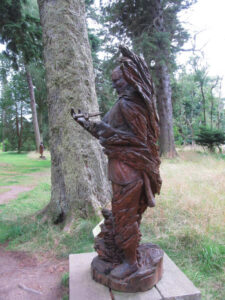
Macbeth. ‘Is this a dagger which I see before me? The handle toward my hand’
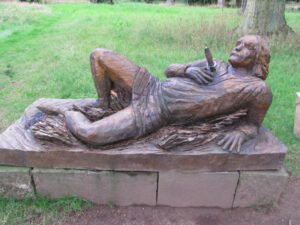
Banquo staggering in death. ‘Revenge’

Lady Macbeth sleepwalking. ‘Out damned spot, out I say’
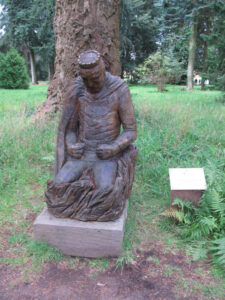
Macbeth contemplating the death of his wife and the futility of it all. ‘Out, out brief candle, life’s but a walking shadow’
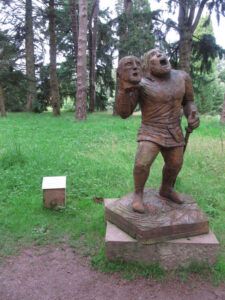
Macduff, Macbeth’s head in his hand. ‘I have no words; my voice is my sword’

I spent over six happy hours in the castle and grounds on Monday. Well worth a visit whether or not you’re a fan of Shakespeare – one of the most beautiful castles in Scotland, steeped in history, set in fabulous grounds, stunning gardens, and the poshest picnic spot I’ve ever encountered! What’s not to like? Oh, and it even has its own set of ghost stories to boot.
Britain’s most prolific baby killer
Big apologies – I promised you a short post this week but shocking events have rather overtaken my good intentions. Sorry. Next time …. hopefully!
 Five years ago, knowing nothing of what was actually happening in Cheshire, I sat in a restaurant in the centre of Edinburgh with a friend who was a senior neonatal consultant, discussing ways of inducing medical catastrophes in small children, for a book I was writing on Fabricated or Induced Illness aka Munchausens by proxy: Killing me Gently. We kept our voices low aware of the possible effect on anyone overhearing our plotting. Two clinicians who had spent decades caring for such tiny infants, now contemplating how to harm them – it was so impossibly improbable it was laughable. Chilling now to think the same methods Lucy Letby used appeared on our list. It makes the horror the more acute and the more horrific. How COULD she?
Lucy Letby worked in our world: the world of tiny super-vulnerable infants. Infants who are so fragile that even a syringe-full of extra fluid can kill them. These tiny scraps of humanity inspire in most of us an instinct to protect and respect and treasure, so this case cuts very deep indeed.

How could a fully trained professional nurse, murder 7 such babies and attempt to murder a further 6 – at least (other suspicious cases were unproven, and an investigation is now on-going to track her footprints through two different hospitals prior to 2015 when the known murders began at the Countess of Chester Hospital).
Though speculations have been offered, no-one yet actually knows what prompted this murderous campaign, but for decent right-minded folk this blonde 33-year-old woman seems a wholly unlikely embodiment of the kind of evil that seems to lie behind it. Indeed her friends stoutly maintain they simply won’t believe it to be true unless Letby herself tells them it is. And we shall never know why unless she eventually chooses to explain herself.
But colleagues began to have suspicions when the mortality rate suddenly shot up in their hospital. It was usually 3 deaths per annum in this unit; suddenly they had 3 in a matter of weeks, unexpected, unexplained. Statistics and mortality reviews and interdisciplinary meetings figure large in units like this, especially where collapses are sudden and inexplicable. At first it was an association, which grew into a mounting conviction, when seven medical consultants discovered one common denominator in every case: the presence of Lucy Letby. No member of any neonatal team ever expects or wants to harbour this kind of suspicion. With hindsight they came to regret not having post-mortems carried out in some of the cases, but when toxicology results revealed evidence of synthetic insulin in the bodies of two of the babies, they were forced to contemplate the unthinkable: a malevolent human hand was responsible for this spate of sudden collapses and inexplicable deaths. They raised the alarm with management.
And this is where is becomes incomprehensible to me.
This team of medical experts – senior, highly trained, experienced, authority figures with ultimate responsibility for these patients – asked for an urgent meeting. Management took 3 months to respond.
After two more deaths the consultants asked that Letby be removed from the clinical arena. Management refused. What’s more the managers even demanded the consultants write a formal message of apology to Letby for maligning her! Still no formal investigation, no referral to the police.
Not till three weeks after yet another attempted murder was Letby finally removed from clinical practice and given administrative duties.
Protecting the reputation of the organisation and staffing levels appear to have played a big factor in this whole sorry saga; we know now the cost of management’s failure to act can be measured in the lives of babies, the grief of parents, the ongoing burden carried by colleagues, the regrets. That system which allowed the murderer to continue killing is itself rightly now under close scrutiny and has been publicly condemned.
Another strange phenomenon in this case is that the babies and their parents have been granted lifelong anonymity which makes it hard for the public to understand and appreciate the full facts and circumstances of each case. Each baby has been given a letter to identify them, but this seems to put him or her at one remove from reality. We can only hope that ultimately a clear, independent and transparent review – please please please not another donkey’s years inquiry! – will allow access to and dissemination of accurate relevant facts, no matter how disturbing, in order to uphold the sacred legal principles of open justice for all concerned.
What we do already know is that Lucy Letby began her killing spree in the Countess of Chester neonatal unit in 2015. Twenty-five suspicious incidents were catalogued; she was present on every occasion. A variety of methods were used, carefully disguised to mimic natural occurrences in premature infants: air injected into veins or stomachs, insulin given, fluid overload induced. Neonatal units are busy places with lots of staff and parents around; she managed to carry out a phenomenal number of assaults in plain sight and somehow avoid detection. She was a quiet, ‘beige’, professional health care worker doing what she was trained to do, in the place where she was legitimately employed: looking after babies. Indeed, after the assaults, she comforted the parents, gave the dead babies their last bath, collected mementoes of hair, handprints, footprints, wrote condolence cards.
She was not removed from clinical practice till July 2016, and not finally arrested until 2018. Her trial began in October 2022 and lasted for ten months, culminating this week. The jury were out deliberating for 110 days considering each case separately in order to reach a verdict for each one. There has been only one death in the Countess of Chester unit in the seven years since Lucy left.
Letby herself has refused to be present in court either when the verdicts were delivered last week, or when the parents gave their impact statements and the judge passed sentence on Monday this week. It’s been castigated as the final insult, not standing up to what she has done, facing the families who have been irrevocably damaged, and to society’s condemnation of her actions as expressed through the judge.  A campaign to change the law on this right to be absent will doubtless be given extra traction because of the harrowing evidence in this particular case. But it won’t affect Letby – she will remain in prison for the rest of her life without possibility of release. A whole life tariff is reserved for the most heinous of crimes and Letby becomes only the fourth woman in British history to be handed this sentence, joining notorious criminals Myra Hindley and Rosemary West.
My heart goes out to her parents; what an unimaginable horror to live with. I weep for the parents who came within her orbit and who now live with the loss of their precious babies or the terrible damage done to those who survive with developmental problems and physical and mental deficits. I fear for those staff who worked alongside a child killer and live with the ongoing questions and doubts. The wounds go profoundly deep; some will never heal.
Forensic science close up
I suspect I’m not alone in sometimes railing against the time taken for real-life cases to come to court, or the release of dangerous criminals on technical grounds, or the vast sums spent on enquiries long after the event. How can people really recall events accurately years later? How can the judiciary live with the knowledge someone else was assaulted or kidnapped or died because they didn’t keep a criminal behind bars? How much money is wasted by the protracted goings on in our justice system? …

I occasionally dip into programmes like Forensics: the real CSI, or Silent Witness, or Professor Sue Black in action, and find the science fascinating. But I was brought up short in a more intense way by a detailed book about the work of the scientists whose job it is to provide evidence that will be robust enough to stand up in a court of law against other scientists and lawyers doing their damnedest to get the criminal off. Conscience duly smitten. How dare I criticise these people? The only wonder now is how those involved cope with the exhaustion, frustration and criticism, and keep persisting case after case after case. Some take years and years of meticulous investigation; some are never solved. Forget needle in a haystack; we’re talking a single hair or thread in a whole crime scene, a minute particle of a chemical in the bones of a whole nation.
 The book is Shallow Graves, by forensic scientist Ray Fysh, (well, actually written for him by James Nally) – a fascinating insider’s view into the demanding work of gathering evidence. Fysh was a working class lad from South East London. Back in 1970, at the time he joined the Met Police, forensic investigation was seen as a niche area for geeks and boffins, but Ray and his team set about transforming it into an essential and integral part of police investigations. He progressed from being a toxicologist to become specialist advisor on all areas of forensic evidence gathering, helping to solve cases and stop violence, a key player in reducing murder rates and saving lives and minimising traumatic loss to families. No mean feat, huh?
So highly prized was his expertise, that he became the go-to man for many major investigations, cases indeed that strike a cold dread into the hearts of anyone who read or heard about them – the murders of Sarah Payne and Damilola Taylor and Billie-Jo Jenkins; London’s 7/7 and 21/7 transport bombings; the poisoning of Alexander Litvinenko – that kind of level.
The detailed descriptions of what happened and how tiny factors like a thread or a hair or a shoe print or a radio-active isotope could clinch a case, make mesmerising reading. So, for example, in the case of Billie-Jo Jenkins in 1997, it was the pattern of pinprick blood spatter and minute skin particles on her foster-father’s clothing that eventually convicted him of the murder. Imagine the sheer impotence of the team, then, when seven years after her death, Sion Jenkin’s team successfully appealed against this incriminating evidence on the say-so or another expert, resulting in him walking out of prison a free man.
Who could ever forget the abduction and killing of 8-year-old Sarah Payne in 2000; those haunting photos of her beautiful innocent little face, and the devastation of her family? It took 7 months and 5 days to convict and charge Roy Whiting – months and months of sifting through a vast collection of items from Whiting’s white van and her makeshift burial site, constantly bearing in mind the mantra: Every contact leaves a trace. Then a black child’s shoe was found on the road; 350 fibres were extracted from the velcro strap; a few proved it was Sarah’s, worn on the day of her abduction; others were indistinguishable from fibres from a red sweatshirt on the front seat of Whiting’s van. And on that sweatshirt was a hair from Sarah’s head – bearing her DNA.
The scale of the case remains unparalleled. Police received over 35,000 calls from the public. Eight hundred premises, waterways and agricultural complexes were searched across five counties. More than sixty miles of roads were combed for clues. The case involved 910 police officers and 112 support staff, costing the taxpayer over £2 million. in all, counting everyone involved, 136,941 hours have been put in – which equates to 5,705 days, or 15.6 years.
And yet Whiting’s conviction ultimately came down to the discovery of a few fibres and a single blonde hair …
You can’t put a price on a moral imperative like getting justice for Sarah Payne and her family.
It took 25 years to catch David Fuller for the so-called ‘Bedsit murders’ in Kent; 34 years until he was sentenced. And again it was forensic evidence that convicted him. But in those intervening years he had been busy. Police found in his home a massive collection of written and filmed evidence of 10 years of violating 102 deceased females aged between 9 and 100 in mortuaries in Kent and Sussex hospitals where he worked as an electrician with access to all areas – crimes committed while the police were methodically looking for evidence for the bedsit murders.
The discovery of a tiny torso wearing bright orange shorts in the Thames was a huge challenge to Ray Fysh and the team. No child had been reported missing. There was no face to use in appeals to the public. Desperate to give this little boy some dignity in death, using applied science, they made amazing strides in tracking across continents to try to identify him, discovering that he was from West Africa, the victim of people trafficking for human sacrifices to appease African deities. No one was ever charged for his murder but the relentless pursuit of answers led to the development of ground-breaking techniques in familial DNA searches and geological mapping to identify where someone had lived – techniques since used to solve countless crimes. Ray sees this progress as the investigative team’s tribute to the little lad whose name they were unable to discover. They themselves assumed the role of his family and gave him a dignified farewell.
The constant struggle to find water-tight forensic evidence even in cases of blatant crime was so clearly evident in the case of the serial rapist who committed 8 such attacks in the space of a year, 4 of them in less than a month. He brazenly seized females aged from 10 to 52, dragging them into more secluded spots to carry out his sexual assaults. And when the evidence is deemed to be insufficient, the team must watch in horror those responsible either go free or be allowed out on parole or prematurely released. Their exhausted impotence surely knocks my semi-detached anger off the bottom of the scale.
The Night Stalker terrorised south London for 17 years, going on sprees of burglary and sexual assault and then lying low. He targetted elderly people who lived alone and attacked at least 98 victims – mostly elderly women but a few men, aged between 68-93. Though thousands of names were added to the ‘possible’-list based on forensic factors, somehow the real villain had been erroneously eliminated from enquiries early on, which meant he was thereafter not considered a possible suspect. Bizarrely investigators actually had his DNA, they knew about his shoe size, his accent, his smell, his MO, his Carribean origins. They suspected he was a carer of some kind, with a religious background, but again and again he eluded them. In the end it was his car which identified him, and the Jamaican taxi driver who had cared for his wife with MS and been a Jehovah’s Witness was finally arrested after 17 years of diligent work involving state-of-the-art equipment and countless experts.

The stories individually and collectively catalogue the colossal amount of work, the eye-watering costs, much of it not bringing results, which these skilled and patient people carry out. They show the huge hurdles to be overcome to get a conviction in court even where no-one is in any doubt as to guilt. I have a new respect for their stamina and dogged determination, and I am moved by their sheer humanity in wanting to give closure and dignity and a sense of justice to the families as well as the deceased. It’s a sad end to this tale that the government decided to cease funding this service which was the envy of the world on the grounds of cost.
Apologies for this long post … I’ll make it super brief next week!
Nightmares – general and specific
Hmmm, I’ve been rather troubled by vivid nightmares myself lately so when I saw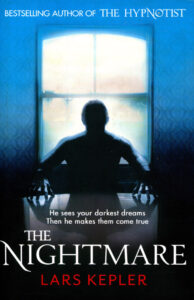 The Nightmare by Lars Kepler among the second-hand books in a stately home a couple of weeks ago, I decided to give it a whirl. It’s 500 pages long, so I needed a good incentive to tackle it. But the main reason that I bought and then persisted with it was that I’d been impressed by The Mirror Man by the same husband-and-wife team (written ten years later) as I mentioned in my review last week. Would this one live up to expectation, I wonder?
A young woman’s body is discovered aboard a boat drifting in a bay south of Stockholm. Her lungs are full of brackish water but her clothes are completely dry. Then a General Director of a Swedish Arms Committee is found hanging in his own apartment in a scenario that looks like suicide. Detective Inspector Joona Linna suspects the two incidents are connected in some sinister way, but even he is unprepared for the professional killing spree which follows, and the intricacy of the events which lie behind this. It’s a tale of corruption in high places, of blackmail and betrayal, of illegal arms deals and smuggling, of security policies and embargoes, of treason, violations of international law, crimes against humanity.
Short chapters make it easy reading, but I confess this one really didn’t appeal to me. It wasn’t so much the rather annoying aspects (frequent statements as to what characters are thinking; repetition of background facts; improbable aspects to the solving of the case; some stiltedness from translation) as that I didn’t care enough for the characters, and found the theme of high level greed and unscrupulous backstabbing somewhat tedious. In my opinion it’d be more pacey and engaging if it were reduced to half the length. Sorry. But it’s a salutary reminder that authors can’t expect readers to like all their books equally.
Oh, and these fictional nightmares make mine so inconsequential as to be not worth a mention. In my case I just need some chill-out time!!
Nordic Noir
Much of my reading has a purpose, and since becoming a novelist myself I’ve broadened my horizons and learned so much – from books I actually dislike as well as those that tick my boxes.  This week I noticed a book in a local shop that intrigued me by its combination of a striking cover and its genre – psychological thriller: The Mirror Man. And as you know, I’ve been studying how to accomplish writing a good psychological thriller for some years now. Having tried it myself I’m in awe of those who pull it off big time.
I’d never heard of this author, Lars Kepler, before so, of course, I looked him up, only to find it’s the name under which a Swedish husband-and-wife-team write. Extra layers of intrigue – how do they do that? I can only imagine the incredible conversations at the breakfast table!
They don’t mess about, that’s for sure. We’re immediately drawn into the sick world of a person who abducts innocent teenager girls. We’re there with Jenny Lind as she’s grabbed on her way home from school and anaesthetised and thrown into a lorry and whisked away into the unknown. And they’re very very good at building and maintaining tension – fast pacing, multiple POVs, single sentence paragraph, staccato prose, cliff hangers aplenty. In some places the descriptions are so vivid as to make me feel physically nauseated. And tension remains high throughout with the ‘goodies’ constantly in danger and no confidence in the survival of even the principal characters.
In the first few pages not only Jenny but another teenage girl also vanishes. Alice Nordström has been fishing in a frozen lake with her step father, Martin. He is rescued from the water hypothermic and now severely traumatised, almost mute and increasingly paranoid with obsessive thoughts. His diagnosis: paranoid psychoses and complex PTSD. For five years he needs round the clock care in a psychiatric ward, unable to accept what has happened. But when his wife Pamela decides to take in an orphaned 17 year old girl Mia, he promises to make a real effort to live at home. However, on top of the most recent trauma, he is haunted by the ghosts of his brothers who died in an accident years ago. We are given vivid access into his tortured mind.
No one believes Jenny could still be alive, but five years after she goes missing, her fresh body is found hanging lifeless in a child’s playground. It’s raining. Where has she been all this time? Enduring unimaginable horror – culminating in having her feet sawn off. Who could have been so ruthless, so entirely without mercy, as to treat this girl so brutally?
A man with an umbrella and a dog is seen on camera witnessing the hanging – making no discernable reaction at all. Who is he and why did her calmly watch without acting to prevent it or alert the police?
When Pamela finds a drawing Martin has done of a girl hanging by her neck, she questions him, but he can’t remember what it means. The police, however, are extremely interested and arrest Martin immediately. He confesses to the murder, but is soon released when his mental state is understood.
But now the real killer knows Martin has knowledge stored somewhere in his mentally disturbed mind. The maniac has his sights on Mia, the girl Pamela wants to take into her home: if Martin divulges what he saw she will be hurt. Pamela is torn but Martin insists he must do his bit and help by undergoing hypnosis to get to the truth.
When we are given insights into the minds of the killer and his accomplice – Caesar and Granny – the horror mounts; the violence ratchets up several notches. Not only are they abducting and torturing the girls they abduct, branding them, raping them, but they are stalking them, taking pictures, even getting into their houses, taking their underwear. But thanks to Martin, some of the details of this pair are revealed when he overhears a fellow-inmate in his ward, Primus, talking to the killer on the phone. Gradually the net tightens, the body count rises, but the detective in charge, Joona Linna, begins to make sense of the facts and to unravel crimes way more shocking and macabre than he ever envisaged.
The title, The Mirror Man, captures the subtlety of the story. The sub-title – If you see his reflection it’s already too late – gives a glimpse into the deviousness of the plotting. At once intense and chilling and riveting and psychologically terrifying. I have no means of knowing if the psychology is scientifically accurate, but if it is, there are conditions that take a person to the edge of a very dark place indeed. Can’t imagine ever going there in my own writing but I learned a lot from reading this particular piece of Nordic noir.
How to Kill Your Family
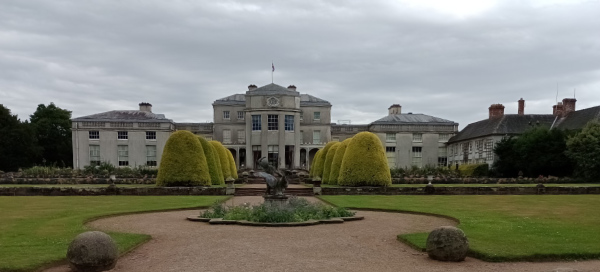
Ahah, if you read my post last week, I guess you’ll have been wondering when this topic might appear – How to Kill Your Family. 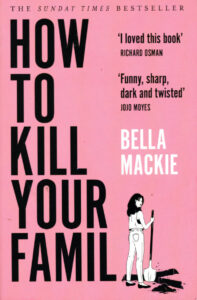 This debut novel by Bella Mackie was written during the pandemic and published last year, quickly becoming a Sunday Times bestseller. Given the reaction of the lovely waitress at Shugborough Manor, I felt somewhat compelled to get on and read the book, to assure her/readers that it was indeed part of my writerly research, not signifying any evil intent on my part!
It’s a tale that takes us inside the mind of an unusual psychopath, one who is possessed and intoxicated by her need/desire to wipe out a complete family. The young killer in this case believes that there’s a certain art to a good murder. She’s not into bloodshed and savage violence; rather she’s fascinated by the motives and habits of her potential victims, and wants their own extravagant lifestyles to be the cause of their undoing. To that end her research is meticulous. She studies the minutiae of the lives and appetites of each of her victims to find a way of killing that happens while they are going about their ordinary everyday activities doing something perfectly normal for them. And, of course, that way credibility is given to a verdict of ‘accidental death’.
Grace Barnard was born of a short unbalanced relationship between an impecunious but effortlessly-beautiful French girl, Marie, and a wealthy entitled already-married man, Simon Artemis, 22 years her senior, one of the richest men in the world, who rejected Marie and her baby both at the pregnancy stage and when Marie appealed to him just before her own untimely premature death.
From the age of 13 Grace has planned a way to avenge her mother: she would rid the world of this morally rotten family, the embodiment of toxic capitalism, a vacuum of morality, a totem of greed. And she had absolutely no qualms about doing so. After all, it wouldn’t be taking anything decent away, would it? Indeed it would be for the public good.
By the time we meet her, she has calmly and methodically killed six members of the Artemis family and then carried on with the rest of her life without a single regret. But having evaded justice for these murders, she is now in Limehouse prison for a crime she did not commit – the death of her foster-brother’s fiancee. To relieve the relentless boredom inside while she awaits her expensive lawyer arranging to get her off her life sentence, she decides to secretly write an accurate account of her life and actions. Re-living the murders, observing her own cleverness, and remembering how she contrived to right a great wrong, helps, though she’s only too conscious that her scribblings are nowhere near the level of Oscar Wilde‘s musings from his prison cell.
Killing her biological grandparents seemed like the least problematic task.
‘… it didn’t matter as much. Old people who do nothing but drain their pensions and stultify in their favourite armchairs isn’t a brilliant advertisement for humanity.’ They’ll only ‘become useless bed blockers who get more and more mean-spirited until they are nothing more than bigoted beasts of burden living in the room you wanted to make a study … old and disposable, and they live staggeringly useless lives.’
Oh, and from the outset her own grandparents wanted nothing to do with their illegitimate granddaughter, Grace, so they don’t deserve to go on living. A ‘natural’, ‘accidental’ death in a car crash attracts no unwarranted attention.
Her cousin Andrew poses a bigger problem. She hasn’t bargained for him being likeable. But, unknown to her, he had already turned his back on wealth and privilege, and now spends his days trying to save the world and mankind through conservation and natural remedies, currently centring on amphibians and hallucinogens. He has put his toxic family out of his life and Grace finds it far harder to carry out her plan with a truly blithe spirit. Finding a way to kill him without arousing suspicion takes a long time in the planning, but his end is suitably gentle and amongst his beloved frogs.
Uncle Lee is a chancer steeped in privilege and greed … a heartless sociopath with nothing at all to recommend him to Grace. It’s a pleasure to carry out her plan with him. His seedy proclivities become his undoing and she watches him die with great satisfaction. But his wife Lara is a different kettle of fish and Grace simply can’t bring herself to harm someone so guileless and decent and wronged.
Her father’s wife Janine, however, is a mean, selfish, indulged woman who spends her whole days doing precisely as she wishes and bullying those whom she considers beneath her. Grace is increasingly drawn to the idea of letting her obscenely luxurious home in Monaco turn on her, and she employs the skill of a needy 17-year-old computer nerd and Janine’s put-upon maid to enable her plan. It’s a calculated risk involving others but she builds in protection for herself to minimise the possibility of a backlash. And again the murder passes as a tragic accident.
Totally spoilt and pampered Bryony, Simon’s 27-year-old legitimate daughter, is the one whose death is most likely (if any) to affect Simon, so Grace leaves her till the penultimate kill. Only when he has suffered this acute loss will she reveal herself and her final intention to him. Bryony has one specific natural weakness which Grace decides to exploit: she is allergic to peaches. The premature death of a young heiress attracts media attention but no suspicion and Grace finally gets a glimpse into the pain she is inflicting on her father.
Only one target left: Daddy dearest himself, the principal victim from the outset. But she hasn’t bargained on him being paranoid for his own safety after losing so many relatives, rendering him virtually unreachable. And it’s an enormous anticlimax when Simon disappears at sea piloting his speedboat while drunk during a visit to his villa in St Tropez. Frustrated and bewildered, Grace weeps for days. Now he would never get to know what she had done and why – the whole point of the plan.
Explanation comes in an unexpected email which she receives the day she is released from prison; an email that will vanish once it’s read. Someone else had a vested interest in the Artemis family; someone else shared a remarkably similar status; someone else was born to a young silly woman dazzled by a larger-than-life Simon Artemis, and then cast aside when he became bored with her; someone else feels entitled to the Artemis’ wealth; someone else was involved in the end of a dynasty. It comes as a complete shock. Especially when that someone knows so much about Grace and her actions. When that someone has effectively scuppered her entire operation.
Journalist and columnist Bella Mackie has created a brilliant plot, based on clever insights into the mind of an emotionally detached but somewhat naive psychopath, and an understanding of human psychology and behaviour. The book is at once gripping, compulsive and chillingly dark. It’s not a comfortable feeling getting inside the head of someone who can kill without scruple, but Mackie manages to keep a lightness of touch and humour by tailoring the deaths – not the usual messy slaughtering, but clean, almost natural ends to pampered lives; and by fleshing out the impact of social injustices and inequalities that fuel Grace’s slow-burning anger, using caustic commentary to give us a degree of sympathy with her single-minded crusade to clean up the world.
The book served as a small diversion from some serious study into much more edifying subjects the waitress at Shugborough would be pleased to know – about virtue and ethics and integrity in real life. The other end of the spectrum from murder.
Interestingly this week the BBC aired a four part programme called The Sixth Commandment based on the true story of a young man who befriended lonely elderly people and conned them out of their money and self respect. He too could take life without scruple. Sobering reality.