Jonathan Kellerman
The Wedding Guest
Writing about some of the best-known detectives in crime fiction recently got me thinking about others that didn’t instantly spring to mind. Cue LAPD Lieutenant Milo Sturgis with his sidekick psychologist Dr Alex Delaware, creations from the mind of Jonathan Kellerman (himself a psychologist as well as best-selling novelist). It will come as no surprise that psychology is closer to my field of interest than crime, so I’ve enjoyed previous books in the series where Delaware shares his insights as a first person narrator.

And what d’you know, there on my tbr shelf was an unread volume featuring this duo picked up in a charity shop recently: The Wedding Guest.
The scene is a wedding reception with a Saints and Sinners theme in a rather seedy venue that used to be a strip club. A pathologically self-centred bride and a wimpish groom do nothing to endear the tale to us. Then one of the bridesmaids discovers the body of a beautiful young woman draped over the cistern in a grotty backroom toilet, a stranger whom no one in the party recognises. There are no means of identification on her and we don’t discover who she is till almost exactly half way through the book.
It’s an easy read with a linear story line but I confess the plot of this one didn’t appeal and I really didn’t care about any of the characters.  However, I’m mentioning it because it serves to remind me that there are many facets of writing which can be valuable, even those we thoroughly dislike. In this case one thing Kellerman does do well is dialogue. Whether it’s the easy banter between Delaware and Sturgis, or the obfuscation and incriminating cues dropped by those with something to hide, or the coded exchanges of colleagues, they drive the narrative on and flesh out the characters.
As the saying goes, no reading is wasted for a writer.
Twisted
What to choose for my break from serious study? Ahah! Jonathan Kellerman! Twisted. 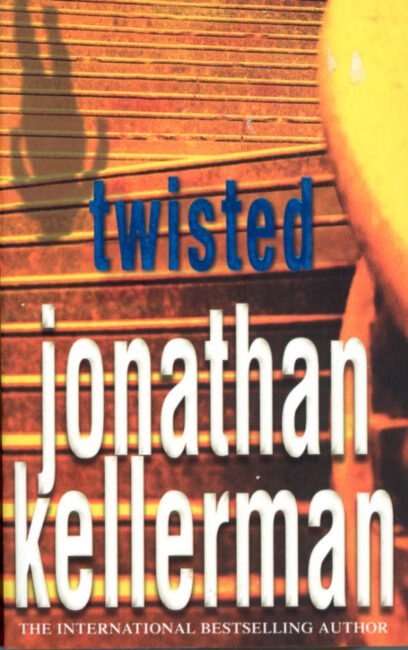 That’ll do nicely. Kellerman’s a child psychologist by background and an acknowledged master of psychological thrillers, so it’ll grip my attention and require close concentration to stay with the plot. The thinking behind criminal acts rather than the actual killing intrigues me.
And did it ever?! A huge cast of characters; red herrings; multiple cases; twists and turns and subplots aplenty; suspense added with a concrete deadline setting the parameters and count down for the chase.
Detective Petra Connor is a busy hands-on homicide officer in California juggling assorted cases when Isaac Gomez, a young research prodigy from an underprivileged background, is assigned to her. Soon after his introduction to police procedures and files, he tells her he’s found an interesting phenomen linking six unsolved murders that occurred over six years: all were committed at around midnight on June 28th. Initially rather sceptical, Petra comes to recognise Isaac’s uncanny ability to think analytically, and together they begin to unravel new material, pursuing witnesses and acquaintances of the victims, all of whom were killed by a massive blow to the back of the head with a blunt instrument, so violent that brain matter is splattered over the scene of the crime. A picture begins to build of a cold and evil mind at work, calculating and orchestrating a pattern of annual murders.
But why June 28th? Isaac enlists the help of librarians who know him well to search the archives for possible enlightenment, while Petra interviews and follows and sifts the people and facts connected with the six cases, both only too aware of the days ticking down to June 28th, and in the process ruffling feathers as they expose negligence and carelessness and perhaps even cover-up on the part of the officers initially assigned to these murders. But not even being suspended from the force will stop Petra doing all she can to save the life of another innocent person on June 28th.
The suspense holds until the very last chapter when an unexpected twist reveals the identity of the real killer. A masterfully plotted tale. And just what the doctor ordered!
Obsession
Prolific author, Jonathan Kellerman, is one of those writers who brings real lived experience to bear on his fictional world. He’s a clinical psychologist with a PhD, as is his most well known sidekick-to-a-cop, Dr Alex Delaware. Obsession is one of the (now 38) Delaware psychological thrillers which has been hiding in the back row of my bookshelves for years but only now come to the front of the queue. I find psychology endlessly fascinating so settled down for an entertaining read.
Patty Bigelow, short, dark eyes, brown mannish haircut, asexual, agnostic, ER nurse, control freak, perfectionist, with OCD, dies at 54 of pancreatic cancer. When she gets her diagnosis and very limited prognosis, she takes control of her own treatment, determined to get ‘all her ducks in a row’. She even stops the morphine to ensure she’s fully aware and functioning rationally. But she has only 25 days from diagnosis to death, and she can only barely convey an urgent final message to her adopted daughter, Tanya: ‘Terrible thing … Killed him. Close by. Know it.’
Tanya Marie is just 3 yr old when her biological mother Lydia, abandons her on her sister Patty’s doorstep. When Lydia dies in a motorcycle accident, Patty adopts the little girl and the two forge a close relationship. But when she’s 5 Tanya starts to manifest signs of OCD, and it’s Dr Delaware who treats her, and is there for her whenever she needs support. She turns to him again when the compulsive habits return following Patty’s death. By now she’s 19 and studying medicine, and she’s alone in the world.
When she reports her mother’s dying words to the psychologist she triggers an investigation that takes Alex and homicide detective Milo Sturgis into some seedy places. How come a nurse could afford the smart duplex Patty has left to her daughter? And who has she killed? And what has she been embroiled in? And how much does Tanya need to know? The underworld brings them up against drug dealers and addicts, porn makers and buyers, murderers and unscrupulous wheeler-dealers, and all manner of accomplices and victims.
I confess I struggled to follow every element of every part of their enquiries and their unique style of banter, but the more I learned of Patty’s compassion and steely determination and good-heartedness, the more I wanted her to be squeaky clean. It’s an intricately woven plot which keeps the threads tightly strung, even till the last page when the knife twists one last time.
Thrillers – lessons learned
 OK, with a pile of thrillers of various kinds now read and analysed, I’m a bit closer to refining my own choices for the current novel. What have I decided so far?
Main narrative thread
The issue must be one I personally care about. And I need to be clear who I’m trying to appeal to. A tale of individuals seeking personal justice or dealing with their own family dramas holds my interest more than stories about money laundering or righting organisational wrongs.
Main protagonist(s)
The lead doesn’t have to be likeable but the reader must care about his/her fate so the character needs to be carefully drawn and handled, with a plausible and intriguing backstory.
His/her motivation must be worthy so readers will root for him/her.
He/she must be up against tremendous odds.
Secondary characters
Too many tangential stories and secondary characters run the risk of losing narrative tension and interest. (Or am I a wimp when it comes to holding umpteen names and storylines in my head?)
Style
Short sentences and staccato prose can help build tension but lose impact if used too often. Sentence structure, length and complexity need to be varied.
Grammatically incomplete sentences also need to be used with caution; they can hold up the pace of a story.
Action
The psychology of the characters must be authentic and plausible. (See writers like Jonathan Kellerman who’s a psychologist himself and uses a psychologist to help solve crimes, or Linda Fairstein who was a prosecutor focusing on crimes of violence against women and children and really understands police procedure.)
Accuracy
If the story includes historical reality or geographical locations, the facts must be spot on accurate.
So, with that foundation, I’m now concentrating on fleshing out the profiles of my own characters.