blackmail
Blood Count
Robert Goddard is a master at convincingly weaving fiction through a period in history, and can always be relied on to give a compelling picture of a time and place alongside his intricate plotting.
 Blood Count is set in the 1990s during the Bosnian War and the subsequent pursuit and trials of the principal war criminals. Interlacing the fictional characters with the real, and authenticating their lives with reference to actual places and events known to us through our newsfeeds if not our own travels, brings them alive.
Thirteen years ago, successful transplant surgeon Edward Hammond performed a life-saving liver transplant on a Serbian gangster, Dragan Gazi. He was paid an eye-watering amount of money for doing so. Gazi is now standing trial at the international court in The Hague (ICTY) for horrific war crimes – persecution, deportation, imprisonment, expropriation, extermination, and the slaughter of thousands of people in the Balkan civil wars. Hammond feels a heavy burden of guilt for having saved the life of such a man, paving the way for him to commit such atrocities.
Now he faces blackmail by ruthless people. Unless he tracks down Gazi’s hidden ill-gotten fortune for daughter, Ingrid Hurtado-Gazi, his reputation and career will be ruined by allegations of his having been complicit in the murder of his wife, Kate, mother of his daughter, Alice.
But the search for the man holding Gazi’s money leads Hammond deeper and deeper into Europe and a dark world of blackmail, torture, assassination and death. He himself spirals further and further into a tissue of lies and deceit, and what started as a search for a missing accountant becomes a battle to stay alive as the body count rises.
You’re a frightened man with a lot to be frightened of.
The picture that unravels reveals horrors he had never envisaged, and gradually the intention to comply with Ingrid’s greedy demands in order to save his reputation, metamorphoses into something much worthier: handing over concrete evidence of terrible crimes to the authorities. Because, before his arrest, Gazi had hidden cassettes covering his nefarious actions between 1995 and 2000 in Belgrade as an insurance policy, and they come into Hammond’s possession. But by this time he’s a wanted man himself, stripped of all the advantages of status and wealth and reputation, and somehow he has to evade his remorseless hunters, and deliver the crucial evidence to The Hague.
Just to complicate things still further, there’s someone else who has a vested interest in these tapes: Zineta, the mother of Gazi’s illegitimate son, who was taken away by his father and given up for adoption. She’s desperate to see her boy again. In the tapes, she sees her chance to blackmail the man who was instrumental in the abduction. And once more Hammond finds himself being double-crossed and facing psychopaths who will stop at nothing to get the evidence that incriminates them. His own moral compass is again in question.
The previous eleven days had changed him. He could never go back to what he was before. He had become an exile from himself.
Gradually, gradually, a more accurate picture emerges. And though a top villain is apprehended, and a serious security risk avoided, Hammond is left fretting and regretting the appalling price that has been paid for this outcome.
 The battle to win back his principles and do the right thing gives him a temporary sense of freedom that’s been hard won, but that integrity looks very much like stupidity when pitched against the devious cruelty of an unscrupulous and amoral group of people. Again and again, in true Goddard style, just when the main protagonist thinks things are resolving, betrayals and counterplots take him and us further away from a conclusion.
Once again Hammond becomes instrumental ln saving the war criminal, Gazi – unwittingly and unwillingly maybe, but no less crucially. But he is enveloped in shame: Gazi’s captivity has lasted less than a year. How can he ever explain all this to his unsuspecting daughter, Alice, whose peace of mind was the prime reason he became embroiled with one of the most notorious perpetrators of ethnic cleansing in the former Yugoslavia in the first place?
It’s a disturbing read bringing to life the atrocities committed in the Balkans, but as usual, told with Goddard’s skill and thoroughness and flair.
Nightmares – general and specific
Hmmm, I’ve been rather troubled by vivid nightmares myself lately so when I saw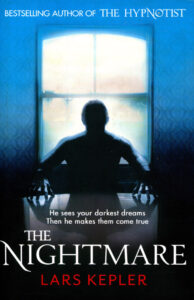 The Nightmare by Lars Kepler among the second-hand books in a stately home a couple of weeks ago, I decided to give it a whirl. It’s 500 pages long, so I needed a good incentive to tackle it. But the main reason that I bought and then persisted with it was that I’d been impressed by The Mirror Man by the same husband-and-wife team (written ten years later) as I mentioned in my review last week. Would this one live up to expectation, I wonder?
A young woman’s body is discovered aboard a boat drifting in a bay south of Stockholm. Her lungs are full of brackish water but her clothes are completely dry. Then a General Director of a Swedish Arms Committee is found hanging in his own apartment in a scenario that looks like suicide. Detective Inspector Joona Linna suspects the two incidents are connected in some sinister way, but even he is unprepared for the professional killing spree which follows, and the intricacy of the events which lie behind this. It’s a tale of corruption in high places, of blackmail and betrayal, of illegal arms deals and smuggling, of security policies and embargoes, of treason, violations of international law, crimes against humanity.
Short chapters make it easy reading, but I confess this one really didn’t appeal to me. It wasn’t so much the rather annoying aspects (frequent statements as to what characters are thinking; repetition of background facts; improbable aspects to the solving of the case; some stiltedness from translation) as that I didn’t care enough for the characters, and found the theme of high level greed and unscrupulous backstabbing somewhat tedious. In my opinion it’d be more pacey and engaging if it were reduced to half the length. Sorry. But it’s a salutary reminder that authors can’t expect readers to like all their books equally.
Oh, and these fictional nightmares make mine so inconsequential as to be not worth a mention. In my case I just need some chill-out time!!