The Mirror Man
Nightmares – general and specific
Hmmm, I’ve been rather troubled by vivid nightmares myself lately so when I saw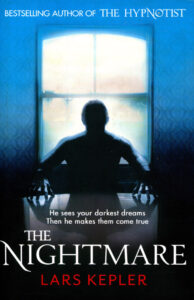 The Nightmare by Lars Kepler among the second-hand books in a stately home a couple of weeks ago, I decided to give it a whirl. It’s 500 pages long, so I needed a good incentive to tackle it. But the main reason that I bought and then persisted with it was that I’d been impressed by The Mirror Man by the same husband-and-wife team (written ten years later) as I mentioned in my review last week. Would this one live up to expectation, I wonder?
A young woman’s body is discovered aboard a boat drifting in a bay south of Stockholm. Her lungs are full of brackish water but her clothes are completely dry. Then a General Director of a Swedish Arms Committee is found hanging in his own apartment in a scenario that looks like suicide. Detective Inspector Joona Linna suspects the two incidents are connected in some sinister way, but even he is unprepared for the professional killing spree which follows, and the intricacy of the events which lie behind this. It’s a tale of corruption in high places, of blackmail and betrayal, of illegal arms deals and smuggling, of security policies and embargoes, of treason, violations of international law, crimes against humanity.
Short chapters make it easy reading, but I confess this one really didn’t appeal to me. It wasn’t so much the rather annoying aspects (frequent statements as to what characters are thinking; repetition of background facts; improbable aspects to the solving of the case; some stiltedness from translation) as that I didn’t care enough for the characters, and found the theme of high level greed and unscrupulous backstabbing somewhat tedious. In my opinion it’d be more pacey and engaging if it were reduced to half the length. Sorry. But it’s a salutary reminder that authors can’t expect readers to like all their books equally.
Oh, and these fictional nightmares make mine so inconsequential as to be not worth a mention. In my case I just need some chill-out time!!
Nordic Noir
Much of my reading has a purpose, and since becoming a novelist myself I’ve broadened my horizons and learned so much – from books I actually dislike as well as those that tick my boxes.  This week I noticed a book in a local shop that intrigued me by its combination of a striking cover and its genre – psychological thriller: The Mirror Man. And as you know, I’ve been studying how to accomplish writing a good psychological thriller for some years now. Having tried it myself I’m in awe of those who pull it off big time.
I’d never heard of this author, Lars Kepler, before so, of course, I looked him up, only to find it’s the name under which a Swedish husband-and-wife-team write. Extra layers of intrigue – how do they do that? I can only imagine the incredible conversations at the breakfast table!
They don’t mess about, that’s for sure. We’re immediately drawn into the sick world of a person who abducts innocent teenager girls. We’re there with Jenny Lind as she’s grabbed on her way home from school and anaesthetised and thrown into a lorry and whisked away into the unknown. And they’re very very good at building and maintaining tension – fast pacing, multiple POVs, single sentence paragraph, staccato prose, cliff hangers aplenty. In some places the descriptions are so vivid as to make me feel physically nauseated. And tension remains high throughout with the ‘goodies’ constantly in danger and no confidence in the survival of even the principal characters.
In the first few pages not only Jenny but another teenage girl also vanishes. Alice Nordström has been fishing in a frozen lake with her step father, Martin. He is rescued from the water hypothermic and now severely traumatised, almost mute and increasingly paranoid with obsessive thoughts. His diagnosis: paranoid psychoses and complex PTSD. For five years he needs round the clock care in a psychiatric ward, unable to accept what has happened. But when his wife Pamela decides to take in an orphaned 17 year old girl Mia, he promises to make a real effort to live at home. However, on top of the most recent trauma, he is haunted by the ghosts of his brothers who died in an accident years ago. We are given vivid access into his tortured mind.
No one believes Jenny could still be alive, but five years after she goes missing, her fresh body is found hanging lifeless in a child’s playground. It’s raining. Where has she been all this time? Enduring unimaginable horror – culminating in having her feet sawn off. Who could have been so ruthless, so entirely without mercy, as to treat this girl so brutally?
A man with an umbrella and a dog is seen on camera witnessing the hanging – making no discernable reaction at all. Who is he and why did her calmly watch without acting to prevent it or alert the police?
When Pamela finds a drawing Martin has done of a girl hanging by her neck, she questions him, but he can’t remember what it means. The police, however, are extremely interested and arrest Martin immediately. He confesses to the murder, but is soon released when his mental state is understood.
But now the real killer knows Martin has knowledge stored somewhere in his mentally disturbed mind. The maniac has his sights on Mia, the girl Pamela wants to take into her home: if Martin divulges what he saw she will be hurt. Pamela is torn but Martin insists he must do his bit and help by undergoing hypnosis to get to the truth.
When we are given insights into the minds of the killer and his accomplice – Caesar and Granny – the horror mounts; the violence ratchets up several notches. Not only are they abducting and torturing the girls they abduct, branding them, raping them, but they are stalking them, taking pictures, even getting into their houses, taking their underwear. But thanks to Martin, some of the details of this pair are revealed when he overhears a fellow-inmate in his ward, Primus, talking to the killer on the phone. Gradually the net tightens, the body count rises, but the detective in charge, Joona Linna, begins to make sense of the facts and to unravel crimes way more shocking and macabre than he ever envisaged.
The title, The Mirror Man, captures the subtlety of the story. The sub-title – If you see his reflection it’s already too late – gives a glimpse into the deviousness of the plotting. At once intense and chilling and riveting and psychologically terrifying. I have no means of knowing if the psychology is scientifically accurate, but if it is, there are conditions that take a person to the edge of a very dark place indeed. Can’t imagine ever going there in my own writing but I learned a lot from reading this particular piece of Nordic noir.