translation
Nightmares – general and specific
Hmmm, I’ve been rather troubled by vivid nightmares myself lately so when I saw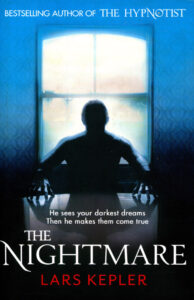 The Nightmare by Lars Kepler among the second-hand books in a stately home a couple of weeks ago, I decided to give it a whirl. It’s 500 pages long, so I needed a good incentive to tackle it. But the main reason that I bought and then persisted with it was that I’d been impressed by The Mirror Man by the same husband-and-wife team (written ten years later) as I mentioned in my review last week. Would this one live up to expectation, I wonder?
A young woman’s body is discovered aboard a boat drifting in a bay south of Stockholm. Her lungs are full of brackish water but her clothes are completely dry. Then a General Director of a Swedish Arms Committee is found hanging in his own apartment in a scenario that looks like suicide. Detective Inspector Joona Linna suspects the two incidents are connected in some sinister way, but even he is unprepared for the professional killing spree which follows, and the intricacy of the events which lie behind this. It’s a tale of corruption in high places, of blackmail and betrayal, of illegal arms deals and smuggling, of security policies and embargoes, of treason, violations of international law, crimes against humanity.
Short chapters make it easy reading, but I confess this one really didn’t appeal to me. It wasn’t so much the rather annoying aspects (frequent statements as to what characters are thinking; repetition of background facts; improbable aspects to the solving of the case; some stiltedness from translation) as that I didn’t care enough for the characters, and found the theme of high level greed and unscrupulous backstabbing somewhat tedious. In my opinion it’d be more pacey and engaging if it were reduced to half the length. Sorry. But it’s a salutary reminder that authors can’t expect readers to like all their books equally.
Oh, and these fictional nightmares make mine so inconsequential as to be not worth a mention. In my case I just need some chill-out time!!
The Badly Behaved Bible
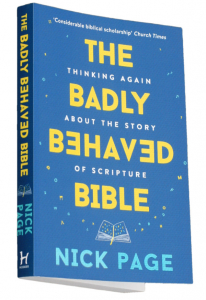 The Badly Behaved Bible. Well, the title grabs you immediately, doesn’t it? We’ve been raised on the idea that the Bible is about teaching us what’s good and right and how to behave in a godly way. So how can it itself be badly behaved?
I saw this book on a friend’s bookshelves during a Zoom meeting, and was intrigued enough to order a copy immediately. And wow! What a lot of things Nick Page challenges; and what a lot of common sense he talks. I confess I don’t go along with everything he says – which he would certainly approve of! – but I loved his robust down-to-earth head-on approach to a traditionally wrapped-in-serious-holy-language topic. Enough in itself to make you think again. He certainly made me sit up and think … and think again.
So many Christians have been brought up with the idea that the Bible is a sacred inerrant book, one coherent whole, and everything does, nay MUST, fit together. If it doesn’t, you’re somehow lacking in spiritual wisdom or knowledge or understanding or whatever other commodity might be crucial. Page has met them all in the course of his work as a writer, speaker, podcaster, unlicensed historian, applied ranter… Orthodox Anglo-Baptecostal.
I meet them when I give talks or lead retreats. Some are cheerful, but confused; some are subdued and quietly thoughtful; some wear the pained expression of people who have suddenly realised that the underwear they have on has shrunk two sizes in the wash. Others look genuinely shocked and distressed, as if they have discovered that their sweet, little, eighty-year-old grandmother has secretly been selling crystal meth down at the day centre.
All of them say the same thing to me: ‘I have this question about the Bible …’
It might be to do with the brutality and the bloodshed, the difference between the God of the Old Testament and the God of the New. Or a ridiculously obscure passage that they simply can’t understand. Maybe it’s a law or command which seems unfair, discriminatory, misogynistic or otherwise at odds with just, you know, ordinary decent behaviour. Quite often they simply can’t believe a word of what they’re reading – that a fish can swallow a man, that a boat can contain all known species, that God placed responsibility for the entire fate of humankind on two people and their behaviour around a fruit tree.
And with verve and humour and straightforward logic, not to mention a hint of borderline irreverent glee in places, he sets out to explain how the real problem is that people are starting from the wrong place. They’ve been misinformed or misled, he says. The Bible isn’t one cohesive and infallible whole; and furthermore it never claims to be. It’s a collection of books all with their own cultural background, history, development, genre and perspective. Every single one has been translated and is subject to translator bias and educated guesswork, with inconsistencies and mismatches and contradictions. Don’t even try to force the pieces of the jigsaw into one box, he recommends.
… we have to stop trying to control it, to tame it, domesticate it, make it support what we want it to say … To open the Bible is to risk our theology, our presuppositions, our deepest-held beliefs.
The fact is, you see, the Bible is a very badly behaved book.
According to Page, we don’t have to struggle with theological contortions any longer. Forget those blanket statements and tablets of stone and fears of perdition you were fed from your cradle up, and instead take each book for what it is, a product of its time, flaws and all. Accept them.
… if we insist on seeing the books as one unified work then we will always have problems with the fractures, the edit points, the duplications and the differing details. But if we just let the text speak for itself, then a different picture emerges; one of collaboration and careful preservation, one of multiple anchors and witnesses, each doing their bit to tell the great story of God and humanity.
 Only then will we be liberated from the mindset that shackles us to an indefensible position, that gives rise to such doubt and angst, and be free to see and hear the message for us personally in our own place, in our own time, and our own culture. Because make no mistake, he’s a genuine fan of this fallible collection of books, the Bible – he believes it to be a place to encounter God.
Oh, and The Badly Behaved Bible is a book for all shades of religious persuasion. The author isn’t about forcing everyone into a mould of his design; rather he wants us all to admit our doubts and questions and frank disbelief. If you don’t doubt, you won’t grow. You won’t change.
Doubt is not a sin. Doubt is a necessity.
Doubt takes you places. Certainty stops you dead in your tracks.
… it is not disrespectful to question the Bible, it is absolutely vital. Because it’s only by questioning that we move to a new understanding.
By now you’re thinking, why am I raising this on my blog about literature and ethics? Because Page draws attention to important aspects of literature.
When we read we subconsciously enter the world of that book. He bases his comments here on scientific research which has demonstrated this fact. We don’t just listen or read when we pick up a book; because of how our brains are wired we live the stories. We feel the things the characters feel. We face their challenges. At least with good stories we do!
Stories are transformational. Stories make us feel and think. Stories empower us …
There are different kinds of truth. A story might not be true in the sense that it’s borne out by historical or scientific or archaeological evidence, but it can still be true. It’s truth lies in its validity for us today. It’s a metaphor, a parable, teaching us something valuable about how we should behave or be, in our time and culture, with our modern understanding of all the -ologies.
This is an absolutely crucial point about the Bible. The truth of a metaphor – whether it is carried as a saying, a poem or a story – is not dependent upon the fact that it literally happened. Metaphors and stories do not have to be literally true. But all of them say something that is true.
The best stories challenge us. You know already my personal predilection for stories that leave me thinking about issues of morality or truth long after I’ve finished reading. So I would agree with this point, wouldn’t I?!
… ask yourself, ‘Is this true? What is the story about? What counsel has this storyteller got for me?’
Participate in the story. That’s why this story is there. Ask the questions. Use your curiosity.
And feel free to use your imagination.
I so agree with all three points, and indeed it’s exactly the reason why I went into writing stories to explore ethical issues all those years ago. So, Nick Page is on my wavelength. And this is one well-written and refreshingly different book that lives up to its whacky title.