control
The Accidental Husband
 The Accidental Husband by Jane Green describes itself as ‘women’s fiction’ or a ‘family drama’. I picked it up in the fabulous secondhand book room at Ushaw I mentioned a few weeks ago.
In essence it tells the story of two women – Sylvie in the UK, Maggie in California, USA – both living in stunning homes, with beautiful children, and a handsome, devoted and wealthy husband. The envy of their friends. Maggie lives in a world of Porsches and massive houses and expensive jewellery; a glamourous and controlling perfectionist. Sylvie is used to living frugally but her many talents have created a lovely home and life for them all. Then one day a secret is revealed that shakes both women to their very foundations.
WARNING: THE REST OF THIS POST CONTAINS SPOILERS
Sylvie’s daughter Eve is on a short holiday to New York with her best friend when she meets up with Maggie’s daughter, Grace. Grace invites her to the family home in Connecticut where Eve sees a picture of the whole family and recognises Grace’s father. Her step-father!
At the same time, back in England debt collectors arrive at Sylvie’s house and remove her husband’s Harley-Davidson. When she protests that they must have the wrong Mark Hathaway, they show her the paperwork which lists two addresses for him, and a wife called Maggie. A Google search confirms that he has indeed got another family in California.
For Sylvie the timing of this couldn’t be worse; she already has a teenage daughter with serious eating problems and a mother lying in a medically induced coma, possibly on her deathbed. The revelation for Maggie drops publicly in front of all the women she is seeking to impress. And Mark? Well, suddenly he is now unavailable to both; his phone switched off.
The shock of discovery and the implications for their families brings these two very different women together: Sylvie, wife of 11 years, laid-back, hard-working, responsible; Maggie, wife of 22 years, self-centred, controlling, ultra-organised, obsessed about perfection. Now united in the blurred world of bigamy.
And gradually they uncover a tissue of lies and deceit, financial problems on a collossal scale. There is a warrant out for Mark’s arrest: not just for bigamy, but fraud, embezzlement, grand larceny. How could he have got away with this for so long? Suddenly both women are the object of pity and humiliation, they and their homes beseiged by reporters and camera men. Money dries up, social contacts dwindle, and they’re forced to examine their own values and priorities and friendship circles. Both struggle to deal with the fall-out for their children too, their daughters in particular reacting powerfully. The only person who truly understands the depths to which they have sunk is their co-wife.
The errant husband is eventually arrested on a beach in Santa Monica for being drunk and disorderly. For their daughter Eve’s sake, Sylvie borrows the money to bail him out of prison and lets him stay in her guest room. She wants nothing from him, no explanations, no apologies, only the possibility of helping Eve. But Eve is in the grip of her anorexia, blaming Sylvie for everything, and she runs to the USA where her condition nose-dives resulting in two cardiac arrests.
This extreme situation throws the two mothers together and gradually the whole family begin to claw back their lives and establish new boundaries, new relationships.
 Though there are literary aspects which niggled for me, overall I was sufficiently interested in the many issues Green tackles – volatile parenting, pathological anxiety, food disorders, body dysphoria, empty nest syndrome, family dynamics – to stick with it.
And the moral of the tale?
It’s summed up best by Maggie’s youngest, Buck:
… blaming doesn’t get you anywhere. It keeps you stuck. Blaming stops you from moving on with your life.
Pathological relationships
I was standing on the shingle bank when they towed her boat back in. The last of the sun was slipping below the horizon, pulling the dying day after it, turning the water of the Solent black … The lifeboat was coming up from the Needles, its orange decks a bright mark in the gloaming, but the throttled down rumble of its engine reached over the surface of the sea like a growl … Less than a minute later, the engine was cut and silence fell.
It was as if the town had taken an inward breath. Nothing moved.
…
They had found her boat, I realised, but they hadn’t found her.
Quite an opening, huh? Palpable tension pervading the scene; a moment in time after which life will be forever changed.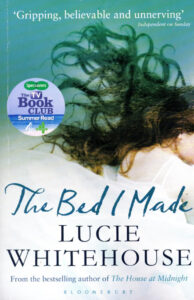 You just know this is going to be psychologically challenging.
The book? The Bed I Made, the second novel by Lucie Whitehouse, and a TV Bookclub Summer Read. (She has gone on to publish more since this one came out in 2010.)
Kate Gibson is on the Isle of Wight, running away from a dark time in her life, when she witnesses this chilling scenario. She’s a translator, so can do her work anywhere … but not if her mind is seething with conflicting emotions. Not if she’s feeling intimidated. Not when every noise in the night fills her with terror. Not when sinister things start to disturb her sense of security.
Richard Brookwood had swept her off her feet instantly when they met in a Soho bar; she’d given herself unreservedly. He was exciting, clever, ambitious, ruthless, rich, handsome, charming, intense, chaotic, challenging, competitive. And he knew exactly how to press her buttons. But now, eighteen months later, she’s doing all in her power to find a safe space away from everything connected with him, from every memory made with him …
… because what we had was not ordinary, there was a higher price for it.
And gradually, incident by incident, the truth begins to emerge from beneath layers of lies and half truths. Those chilling words echo in her head: ‘People have to learn that they can’t outsmart me.’
The attraction had been so strong, the protestations of love so fierce and swift. Then, when the fish was irrevocably hooked, it was payback time.
How could she have been so blind to the warning signs? How could she have made herself so vulnerable?
Whitehouse creates an unnerving story of control and psychopathological behaviour that maintains its tension, whilst leaving space for the reader’s suspicions to fluctuate, and the predator to stalk its prey, coming ever closer, merciless and determined. And through fiction we’re brought closer to the lived reality, and hopefully to more empathy for those caught in these toxic relationships – too many of which we hear about on the news too late.
Psychological control
I’ve been spending a fair amount of time on train stations of late, and browsing in the book sections on platforms while I wait … and wait … and wait. This week I was struck by the proportion of books in the top 60 which deal with psychology and crime – not just through fiction (there were several of those), but factual books.
Confessions of a Psychopath by ME Thomas
Stalkers by Rachel Cassidy
Talking with Psychopaths and Savages by Christopher Berry-Dee
Talking with Serial Killers by Christopher Berry-Dee
Unnatural Causes by Dr Richard Shepherd
…
Hmmm. Is this the current trend, d’you suppose/know?
Weirdly enough, I had a book for the journey on Thursday that takes psychological thriller writing to a whole new level. “A wonderful portrayal of psychological obsession at its creepy best’ as one reviewer puts it. The Girl Before by JP Delaney. Creepy serendipity? or just my mind atuned to the subject?
 The setting for The Girl Before is an ultra-minimalist house in South Hendon in London: One Folgate Street. Austere, sterile, disciplined. Serene, calm, beautiful emptiness. A mausoleum of a place. Its award-winning architect and owner, Edward Monkford, insists on a huge number of rules – over 200! – for anyone leasing the property: no flatpack furniture, no cushions or rugs, nothing to be left on the floor at any time, no animals, no handrails, no books! …These rules constitute a restrictive covenant, a legal condition imposed on the property in perpetuity. Potential inhabitants must sign documents, fill in questionnaires, submit to being interviewed, before being selected to move in, and undergo repeated ongoing psychometric measurements grappling with intense ethical dilemmas – we get glimpses of the penetrating questions they’re asked throughout the book. Once in, they must undertake to keep the property completely uncluttered and regimented in line with Edward’s exacting standards. And every tenant so far has been a beautiful red-headed girl with determination and intelligence – facsimiles of Edward’s dead wife. Every one a vulnerable woman who has know grief and loss.
I’m always somewhat fascinated by the concept of the unreliable narrator, but it’s a tricky tactic to adopt in reality. This story follows two of the tenants – Emma and Jane – as they attempt to live up to the expectations of One Folgate Street, as they unravel the tragedies and stories relating to their predecessors. Because, for all its outward perfection, the house’s history is dark and sinister. Three people have died tragically – Edward’s wife and son amongst them. And Edward’s obsessive tendencies spill over into his control of the women sexually as well as mentally. He is looking for a pure relationship, unencumbered by convention, with a sense of simplicity and freedom on both sides. When it’s no longer perfect, each must be ready to move on, without regret.
Well written, cleverly plotted, interesting structure, well researched – and a runaway success. It took the author a decade or so to work out how to write the book, but she has captured something very special. It was well worth the wait.
I don’t pretend to be an expert in obsessive perfectionism, but it rings true. As does Delaney’s description of grief and loss, and the emotions around having a disabled child. Not surprising maybe as the author has herself lost a son, and has another one with a rare medical syndrome.
And the poignancy of this book is enhanced further for me by a report out the very day I finished it, about a five year high in the statistics for deaths relating to domestic violence in the UK. There is something particularly sinister about pathological behaviour behind closed doors. And Delaney has captured the essence of it in The Girl Before.