family dynamics
The Accidental Husband
 The Accidental Husband by Jane Green describes itself as ‘women’s fiction’ or a ‘family drama’. I picked it up in the fabulous secondhand book room at Ushaw I mentioned a few weeks ago.
In essence it tells the story of two women – Sylvie in the UK, Maggie in California, USA – both living in stunning homes, with beautiful children, and a handsome, devoted and wealthy husband. The envy of their friends. Maggie lives in a world of Porsches and massive houses and expensive jewellery; a glamourous and controlling perfectionist. Sylvie is used to living frugally but her many talents have created a lovely home and life for them all. Then one day a secret is revealed that shakes both women to their very foundations.
WARNING: THE REST OF THIS POST CONTAINS SPOILERS
Sylvie’s daughter Eve is on a short holiday to New York with her best friend when she meets up with Maggie’s daughter, Grace. Grace invites her to the family home in Connecticut where Eve sees a picture of the whole family and recognises Grace’s father. Her step-father!
At the same time, back in England debt collectors arrive at Sylvie’s house and remove her husband’s Harley-Davidson. When she protests that they must have the wrong Mark Hathaway, they show her the paperwork which lists two addresses for him, and a wife called Maggie. A Google search confirms that he has indeed got another family in California.
For Sylvie the timing of this couldn’t be worse; she already has a teenage daughter with serious eating problems and a mother lying in a medically induced coma, possibly on her deathbed. The revelation for Maggie drops publicly in front of all the women she is seeking to impress. And Mark? Well, suddenly he is now unavailable to both; his phone switched off.
The shock of discovery and the implications for their families brings these two very different women together: Sylvie, wife of 11 years, laid-back, hard-working, responsible; Maggie, wife of 22 years, self-centred, controlling, ultra-organised, obsessed about perfection. Now united in the blurred world of bigamy.
And gradually they uncover a tissue of lies and deceit, financial problems on a collossal scale. There is a warrant out for Mark’s arrest: not just for bigamy, but fraud, embezzlement, grand larceny. How could he have got away with this for so long? Suddenly both women are the object of pity and humiliation, they and their homes beseiged by reporters and camera men. Money dries up, social contacts dwindle, and they’re forced to examine their own values and priorities and friendship circles. Both struggle to deal with the fall-out for their children too, their daughters in particular reacting powerfully. The only person who truly understands the depths to which they have sunk is their co-wife.
The errant husband is eventually arrested on a beach in Santa Monica for being drunk and disorderly. For their daughter Eve’s sake, Sylvie borrows the money to bail him out of prison and lets him stay in her guest room. She wants nothing from him, no explanations, no apologies, only the possibility of helping Eve. But Eve is in the grip of her anorexia, blaming Sylvie for everything, and she runs to the USA where her condition nose-dives resulting in two cardiac arrests.
This extreme situation throws the two mothers together and gradually the whole family begin to claw back their lives and establish new boundaries, new relationships.
 Though there are literary aspects which niggled for me, overall I was sufficiently interested in the many issues Green tackles – volatile parenting, pathological anxiety, food disorders, body dysphoria, empty nest syndrome, family dynamics – to stick with it.
And the moral of the tale?
It’s summed up best by Maggie’s youngest, Buck:
… blaming doesn’t get you anywhere. It keeps you stuck. Blaming stops you from moving on with your life.
Psychological thriller meets family saga
Ever since I decided to write one myself (Killing me Gently) I’ve been fascinated by the structure of, and driving force behind, psychological thrillers. Family sagas tick another of my boxes.  Plus I’ve read Louise Jensen before, so The Fall caught my attention when it came out recently. It’s set against the background of the effects of Brexit, the pandemic, and the current economic instability, which makes it feel real and immediate.
Beth and Kate are 40 years old, and identical twins. They both have 15-year-old daughters who have been inseparable … until a secret drives them apart. Now one of them, Caily, is in a coma in hospital following a fall from a bridge. The police think she was pushed – her cousin’s DNA is under her nails.
But everyone in the family is harbouring a secret. Some of them dread Caily recovering consciousness. What will she remember? What did she know that put her in such danger? Will relationships survive if she regains her memory; if she talks?
Someone is leaving gifts for her. How are they getting in? Why bring her bloodied ballet shoes into hospital?
Where has the handsome farmhand Travis gone so suddenly? Why does he reject Caily’s interest so violently?
Who are these men who lurk in the shadows, and drive Range Rovers, and threaten people in their own homes?
The story is cleverly conceived and skillfully unravelled, and I did like the echo in the first line of each chapter of the last line in the preceding one. Other stylistic choices niggled me somewhat, but hey, this author has had considerable success, so she’s allowed some idiosyncrasies. And she certainly kept me guessing as one after another character came under the spotlight with their guilty secrets and mixed motives and reasons to fear Caily recovering her memory and speech. A page-turner and a salutary tale about the impact of deception and lies on relationships.
While She Sleeps
This is something of a moral quandary for me. Do I review a book that I find rather flawed when I could just stick it into a charity shop and say nothing? I’ve done that before. In the end I decided to go for it because it so much reminded me of my own first novel and the issues I had when it was published way back in 1994 – in my case, inadequate editorial scrutiny from people who knew what they were doing, poor proof-reading, too much trust placed in the publisher to get things right. And a terrible sense of disappointment and self-reproach because I had been naive enough to trust in what was promised. So I’m going to put scruples to one side in order to make a point. After all, this is a blog about writing, and we can all learn from other people’s mistakes, mine included.
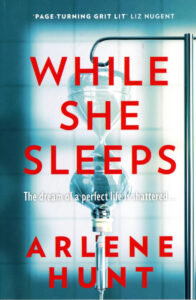 The book is While She Sleeps by Arlene Hunt. The cover is my kind of thing: tick.
The blurb tells me a young woman who is talented and loved, is lying in an induced coma following a murder attempt: tick.
Her family-life is far from perfect and several members of it are in the frame. Another tick.
So far so good. I bought it. And started reading straight away.
Instantly I’m in my comfort zone – fertility, family dynamics, pathological relationships, mental illness, moral responsibility … Yep. Lots more ticks.
But then … oh dear, various things started to really irritate – typos galore; characters misnamed; glancing references to other investigations by the police without a framework on which to pin them. I had to write a profile of the principal characters in order to stay with their details and links to other bit-players. Looked rather like a profile board for a murder in a detective’s office! And then the denouement – well, one minute we had so many loose threads it was anyone’s guess, and then wham! all is revealed from camera footage.
What were Hachette Books Ireland thinking of? Do they have editors and proofreaders these days? I only hope the author didn’t suffer the same sense of disappointment I felt all those years ago. If these were mistakes quite outside her control, she has my sincere sympathy.
Missing …
 I do love discovering a new author and devouring their books. It’s a bit like getting to know a new friend. One such recent discovery was Samantha Hayes. You might – or much more likely, might well not! – remember I posted a review of a psychological thriller by her at the beginning of August. It rang lots of bells with me, which sent me off in search of more of her books. I bought four – enough to give me a feel for the kind of writer she is, I thought.
 Until You’re Mine which came out in 2013, was her first published thriller, so it was appropriate that this was the first one I read. Had her style changed over the years? Is she a predictable author? Would I find her later novels as exciting? I’m very aware that there are downsides to immersing oneself in the writings of a single author – even the best can pall somewhat with over-exposure.
Well, Hayes specialises in scary, skin-crawling tension, that’s for sure … and missing persons … and last minute unpredictable twists. I’ll give you a brief summary of each novel in chronological order of publication.
 You Belong to Me (2015)
Three women have been terrified by stalkers. Two of them – Alexandra Stanford and Melanie Carter – are now dead. Both had red hair, both had infinity tattoos surgically removed from their bodies. The third one, Isabel Moore, also red haired with the same tattoo on her neck, vanished without trace.
DI Lorraine Fisher is haunted by the memory of Alexandra’s dead body. She feels responsible; Alex had reported her terror but there had been insufficient evidence for the police to do anything about her stalker, Jimmy Hardwick. Melanie’s case was different, but some time after her death, Lorraine is told about a man having hassled her too. Could this be the same stalker? Is there a serial killer on her patch?
Isabel Moore, the third woman, has hidden herself away in India, but she comes out of hiding when she receives word that both of her parents are dead; killed in a car crash. And to her horror, she learns that the driver of the car was Felix Darwin, the same controlling man who had made her life a living hell.
Three first person voices tell the story, all with serious issues. One of those voices is that of the seriously disturbed man who terrorises women. It’s scary stuff and certainly gets inside the experience of abusive control. I didn’t guess the final twist but I did find some of the action rather stretched my credulity.
 In Too Deep (2016)
Gina Forrester is struggling – first her son Jacob dies; then her husband Rick disappears. Now someone is taunting her. Is she going mad? Who was watching her from inside that house in Evalina Street? Who really booked a week’s holiday in a luxury hotel for her? And what exactly is her daughter Hannah hiding from her? Everywhere she goes Gina sees ‘bits of Rick, as if he’s been blown into a million pieces‘, and she’s determined to gather them all up, piece him back together again.
Some of the clues are rather too clunky/unsubtle for my liking and I did guess the main twists well before they were revealed, but the question of how it would all resolve itself remained, and that tension kept me reading. Nothing, however, prepared me for the last few lines. (It was the final page of Until you’re Mine that blew me away too.)
 The Reunion (2018)
It’s every parent’s worst nightmare. The Reunion conjures up the cold horror felt by a family when a thirteen year old girl, Lenni, vanishes. It’s 21 years ago now … and the family are in trouble once again. Her father is suffering from Alzheimer’s disease; family rifts are unresolved; someone is sending creepy messages saying the caller knows where Lenni is. It’s time to sell the property which gave such joy and security to the children and their friends. Lenni’s sister Claire decides they’ll have one last hurrah at the house and arranges a reunion of everyone from those halcyon days – which means all those who were present when Lenni actually went missing. But the week intended for reminiscence therapy for her father and healing for them all, turns into a nightmare. Another teenager goes missing. Crimes are committed. Trust is shaken.
This one ticks lots of boxes. It covers my kind of territory: eating disorders, dementia, family dynamics and secrets. Again the ending was a surprise, but for me, the writing isn’t as good as the first one of Hayes’ books I read, and that took the edge off my enjoyment.
So, overall, Samantha Hayes gets a big tick from me for her devious plotting, and for her breathless ‘well-I-didn’t-see-that-coming’ endings. And I’ve learned something more about how to tingle spines in a domestic psychological thriller. But comparisons show me that the component that grabs my interest most is the topic under review and its ethical dimensions. Part of my mind is sorting, seething, delving beneath the surface, wondering What would I do?