Cornwall
13 hours locked in a psychiatric unit
When I was about 20 I was faced with a choice of rotation: obstetrics or psychiatry. It was a no-brainer for me; I was only too aware of the fine dividing line between mental health and mental illness. My vivid imagination played into this decision too.
I grew up in the country in Cornwall not far from the River Tamar. On the other side of the river, on Dartmoor in Devon, was a prison, and very occasionally one of the inmates would escape. I was convinced every owl hoot was them sending signals to their co-conspirators! I couldn’t scuttle the mile home along an unlit path in the gloomy light fast enough. I lay quivering under the bedcovers at night. And I’ve had wierd inexplicable experiences that hover in a twilight zone on and off ever since.
During my decades of clinical practice, I encountered real patients with real mental illness, and visited good friends who needed inpatient treatment for a time. Effective management has changed dramatically over the years, but there’s still for me a scary element of there-but-for-the-grace-of-God … The margins feel all too fragile.
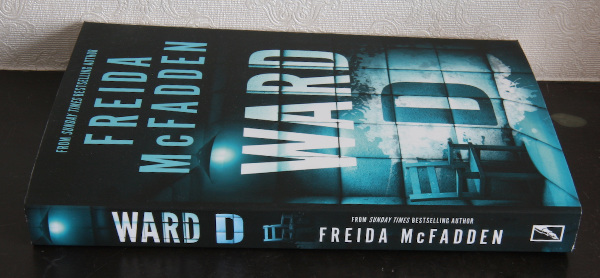
So, last week I picked up a thriller, Ward D, about a psychiatric unit, with a degree of trepidation. Should I get it … should I not? My curiosity overcame my demons and not only did I buy it, but I deliberately put it on the top of my tbr pile. Better not keep procrastinating or I might never dare to open it!
The author, Freida McFadden, is herself a physician specialising in brain injury; her father a practising psychiatrist. She’s a very successful novelist too with accolades in the world of thriller writing, so her credentials are excellent. This should at least be authentic … or is it?
Ward D is a primary locked psychiatric unit. Medical student Amy Brenner is currently rotated to psychiatrics, although she knows she’ll never choose that specialty. Never. Ever. Like me, she’s acutely conscious of the fine line. Almost ten years before, her best friend had been an inpatient there and Amy came face to face with the fragility of the human mind. Hers included. Most especially hers. Because she’d started to hallucinate and hear a voice telling her to do bad things.
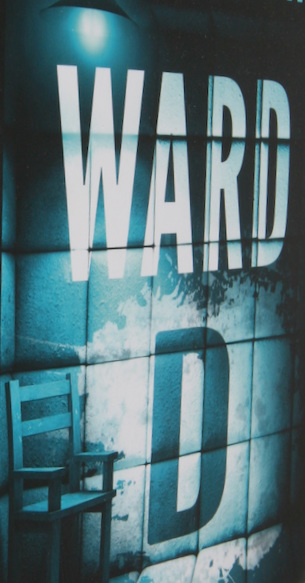 She’s already completed the outpatient bit of her rotation but now she’s scheduled to do one 13-hour night shift in Ward D. Just one night. One night. But for 13 hours she’ll be locked in with seriously disturbed patients and a skeleton staff. She’s frankly terrified, and that feeling only increases when she’s told that two rooms are reserved for the most dangerous patients, one of which is occupied. On no account must she unlock that door. The noises that emanate from behind it are bloodcurdling enough.
The story is written with two time frames. One takes us back eight years to Amy’s friendship at school with Jade, a girl from a troubled home, who develops mental illness sufficiently serious to need incarceration in Ward D for a time. The other, set in the present, counts down the 13 hours of Amy’s night shift as inexplicable things start to happen, terror mounts, and she begins to doubt everyone and everything. The patients have histories of violence but roam around the unit at will, some of them warning her she will be killed that night. A fellow medical student suddenly vanishes from the unit. Even the experienced doctor and nurse she’s working with seem suspect. Who can she trust? But not only is she locked in with them, she has no means of connecting with the outside world, and when a patient manages to damage the electrics, not even a code to allow her to get out.
What actually happens is so extreme I could detach myself from the action for much of the time; it’s inconceivable that this could actually happen. But it was still a tense read.
I did finish it – honestly I did! But perhaps the most sobering message I took from it was that, no matter the severity of the illness or the crimes such patients might commit, they are nevertheless human beings first.
Fiction illuminating ethics
As most of you will know, all my novels explore ethical issues in medicine in an accessible form. So my antennae twitched big time when I saw a trailer to Playing Nice, a series on ITV/STV where a couple were being told that the little boy they had brought home from the hospital was not their biological son.
It’s a psychological thriller set in the fabulous landscape of the Cornish coast with its rugged cliffs and crashing waves (my homeland!); not altogether believable but it doesn’t need to be to hold the attention and exercise the mind.
 In a nutshell:
Theo was born prematurely and cared for in a Neonatal Unit (again, my world!!) alongside another baby boy, David, and somehow the boys have been swapped. The children are now three years old so this discovery tears at their very roots. When the scenario moves from the formal legal to the personal with the appearance of the other father at their door, apparently keen to negotiate a mutually agreeable arrangement, there are big questions to be answered, and it soon becomes clear that the two couples are worlds apart – temperaments, home circumstances, material possessions, approach to parenting, expectations. Different in every way except that all four adults love these children – who’re played by two enchanting little boys! The ensuing unequal legal and psychological battles eat away at relationships and undermine trust, and the underhand shennanigans lead to dangerous and threatening situations.
 Irrespective of the limitations of the adaptation, the storyline offers plenty of challenge:
Would you give up a child whom you’ve raised for three years?
Does biology trump years of nurturing and loving?
Whose interests take precedence?
Who should decide?
Can such situations ever be resolved satisfactorily without involving professionals?
What factors in a person’s background should be regarded as rendering them unsuitable to parent a child?
Is it fair to instantly suspend the professionals caring for the babies who were swapped?
Should there be a formal inquiry?
Does a history of mental illness sway the decision?
At what age should the child have a casting vote?
Does/should a higher standard apply to parents taking a non-biologically related child into their homes?
And so on, and so on. Questions raised not just by circumstances as improbable as in this drama, but in cases of fostering and adoption, of child abuse, or indeed in any circumstance where vulnerable children are involved or at risk. OK, the critics and nitpickers will gripe, but nevertheless the drama serves a very useful function, so I salute JP Delaney who wrote the book on which it’s based, and Grace Ofori-Attah who adapted it for the small screen.
What’s in a name?
You know that point when you think … life can’t get any weirder ….? And it does. Well, I had such a moment this week.

You might have noticed that my beautiful homeland, Cornwall, has been high profile for months – TV programmes, news items, holiday recommendations … now it’s in the spotlight again, this time for re-naming its fish to make them sound more appealing on restaurant menus. Spider crabs become king crab; megrim become Cornish sole. Pilchards have already become Cornish sardine. Made me think about names and what they conjure up. And about competing rights and interests.

But that’s when the ultimate craziness hit me. And it relates to another of my old stamping turfs: the maternity hospital. Midwives in one University Hospitals NHS Trust (Brighton and Sussex) are now being told to stop using terms like ‘breastfeeding’ and ‘breast milk’, and even ‘mothers’ without a qualifying add-on …! Like I say … Hello? OK, I accept that there’s an above average percentage of LGBTQ folk in that area of England, with sensitivities, but still … Has the world gone mad? In a hospital where women are naturally and normally having babies and feeding them from their breasts?
Why, you might well ask. Well, apparently such gender-exclusive terms might cause offence and upset non-binary people.
So, out goes ‘mothers’; in comes ‘mothers or birthing parents’
Out goes ‘breastfeeding’; in comes ‘chestfeeding’
Out goes ‘maternity services department’; in comes ‘perinatal services’
Out goes ‘breastmilk’; in comes ‘human milk’ or ‘chestmilk’ or ‘milk from the feeding mother or parent’
Out goes ‘woman’; in comes ‘woman or person’
Out goes ‘father’; in comes ‘co-parent’ or ‘second biological parent’
Out goes ‘maternal’; in comes ‘maternal and parental’
To begin with, are the folk behind this drive unaware of the facts?
– that men have breastbones
– that men can get breast cancer
– that it’s a biological fact that only women can give birth to babies
– that, in the excitement and responsibility of assisting the delivery of a baby, it’s hard enough to always use acceptable words, without this additional layer of prohibition and verbal diligence
– that in seeking not to offend an Infinitesimally small percentage of the population who object to exclusively female words, they are probably losing the goodwill of the vast majority
– that this attempt to be politically correct and woke, is most likely to put hackles up against the very people it purports to speak for.
I have no wish to attract the venom JK Rowling endured when she challenged a decision to use the expression ‘people who menstruate’ instead of ‘women’, so I will merely leave the matter in your capable hands. As for me, I’m still in recovery stage, and in danger of being left behind with the old dogs beyond learning new tricks.
The South West Coast Path
Moth and Raynor Wynn are in their fifties when, within a matter of days, they lose everything. Betrayed by a close friend, bankrupted by a failed financial transaction and punishing solicitors’ fees through three years of fighting a court case, their home and land possessed by the bailiffs, they are then weighed down with Moth’s diagnosis of a rare degenerative brain condition. There are no drugs to halt the progress, no therapies to keep the disease at bay, and time is running out. Their hopes and dreams lie in tatters.
Raynor is determined not to waste a moment of the time she has left with her beloved husband of thirty-two years. Now officially homeless, in the summer of 2013, they decide on an impulse to leave Wales and take on the South West Coast Path, from Somerset to Dorset via Devon and Cornwall – all 630 miles of it. Home will be a tent bought from eBay, camping in the wild, at the very edgeland of life.

No facilities, often no food, scant possessions, stinking from neglected hygiene, pain in their joints, battered and bruised feet, sunburnt, cut and bruised skin, headaches, dizziness and hunger constant companions, frequently accused of being disgusting tramps, or drunk.
A tramp. A homeless tramp. A few weeks earlier I’d owned my own home, my own business, a flock of sheep, a garden, land, an Aga, washing machines, a lawn mower; I had responsibilities, respect, pride …
Stupid, stupid, stupid.
Stupid to think we could walk this path, to not have enough money, to pretend we were homeless, to get the court procedure wrong, to lose the children’s home, to not have enough water, to pretend we weren’t dying, to not have enough water.
Stupid, stupid, stupid.
But gradually, as time goes on, they readjust their thinking, find new values, new dreams, learn new survival skills. Against all medical predictions, Moth’s health improves dramatically. And their own generosity of spirit shines through. Even though eeking out starvation rations themselves, Moth instinctively shares his last chocolate bar, a sausage sandwich, pasties, with fellow destitutes. By contrast, it’s sobering to hear of a vendor refusing even a cup of cold water. Not knowing their story, being downwind of them, how would I have reacted, I wonder?
This tale has so many resonances for me. I grew up in Cornwall. Yet I hadn’t been aware that depending on which statistics you read, Cornwall has the second or fifth highest rate of rough sleepers in the country, outside of London.
I had to smile at the picture of Raynor cutting her ripped leggings off at the knees with a tiny pair of nail scissors to make shorts. I once sliced the bottom off a posh full-length evening skirt with nail scissors when I realised I’d completely misjudged the dress code for an evening Conference dinner in Australia.
When the Winns were forced to put their boots back on because the soles of their feet were being burned by the scorching hot sand, it brought back vivid memories of a similar situation on a baked beach in Greece in 1968.
Raynor Winn has the skill to conjure up a wonderful combination of sights and sounds and smells and emotions in her writing:
Mozzarella, basil and tomatoes combined in some kind of wind-whipped, gull-swirling heaven. I sat with my back to the football and the wind in my face, looking out over the end of the Bristol Channel and the start of the wide, endless Atlantic Ocean. It’s wild here, a corner where tides, winds and tectonic plates collide in a roar of elemental confusion. A place of endings, beginnings, shipwrecks and rockslides. The viewpoint by the railings caught the air and rushed it up in a jet of cold, oxygenated, sea-spray fizz. I flew with the power of the uplift; alive, we were alive.
She searches for meaning in their new life:
On a basic level, maybe all of us on the path were the same; perhaps we were all looking for something. Looking back, looking forward, or just looking for something that was missing. Drawn to the edge, a strip of wilderness where we could be free to let the answers come, or not, to find a way of accepting life, whatever that was. Were we searching this narrow margin between the land and sea for another way of being, becoming edgelanders along the way? Stuck between one world and the next. Walking a thin line between tame and wild, lost and found, life and death. At the edge of existence …
What they did find was redemption, renewed purpose and hope.
 Small wonder that this remarkable author has been in hot demand on the speaking circuit since The Salt Path was published, and is now commercially successful in her own right.
On a personal note, I’m staggered by how often serendipity/coincidence bring ideas together in life. I was in the middle of this book when BBC2 showed thwarted foreign-travel-writer Simon Reeve’s travels through Cornwall as the county emerged from the first lockdown, and explored what the future holds for a stunningly beautiful tourist hot-spot, riven with homelessness and poverty and inequality. The sight and sound of a fellow-writer forced to live in a run-down shed linger.
It’s been a nostalgic journey to the land of my youth, but provided sobering insights into lives lived beyond my experience. And challenged my values and priorities.
The privilege of ready access to books
With a whole lot of quite ridiculous chasing up and down the country over the past fortnight, we’ve seized the opportunity to visit interesting places en route to relieve the boredom of long drives and give the spine a chance to decompress. I’m not going to wax lyrical about architectural phenomena, nor indeed regale you with tales of great families and grand alliances, nor yet conjure up visions of loveliness twirling parasols on the avenues while dashing young beaux pay court in the rose garden. No, for the purposes of this blog, I want to home in on one of my favourite topics: books.

Tyntesfield in Somerset has been on my to-do list since it was taken over by the National Trust in 2002, and it was conveniently on the way to Cornwall two weeks ago.  It has a fascinating history based around an ordinary family who acquired extraordinary wealth from the sale of guano (yes, indeed, bird droppings!), and I was haunted by the vision of the last owner, unmarried and alone, living in just three modest rooms but surrounded by magnificence and beauty which he had carefully shrouded and preserved for generations to come after his death. It more than lived up to my expectations; in my view one of the loveliest houses in the Trust. A veritable Gothic extravaganza set in superb gardens and surrounded by gorgeous period estate houses and ancient trees. With so much to see then, it was intriguing to find … a second hand bookshop at the entrance!
A big tick for the love of books, huh?
 A week later Belton House near Grantham in Lincolnshire was only a swerve away from the A1 to London. A quintessential country estate, it’s much smaller and less spectacular than Tyntesfield but still well worth visiting, especially with its direct links to the abdication of Edward VIII. But the reason to include it in my blog is twofold. First because the Trust has cunningly converted the stables into a series of most attractive bookshops with used volumes on every conceivable subject crammed into each stall. Wouldn’t you just love to perch here and lose yourself in a period tale or two?


And second because of the library in the main house.
 A beautiful light and airy room with a huge collection of books. But most notable of all, back in the days when an army of servants scurried up and down uncarpeted back staircases to avoid being seen by the family, here they were encouraged to pop up to the family library and borrow books from it to improve their reading skills and their knowledge – provided they put them back, of course. Amazing! A remarkably advanced approach to staff welfare.
So our dalliances during long excursions became unexpectedly book-orientated and uplifting. Long live the physical book.
Pause for reflection
There’s nothing quite like a spot of immobility to challenge one’s priorities. So much of who we are is wrapped up in what we do. If we can’t do, what then?
A rather nasty early morning fall on black ice (who ever suggested pre-breakfast power walking was good for people of my age in winter time?!) and the equivalent of whiplash injury in my lower spine, have curtailed my movements rather too effectively. Please don’t misunderstand me – this is no cry for sympathy; I’ve no one but myself to blame. No one forced me. But the effect is that I’ve been doing rather too much thinking for my own mental well being. (Well, truth be told, I was always pretty borderline.)
Regardless of the accident, March was always going to be a weird time, a kind of cold turkey, waiting for the latest novel to come off the production line. No more tweaking. No more proof reading. What is, is. And most ‘next-jobs’ can’t begin until the book is actually available – next week!
It’s surprisingly hard to concentrate when you’re in constant pain – or maybe I’m just a terrible wimp. And everything feels cack-handed. Imagine said author draped over an ironing board to write, read, eat, and you have a glimmering of the scenario chez moi. Just not being able to sit down becomes remarkably wearisome. Life gets reduced to essentials.
Unfortunately ‘essentials’ includes a lot of travel right now – Ireland, Cornwall, Midlands, London, all within the space of three weeks. ‘Keep getting out of the vehicle and walking around‘, advises my expert osteopath. ‘Try reclining the seat and lying on your side.‘ Hmm. I guess it depends on the vehicle, and who’s driving, and how soon you want to get there.
 So, reflections it is then.
The trip to Galway in Ireland was for an event about dying – both natural and assisted. I was invited on the strength of my novel, Right to Die, and my background in ethics. Eire is working on a parliamentary bill on this subject right now so it’s a hot topic over there; it was an honour to be included. And I felt heartened. After eight years in print my little book is still borrowed from libraries large and small, and the topic is still relevant and controversial,. All very encouraging.
Question is, encouraging enough to keep doing what I do? Hmm. Let’s see.
Things about my work I love and want to retain in my life:
Reading
Writing
Blogging
Editing and revising
Talking about my books/pet subjects
Entering into the debate
Exploring new topics
Good reviews
Hearing from satisfied readers
Things I’m less keen on:
Promotion
Marketing
Tax returns!
 Ahh. The tally says it all. I might revisit this once Inside of Me is on the shelves and my back restored. Who knows, I might even reinvent myself and go for those four inch crimson stilettos!