Devon
13 hours locked in a psychiatric unit
When I was about 20 I was faced with a choice of rotation: obstetrics or psychiatry. It was a no-brainer for me; I was only too aware of the fine dividing line between mental health and mental illness. My vivid imagination played into this decision too.
I grew up in the country in Cornwall not far from the River Tamar. On the other side of the river, on Dartmoor in Devon, was a prison, and very occasionally one of the inmates would escape. I was convinced every owl hoot was them sending signals to their co-conspirators! I couldn’t scuttle the mile home along an unlit path in the gloomy light fast enough. I lay quivering under the bedcovers at night. And I’ve had wierd inexplicable experiences that hover in a twilight zone on and off ever since.
During my decades of clinical practice, I encountered real patients with real mental illness, and visited good friends who needed inpatient treatment for a time. Effective management has changed dramatically over the years, but there’s still for me a scary element of there-but-for-the-grace-of-God … The margins feel all too fragile.
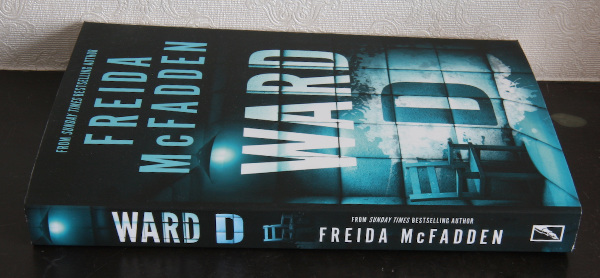
So, last week I picked up a thriller, Ward D, about a psychiatric unit, with a degree of trepidation. Should I get it … should I not? My curiosity overcame my demons and not only did I buy it, but I deliberately put it on the top of my tbr pile. Better not keep procrastinating or I might never dare to open it!
The author, Freida McFadden, is herself a physician specialising in brain injury; her father a practising psychiatrist. She’s a very successful novelist too with accolades in the world of thriller writing, so her credentials are excellent. This should at least be authentic … or is it?
Ward D is a primary locked psychiatric unit. Medical student Amy Brenner is currently rotated to psychiatrics, although she knows she’ll never choose that specialty. Never. Ever. Like me, she’s acutely conscious of the fine line. Almost ten years before, her best friend had been an inpatient there and Amy came face to face with the fragility of the human mind. Hers included. Most especially hers. Because she’d started to hallucinate and hear a voice telling her to do bad things.
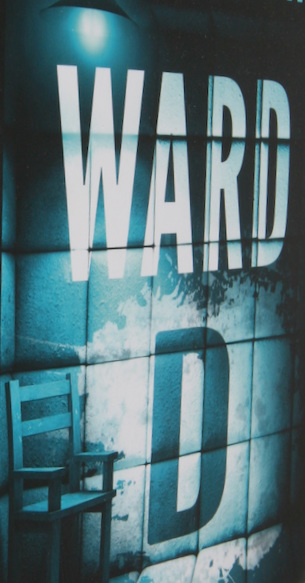 She’s already completed the outpatient bit of her rotation but now she’s scheduled to do one 13-hour night shift in Ward D. Just one night. One night. But for 13 hours she’ll be locked in with seriously disturbed patients and a skeleton staff. She’s frankly terrified, and that feeling only increases when she’s told that two rooms are reserved for the most dangerous patients, one of which is occupied. On no account must she unlock that door. The noises that emanate from behind it are bloodcurdling enough.
The story is written with two time frames. One takes us back eight years to Amy’s friendship at school with Jade, a girl from a troubled home, who develops mental illness sufficiently serious to need incarceration in Ward D for a time. The other, set in the present, counts down the 13 hours of Amy’s night shift as inexplicable things start to happen, terror mounts, and she begins to doubt everyone and everything. The patients have histories of violence but roam around the unit at will, some of them warning her she will be killed that night. A fellow medical student suddenly vanishes from the unit. Even the experienced doctor and nurse she’s working with seem suspect. Who can she trust? But not only is she locked in with them, she has no means of connecting with the outside world, and when a patient manages to damage the electrics, not even a code to allow her to get out.
What actually happens is so extreme I could detach myself from the action for much of the time; it’s inconceivable that this could actually happen. But it was still a tense read.
I did finish it – honestly I did! But perhaps the most sobering message I took from it was that, no matter the severity of the illness or the crimes such patients might commit, they are nevertheless human beings first.
The South West Coast Path
Moth and Raynor Wynn are in their fifties when, within a matter of days, they lose everything. Betrayed by a close friend, bankrupted by a failed financial transaction and punishing solicitors’ fees through three years of fighting a court case, their home and land possessed by the bailiffs, they are then weighed down with Moth’s diagnosis of a rare degenerative brain condition. There are no drugs to halt the progress, no therapies to keep the disease at bay, and time is running out. Their hopes and dreams lie in tatters.
Raynor is determined not to waste a moment of the time she has left with her beloved husband of thirty-two years. Now officially homeless, in the summer of 2013, they decide on an impulse to leave Wales and take on the South West Coast Path, from Somerset to Dorset via Devon and Cornwall – all 630 miles of it. Home will be a tent bought from eBay, camping in the wild, at the very edgeland of life.

No facilities, often no food, scant possessions, stinking from neglected hygiene, pain in their joints, battered and bruised feet, sunburnt, cut and bruised skin, headaches, dizziness and hunger constant companions, frequently accused of being disgusting tramps, or drunk.
A tramp. A homeless tramp. A few weeks earlier I’d owned my own home, my own business, a flock of sheep, a garden, land, an Aga, washing machines, a lawn mower; I had responsibilities, respect, pride …
Stupid, stupid, stupid.
Stupid to think we could walk this path, to not have enough money, to pretend we were homeless, to get the court procedure wrong, to lose the children’s home, to not have enough water, to pretend we weren’t dying, to not have enough water.
Stupid, stupid, stupid.
But gradually, as time goes on, they readjust their thinking, find new values, new dreams, learn new survival skills. Against all medical predictions, Moth’s health improves dramatically. And their own generosity of spirit shines through. Even though eeking out starvation rations themselves, Moth instinctively shares his last chocolate bar, a sausage sandwich, pasties, with fellow destitutes. By contrast, it’s sobering to hear of a vendor refusing even a cup of cold water. Not knowing their story, being downwind of them, how would I have reacted, I wonder?
This tale has so many resonances for me. I grew up in Cornwall. Yet I hadn’t been aware that depending on which statistics you read, Cornwall has the second or fifth highest rate of rough sleepers in the country, outside of London.
I had to smile at the picture of Raynor cutting her ripped leggings off at the knees with a tiny pair of nail scissors to make shorts. I once sliced the bottom off a posh full-length evening skirt with nail scissors when I realised I’d completely misjudged the dress code for an evening Conference dinner in Australia.
When the Winns were forced to put their boots back on because the soles of their feet were being burned by the scorching hot sand, it brought back vivid memories of a similar situation on a baked beach in Greece in 1968.
Raynor Winn has the skill to conjure up a wonderful combination of sights and sounds and smells and emotions in her writing:
Mozzarella, basil and tomatoes combined in some kind of wind-whipped, gull-swirling heaven. I sat with my back to the football and the wind in my face, looking out over the end of the Bristol Channel and the start of the wide, endless Atlantic Ocean. It’s wild here, a corner where tides, winds and tectonic plates collide in a roar of elemental confusion. A place of endings, beginnings, shipwrecks and rockslides. The viewpoint by the railings caught the air and rushed it up in a jet of cold, oxygenated, sea-spray fizz. I flew with the power of the uplift; alive, we were alive.
She searches for meaning in their new life:
On a basic level, maybe all of us on the path were the same; perhaps we were all looking for something. Looking back, looking forward, or just looking for something that was missing. Drawn to the edge, a strip of wilderness where we could be free to let the answers come, or not, to find a way of accepting life, whatever that was. Were we searching this narrow margin between the land and sea for another way of being, becoming edgelanders along the way? Stuck between one world and the next. Walking a thin line between tame and wild, lost and found, life and death. At the edge of existence …
What they did find was redemption, renewed purpose and hope.
 Small wonder that this remarkable author has been in hot demand on the speaking circuit since The Salt Path was published, and is now commercially successful in her own right.
On a personal note, I’m staggered by how often serendipity/coincidence bring ideas together in life. I was in the middle of this book when BBC2 showed thwarted foreign-travel-writer Simon Reeve’s travels through Cornwall as the county emerged from the first lockdown, and explored what the future holds for a stunningly beautiful tourist hot-spot, riven with homelessness and poverty and inequality. The sight and sound of a fellow-writer forced to live in a run-down shed linger.
It’s been a nostalgic journey to the land of my youth, but provided sobering insights into lives lived beyond my experience. And challenged my values and priorities.
Maritime disasters
The last few weeks have been crazy. I’m at the stage of saying: If this is Plymouth it must be Sunday! But in zooming from the Outer Hebrides to Devon with trips to assorted cities in between, there’s been ample opportunity to appreciate what a beautiful country we live in. With temperatures in the 20s and 30s, everything lush and flowering, the countryside is glowing in its prime.
But one evening stroll brought me back to earth in a quite unexpected way. It was Monday: then this much be Lichfield!
 Lichfield is a place I’ve never visited before and expected only to overnight in, but events required a second day there leaving an evening free to explore. And what a lovely city it is – especially when the cathedral bells are peeling out during Monday night practice!
  My footsteps took me to the parks and there I found a statue of Commander Edward John Smith, captain of the ill-fated Titanic on its maiden voyage in 1912. We’ve all heard of the ship of course, but how many knew its captain, I wonder? Not I.
My thoughts unravelled to a book I’ve just finished reading: Salt to the Sea by Ruta Sepetys.  The Titanic, the Lusitania … yes, their names are embedded in our vocabulary. But what of the Wilhelm Gustloff? And yet this ship was at the centre of the worst disaster in maritime history. Over 1500 lives were lost when the Titanic went down; 9400 people died when the Wilhelm Gustloff was torpedoed by a Soviet submarine off the coast of Poland in 1945.
This historical fiction breathes life into a neglected tragedy. It’s a young adult novel set during World War II, beginning in January 1945, as the Third Reich was beginning to collapse. The Russians were gaining ground in East Prussia where Operation Hannibal, the largest evacuation by sea in history, got underway. Thousands of terrified refugees from the Baltic region migrated to the port of Gotenhafen, Prussia (now Gydnia, Poland) to escape the encroaching Russians. There, they boarded the Wilhelm Gustloff, a massive ship owned by the Germans.
Four young people lie at the centre of this tale; four very different characters, all bearing haunting secrets, all seeking to flee from those who hunt them. Emilia is a shy pregnant Polish teenager pretending to be Latvian. Joana is a Lithuanian nurse full of compassion but weighed down by guilt. Florian is a Prussian with a ruthless agenda, carrying a priceless stolen artefact. German Alfred is bent on showing the world he’s a hero, though in reality a coward at heart, living in a fantasy world. No one knows whom they can trust. Their disparate circumstances bring them together on the Wilhelm Gustloff as they join the teeming masses desperately seeking safety and freedom.
By the time the deadly torpedoes are unleashed we know something of the scenes of horror and destruction these young eyes have witnessed, we know their private burdens, we’re willing them to reach their goal. Unlike them we know what lies ahead, but that foreknowledge takes nothing away from the tension of Sepetys’ writing. Extremely short chapters, brisk sentences, one voice at a time taking its turn, sparse language, everything conveys the perspectives of youth and tentative lives lived minute by minute.
Salt of the Sea was loaned to me by my youngest granddaughter, aged thirteen, herself an avid reader. It’s written for her age group but well worth the attention of any age. And a sobering reminder of the tragedy of war and how quickly sacrifice and hardship can be forgotten. Our present day comfortable lives are built upon the sacrifice of others; let’s not forget.
