IRA
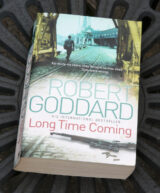
Long Time Coming
It’s bonanza time this month! I’ve been indulging in a second Robert Goddard mystery. Why? Well, I’m recovering from a fall and damaged jaw, and somehow the other two authors I tried simply didn’t have the power to deflect attention away from the pain and awkwardness of my situation.

Long Time Coming worked that magic.
As always with Goddard, it’s intricately plotted with a background of historical accuracy – this time the Irish situation and conflicts in the 1940s – plenty of false trails, deceit, betrayal and skullduggery. Throughout the novel, two different timeframes alternate: 1940 and 1976, with a flashback to 1922 and a forward projection to 2008 at the end to bookend the narrative.
We’ve poked a stick in an anthill, you and I. Stand still too long and we could get badly bitten.
Stephen Swan is a geologist working in the USA in the oil industry. When he returns to Paignton in Devon to check how his morther is coping, two years after his father’s death, he’s told his uncle Eldritch Swan is not dead as he’d always been told, but alive, just out of Portlaoise Prison in Ireland after 36 years, and currently staying in his mother’s guesthouse! His crime seems to be shrouded in mystery, but by accepting release from political internment, which implies renouncing principles which were once held dear and firm, he becomes a pariah to the men he’s served and fought alongside.
Now assorted people – an Irish journalist, a solicitor, an unknown client – are hinting at a lucrative deal if Eldritch will tell his story, but he’s adamant he will not.
Stephen is appalled to discover from his uncle that slave labour in Congolese diamond mines long before he was born had indirectly furnished his father with the unexpectedly large inheritance that had allowed him to buy the Paignton guesthouse and live in comfort. Stephen feels tainted by association with those long ago decades of oppression and exploitation, massacres and mutilations. And now his uncle is asking him to become involved in searching for proof that some famous stolen artwork painted by Picasso belongs to the daughter of Eldritch’s old boss.
I loved the description of Picasso’s work:
… nudes twisted out of shape; portraits with dismantled features; still lifes in which nothing was still; collage-like assemblies of disparate objects; colourful explosions of form and figure.
It’s then that Eldritch shares enough of his past to show Stephen an audacious and sophisticated plot/crime committed as Europe went into the war in the early 40s, that had remained undetected and was quite unrelated to the accusations that put him in prison unjustly. Only trouble is, Stephen quickly sees that he can’t actually rely on anything his uncle says.
 As the story unravels, Stephen begins to piece together the truth, and as his own position is compromised and threatened, and his emotions engaged, he discovers that there are circumstances where expedience must take precedence over justice. That Governments and diplomats and the IRA work to different rules from normal civilised society. That lives and freedoms are sometimes deemed expendable. That silence is sometimes a price worth paying. And his uncle has been, and still is, a victim of them all.
As ever Goddard’s skill as a storyteller blows my mind. Not only is he a master of language, but the way in which he keeps so many threads, all anchored by history, interwoven and overlapping, coherent and sound, is astounding. And alongside all the dark elements he even incorporates a gentle romance. When it comes to duplicity and intrigue, he is indeed in a class of his own.
Warrington travesty
When our railings and gates were stolen eighteen months ago I found it hard to understand the mentality of people who would capitalise on others’ misfortune.  Since then I’ve listened and watched with a growing sense of incredulity, a catalogue of sorry tales involving similar opportunistic or planned crimes, some involving personal injury as well as loss to the innocent victims. Apparently, according to this week’s figures, there are now 1000 metal thefts a week, costing the economy £770 million a year. Birmingham alone had 950 drain covers stolen in just six months last year. One church elsewhere has had its lead stolen seven times! Staggering statistics.
But surely revulsion plumbed new depths with the incident in Warrington earlier this month. It involved a plaque worth a mere £30 to scrap dealers. But this was not just any old strip of bronze; it commemorated the life and death of two young boys – 12 year old Tim Parry and Johnathan Ball, who was only 3 – innocent victims caught up in an IRA bomb blast in 1993. What kind of a mentality sinks this low?
The names of children killed in brutal circumstances remain in the memory, don’t they? Damilola Taylor, Stephen Lawrence, Sarah Payne, Baby P, James Bulger, to name but a few. And where the parents respond to the event with selflessness and generosity, devoting their lives to bringing some good out of their tragedy, these memories are kept fresh and vital.
Instead of spending the rest of their days railing against the perpetrators of a crime that robbed them of their beloved son,Tim’s parents, Colin and Wendy Parry, became active in the peace process in Northern Ireland, vigorously campaigning for an end to the hostilities and divisions that had torn that community apart for so long.The community too, reacted positively by setting up The Tim Parry and Johnathan Ball Foundation for Peace which works nationally with people affected by conflict and violence.
Now it feels as if the thugs who desecrated this memorial are thumbing their noses at the Parry’s altruism. Not surprisingly there has been a national outpouring of sympathy and outrage which Warrington describes as ‘overwhelming’. The plaque will be replaced. Donations are still flooding in to the Foundation.
What’s more, the chief executive has appealed for everyone to follow the Parry’s example in ‘taking a positive approach to managing conflict, rather than engaging in any negative actions as a result of this incident.’
What a fine example of forgiveness and generosity of spirit. One can only hope that at least some metal thieves somewhere will be chastened and shamed into reforming their ways.