master storyteller
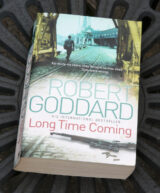
Long Time Coming
It’s bonanza time this month! I’ve been indulging in a second Robert Goddard mystery. Why? Well, I’m recovering from a fall and damaged jaw, and somehow the other two authors I tried simply didn’t have the power to deflect attention away from the pain and awkwardness of my situation.

Long Time Coming worked that magic.
As always with Goddard, it’s intricately plotted with a background of historical accuracy – this time the Irish situation and conflicts in the 1940s – plenty of false trails, deceit, betrayal and skullduggery. Throughout the novel, two different timeframes alternate: 1940 and 1976, with a flashback to 1922 and a forward projection to 2008 at the end to bookend the narrative.
We’ve poked a stick in an anthill, you and I. Stand still too long and we could get badly bitten.
Stephen Swan is a geologist working in the USA in the oil industry. When he returns to Paignton in Devon to check how his morther is coping, two years after his father’s death, he’s told his uncle Eldritch Swan is not dead as he’d always been told, but alive, just out of Portlaoise Prison in Ireland after 36 years, and currently staying in his mother’s guesthouse! His crime seems to be shrouded in mystery, but by accepting release from political internment, which implies renouncing principles which were once held dear and firm, he becomes a pariah to the men he’s served and fought alongside.
Now assorted people – an Irish journalist, a solicitor, an unknown client – are hinting at a lucrative deal if Eldritch will tell his story, but he’s adamant he will not.
Stephen is appalled to discover from his uncle that slave labour in Congolese diamond mines long before he was born had indirectly furnished his father with the unexpectedly large inheritance that had allowed him to buy the Paignton guesthouse and live in comfort. Stephen feels tainted by association with those long ago decades of oppression and exploitation, massacres and mutilations. And now his uncle is asking him to become involved in searching for proof that some famous stolen artwork painted by Picasso belongs to the daughter of Eldritch’s old boss.
I loved the description of Picasso’s work:
… nudes twisted out of shape; portraits with dismantled features; still lifes in which nothing was still; collage-like assemblies of disparate objects; colourful explosions of form and figure.
It’s then that Eldritch shares enough of his past to show Stephen an audacious and sophisticated plot/crime committed as Europe went into the war in the early 40s, that had remained undetected and was quite unrelated to the accusations that put him in prison unjustly. Only trouble is, Stephen quickly sees that he can’t actually rely on anything his uncle says.
 As the story unravels, Stephen begins to piece together the truth, and as his own position is compromised and threatened, and his emotions engaged, he discovers that there are circumstances where expedience must take precedence over justice. That Governments and diplomats and the IRA work to different rules from normal civilised society. That lives and freedoms are sometimes deemed expendable. That silence is sometimes a price worth paying. And his uncle has been, and still is, a victim of them all.
As ever Goddard’s skill as a storyteller blows my mind. Not only is he a master of language, but the way in which he keeps so many threads, all anchored by history, interwoven and overlapping, coherent and sound, is astounding. And alongside all the dark elements he even incorporates a gentle romance. When it comes to duplicity and intrigue, he is indeed in a class of his own.