Letters from Helfenberg
Letters from Helfenberg
In 2002 several large trunks of family correspondence between Dresden and Cambridge, were discovered in the attic of a red-brick, semi-detached house near Girton College in Cambridge. They had lain undisturbed since 1952, neatly tied into bundles with string. Most were written in old German handwriting.
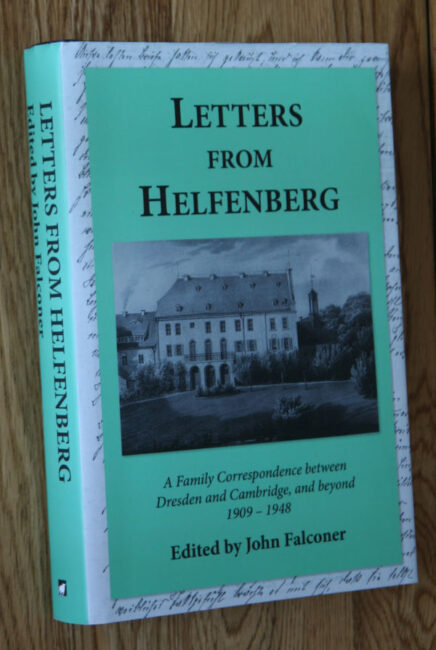
The letters (well over 1000), spanning three generations of a German/English family and half a century of great turbulence, were painstakingly translated and edited by a member of the fourth generation, John Falconer, (a teacher of classics) in a book entitled Letters from Helfenberg; Helfenberg – at the centre of the story – being a rather grand four-storeyed house and farm estate east of Dresden, owned and leased to them by the King of Saxony.
The book is liberally illustrated with evocative photographs of the family and their home across those years, bringing them to life; powerful reminders to me of old photos of my own forebears at a similar time.
The story begins in 1909, when a young Cambridge classicist, William Duke, travels to Germany for a semester’s post-grad study; there he meets Gertrud von Lippe who’s in Berlin for a season taking lessons in English and French in an attempt to improve her education. Their acquaintance is brief but clearly memorable because they agree to correspond, each writing in the other’s language and returning the letters with corrections and comments to improve their linguistic skills.

But other relatives enter into the exchange of letters, and when in 1911 Duke gets engaged it’s to Gertrud’s younger sister Johanna not Gertrud herself. It’s a measure of the formalities in etiquette that Johanna doesn’t even know his first name when she accepts his proposal!
This is not yet another tale of Nazi persecution, but an intimate portrayal of the effect of the two great wars on this family. And even with the benefit of our hindsight it’s chilling to read about the first hint of coming trouble between Germany and England, of the false hopes and propaganda that divert attention from the reality of what’s brewing.
When the young couple marry in 1913 and Johanna moves to England, her parents’ letters pick up the story of life back in her homeland. Gertrud is by this time a semi-permanent invalid limited by her chronic heart condition and lonely without her baby sister, so she’s delighted when Johanna travels to Dresden with her first child Margaret at only 6 months of age. But it’s a tricky time to be in Germany, and while she’s there William writes of the distinct probability of war breaking out. Nobly he gives her the choice of whether to stay in Germany or return to England.
I give you free choice: nevertheless i should like you to come back while it is still possible. It is at times like this that the difficulties of an international marriage surface so vividly!
Johanna is torn but decides to return. However, even before she can arrange things, a letter sent to William, postmarked 1 August 1914, is returned unopened – the first concrete sign that the war has begun. What a conflict for this mixed-race family with divided loyalties, captured by these two excerpts.
Johanna to her brother in the field:
You can imagine that it hurts me if the English cannons are shooting at my own brothers.
Her youngest brother Karl:
It was a strange feeling for me that from now on these [English] guns must protect my little sister against me.
Johanna feels the separation from her birth family acutely when first Karl is killed in action in 1916, and the following year her eldest brother Fritz, both of the deaths conveyed in a letter from Gertrud. The letters from Germany also movingly capture the terrible state of the country after the war: revolution leading to abdication of the Kaiser and declaration of the Republic, social division and hyperinflation, occupation by France and Belgium, strikes, political unrest.
Gertrud was the family philosopher, and after her death in 1922 the tone of the correspondence changes significantly, the men in the family being more preoccupied with political issues, farming and local unrest, and the price of everything. But one by one these correspondents too die (their father in 1924, mother in 1927, and William Duke aged only 42 in 1929).
The family’s tenancy of Helfenberg ends in 1930 after almost 30 years. The story could well have come to a natural end there, but Johanna’s brother Walther’s letters from Germany, and Johanna’s exchanges with her two daughters survive and give a glimpse into life as the two countries once more move towards another conflict, and the women occasionally make trips to the Fatherland.
Draconian postal restrictions from 1939 onwards mean that only the briefest of messages (max 25 words, restricted to family news) between the two countries are possible, and there follows almost six years of silence from Germany.
In time there are happy highlights from England – both Johanna’s daughters become classics teachers (Cambridge University and a school in St Andrews in Scotland), Johanna remarries, and Margaret moves with her family to Scotland. But in Germany Johanna’s niece Renate reports a very bleak picture indeed. Tragedies have befallen the German side of the family, alluded to in a brief post-war message from Renate, but once she’s sufficiently recovered from the emotional and psychological suffering, she pours out her feelings in some amazingly upbeat letters to her aunt recounting some of the evils they are still enduring in 1946-7. She calls it the great desolation. The country is destitute and lawless, with bureaucrats controlling Berlin, which she describes as one great concentration camp.
Yes, it wasn’t for nothing they told us that once more we would envy the dead, and I’ve finally reached that point myself.
The world indulges in the accounts of our atrocities, but about what is going on (in post-war Germany), nobody utters a word.
And indeed I was deeply shocked to read these accounts.
So too was Margaret:
I’d no idea of the details of the economic destruction of Germany, e.g. the confiscation of all her interests in all countries, whether allied, central powers or neutrals, and the entire break-up of her organisation.
Helfenberg, the hub of the family, was expropriated from its royal owners, subdivided, and neglected for the next sixty years. Renate and her parents later safely resettled in West Germany and the story ends in Berlin in 1948.
It’s a sobering read and I can only imagine the pain for John Falconer reading these letters from and about his relatives. But it’s pervaded by immense courage and I leave these assiduous letter-writers to conclude with their own philosophy.
William to Johanna:
It is by unions such as ours that more and more strong chains are forged which bind the two great peoples tighter and tighter together.
William to Johanna at the end of the war:
I think the right line is to hope that the general joy is at the prospect of international brotherhood and the cessation of war, and not at the triumph of one nation over another.
Gertrud:
What a good thing it is that the future is hidden from us in thick veils!
 Our family have wonderful friends in Germany ourselves and both sides would echo these sentiments.