Germany
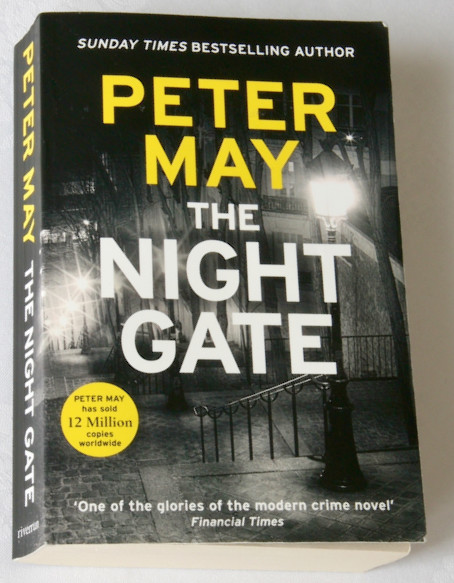
The Night Gate: Peter May
I do love a main protagonist in a series to exhibit unusual characteristics. Peter May‘s forensic expert, Enzo Macleod, has a white stripe in his dark hair running back from one side of his forehead, and one brown eye, one blue eye – both physical manifestations of Waardenburg syndrome. The faulty gene has skipped a generation but reappeared in one of his grandsons as hearing issues. What kind of a mind conjures up something as obscure as that?! Love it. And it’s only one of many trademarks that single this author out as exceptional. I’m a big fan.
Another skill he excels at is evoking different places in different countries. In The Night Gate, we flip from Scotland to France to Germany by means of deft descriptions and a few local words. From the desolate windy shores of the Outer Hebrides to the dusty heat and rural charm of the Occitanie region in SW France, we’re in the hands of a writer who knows where he is.
By now, Macleod is officially retired, but missing the challenge and buzz of his old job. So he can’t resist a request to consult on two murders which have been discovered in a tiny medieval village, Carennac, on the banks of the river Dordogne. One is 75 years or more old: a storm has uprooted a tree and its roots have lifted a tangle of bones and leather and assorted remains of a ranking officer of the Luftwaffe with a bullet hole in his skull. The other is contemporary: it’s the 2020s, pandemic time, and Emile Narcisse, an art dealer from Paris, is found with his throat cut in the rustic kitchen of an elderly woman, Anny Lavigne, in the same village as the WW2 German’s body was discovered.
Immediately suspect for the fresh murder is Hans Bauer, a young German in his twenties, director of a small private art gallery in Germany, who has a history of violent outbursts, and is known to have visted the old lady that day. And incriminating evidence is indeed found placing him at the scene of the murder. But just what is his connection to both these bodies? It all seems too coincidental, and Enzo hates coincidences. So he begins to dig deeper.
The dead man, Narcisse, he discovers, was phenomenally wealthy, a huge name in the world of international art, who came to public recognition when he uncovered a haul of looted Nazi art in an apartment in Geneva, Switzerland. He’d done all he could to return the priceless works to their rightful owners, and where no heirs existed, sell them to museums and art galleries or private collectors. So what had brought a man such as Narcisse to the modest home of an old lady in a tiny backwater village in south-west France?
It’s Anny Lavigne who provides valuable insights which fill in the backstory to the historic case. She tells Enzo so much about what happened in occupied France in the 1940s; a story she’d heard time and again from her mother. How Hitler commandeered an art historian, Paul Lange, to procure the most famous painting in the world, the Mona Lisa, and hide it somewhere until after the war, when it would be given pride of place in the museum Hitler planned to have built in his hometown Linz in Austria. How General de Gaulle knew of this plan and enlisted the help of another art historian, half-French Georgette Pignal, who had personally helped to pack the precious painting and send it into the country for safekeeping from the Germans. Now she was being given full responsibility for guarding it, but she was to tell no one.
 So she’s shocked to discover that Paul Lange, now a German officer, knows exactly what her mission is. She feels nothing but hostility towards him, but he appears unoffended, even mildly amused by her blatant venom and embarassment at being seen in his company. However, her bosses instruct her not to cause any offence to the Germans, so she reluctantly agrees to being wined and dined every Friday night by Lange. He proves himself to be always the gentleman, making no effort to seduce her, and gradually she learns to trust him.
But others too have designs on the famous painting and we get sucked into an increasingly complex vortex of desire and greed and subterfuge. Who will acquire it? And at what cost to those who thwart them?
The fact that so much of the backstory is historically accurate gives added heft and credibility to this tale: the evacuation of art from the Louvre during WW2 to various chateaux around France; the appropriation of countless works of art by the Germans, including burning some of the canvasses; the courage of named individuals in cataloguing the stolen paintings and tracking them down in order to restore them to their rightful owners after the war; the bravery of the resistance fighters. And the cost in lives.
The plotting is tightly and unerringly woven like an underground map with tracks and links and connections steering the reader to a powerful conclusion. And through it all Peter May drops his trademark literary gems which make his writing sing.
Leaves fell like snow in his headlights. September was stating its case for an early winter.
Depression fell over her like a shroud shaken free of its folds, black and all-enveloping.
Moonlight bled through stained glass to sprinkle dead light among the pews.
Compelling, thrilling, and one to haunt me for some time to come.
Letters from Helfenberg
In 2002 several large trunks of family correspondence between Dresden and Cambridge, were discovered in the attic of a red-brick, semi-detached house near Girton College in Cambridge. They had lain undisturbed since 1952, neatly tied into bundles with string. Most were written in old German handwriting.
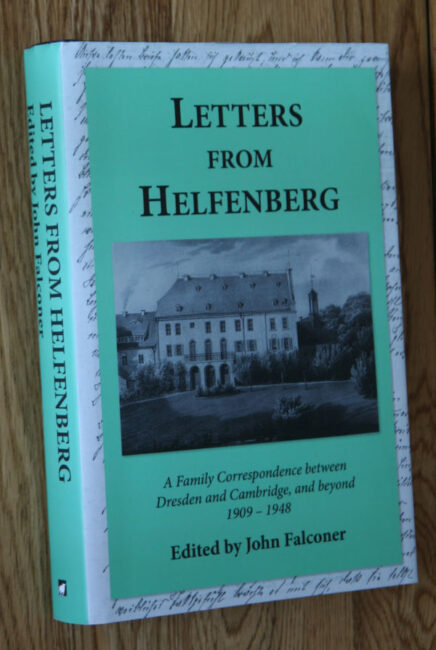
The letters (well over 1000), spanning three generations of a German/English family and half a century of great turbulence, were painstakingly translated and edited by a member of the fourth generation, John Falconer, (a teacher of classics) in a book entitled Letters from Helfenberg; Helfenberg – at the centre of the story – being a rather grand four-storeyed house and farm estate east of Dresden, owned and leased to them by the King of Saxony.
The book is liberally illustrated with evocative photographs of the family and their home across those years, bringing them to life; powerful reminders to me of old photos of my own forebears at a similar time.
The story begins in 1909, when a young Cambridge classicist, William Duke, travels to Germany for a semester’s post-grad study; there he meets Gertrud von Lippe who’s in Berlin for a season taking lessons in English and French in an attempt to improve her education. Their acquaintance is brief but clearly memorable because they agree to correspond, each writing in the other’s language and returning the letters with corrections and comments to improve their linguistic skills.
But other relatives enter into the exchange of letters, and when in 1911 Duke gets engaged it’s to Gertrud’s younger sister Johanna not Gertrud herself. It’s a measure of the formalities in etiquette that Johanna doesn’t even know his first name when she accepts his proposal!
This is not yet another tale of Nazi persecution, but an intimate portrayal of the effect of the two great wars on this family. And even with the benefit of our hindsight it’s chilling to read about the first hint of coming trouble between Germany and England, of the false hopes and propaganda that divert attention from the reality of what’s brewing.
When the young couple marry in 1913 and Johanna moves to England, her parents’ letters pick up the story of life back in her homeland. Gertrud is by this time a semi-permanent invalid limited by her chronic heart condition and lonely without her baby sister, so she’s delighted when Johanna travels to Dresden with her first child Margaret at only 6 months of age. But it’s a tricky time to be in Germany, and while she’s there William writes of the distinct probability of war breaking out. Nobly he gives her the choice of whether to stay in Germany or return to England.
I give you free choice: nevertheless i should like you to come back while it is still possible. It is at times like this that the difficulties of an international marriage surface so vividly!
Johanna is torn but decides to return. However, even before she can arrange things, a letter sent to William, postmarked 1 August 1914, is returned unopened – the first concrete sign that the war has begun. What a conflict for this mixed-race family with divided loyalties, captured by these two excerpts.
Johanna to her brother in the field:
You can imagine that it hurts me if the English cannons are shooting at my own brothers.
Her youngest brother Karl:
It was a strange feeling for me that from now on these [English] guns must protect my little sister against me.
Johanna feels the separation from her birth family acutely when first Karl is killed in action in 1916, and the following year her eldest brother Fritz, both of the deaths conveyed in a letter from Gertrud. The letters from Germany also movingly capture the terrible state of the country after the war: revolution leading to abdication of the Kaiser and declaration of the Republic, social division and hyperinflation, occupation by France and Belgium, strikes, political unrest.
Gertrud was the family philosopher, and after her death in 1922 the tone of the correspondence changes significantly, the men in the family being more preoccupied with political issues, farming and local unrest, and the price of everything. But one by one these correspondents too die (their father in 1924, mother in 1927, and William Duke aged only 42 in 1929).
The family’s tenancy of Helfenberg ends in 1930 after almost 30 years. The story could well have come to a natural end there, but Johanna’s brother Walther’s letters from Germany, and Johanna’s exchanges with her two daughters survive and give a glimpse into life as the two countries once more move towards another conflict, and the women occasionally make trips to the Fatherland.
Draconian postal restrictions from 1939 onwards mean that only the briefest of messages (max 25 words, restricted to family news) between the two countries are possible, and there follows almost six years of silence from Germany.
In time there are happy highlights from England – both Johanna’s daughters become classics teachers (Cambridge University and a school in St Andrews in Scotland), Johanna remarries, and Margaret moves with her family to Scotland. But in Germany Johanna’s niece Renate reports a very bleak picture indeed. Tragedies have befallen the German side of the family, alluded to in a brief post-war message from Renate, but once she’s sufficiently recovered from the emotional and psychological suffering, she pours out her feelings in some amazingly upbeat letters to her aunt recounting some of the evils they are still enduring in 1946-7. She calls it the great desolation. The country is destitute and lawless, with bureaucrats controlling Berlin, which she describes as one great concentration camp.
Yes, it wasn’t for nothing they told us that once more we would envy the dead, and I’ve finally reached that point myself.
The world indulges in the accounts of our atrocities, but about what is going on (in post-war Germany), nobody utters a word.
And indeed I was deeply shocked to read these accounts.
So too was Margaret:
I’d no idea of the details of the economic destruction of Germany, e.g. the confiscation of all her interests in all countries, whether allied, central powers or neutrals, and the entire break-up of her organisation.
Helfenberg, the hub of the family, was expropriated from its royal owners, subdivided, and neglected for the next sixty years. Renate and her parents later safely resettled in West Germany and the story ends in Berlin in 1948.
It’s a sobering read and I can only imagine the pain for John Falconer reading these letters from and about his relatives. But it’s pervaded by immense courage and I leave these assiduous letter-writers to conclude with their own philosophy.
William to Johanna:
It is by unions such as ours that more and more strong chains are forged which bind the two great peoples tighter and tighter together.
William to Johanna at the end of the war:
I think the right line is to hope that the general joy is at the prospect of international brotherhood and the cessation of war, and not at the triumph of one nation over another.
Gertrud:
What a good thing it is that the future is hidden from us in thick veils!
 Our family have wonderful friends in Germany ourselves and both sides would echo these sentiments.
Life after Life
A bonus of lockdown was acquiring ‘new’ books from those donated to our outdoor bookshelf.  One such was Life after Life by Kate Atkinson, about which I’d seen and read excellent reports. (I’m horrified to discover it’s eight years since it came out, and I’m only now getting round to reading it! Too many books, not enough hours in the day.) But somehow, living in this parallel universe of pandemic for the last eighteen months has made Atkinson’s premise – What if you had the chance to live your life again and again, until you finally got it right? – even more pertinent; so perhaps after all it’s a good time to read it.
The hook on the back cover is tantalising:
During a snowstorm in England in 1910, a baby is born and dies before she can take her first breath.
During a snowstorm in England in 1910, the same baby is born and lives to tell the tale.
What if there were second chances? And third chances? In fact an infinite number of chances to live your life?
An ingenious premise upon which to build a novel, huh? And it challenges us to think, What would I do differently, given the opportunity? Would I even want to change things?
Add to that the time period of the story – 1910-1967 – including two great wars, and the implications of a second chance assume even more momentous proportions.
What if a pretty English girl had shot Adolf Hitler in November 1930?
What if a pretty British girl was actually living in Germany when war was declared?
The historic detail relating to big events gives a solid skeleton to this story, but inevitably some factual accuracy is forfeited in the name of literature, as the author herself acknowledges: To find the truth as the heart of a book, a certain amount of reality falls by the way.
Ursula Todd, born in 1910, is a strange child with odd ‘powers’. Was it reincarnation, or clairvoyance, or deja vu, or living in a parallel universe, sixth sense, or what? Certainly her mother thinks she needs ‘fixing’. A Harley Street psychiatrist does his best when she’s 10, but as she grows up, and bad things happen to her, Ursula persists in wondering if death is the answer; she can then have another stab at life and hopefully a happier ending.
We follow her different lives through her rural upbringing with an indulgent father and a superior mother, adult life in London, during the Blitz, and in post-war Berlin. She goes from knowing child, to rape victim, abused wife, assassin, mistress, rescue warden. Back and forth. At times she doesn’t even recognise herself.
It was, I must admit somewhat discombobulating to live through a traumatic experience of the death of a child or young person, only to have them return later in the book very much alive because an alternative version of their lives is being narrated. Short of cataloguing each iteration, I couldn’t hold them all in my head, so went for simply enjoying the moment.
Something of the challenge underpinning this story is captured in these few lines of dialogue about half way through the book:
‘Don’t you wonder sometimes,’ Ursula said. ‘If one small thing had been changed, in the past, I mean. If Hitler had died at birth, or if someone had kidnapped him as a baby and brought him up in – I don’t know, say, a Quaker household – surely things would be different.’
‘Do you think Quakers would kidnap a baby?’ Ralph asked mildly.
‘Well, if they knew what was going to happen they might.’
‘But nobody knows what’s going to happen. And anyway he might have turned out just the same, Quakers or no Quakers. You might have to kill him instead of kidnapping him. Could you do that? Could you kill a baby? With a gun? Or what if you had no gun, how about with your bare hands? In cold blood?’
For me this book came into its own in the section A Long Hard War, where Ursula is a warden dealing with the aftermath of the bombings in London. It poignantly captures the fragility of life, the human tragedy on both sides, the courage and stamina people can find within them, and the importance of small things.
When asked what the book is about, Atkinson says, It’s about being English. That’s not what I took from it. For me it’s about something much more complex; an unravelling of our multi-layered selves, who we are in our imaginations as well as in different circumstances. And how our destiny can be determined by an accident of birth, or a chance conversation, or a seemingly casual encounter or decision. I’m still mulling over all that … and isn’t that one measure of a successful story?

Maritime disasters
The last few weeks have been crazy. I’m at the stage of saying: If this is Plymouth it must be Sunday! But in zooming from the Outer Hebrides to Devon with trips to assorted cities in between, there’s been ample opportunity to appreciate what a beautiful country we live in. With temperatures in the 20s and 30s, everything lush and flowering, the countryside is glowing in its prime.
But one evening stroll brought me back to earth in a quite unexpected way. It was Monday: then this much be Lichfield!
 Lichfield is a place I’ve never visited before and expected only to overnight in, but events required a second day there leaving an evening free to explore. And what a lovely city it is – especially when the cathedral bells are peeling out during Monday night practice!
  My footsteps took me to the parks and there I found a statue of Commander Edward John Smith, captain of the ill-fated Titanic on its maiden voyage in 1912. We’ve all heard of the ship of course, but how many knew its captain, I wonder? Not I.
My thoughts unravelled to a book I’ve just finished reading: Salt to the Sea by Ruta Sepetys.  The Titanic, the Lusitania … yes, their names are embedded in our vocabulary. But what of the Wilhelm Gustloff? And yet this ship was at the centre of the worst disaster in maritime history. Over 1500 lives were lost when the Titanic went down; 9400 people died when the Wilhelm Gustloff was torpedoed by a Soviet submarine off the coast of Poland in 1945.
This historical fiction breathes life into a neglected tragedy. It’s a young adult novel set during World War II, beginning in January 1945, as the Third Reich was beginning to collapse. The Russians were gaining ground in East Prussia where Operation Hannibal, the largest evacuation by sea in history, got underway. Thousands of terrified refugees from the Baltic region migrated to the port of Gotenhafen, Prussia (now Gydnia, Poland) to escape the encroaching Russians. There, they boarded the Wilhelm Gustloff, a massive ship owned by the Germans.
Four young people lie at the centre of this tale; four very different characters, all bearing haunting secrets, all seeking to flee from those who hunt them. Emilia is a shy pregnant Polish teenager pretending to be Latvian. Joana is a Lithuanian nurse full of compassion but weighed down by guilt. Florian is a Prussian with a ruthless agenda, carrying a priceless stolen artefact. German Alfred is bent on showing the world he’s a hero, though in reality a coward at heart, living in a fantasy world. No one knows whom they can trust. Their disparate circumstances bring them together on the Wilhelm Gustloff as they join the teeming masses desperately seeking safety and freedom.
By the time the deadly torpedoes are unleashed we know something of the scenes of horror and destruction these young eyes have witnessed, we know their private burdens, we’re willing them to reach their goal. Unlike them we know what lies ahead, but that foreknowledge takes nothing away from the tension of Sepetys’ writing. Extremely short chapters, brisk sentences, one voice at a time taking its turn, sparse language, everything conveys the perspectives of youth and tentative lives lived minute by minute.
Salt of the Sea was loaned to me by my youngest granddaughter, aged thirteen, herself an avid reader. It’s written for her age group but well worth the attention of any age. And a sobering reminder of the tragedy of war and how quickly sacrifice and hardship can be forgotten. Our present day comfortable lives are built upon the sacrifice of others; let’s not forget.

The Undertaking
Imagine a book opening with consecutive sentences starting like this:
‘He …’
‘He …’
‘He …’
‘He …’
‘She …’
‘He …’
‘But he …
‘The ground …
‘He …’
‘The man …’
Yep, visions of primary school teachers underscoring with red ink imploring pupils to vary their structure … A-Level students receiving a begrudging scraping pass … a manuscript landing with an irritable thwack in the publisher’s waste bin, unread beyond the first page. Definitely a no-no in most people’s handbook of good writing.
And then there’s the complication of three German soldiers working alongside each other, sharing experiences and food, sharing a mission ‘to clear the communists and Jews from Russia‘ – all three surnames beginning with the same letter: Faber, Fuchs, Faustmann. Who thought that was a bright idea?
 I could go on listing broken rules and yet … and yet … this book, The Undertaking by Irish author, Audrey Magee, was published by a reputable company, has been much lauded and admired, and was even shortlisted for the Bailey’s Women’s Prize for Fiction. Justifiably.
As reviewers have said it’s ‘An engaging and beautifully written novel, with an emotional resonance that remains long after you’ve closed the book‘; ‘A violent, elegant, unsentimental journey through hell and halfway back’; ‘A moving journey through the emotional hinterlands of grief and guilt.‘
The language is sparse, the structure simple, the dialogue pared to the bone. But immensely powerful. Set in the time of the Second World War it tells the story of a German soldier, Peter Faber, fighting on the Russian Front who marries a photograph of a woman he has never met in order to get leave and a reason to survive the atrocities of the Front. Hundreds of miles away in Berlin the woman, Katharina, marries a photograph of the soldier to qualify for a war widow’s pension. When they meet, to their surprise and wonder, love and passion blossom, and they start to dream of a bright future in a new and better Germany with the Nazis in control. But war tears them apart and they both separately endure the terrible consequences of destruction, humiliation and defeat.
Such is Magee’s skill with language that we can feel the lice crawling in Peter’s scalp, smell his rank odour after weeks of wearing the same sweat-soaked uniform, cringe with Katharina as he begins his courtship of her in this unsavoury state. We hear the venom in the voices of soldiers who hound innocent Jews from their hiding places. We watch in stunned silence as desperate brutalised men commit acts of barbarity against animals and humans alike, as they ransack homes, violate corpses, fight against the treacherous winds howling across the Russian steppes, all on the orders of their leaders safe at home in Berlin.
It’s salutary to learn what it felt like to be German during wartime, bombed by the allies, but rewarded richly for unquestioning loyalty, on the receiving end of the largesse left by the Jews, flagging spirits rallied with falsehoods and bribes. How would we have reacted to the pressures and promises, I wonder?
The men on the battlefields believe they are in hell; wives and mothers left behind in Germany believe their own lives are a form of hell too. It’s all relative. And perhaps there could be no happy outcome in the face of such obscene suffering and futility. How can either ‘side’ really appreciate the atrocities the other has seen and endured. Many were unspeakable. Rehearsing them would only perpetuate the nightmare. Even reading the pared down accounts creates a despairing hollow in the pit of one’s stomach. Nevertheless I was left feeling profoundly sad that a love that had sustained Peter and Katharina through so much pain and horror, in the end could not survive the shame and consequences of an experience completely outside of their control.
This was Audrey Magee’s first novel and it’s a brilliant, sweeping epic of a book that compels the reader to keep turning the pages, to watch helplessly as injustice and hate and human frailty destroy lives and devastate families. It’s far from comfortable reading but I highly recommend it. And how right she was to keep her sentences sparse and simple, give us the bare bones or moral bankruptcy without adornment. This is one occasion where the rule book needed to be consigned to an inaccessible shelf.
Berlin: Imagine a City

The iconic Brandenburg Gate
Berlin is a ‘haunted, ecstatic, volatile city’: so says Rory Maclean, in Berlin: Imagine a City. ‘Its identity is based not on stability but on change. No other city has repeatedly been so powerful, and fallen so low. No other capital has been so hated, so feared, so loved. No other place has been so twisted and torn across five centuries of conflict, from religious wars to Cold War, at the hub of Europe’s ideological struggle. Berlin is a city that is forever in the process of becoming, never being, and so lives more powerfully in the imagination.’
I’ve just this evening returned from a six day visit to this amazing city, having read Maclean’s book in preparation for my trip. It’s no ordinary tourists’ guide, no street map trekking across town and noting historic sites, principal attractions, beautiful buildings, interesting facts. Rather it reads more like a novel as it weaves together portraits of 21 of its former inhabitants who shaped its various incarnations over five centuries; artists, leaders, thinkers, activists. Harrowing tales from the inside of atrocities sit side by side with evocative imaginings of lives lived behind glittering facades and forbidding walls, stark facts about divided loyalties and brutality beyond belief merge with heart-warming touches of human compassion and love, invention cohabiting with reality.
It gave me a tantalising glimpse into the background behind the seen and the unseen, the beautiful and the ugly, the conflicts and the peace. A little chaotic at times maybe, embellished history, creative reporting, but it didn’t matter; it brought everything to life in a most engaging way. And for more present-day practicalities we had my son as personal guide – he loves the city which he has visited many times, he was living in Germany and travelled to Berlin within weeks of the Wall coming down, he studied there for his PhD, he revisited for the 25th anniversary of reunification of East and West, he writes about Berlin today.
So did real life 21st Century Berlin match up to the one conjured up through the lives and passions of those myth makers and historical figures? Indeed it did; more than. Yesterday really does echo along today’s alleyways and streets. There was a pervading sense that had I asked, ‘Where is the real Berlin?‘ the answer would have been, ‘Just walk down this street and turn right at 1933.‘
Films, exhibitions, museums, books, statues, monuments … the city abounds with vivid portrayals to give us an insight into Berlin’s dark history. Wandering its streets the imagination goes into overdrive.
‘So much of it has been lost or reinvented that the mind rushes to fill the vacuum, fleshing out the invisible, linking facts with fiction’ much as the book does. One can feel ‘its aching absences as much as its brazen presence: the sense of lives lived, dreams realised and evils executed with an intensity so shocking that they rent the air and shook its fabric.’
Naturally enough the most powerful messages relate to the Holocaust and the Berlin Wall. It was overwhelmingly sad to see the railway station where thousands of Jews were deported to the concentration camps with the numbers despatched each day (anything from 90 to 1780 plus) etched into the edge of the line, to stand beside a water sculpture dedicated to the huge numbers of Romani people similarly annihilated, or to see the individual names of the murdered set into monuments and Stumbling stones in the cobbles.

Stumbling stones in the pavement commemorate Jews who were deported from that house to concentration camps
And the horrors around the East/West divide are indelibly captured by plaques and pavers, monuments and memorials, even remaining sections of the Wall.

The remains of the Berlin Wall

Memorial to those who were killed trying to get over the Berlin Wall
But as Maclean says, ‘In a courageous, humane and moving manner modern Germany is subjecting itself to national psychoanalysis‘ to deal with the memory of historical suffering. So many reminders must surely be some measure of their determination to learn from the lessons of the past.

Monument to children who were selected for either concentration camps or Kindertransport: trains to death or a new life
However, a painter (of the fine art variety not Dulux) challenges the rest of us to take stock too: ‘I do not want to say that they – the SS officers, the camp guards, even the soldiers by the Wall – are like us. It is different, worse I guess. They are us – and we would have been them, in our respective times. It does not mean that I think we – the Germans – are likely to ever become Nazis or Communists again. Germany is a profoundly different land now, its identity reshaped for ever by cataclysmic events. But it is the potential for us, them, me, to have been part of such events that is the horror of today.‘

The Reichstag (where the German Parliament meets)
For all its ghosts, though, today Berlin is vibrantly alive. And we, the living, are privileged to walk alongside the dead, remembering, but appreciating and imagining a better world. (Ironic that the very day I visited the Reichstag we picked up a copy of DasParlament – reporting the politicians’ activities – and what should be the headline article on the front page but the issue of assisted suicide!)
The Book Thief
I love autumn. All those crisp mornings, the sound of crunchy leaves underfoot, fabulous colours. Our copper beech hedge is a golden blaze at the moment. Something to do with the spring drought and cool damp summer apparently.
I’ve just returned from Oxford, travelling by train, and can vouch for stunning russets and vibrant reds through to sunshine yellow everywhere. But speaking of colours … what about this as a description:
‘Summer came.
For the book thief, everything was going nicely.
For me, the sky was the colour of Jews.’
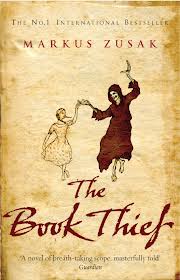 Death is the narrator of The Book Thief by Markus Zusak. It’s 1939. In Germany. The Nazis are increasingly forcing their politics onto the people, poverty and betrayal lurk in the scared streets, and Death is extremely busy. This could easily be a depressing, even macabre book, but it isn’t. Even Death himself is gently compassionate.
‘Please believe me when I tell you that I picked up each soul that day as if it were newly born. I even kissed a few weary, poisoned cheeks. I listened to their last gasping cries. Their French words. I watched their love-visions and freed them from their fear.
…
In complete desolation, I looked at the world above. I watched the sky as it turned from silver to grey to the colour of rain. Even the clouds tried to look the other way.’
And he is gentle with the reader too, slipping in the occasional spoiler to soften the approach to sadness.
Tucked away in a little town called Molching, on the outskirts of Munich, lives Liesel. She’s a child with dangerous eyes – brown eyes, who has already known death and loss. Late at night her foster father, Hans Hubermann, patiently teaches her to read. Liesel is utterly mesmerised by words, but there is no money for books, so she takes matters into her own hands and acquires them by stealth.
Three men exert a powerful influence over her: a young criminal, a fugitive Jew and a man with a heart of gold. And gradually realisation of the encroaching horrors of war impinge on her childish innocence. She becomes even more intimately acquainted with Death.
Zusak’s writing style is uniquely his own. Strange little curlicued inserts give vital information. Staccato sentences, truncated paragraphs, haul you without mercy into the very kernel of the emotions and experiences of the time. The almost childish writing fits perfectly with the whole life-view of the characters. Its very simplicity tugs at the heart strings.
And seeing things from his own perspective, Death paints wonderfully evocative pictures of …
… the holocaust:
‘When their bodies had finished scouring for gaps in the door, their souls rose up. Their fingernails had scratched at the wood and in some cases were nailed into it by the sheer force of desperation, and their spirits came towards me, into my arms. We climbed out of those shower facilities, onto the roof and up, into eternity’s certain breadth. They just kept feeding me. Minute after minute. Shower after shower.’
… of the blitz:
‘The only sign of war was a cloud of dust migrating from east to west. It looked through the windows, trying to find a way inside, and as it simultaneously thickened and spread, it turned the trail of human beings into apparitions.
There were no more people on the streets any more.
There were rumours carrying bags.’
… of illness and death almost seven decades ago:
‘At thirteen, tragedy struck again when his uncle died.
As percentages would suggest, his uncle was not a hot-head like Max. He was the type of person who worked quietly away for very little reward. He was not a rich man. He did not take what was rightfully someone else’s – and he died of something growing in his stomach. Something akin to a poison bowling ball.
As is often the case, the family surrounded the bed and watched him capitulate.
Somehow, between the sadness and loss, Max Vandenburg, who was now a teenager with hard hands, blackened eyes and a sore tooth, was also a little disappointed. Even disgruntled. As he watched his uncle sink slowly into the bed, he decided that he would never allow himself to die like that.
The man’s face was so accepting.
So yellow and tranquil, despite the violent architecture of his skull –
The endless jawline, stretching for miles, the pop-up cheekbones and the pot-hole eyes. So calm it made the boy want to ask something.
Where’s the fight? he wondered.
Where’s the will to hold on?
Of course, at thirteen he was a little excessive in his harshness. He had not looked something like me in the face. Not yet.
With the rest of them, he stood around the bed and watched the man die – a safe merge, from life to death. The light in the window was grey and orange, the colour of summer’s skin, and his uncle appeared relieved when his breathing disappeared completely.
“When death captures me,” the boy vowed, “he will feel my fist in his face.”
Personally, I quite like that. Such stupid gallantry.
Yes.
I like that a lot.’
It’s salutary to see the war through the eyes of Germans. To realise the enemy is British. The hands that released the bombs that decimate Liesel’s home are those of the Allies. That the young pilot dying in the smoking and broken plane speaks English.
Suspend any preconceived ideas you might have, and if you can, your personal religious and moral beliefs, and let the poetry of this book speak to you. It’s at once moving and challenging, enjoyable and troubling. And when you’ve lingered a while over the last haunting sentence, do let me know which emotion predominates for you.