World War 2
Letters from Helfenberg
In 2002 several large trunks of family correspondence between Dresden and Cambridge, were discovered in the attic of a red-brick, semi-detached house near Girton College in Cambridge. They had lain undisturbed since 1952, neatly tied into bundles with string. Most were written in old German handwriting.
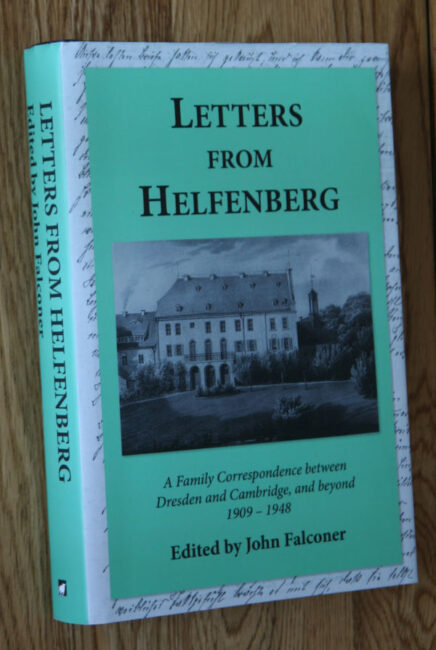
The letters (well over 1000), spanning three generations of a German/English family and half a century of great turbulence, were painstakingly translated and edited by a member of the fourth generation, John Falconer, (a teacher of classics) in a book entitled Letters from Helfenberg; Helfenberg – at the centre of the story – being a rather grand four-storeyed house and farm estate east of Dresden, owned and leased to them by the King of Saxony.
The book is liberally illustrated with evocative photographs of the family and their home across those years, bringing them to life; powerful reminders to me of old photos of my own forebears at a similar time.
The story begins in 1909, when a young Cambridge classicist, William Duke, travels to Germany for a semester’s post-grad study; there he meets Gertrud von Lippe who’s in Berlin for a season taking lessons in English and French in an attempt to improve her education. Their acquaintance is brief but clearly memorable because they agree to correspond, each writing in the other’s language and returning the letters with corrections and comments to improve their linguistic skills.

But other relatives enter into the exchange of letters, and when in 1911 Duke gets engaged it’s to Gertrud’s younger sister Johanna not Gertrud herself. It’s a measure of the formalities in etiquette that Johanna doesn’t even know his first name when she accepts his proposal!
This is not yet another tale of Nazi persecution, but an intimate portrayal of the effect of the two great wars on this family. And even with the benefit of our hindsight it’s chilling to read about the first hint of coming trouble between Germany and England, of the false hopes and propaganda that divert attention from the reality of what’s brewing.
When the young couple marry in 1913 and Johanna moves to England, her parents’ letters pick up the story of life back in her homeland. Gertrud is by this time a semi-permanent invalid limited by her chronic heart condition and lonely without her baby sister, so she’s delighted when Johanna travels to Dresden with her first child Margaret at only 6 months of age. But it’s a tricky time to be in Germany, and while she’s there William writes of the distinct probability of war breaking out. Nobly he gives her the choice of whether to stay in Germany or return to England.
I give you free choice: nevertheless i should like you to come back while it is still possible. It is at times like this that the difficulties of an international marriage surface so vividly!
Johanna is torn but decides to return. However, even before she can arrange things, a letter sent to William, postmarked 1 August 1914, is returned unopened – the first concrete sign that the war has begun. What a conflict for this mixed-race family with divided loyalties, captured by these two excerpts.
Johanna to her brother in the field:
You can imagine that it hurts me if the English cannons are shooting at my own brothers.
Her youngest brother Karl:
It was a strange feeling for me that from now on these [English] guns must protect my little sister against me.
Johanna feels the separation from her birth family acutely when first Karl is killed in action in 1916, and the following year her eldest brother Fritz, both of the deaths conveyed in a letter from Gertrud. The letters from Germany also movingly capture the terrible state of the country after the war: revolution leading to abdication of the Kaiser and declaration of the Republic, social division and hyperinflation, occupation by France and Belgium, strikes, political unrest.
Gertrud was the family philosopher, and after her death in 1922 the tone of the correspondence changes significantly, the men in the family being more preoccupied with political issues, farming and local unrest, and the price of everything. But one by one these correspondents too die (their father in 1924, mother in 1927, and William Duke aged only 42 in 1929).
The family’s tenancy of Helfenberg ends in 1930 after almost 30 years. The story could well have come to a natural end there, but Johanna’s brother Walther’s letters from Germany, and Johanna’s exchanges with her two daughters survive and give a glimpse into life as the two countries once more move towards another conflict, and the women occasionally make trips to the Fatherland.
Draconian postal restrictions from 1939 onwards mean that only the briefest of messages (max 25 words, restricted to family news) between the two countries are possible, and there follows almost six years of silence from Germany.
In time there are happy highlights from England – both Johanna’s daughters become classics teachers (Cambridge University and a school in St Andrews in Scotland), Johanna remarries, and Margaret moves with her family to Scotland. But in Germany Johanna’s niece Renate reports a very bleak picture indeed. Tragedies have befallen the German side of the family, alluded to in a brief post-war message from Renate, but once she’s sufficiently recovered from the emotional and psychological suffering, she pours out her feelings in some amazingly upbeat letters to her aunt recounting some of the evils they are still enduring in 1946-7. She calls it the great desolation. The country is destitute and lawless, with bureaucrats controlling Berlin, which she describes as one great concentration camp.
Yes, it wasn’t for nothing they told us that once more we would envy the dead, and I’ve finally reached that point myself.
The world indulges in the accounts of our atrocities, but about what is going on (in post-war Germany), nobody utters a word.
And indeed I was deeply shocked to read these accounts.
So too was Margaret:
I’d no idea of the details of the economic destruction of Germany, e.g. the confiscation of all her interests in all countries, whether allied, central powers or neutrals, and the entire break-up of her organisation.
Helfenberg, the hub of the family, was expropriated from its royal owners, subdivided, and neglected for the next sixty years. Renate and her parents later safely resettled in West Germany and the story ends in Berlin in 1948.
It’s a sobering read and I can only imagine the pain for John Falconer reading these letters from and about his relatives. But it’s pervaded by immense courage and I leave these assiduous letter-writers to conclude with their own philosophy.
William to Johanna:
It is by unions such as ours that more and more strong chains are forged which bind the two great peoples tighter and tighter together.
William to Johanna at the end of the war:
I think the right line is to hope that the general joy is at the prospect of international brotherhood and the cessation of war, and not at the triumph of one nation over another.
Gertrud:
What a good thing it is that the future is hidden from us in thick veils!
 Our family have wonderful friends in Germany ourselves and both sides would echo these sentiments.
75 years on
6 June 1944, saw the largest combined land, air and naval operation in history; D-Day. Seventy-five years on to the day, it seems fitting that I should mark it in some way. What better for the purposes of this blog than to write about a book that challenged me in many ways to think again about what has been done in the name of honour, duty and country.
 I found The Dark Room by Rachel Seiffert, (shortlisted for the Booker prize in 2001) in the Christian Aid book sale last month. Every now and then I do try to upgrade my literary antennae by reading something from the higher literary shelves! Besides which, my son is an authority on some of the themes it covers; I think we should try to understand what it felt like ‘on the other side’; and the blurb appealed.
The book tells the stories of three ordinary Germans, the descendants of Nazis/Nazi sympathisers.
Helmut is ‘a young photographer in Berlin in the 1930s who uses his craft to express his patriotic fervour‘. Hmm. Well, I’ve read another debut manuscript recently which does something similar – still to be published, so I can’t add a link yet. Both raise issues for me. How far would I have risked my life to expose the horrors of persecution and discrimination in those circumstances?
Lore is a 12-year-old girl in 1945 who ‘guides her young siblings across a devastated Germany after her Nazi parents are seized by the Allies‘. Hmmm, that same year my parents were doing their best to cope with the vicissitudes of life in this country, altered forever by the same war. They struggled with the tensions of conflicting ideologies and family security and public censure. Would I have held fast to my principles and risked so much?
Michael is ‘a young teacher obsessed with what his loving grandfather did in the war, struggling to deal with the past of his family and his country’. Hmmm, my uncle died at the age of 20 on the battlefields of the Somme, in WW1, fighting for the other side. I regret the senseless waste of his life, but I see him as collateral damage, ‘doing his duty’ as he perceived it. How differently would I feel if he had ordered millions to the gas chambers, or shot children in cold blood, or even stood by condoning such barbarity? Would that be ‘doing his duty’?
So this book resonated in many ways, and challenged me to think again about guilt, and responsibility, and both personal and national culpability. Are any of us completely blameless? How much are we accountable for what is done on our behalf? After all, as the famous quote has it, ‘The only thing necessary for the triumph of evil is for good men to do nothing’.
There are two passages in The Dark Room that highlight the importance of facing squarely what is done in our name. Both come from Michael, the young teacher who’s obsessed with the discrepancy between the two faces of Askan Boell; one the loving grandfather who amused him with drawings, and dandled him on his knee; the other a Waffen SS officer who countenanced and carried out the deaths of an untold number of innocents. Michael’s struggling with the whitewashing of history he sees in the education of German students:
They are being taught that there are no perpetrators, only victims. They are being taught like it just happened, you know, just out of the blue people came along and did it and then disappeared. Not the same people who lived in the same towns and did the same jobs and had children and grandchildren after the war.
I just think they should read about the people who did it, too. The real, everyday people, you know. Not just Hitler and Eichmann and whoever. All the underlings, I mean. The students should learn about their lives, the ones who really did the killing.
 Having allowed himself to go there, Michael finds himself consumed with rage and shame. And appalled at the wanton refusal to accept reality that he encounters in his family. Even his own mother denies the possibility that her father was a brutal killer. She was twelve when he returned after the war. Yes, he was a soldier, he killed other soldiers in battle, she accepts that, but not … not murder. Because she ‘knew him‘ – her loving father. ‘He was my Papa. Always Askan. Just the way he was … he wasn’t capable …’ How would we feel in their shoes? Would we even want to know?
And even those most intimately involved reconstructed the truth. As one of Michael’s informants, Josef Kolesniki, a collaborator, says: those in authority said killing the Jews was the thing to do. They didn’t order anyone to do the killing, so they absolved themselves of the responsibility: they said the men voluntarily chose to pull the trigger. But the men aiming the guns were doing what they’d been told was right, so they weren’t responsible either. Is it possible for us too to completely delude ourselves and deny all moral responsibility for what we do? Could we too be sucked into an evil system and lose our own moral compass?
And it’s these big challenges underpinning the tales of three young Germans that lift The Dark Room into a different league. I’d be lying if I said I enjoyed the book, or the writing style. But I did appreciate the bigger messages. It’s only by honestly facing such issues that we can take those vital steps towards learning from the mistakes of the past.

A glimpse into buried history
Hello …? … Last week a Booker prize winner, this week an Orange Prize winner: When I lived in Modern Times by Linda Grant … Am I converting? Where will it all end?
But I was intrigued by the blurb about this one.

We all know about the terrible things that happened to the Jews at the hands of the Nazis; we probably all know about the creation of the State of Israel. But what happened to this displaced people in between? Where did they go when they had no country to point to as home? Who were they at this in-between time when it required a long explanation as to their identity? What did they do?
Well, ‘Scratch a Jew and you’ve got a story.’
When I Lived in Modern Times deals with the immediate post WWII period through the eyes of one such displaced person, a Jewish girl who travels to Palestine to find answers to these questions. It’s a novel. About identity. About accommodating the past while establishing a future. About a kaleidoscope of difference coalescing into a single purpose. It combines the personal and political, idealism and realism, passion and analytical coolness, clever storytelling with rigorously researched historical accuracy.
It probes the conflict in the life and heart of young Evelyn Sert, who is first and foremost Jewish, but feels Britain is where she is most at home, least foreign. ‘It was the British whose taste and idioms, language and dress, cooking and habits I knew and understood.’ Even so it’s conviction rather than necessity that compels her to go to the land of her forefathers, the ‘Holy Land’. She is just 20; ‘a work in progress’, ‘a preliminary sketch for a person’. Part of a shadow family – hidden away by Uncle Joe, the man who kept Evelyn and her mother separate from his legitimate wife and his four legitimate daughters and his legitimate place of worship, the synagogue. But at her core Evelyn is a Jew, part of a proud people.
So, here she is, a single Jewish girl at a time when ‘anti-Semitism was a wolf roaming the world‘. Where, in the Holy Land, ‘alliances are based not on the proper opposition between left and right but blood ties and age-old feuds, pride, shame‘. Where mobs and tribal loyalties not political organisations rule. She’s exploring her history, her people, her roots. As she puts it herself: ‘I was moving through history, I was in it.’ She feels lost in the enormity of expectation and fractured dreams. ‘Why do I, who am one of these people, not know how to be a Jew in a Jewish land?’
In the space of a slim volume Evelyn goes from being a hairdresser’s daughter to ‘dilettante would-be artist‘ to ‘useless immigrant‘ to squirrelled-away girlfriend. She is left with no illusions. This is no utopia. Her fellow citizens of this emerging new race don’t match up to the values of a chosen people: ‘They were sullen or violent or depressed or conniving or lazy or untruthful or greedy. They were a catalogue of the seven deadly sins.‘
Linda Grant’s evocation of the suspicion, subterfuge and bewilderment prevailing in those times conjures up a kaleidoscope of scenes … arcane hairdressing practices of the 1940s … double standards … communal life in a kibbutz … a bleak landscape where a bomb feels like a ‘cleansing, transforming instrument‘ in the struggle against colonial masters.
Sobering, uncomfortable reading, but a useful glimpse into a time where my own understanding was decidedly hazy.
Oh and just for clarity, no, I have NOT fallen hook, line and sinker for literary writing! I’m just keeping my mind sufficiently open to allow new opinions to creep in occasionally. And making good use of days either imprisoned on trains or when the sun beckons me into the garden.
Now for that massive debut manuscript. I might be gone some time!

The Book Thief
I love autumn. All those crisp mornings, the sound of crunchy leaves underfoot, fabulous colours. Our copper beech hedge is a golden blaze at the moment. Something to do with the spring drought and cool damp summer apparently.
I’ve just returned from Oxford, travelling by train, and can vouch for stunning russets and vibrant reds through to sunshine yellow everywhere. But speaking of colours … what about this as a description:
‘Summer came.
For the book thief, everything was going nicely.
For me, the sky was the colour of Jews.’
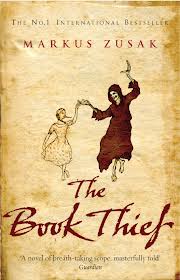 Death is the narrator of The Book Thief by Markus Zusak. It’s 1939. In Germany. The Nazis are increasingly forcing their politics onto the people, poverty and betrayal lurk in the scared streets, and Death is extremely busy. This could easily be a depressing, even macabre book, but it isn’t. Even Death himself is gently compassionate.
‘Please believe me when I tell you that I picked up each soul that day as if it were newly born. I even kissed a few weary, poisoned cheeks. I listened to their last gasping cries. Their French words. I watched their love-visions and freed them from their fear.
…
In complete desolation, I looked at the world above. I watched the sky as it turned from silver to grey to the colour of rain. Even the clouds tried to look the other way.’
And he is gentle with the reader too, slipping in the occasional spoiler to soften the approach to sadness.
Tucked away in a little town called Molching, on the outskirts of Munich, lives Liesel. She’s a child with dangerous eyes – brown eyes, who has already known death and loss. Late at night her foster father, Hans Hubermann, patiently teaches her to read. Liesel is utterly mesmerised by words, but there is no money for books, so she takes matters into her own hands and acquires them by stealth.
Three men exert a powerful influence over her: a young criminal, a fugitive Jew and a man with a heart of gold. And gradually realisation of the encroaching horrors of war impinge on her childish innocence. She becomes even more intimately acquainted with Death.
Zusak’s writing style is uniquely his own. Strange little curlicued inserts give vital information. Staccato sentences, truncated paragraphs, haul you without mercy into the very kernel of the emotions and experiences of the time. The almost childish writing fits perfectly with the whole life-view of the characters. Its very simplicity tugs at the heart strings.
And seeing things from his own perspective, Death paints wonderfully evocative pictures of …
… the holocaust:
‘When their bodies had finished scouring for gaps in the door, their souls rose up. Their fingernails had scratched at the wood and in some cases were nailed into it by the sheer force of desperation, and their spirits came towards me, into my arms. We climbed out of those shower facilities, onto the roof and up, into eternity’s certain breadth. They just kept feeding me. Minute after minute. Shower after shower.’
… of the blitz:
‘The only sign of war was a cloud of dust migrating from east to west. It looked through the windows, trying to find a way inside, and as it simultaneously thickened and spread, it turned the trail of human beings into apparitions.
There were no more people on the streets any more.
There were rumours carrying bags.’
… of illness and death almost seven decades ago:
‘At thirteen, tragedy struck again when his uncle died.
As percentages would suggest, his uncle was not a hot-head like Max. He was the type of person who worked quietly away for very little reward. He was not a rich man. He did not take what was rightfully someone else’s – and he died of something growing in his stomach. Something akin to a poison bowling ball.
As is often the case, the family surrounded the bed and watched him capitulate.
Somehow, between the sadness and loss, Max Vandenburg, who was now a teenager with hard hands, blackened eyes and a sore tooth, was also a little disappointed. Even disgruntled. As he watched his uncle sink slowly into the bed, he decided that he would never allow himself to die like that.
The man’s face was so accepting.
So yellow and tranquil, despite the violent architecture of his skull –
The endless jawline, stretching for miles, the pop-up cheekbones and the pot-hole eyes. So calm it made the boy want to ask something.
Where’s the fight? he wondered.
Where’s the will to hold on?
Of course, at thirteen he was a little excessive in his harshness. He had not looked something like me in the face. Not yet.
With the rest of them, he stood around the bed and watched the man die – a safe merge, from life to death. The light in the window was grey and orange, the colour of summer’s skin, and his uncle appeared relieved when his breathing disappeared completely.
“When death captures me,” the boy vowed, “he will feel my fist in his face.”
Personally, I quite like that. Such stupid gallantry.
Yes.
I like that a lot.’
It’s salutary to see the war through the eyes of Germans. To realise the enemy is British. The hands that released the bombs that decimate Liesel’s home are those of the Allies. That the young pilot dying in the smoking and broken plane speaks English.
Suspend any preconceived ideas you might have, and if you can, your personal religious and moral beliefs, and let the poetry of this book speak to you. It’s at once moving and challenging, enjoyable and troubling. And when you’ve lingered a while over the last haunting sentence, do let me know which emotion predominates for you.