paranoia
Literary genius
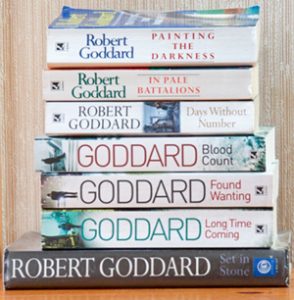 One of my most favourite novels is Past Caring by Robert Goddard, and since reading it I’ve collected a goodly number of his books on my shelves. They’re lengthy and intricate and absorbing though, so I only select them when I have the luxury of enough time to opt out of other commitments, or when I want a literary treat, or escape from reality.
The weather cancelled a couple of diary engagements recently so I seized the opportunity to indulge in a Goddard feast.
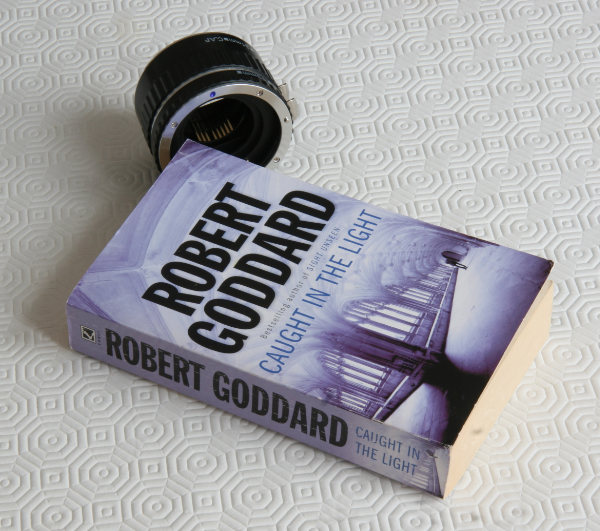 This time it was Caught in the Light … and I’m instantly captivated. He manages to convey an atmosphere of period brilliantly, moving effortlessly between the seventeenth century and the present. His plotting is spellbinding, layer upon layer of intrigue, and whether it’s a sinister menace, or a romantic interlude, or a psychological minefield, he grabs your attention and compels you to keep those 445 pages turning. A truly superb storyteller.
 Photographer Ian Jarrett is in Vienna for a few days on an assignment when he meets and falls in love with a stranger in a red coat standing against a snowy background: Marian Esguard. So utterly captivated is he that he returns to London, leaves his wife, tells his daughter, and goes to meet Marian. But she never appears. She seems to have completely vanished. What’s more the six films of photographs he took are blank. What is going on?
So fixated is he that he vows not to take another picture until he can photograph Marian again. So, not only has he lost his wife and home, and his lover, and his dreams, now he is without a job. His single-minded search for her takes him back into history, and into a dangerous world of unscrupulous men and dabblers in the darkness of a disordered mind.
I became a ghost, hunting a ghost, haunted by a past I couldn’t forget and a future I couldn’t give up.
 He is joined in his search by a Harley Street psychotherapist, Daphne Sanger, who is looking for the same woman, a client who spun her a very different story. Given the circumstances she agrees to breach her ethical code of conduct and share a vivid account of what this missing woman is enduring. Lies and deceit and betrayals abound. Everything swirls dangerously out of control. A man is strangled. Jarrett is caught up in this web of deception, trapped between the enigmas of the part and the greed and revenge of the present.
As the real truth unravels, and his existence is reduced to the narrowing circle of his search for his missing obsession, he becomes increasingly cagey.
There was secrecy bedded in my soul now, a furtiveness about my every word and thought.
And just when you begin to believe he’s about to realise his dream, the entire picture blows up in his face, and he has to acknowledge that he’s a mere puppet in an elaborate plot, his whole life being demolished around him. No one seems to be who they claim to be, yet he is the one who seems pathologically paranoid and deluded … except that he knows for sure he’s not, and he’s utterly determined to call the chief tormentor to account. And to save his sixteen-year-old daughter. But he’s at the mercy of a ruthless enemy who will stop at nothing to exact revenge. Murder, kidnap, suicide: it just keeps getting worse.
 I’d love to reveal the amazing detail of what is really going on, but I absolutely can’t risk spoiling your enjoyment of this incredibly complex story. It’s a masterclass in writing. And whether its the origins of photography, or 17th century historical detail, or the medical facts around haemophilia, or the underpinnings of psychological derangement, the author writes with authority and assurance, never flaunting his research, but weaving fact and fiction together seamlessly with a sure hand.
As critics have already said, when it comes to duplicity and intrigue, Goddard is second to none. He’s a master of manipulation … hypnotic … unputdownable … spellbinding. Genius.
Journey into terror
 3.30pm and New York journalist, Susannah Cahalan, has just walked into the Power Studio Theatre. She’s beams at the audience, big blue eyes and a dimpled smile – the picture of health and vitality. No outward sign of the terrifying illness: acute encephalitis, she’s charted in Brain on Fire.
 She was just 24 in 2009 when she began to experience vague symptoms – numbness, mental blanks, emotional lability, lack of focus. But she’d just begun her first post-grad job as a reporter, and her first long term relationship, so she initially put it down to the sense of confusion and disorientation of new beginnings. The insomnia, erratic behaviour, mood swings and paranoia worsened however, she had a sense of being outside herself looking down on herself. Convulsions, hallucinations, and increasing paranoia followed, and as she says, ‘My first serious blackout marked the line between sanity and insanity‘.
Diagnosis was painfully slow. Initially she was thought to be ‘suffering from alcohol withdrawal‘. It was only when she was given steroids and immune therapy that she started to improve and a diagnosis of auto-immune encephalitis could be established. And as she admits, it takes a courageous ‘renegade‘ of a doctor to give high doses of steroids in the absence of a clear diagnosis.
Looking back on her behaviour at the time, she perceives it as ‘monstrous‘ and admits it frightens her to think she could have acted in this way. What kind of a person is she? What is she capable of?
How did she cope? Her family and friends were key to her survival, and her natural stubbornness stood her in good stead. And taking up a post-graduate course was her ‘cognitive therapy‘. Now she campaigns for better diagnosis and treatment for others. Knowledge is increasing but there is still much to know in a relatively rare illness. (The first case was named as auto-immune encephalitis in 2007; there are now 13 different forms of it.)
The chairman, Charles Fernyhough, a psychologist, describes her book as intensely brave, unflinching, moving and thrilling, pacey and vivid. Given her period of amnesia how did she manage to record events so fully?
She employed her journalistic skills to the task, working in three phases. First, in order to give the book a sense of authenticity, she hand-wrote all she could remember before she read or listened to any other reports, using amongst other aids, her own ‘bizarre‘ Word documents written while she was actively psychotic. She’s fully aware that there are inaccuracies arising out of her own faulty memories – eg. she was convinced that she wore an orange name band saying FLIGHT RISK. Such a name band didn’t exist; it was yellow and said FALLS RISK.
Next she read her medical records, and watched videos of herself hallucinating (she was on an epilepsy ward where patients were monitored by cameras). Finally she interviewed other people for their accounts. This last was not without its problem. Her mother, she says, rewrote history, minimising the seriousness – her way of dealing with it. Her father exaggerated things to such an extent that she had to resort to emailing questions to him, the only way he could handle it.
In writing everything up, Cahalan was conscious of her own obsession with health and science. She knew she had to be brutally honest but she aimed to make the difficult science palatable and accessible, and for the finished book to read like a medical thriller. She reads enough of her own dog-eared copy of it to convince us that it is.