delusion
Literary genius
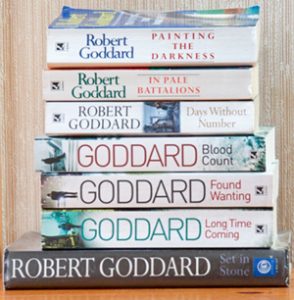 One of my most favourite novels is Past Caring by Robert Goddard, and since reading it I’ve collected a goodly number of his books on my shelves. They’re lengthy and intricate and absorbing though, so I only select them when I have the luxury of enough time to opt out of other commitments, or when I want a literary treat, or escape from reality.
The weather cancelled a couple of diary engagements recently so I seized the opportunity to indulge in a Goddard feast.
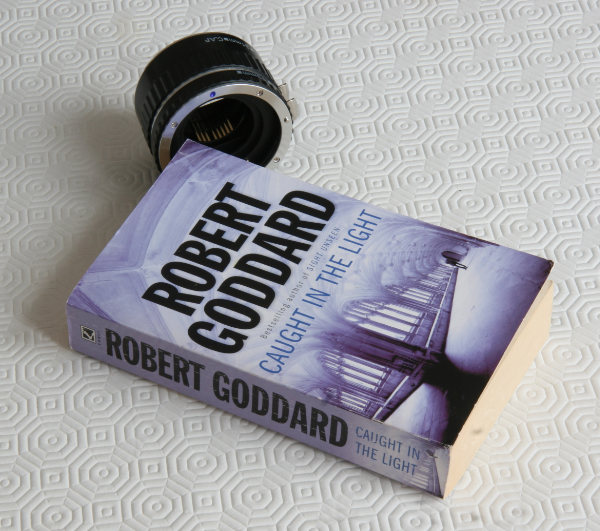 This time it was Caught in the Light … and I’m instantly captivated. He manages to convey an atmosphere of period brilliantly, moving effortlessly between the seventeenth century and the present. His plotting is spellbinding, layer upon layer of intrigue, and whether it’s a sinister menace, or a romantic interlude, or a psychological minefield, he grabs your attention and compels you to keep those 445 pages turning. A truly superb storyteller.
 Photographer Ian Jarrett is in Vienna for a few days on an assignment when he meets and falls in love with a stranger in a red coat standing against a snowy background: Marian Esguard. So utterly captivated is he that he returns to London, leaves his wife, tells his daughter, and goes to meet Marian. But she never appears. She seems to have completely vanished. What’s more the six films of photographs he took are blank. What is going on?
So fixated is he that he vows not to take another picture until he can photograph Marian again. So, not only has he lost his wife and home, and his lover, and his dreams, now he is without a job. His single-minded search for her takes him back into history, and into a dangerous world of unscrupulous men and dabblers in the darkness of a disordered mind.
I became a ghost, hunting a ghost, haunted by a past I couldn’t forget and a future I couldn’t give up.
 He is joined in his search by a Harley Street psychotherapist, Daphne Sanger, who is looking for the same woman, a client who spun her a very different story. Given the circumstances she agrees to breach her ethical code of conduct and share a vivid account of what this missing woman is enduring. Lies and deceit and betrayals abound. Everything swirls dangerously out of control. A man is strangled. Jarrett is caught up in this web of deception, trapped between the enigmas of the part and the greed and revenge of the present.
As the real truth unravels, and his existence is reduced to the narrowing circle of his search for his missing obsession, he becomes increasingly cagey.
There was secrecy bedded in my soul now, a furtiveness about my every word and thought.
And just when you begin to believe he’s about to realise his dream, the entire picture blows up in his face, and he has to acknowledge that he’s a mere puppet in an elaborate plot, his whole life being demolished around him. No one seems to be who they claim to be, yet he is the one who seems pathologically paranoid and deluded … except that he knows for sure he’s not, and he’s utterly determined to call the chief tormentor to account. And to save his sixteen-year-old daughter. But he’s at the mercy of a ruthless enemy who will stop at nothing to exact revenge. Murder, kidnap, suicide: it just keeps getting worse.
 I’d love to reveal the amazing detail of what is really going on, but I absolutely can’t risk spoiling your enjoyment of this incredibly complex story. It’s a masterclass in writing. And whether its the origins of photography, or 17th century historical detail, or the medical facts around haemophilia, or the underpinnings of psychological derangement, the author writes with authority and assurance, never flaunting his research, but weaving fact and fiction together seamlessly with a sure hand.
As critics have already said, when it comes to duplicity and intrigue, Goddard is second to none. He’s a master of manipulation … hypnotic … unputdownable … spellbinding. Genius.
From the Edge of the Couch
When I was a student I made a conscious decision not to do a stint in psychiatry. Why? I was acutely conscious of the fine dividing line between what’s ‘normal’ and what’s ‘abnormal’, and had a sneaking suspicion I was too close to the edge for comfort myself at times. Decades on, I’m more sanguine about my own mental resilience, and more sympathetic to others’ strengths and weaknesses, and I guess, more curious about how the mind works.
Why am I re-living this decision now? Let me explain.
I was at a bit of a loss as to what book to take for eight hours sitting on a train with weighty matters on my mind. I needed something that I could dip in and out of, but something sufficiently absorbing to hold my interest. Ahah! Time maybe to tackle From the Edge of the Couch: Bizarre psychiatric cases and what they teach us about ourselves. The author: Dr Raj Persaud, a consultant psychiatrist, writer and TV personality.
 It’s disturbing (as expected) and raises all sorts of questions about the way the mind functions, the variety of delusions and distorted beliefs that can lurk in its hinterland, and the cracks and flaws that can derail the psyche. More than that, it shows how delusions are far more common than we might imagine, and probing them can reveal much more understanding of how the ‘normal’ mind works.
From werewolves and vampires, to phantom lovers and stalkers, to Munchausens and gender issues, to various distorted perceptions relating to parts of the body, Dr Persaud unravels the problems, the possible causes, and the treatments, through the lives of real people amassed from reported cases over many countries, many years, and from many clinicians. It’s detailed, it’s research based, and it corroborates my remembered feeling that the line between the healthy and the disordered can indeed be thin.
Which of us doesn’t feel unworthy at times?
But most of us don’t resort to eating animal faeces as penitence, or slicing off a hand with a chain saw.
Which of us has not at times disliked a part of our appearance, or experienced anxiety about something untoward happening to cause us acute embarrassment or public humiliation?
But most of us don’t shut ourselves away from society altogether, or deliberately inflict injuries to ourselves and then infect them in order to get a limb amputated.
Which of us has not at some stage tried to alter their body image by something like dieting or exercise?
But most of us don’t eat industrial quantities of toilet paper or our own hair.
Which of us does not have some an experience in our childhood that was fairly traumatic?
But most of us don’t deliberately mutilate our face, amputate limbs, castrate ourselves or enucleate our eyes.
Which of us has not worried about body odour of some kind?
But most of us don’t opt our of work/school to obsessively wash our clothes, and avoid all social and domestic excursions out of the house.
Which of us has not known someone who had a stroke?
But most of us don’t react by becoming pathologically obsessed with eating fine haute cuisine food ourselves.
The list goes on and on. Puts our normal little anxieties into perspective, doesn’t it?
 Dr Persaud takes delusions very seriously – sometimes indeed more seriously that the disturbed patient! Furthermore, for him, anything we can learn from them is valuable, as he points out in the postscript:
… dialogue with the delusional has much to offer us. It will not only assist in the specialized scientific enterprise of understanding the brain and mind, but such people’s experience should inform our personal understanding of what it is to be human … If we can grope towards some understanding of the most bizarre and incomprehensible ideas of all, then surely there is more hope for us to understand what each other thinks.
Many have said the most complex entity in the known universe is the human brain, but in fact there is something much more intricate and elaborate: human society – or groups of brains interacting. What is produced when minds try to understand and manipulate each other is where the real mystery and excitement of the human sciences lie.
From the Edge of the Couch is a lengthy tome, and holds a wealth of information – 59 pages of footnotes alone! All made viable by the bringing together of cases from so many sources, enabling deductions to be generated which would not be possible from the occasional single example that comes the way of any specific clinician. It’s perhaps small comfort that, as Dr Persaud admits, psychiatry is far from being an exact science, and relies heavily on objective interpretation of symptoms. That’s part of my worry!
Yep, I’ve no regrets at bypassing psychiatry! But after finishing this book, I’ve got the gratitude-for-what-life-has-dealt-me T-shirt and the mug.