unbearable suffering
Physician-assisted suicide or mercy killing – a medical thriller
 Mercy by Michael and Daniel Parker (a father and son duo) begins with a quote from the Dalai Lama:
Love and compassion are necessities, not luxuries. Without them humanity cannot survive;
and ends with
Compassion is what binds us. It’s what makes living worthwhile.
A neat bookending of the substance of this novel which centres on the controversy around mercy killing. Yep, I’m back in my familiar milieu. And given that the topic comes before the UK Parliament again tomorrow, it’s topical.
The narrative opens with a chapter recounting the deliberate killing of a patient in end-stage cardiac failure – told from his perspective. But something’s decidedly wrong here. It’s certainly not a mutually agreed procedure. We feel the patient’s terror, and are hooked in immediately. And then there’s the person administering the lethal medication: coldly dispassionate not gently reassuring. We’re alert to trouble from the outset.
By contrast, the main protagonist in this story is emergency room intensivist, Dr Julie Devereux, a passionate but compassionate advocate for death with dignity. Her ambition is to take officialdom and government out of the equation and let the patient with his/her doctor decide together what’s best for them, always staying within the law.
Then one day the patient is her fiancé Sam, hideously injured in a three-vehicle collision which she personally witnessed as he was driving his motorcycle ahead of her on a fast road. Along with multiple fractures and serious open wounds, Sam has suffered a crush injury to his fourth cervical vertebra – he faces the rest of his life as a permanent quadriplegic with a tracheotomy, requiring a raft of medication to keep his body functioning.
When he emerges from oblivion and is able to comprehend the desperate situation, Sam begs Julie to help him die.
‘I can’t live like this … You’ve fought for death with dignity for years, now fight for me.’
She’s appalled by the idea when it applies to the man she loves, but he throws her own words back at her:
‘The best care should be made available to every patient, but a patient deserves the right to hasten death to avoid inhumane suffering or escape from a life turned unbearable.’
Now, on the other side of the situation herself, Julie does an about-turn, arguing passionately against all the speeches she’s made, all the papers she’s written, all the arguments she’s employed for mercy killing – for continuing life.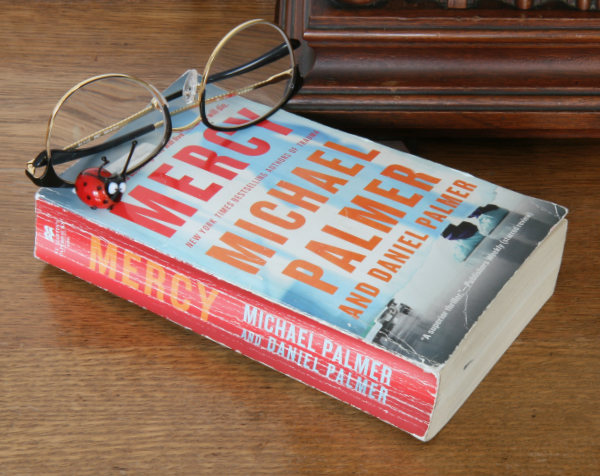
But then something inexplicable happens. Sam suddenly collapses and dies. Julie is acutely aware that something isn’t right. He might have wanted fiercely to die, but he was incapable of doing anything himself to induce death. She didn’t help him, so … what happened? Was this a medical anomaly or did someone do something to cause his death? She starts asking questions, challenging results, and piecing together a bewildering picture. Because the autopsy results indicate a very rare stress phenomenon: takotsubo cardiomyopathy, an instant reaction to an extreme stressful stimulus resulting in an abnormal surge of adrenaline, constricting the coronary arteries, and diminishing blood flow. It seems Sam was literally scared to death.
Julie begins to investigate. She unearths other similar deaths, and gradually a picture emerges of skull-duggery beyond belief. Her search takes her to interview a convicted murderer in prison, to talk to ardent campaigners for life, and experts in many branches of medicine and science. The common link between all the unexpected deaths initially seems to be this enlargement of part of the heart: takotsubo cardiomyopathy … or is it? Why did all these people develop hives just before death? Could it be an acute allergic response? If so to what? And who is behind it?
Administrators desperate to stop the rapid drain of money from the hospital?
Doctors with reputations to maintain?
Parents wanting to avenge their dead children?
Aggrieved staff looking for revenge for dismissal?
Someone with their own personal agenda?
Who?
Still more patients die. When their lab results come back they make no sense; no, more than that, they’re downright sinister. Allergic cardiac events, tics, massive overdoses …?? And a common feature seems to be that all the victims are very ill, severely incapacitated, or at the end of their lives – some even asking to die. It looks on the surface like a macabre version of mercy killing.
It’s now no longer a case of finding out who or what killed Sam; it’s a race to stop more people dying.
But what Julie doesn’t know is that with every piece of the jigsaw she discovers, she’s putting herself in greater danger. Her every word, every movement, is being monitored by a paid assassin who’s simply biding his time. One by one her supporters are picked off. And her own previous high profile in relation to assisted dying becomes a weapon in the hands of her adversaries. She herself becomes a prime suspect.
We’re kept in suspense until the very end, and I for one did not suspect the person who actually killed Sam, though I was suspicious of some of the administrators charged with balancing the books. A thriller in the best sense, and one in my own field of interest! Wahey!!
[NB. Meticulous research went into this story but just for the record, it’s not sparrows but starlings that form murmurations! (pp222-3) But in a work of this calibre it’s actually quite comforting to note a tiny human chink in the overall brilliance!]