war
The Hour I First Believed
Imagine you’re a high school nurse, sitting quietly listening to a troubled student. It’s April 1999. It’s lunch-time, that hour when the maximum number of youngsters gather in one place. Suddenly, without warning, all hell breaks loose. Two teenagers both known to you, now armed with guns and knives and bombs, are laughing and taunting as they systematically shoot the children around them with apparently carefree abandon. You crawl into a dark cabinet, but you can still see and hear their deadly progress, and you expect any moment to be blasted out of existence. When you eventually emerge, bodies litter the floor and the student you were with is missing.
Or imagine you are the spouse of the woman hiding in the cupboard. You too normally work in the same school, but you’re currently miles away organising the funeral of a relative. The developing news of the massacre is running continuously on TV, but you have no way of knowing if your wife, your colleagues, are alive or dead.
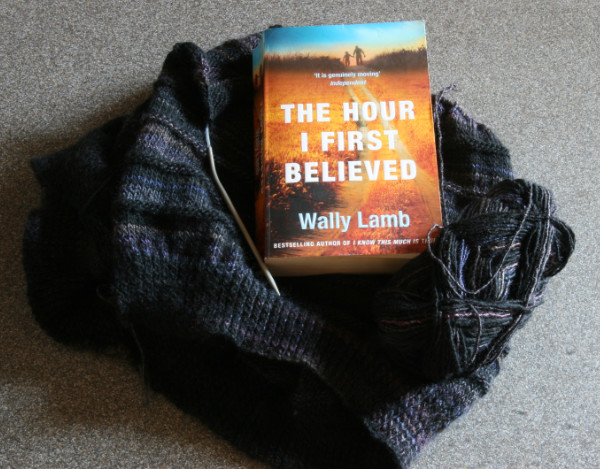 We’ve all read and heard about the Columbine High School massacre in Colorado in 1999, but Wally Lamb takes us inside the school on that fateful day, inside the lives of those for ever marked by these terrifying events.
In a nutshell so as not to spoil the story for future readers …
Both Caelum Quirk, the narrator, a creative writing teacher, and his wife Maureen, though not physically hurt, are seriously traumatised by the experience and seek professional help. They move right away from the scene of the crime and pick up the threads of Caelum’s earlier life, but they both develop dependencies which in turn lead to further tragedies, mounting financial worries, and an unravelling of their family history which brings both solace and heartbreak.
Although The Hour I First Believed is essentially a work of fiction, it feels much more than that. By weaving reality throughout the story – with actual names and words and excerpts from the killers, and reference to well known individuals, and historic events like the destruction of the World Trade Centre on 9/11 and hurricane Katrina – Lamb has given the whole narrative a sense of historic accuracy and credibility, allowing him to explore and examine real tragedies such as war and natural disasters and violent crimes more meaningfully.
Why did he choose this tricky route? For two reasons. First, because he felt a responsibility to name the Columbine victims, both dead and injured, and to acknowledge the strength and suffering of those traumatised by the event. And second, because, having spent 29 years in high schools, he was both frightened and confused by the twisted logic of the two boys who slaughtered those innocent children, and wondered if he would have acted as courageously as some colleagues did. His overarching hope back in 2008, was that the book in some small way would help to broaden understanding and maybe prevent future tragedy. Sadly events since have rather questioned that.
As with I Know This Much is True, I personally found the book overly complicated by the inclusion of long documents and lateral stories (it’s 632 pages long), but I take my hat off to any author who researches meticulously and makes me believe in his story. And perhaps a couple of sentences from early in the book, describing Caelum’s experience of teaching creative writing, capture what he has achieved:
‘Look, don’t just stare at the pages. Become the characters. Live inside the book,’ he’d tell his students.
They’d sit there, staring back politely at the alien from Planet Irrelevance.
Three-a-Penny
Almost exactly 121 years ago to the day, February 1899, Lucy Beatrice Malleson was born in Victorian London. Better known as Anthony Gilbert or Anne Meredith, her two pseudonyms, she was prolific in her literary output but received limited sales and acclaim. It’s a refreshing change to read an autobiography that concentrates on ‘failure’. Even at the height of her success, when she slept with a glowing tribute from her publisher under her pillow, she mourned: ‘I was one of those unhappy authors who can please everyone except the public.’
 Her memoir, Three-a-Penny, is like no other. And her motivation seems to be captured in Dorothy Sayers’ comment to her: ‘You must remember, Anthony Gilbert, that although authors are three-a-penny to us, they are quite exciting to other people.‘ Exciting enough, indeed, to justify a factual account of her life and ambition, but the author seemingly apologetic about her ‘mediocrity’.
From an early age Malleson made up stories. She began publishing articles and poems whilst still a teenager, and brought out her first crime novel aged just 28. In all, she went on to produce over 70 novels, as well as a number of plays for the BBC, before she died in 1973 aged 74. And yet, she never achieved the status of others of her generation. Nevertheless, she remained an incorrigible optimist;
‘… if you know in your heart of hearts that Providence intended you for a success and your main desire in life is to assist Providence to this end, why then you will never see a book with your name on the spine without the eager thought, “This may be it. This probably is.” And when the book sells no more copies than its predecessor, well, by that time you’re always neck-deep in another one, and this one, without doubt, will bring you that elusive fame and financial security that glimmer like distant stars on the far, far horizon.’ And I suspect her gritty determination to plough on despite modest sales, will strike a chord with us lesser writers far more than the success stories of the star-studded celebrity authors.
The beginning section of Three-a-Penny is the best, in my view. It might well be another novel! Her vivid snapshots of her childhood precocity and innocence, in particular, are utterly beguiling, not least because she refers to herself quaintly throughout as ‘one’ instead of ‘I’.
For example, she had her own clear and trusted theories about God. He was not above taking care of an unhemmed tablecloth, but he also kept an enormous ledger like the butcher’s. ‘God presented His bill when you died, and if you had done wrong you went to hell for ever. Hell was like a glorified nursery grate on which people lay, always, in imagination’s eye, decorously dressed in outdoor clothes, perpetually burning yet never consumed.’
 Where babies came from exercised her for a long time. ‘One knew. They came in a doctor’s bag, each with a label round its neck. The doctor’s house resembled the giants’ larders of nursery days, crowds of infants in long clothes hanging on hooks awaiting delivery.’ When her own baby sister was imminent she was deeply troubled by the huge potential for the family to be given the wrong child.
On one occasion her mother insisted the nurse take her and baby outside to get fresh air in terribly inclement weather. Freezing cold, Lucy cried piteously and remorselessly, attracting the sympathy of ladies in fur. But not Nurse.
‘Nurse pushed the pram as though she were a machine. When we reached the Park she anchored it by some railings and went into a little house marked Ladies. She told me to come in too. My tears momentarily ceased. I had never been inside one of these little houses. But once there Nurse seated herself squarely on the wooden seat, plucked me over her knee, and went through the familiar ritual of lifting clothes and undoing buttons. Smack! Smack! Snack!
‘I’ll give you something to cry for, my lady,’ said Nurse.
I stopped crying in sheer astonishment. I had never realised they built little houses in public parks just for this. I was so much surprised I made the rest of the journey in awed and crestfallen silence.’
Again and again Grown-Ups let her down. ‘You couldn’t believe them; they had a different truth from yours.’ She was forced to work out her own understanding of the world.
 She was a precocious child, reading avidly, and romping home with full marks for her essays – her ‘only distinction‘. There was never any career other than writing in her sights and, aged 14, she applied to her father for £10 for a correspondence course to equip her to write for the press – for money. ‘Write! Under my roof! Never!‘ was his implacable response.
When the war started she was forced to a stark realisation. And by now the whole tone of the memoir changes to something much more prosaic and factual. One’s aunts became nurses; one’s menfolk did important war work. ‘… nobody thought it was proper to write novels and one was a little ashamed of reading them.’ Instead she went off to secretarial college and became an unpopular but diligent student, determined to make something of her life. Her first job was a sobering one, with the Red Cross, dealing with relatives searching for information about their missing sons and fathers. Against the nightmare of such raw emotion, a letter from the Family Herald accepting her poems came like a beacon in a dark world. Together with a postal order for three and sixpence. Success! But … ‘I hadn’t imagined I should ever be paid with anything less than a cheque’.
Work in a Government Department, increased her growing awareness that the war had robbed her, as well as the returning soldiers, of youth. She wrote regular columns and articles, subtly concealing political and sociological and economic ‘pills’ in a ‘lot of feminine jam’. She also sold some of her verse to august publications like Punch, the Sunday Times, the Observer, and certain literary weeklies. Buoyed up by this success she progressed to experimenting with novel writing, even taking time out from paid employment to do so.
Early efforts proved unsuccessful but two publishers eventually saw her potential. ‘One day you will write a good novel, but this is not it.’ ‘You have the makings of a novelist, but you haven’t quite rung the bell this time.’ Those were the days when publishers gave feedback and Malleson benefited from their insights and advice. So, when a crime novel was accepted by Collins, she was wild with excitement. When it proved to be ‘a complete flop‘, failing to earn even the paltry advance offered to an unknown writer, she was devastated. To make matters worse, Collins subsequently declined to publish her next book, leaving her feeling permanently discredited by this double failure. ‘I no longer wanted to talk about books.’
Back to office life she went. The work was way beneath her skills and when she was alone she would cry with humiliation. ‘But I was like a dipsomaniac who cannot forsake his bottle. I began a new detective story …’
This time she decided to use a male pseudonym: Anthony Gilbert, and the book was comparatively well received, helped in some measure by the secrecy and speculation surrounding the author’s true identity.
During the next seven years she published no less than fourteen novels, many short stories, and a few poems. American contracts, second rights, and translation into six different languages followed. She felt sufficiently confident and socially conscious, to allow condemnation of the lack of support for the under-classes, to creep into the underpinnings of her writing: ‘What an opportunity they offered to a novelist!’ But she was not a fulfilled person. ‘I was never more financially secure … but I was lonelier than I had ever been in my life.’ So much so, indeed, that when she found herself invited to join the Hiawatha Club for Women she couldn’t think of a single distinguished name to offer for a reference. ‘The women I know are all pure, home-loving people who don’t seek the limelight.’
When The Slump knocked the bottom out of the American market for English novels, Malleson’s agent recommended she concentrate on young romance as the most sure-fire bestseller. ‘That avenue being closed‘, she turned her mind to thriller-writing, naively believing there to be ‘no rules‘ and no need to pay attention to ‘psychology, probability, King’s English or logic‘. She allowed herself three weeks to complete the first one. But she soon realised she was sacrificing art on the altar of filthy lucre and abandoned this supposed shortcut to wealth. Instead she wrote and re-wrote and refined a new manuscript, a crime novel, and submitted it under the name of Anne Meredith. This one eventually appeared in 1933 where it attracted considerable interest and mixed reviews but reignited the interest of the Americans. And it brought her an invitation from Dorothy Sayers herself to join the elite Detection Club. Conditions for entry were exceedingly rigid; in no circumstances could a thriller-writer be admitted for instance! At the swearing-in ceremony, the candidates were reminded of the solemnity of their oaths: ‘… if you fail to keep your promises, may other writers anticipate your plots, may your Publishers do you down in your contracts, may Total Strangers sue you for Libel, may your pages swarm with misprints and your Sales continually Diminish’. Only a writer could, I suspect, feel the full power of such a curse!
 Writing was an obsession with Lucy Malleson regardless of her public profile: ‘When I’m not writing, I am not more than half-alive. I am miserable, hopeful and dejected by turns. Then someone slowly emerges out of this mental fog …’ And this new character would quickly assume a full identity and drive her onwards again.
It was The Coward – about a man who accidentally commits a murder, the character with whom Malleson most identified – that precipitated her into the limelight amongst the literati. She had felt writing this story to be pure self-indulgence; no one would want to read it, but she couldn’t bear the thought of dying in an accident next day without finishing the one book she was most desirous of writing. To her utter astonishment it received rave reviews from the critics and fellow authors. But sadly, poor sales. It seemed she simply could not please the public.
It’s her very honesty that endears her to me. Her experience resonates.
‘… so many authors admittedly have these overwhelming qualms of self-distrust and a sense of their own futility’.
‘ … one reason why writing is such fun – it’s so chancy. And I wouldn’t exchange my one-chance-in-a-million for anybody else’s security.’
Rejection slips, poor sales figures, challenges to one’s sense of self-worth – these bedevil almost all of us; it’s how you react to them that matters. And Lucy Malleson shines through as humbly aware, doggedly determined, delightfully perceptive, entirely without pretension. The kind of person I should like to be placed next to at a dinner party.