psychology
The Wedding Guest
Writing about some of the best-known detectives in crime fiction recently got me thinking about others that didn’t instantly spring to mind. Cue LAPD Lieutenant Milo Sturgis with his sidekick psychologist Dr Alex Delaware, creations from the mind of Jonathan Kellerman (himself a psychologist as well as best-selling novelist). It will come as no surprise that psychology is closer to my field of interest than crime, so I’ve enjoyed previous books in the series where Delaware shares his insights as a first person narrator.

And what d’you know, there on my tbr shelf was an unread volume featuring this duo picked up in a charity shop recently: The Wedding Guest.
The scene is a wedding reception with a Saints and Sinners theme in a rather seedy venue that used to be a strip club. A pathologically self-centred bride and a wimpish groom do nothing to endear the tale to us. Then one of the bridesmaids discovers the body of a beautiful young woman draped over the cistern in a grotty backroom toilet, a stranger whom no one in the party recognises. There are no means of identification on her and we don’t discover who she is till almost exactly half way through the book.
It’s an easy read with a linear story line but I confess the plot of this one didn’t appeal and I really didn’t care about any of the characters.  However, I’m mentioning it because it serves to remind me that there are many facets of writing which can be valuable, even those we thoroughly dislike. In this case one thing Kellerman does do well is dialogue. Whether it’s the easy banter between Delaware and Sturgis, or the obfuscation and incriminating cues dropped by those with something to hide, or the coded exchanges of colleagues, they drive the narrative on and flesh out the characters.
As the saying goes, no reading is wasted for a writer.
Twisted
What to choose for my break from serious study? Ahah! Jonathan Kellerman! Twisted. 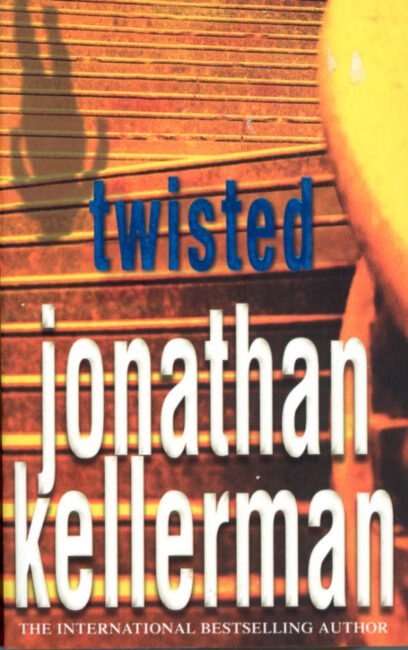 That’ll do nicely. Kellerman’s a child psychologist by background and an acknowledged master of psychological thrillers, so it’ll grip my attention and require close concentration to stay with the plot. The thinking behind criminal acts rather than the actual killing intrigues me.
And did it ever?! A huge cast of characters; red herrings; multiple cases; twists and turns and subplots aplenty; suspense added with a concrete deadline setting the parameters and count down for the chase.
Detective Petra Connor is a busy hands-on homicide officer in California juggling assorted cases when Isaac Gomez, a young research prodigy from an underprivileged background, is assigned to her. Soon after his introduction to police procedures and files, he tells her he’s found an interesting phenomen linking six unsolved murders that occurred over six years: all were committed at around midnight on June 28th. Initially rather sceptical, Petra comes to recognise Isaac’s uncanny ability to think analytically, and together they begin to unravel new material, pursuing witnesses and acquaintances of the victims, all of whom were killed by a massive blow to the back of the head with a blunt instrument, so violent that brain matter is splattered over the scene of the crime. A picture begins to build of a cold and evil mind at work, calculating and orchestrating a pattern of annual murders.
But why June 28th? Isaac enlists the help of librarians who know him well to search the archives for possible enlightenment, while Petra interviews and follows and sifts the people and facts connected with the six cases, both only too aware of the days ticking down to June 28th, and in the process ruffling feathers as they expose negligence and carelessness and perhaps even cover-up on the part of the officers initially assigned to these murders. But not even being suspended from the force will stop Petra doing all she can to save the life of another innocent person on June 28th.
The suspense holds until the very last chapter when an unexpected twist reveals the identity of the real killer. A masterfully plotted tale. And just what the doctor ordered!
A favourite author revisited
Having struggled through A Year of Magical Thinking, I needed something gripping to refresh the parts literary prose simply doesn’t reach for me. And what better distraction than one of my favourite authors, Robert Goddard. I keep a row of his novels for just such moments of rescue.
 As luck would have it, Set in Stone begins with reflections on a death! And instantly it resonates with me far more profoundly than Magical Thinking did. Anthony Sheridan’s wife Marina is found at the foot of a cliff not far from their home in Cornwall. The authorities question whether it was a suicide, but Tony knows Marina was in robust mental health and assumes she was so caught up in enjoying the flowers that she trod unwarily near the cliff edge. She was, after all, in her personal element, having recently moved to the house and the county of her choice and dreams. The prologue perfectly captures the mood and style:
I can’t see you, Marina. I can’t hear you… More than anything I love you. I will always love you. … It’s as simple and desolate as that. I don’t need to chase your ghost. It’s here, at every moment, beside me. It’s almost tangible. But not quite. You’ll always be just out of reach. I can’t touch you. Ever again.
But I can talk to you. And maybe, just maybe, you can listen. I wish I could tell you a different story, though. I wish I could tell you your death was just a single outbreak of meaningless misfortune. I wish I could wipe away the events it set in motion and have you back, alive and contented, to love and be loved. But wishing is all it comes to. It changes nothing. There is only one story I can tell you. And this is it.
 And the book is written as if he’s speaking to her. It’s a powerful technique in the hands of a master.
Following Marina’s death, Tony is bereft. and instantly puts the house on the market, before going to stay with Lucy, Marina’s sister, and her husband Matt. He’s slightly taken aback by her likeness to Marina especially when she wears some of her sister’s favourite clothes. But he’s also intrigued by Otherways, the architect-designed circular house they have recently bought, with its own moat and lake, complete with a macabre history: a woman was murdered in the garden; her husband was hanged for the crime; and her brother-in-law defected to Russia after spying for them for years. What’s more, Lucy has recently befriended the now-elderly sister of the murdered woman who was herself briefly engaged to the spy.
Little by little Tony is drawn into the secrets and horrors of this house. The more he learns the deeper he gets into questioning everything related to it; even exactly how Marina died. She and Matt and Lucy were all keeping secrets he knew nothing of. His own personal life spirals into chaos. He has vivid dreams which subsequently mysteriously materialise in real life. When Matt goes off on business for a few days, he and Lucy, alone together in Otherways, are drawn together intimately as if this was always preordained. He forsees accidents and deaths. And he becomes increasingly conscious of a haunting feeling of other presences in this cursed house. Eventually, wracked with guilt, he leaves Otherways before Matt returns, but it doesn’t leave him, and he begins to follow up on links to its previous owners and their secrets with horrific consequences, putting his own as well as others’ lives in danger.
Goddard is a master at creating suspense and unravelling a multi-layered story. In this book he weaves together complex political intrigue, spine-chilling paranormal phenomena, and psychological depths that keep us guessing to the last page. Just whose version of events is the true one? A brilliant diversionary read.
Some you win …
Ahah, just when I’d got back together with Jodi Picoult and her clever novel, Mad Honey (reviewed in a post three weeks ago), the balloon bursts again. Big time.
I ordered another of her books with high hopes, and settled down to a good read. But alas, t’was not to be. No matter how fast I knitted, no matter how much I applied my mind! Reminded me yet again that each book has to stand alone, and just because I’m entranced by one doesn’t mean I’ll love everything by that author.
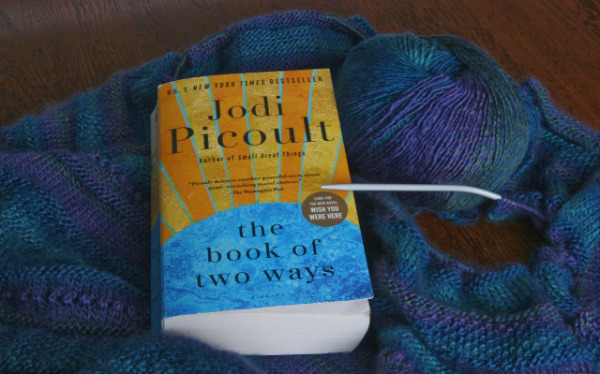
The Book of Two Ways tells the story of Dawn McDowell/Edelstein at two points in her life. The first is a young Dawn, a post grad Egyptologist working amongst the tombs of the Pharaohs and rulers, falling in love with an English earl in the dirt of the necropolis. The second, fifteen years later, is Dawn when she’s a mother and death doulah, accompanying clients on their last journey on earth, briefly returning to the site of the Egyptian excavations, reconnecting with the man who stole her heart.
As ever the author has done a phenomenal amount of research and background work. She’s even included hieroglyphs and ancient drawings in the book – how, I’ve no idea! But in spite of my admiration for her diligence, I struggled.  I found the main character annoyingly hypocritical and dysfunctional. To my mind there was way, way too much technical detail about quantum physics and ancient Egypt and its languages and customs, for the purposes of a novel. Though I’m certainly particularly interested in terminal care and its management, I found the detail even here excessive and off-putting. I had to take frequent breaks and steel myself to persist to the end. As so often with Picoult, the psychological musings and insights didn’t fit with my own experience of ordinary people and how they think. And finally we don’t get to know Dawn’s decision about the two men in her life … ever! The very thread that kept me reading the last seventy pages!! The balloon I mentioned at the beginning deflated with an annoying splutter.
Shame. I wanted to get lost in it, but couldn’t.
How to Kill Your Family
Ahah, if you read my post last week, I guess you’ll have been wondering when this topic might appear – How to Kill Your Family. 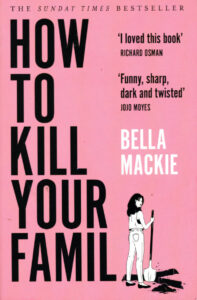 This debut novel by Bella Mackie was written during the pandemic and published last year, quickly becoming a Sunday Times bestseller. Given the reaction of the lovely waitress at Shugborough Manor, I felt somewhat compelled to get on and read the book, to assure her/readers that it was indeed part of my writerly research, not signifying any evil intent on my part!
It’s a tale that takes us inside the mind of an unusual psychopath, one who is possessed and intoxicated by her need/desire to wipe out a complete family. The young killer in this case believes that there’s a certain art to a good murder. She’s not into bloodshed and savage violence; rather she’s fascinated by the motives and habits of her potential victims, and wants their own extravagant lifestyles to be the cause of their undoing. To that end her research is meticulous. She studies the minutiae of the lives and appetites of each of her victims to find a way of killing that happens while they are going about their ordinary everyday activities doing something perfectly normal for them. And, of course, that way credibility is given to a verdict of ‘accidental death’.
Grace Barnard was born of a short unbalanced relationship between an impecunious but effortlessly-beautiful French girl, Marie, and a wealthy entitled already-married man, Simon Artemis, 22 years her senior, one of the richest men in the world, who rejected Marie and her baby both at the pregnancy stage and when Marie appealed to him just before her own untimely premature death.
From the age of 13 Grace has planned a way to avenge her mother: she would rid the world of this morally rotten family, the embodiment of toxic capitalism, a vacuum of morality, a totem of greed. And she had absolutely no qualms about doing so. After all, it wouldn’t be taking anything decent away, would it? Indeed it would be for the public good.
By the time we meet her, she has calmly and methodically killed six members of the Artemis family and then carried on with the rest of her life without a single regret. But having evaded justice for these murders, she is now in Limehouse prison for a crime she did not commit – the death of her foster-brother’s fiancee. To relieve the relentless boredom inside while she awaits her expensive lawyer arranging to get her off her life sentence, she decides to secretly write an accurate account of her life and actions. Re-living the murders, observing her own cleverness, and remembering how she contrived to right a great wrong, helps, though she’s only too conscious that her scribblings are nowhere near the level of Oscar Wilde‘s musings from his prison cell.
Killing her biological grandparents seemed like the least problematic task.
‘… it didn’t matter as much. Old people who do nothing but drain their pensions and stultify in their favourite armchairs isn’t a brilliant advertisement for humanity.’ They’ll only ‘become useless bed blockers who get more and more mean-spirited until they are nothing more than bigoted beasts of burden living in the room you wanted to make a study … old and disposable, and they live staggeringly useless lives.’
Oh, and from the outset her own grandparents wanted nothing to do with their illegitimate granddaughter, Grace, so they don’t deserve to go on living. A ‘natural’, ‘accidental’ death in a car crash attracts no unwarranted attention.
Her cousin Andrew poses a bigger problem. She hasn’t bargained for him being likeable. But, unknown to her, he had already turned his back on wealth and privilege, and now spends his days trying to save the world and mankind through conservation and natural remedies, currently centring on amphibians and hallucinogens. He has put his toxic family out of his life and Grace finds it far harder to carry out her plan with a truly blithe spirit. Finding a way to kill him without arousing suspicion takes a long time in the planning, but his end is suitably gentle and amongst his beloved frogs.
Uncle Lee is a chancer steeped in privilege and greed … a heartless sociopath with nothing at all to recommend him to Grace. It’s a pleasure to carry out her plan with him. His seedy proclivities become his undoing and she watches him die with great satisfaction. But his wife Lara is a different kettle of fish and Grace simply can’t bring herself to harm someone so guileless and decent and wronged.
Her father’s wife Janine, however, is a mean, selfish, indulged woman who spends her whole days doing precisely as she wishes and bullying those whom she considers beneath her. Grace is increasingly drawn to the idea of letting her obscenely luxurious home in Monaco turn on her, and she employs the skill of a needy 17-year-old computer nerd and Janine’s put-upon maid to enable her plan. It’s a calculated risk involving others but she builds in protection for herself to minimise the possibility of a backlash. And again the murder passes as a tragic accident.
Totally spoilt and pampered Bryony, Simon’s 27-year-old legitimate daughter, is the one whose death is most likely (if any) to affect Simon, so Grace leaves her till the penultimate kill. Only when he has suffered this acute loss will she reveal herself and her final intention to him. Bryony has one specific natural weakness which Grace decides to exploit: she is allergic to peaches. The premature death of a young heiress attracts media attention but no suspicion and Grace finally gets a glimpse into the pain she is inflicting on her father.
Only one target left: Daddy dearest himself, the principal victim from the outset. But she hasn’t bargained on him being paranoid for his own safety after losing so many relatives, rendering him virtually unreachable. And it’s an enormous anticlimax when Simon disappears at sea piloting his speedboat while drunk during a visit to his villa in St Tropez. Frustrated and bewildered, Grace weeps for days. Now he would never get to know what she had done and why – the whole point of the plan.
Explanation comes in an unexpected email which she receives the day she is released from prison; an email that will vanish once it’s read. Someone else had a vested interest in the Artemis family; someone else shared a remarkably similar status; someone else was born to a young silly woman dazzled by a larger-than-life Simon Artemis, and then cast aside when he became bored with her; someone else feels entitled to the Artemis’ wealth; someone else was involved in the end of a dynasty. It comes as a complete shock. Especially when that someone knows so much about Grace and her actions. When that someone has effectively scuppered her entire operation.
Journalist and columnist Bella Mackie has created a brilliant plot, based on clever insights into the mind of an emotionally detached but somewhat naive psychopath, and an understanding of human psychology and behaviour. The book is at once gripping, compulsive and chillingly dark. It’s not a comfortable feeling getting inside the head of someone who can kill without scruple, but Mackie manages to keep a lightness of touch and humour by tailoring the deaths – not the usual messy slaughtering, but clean, almost natural ends to pampered lives; and by fleshing out the impact of social injustices and inequalities that fuel Grace’s slow-burning anger, using caustic commentary to give us a degree of sympathy with her single-minded crusade to clean up the world.
The book served as a small diversion from some serious study into much more edifying subjects the waitress at Shugborough would be pleased to know – about virtue and ethics and integrity in real life. The other end of the spectrum from murder.

Interestingly this week the BBC aired a four part programme called The Sixth Commandment based on the true story of a young man who befriended lonely elderly people and conned them out of their money and self respect. He too could take life without scruple. Sobering reality.
From the Edge of the Couch
When I was a student I made a conscious decision not to do a stint in psychiatry. Why? I was acutely conscious of the fine dividing line between what’s ‘normal’ and what’s ‘abnormal’, and had a sneaking suspicion I was too close to the edge for comfort myself at times. Decades on, I’m more sanguine about my own mental resilience, and more sympathetic to others’ strengths and weaknesses, and I guess, more curious about how the mind works.
Why am I re-living this decision now? Let me explain.
I was at a bit of a loss as to what book to take for eight hours sitting on a train with weighty matters on my mind. I needed something that I could dip in and out of, but something sufficiently absorbing to hold my interest. Ahah! Time maybe to tackle From the Edge of the Couch: Bizarre psychiatric cases and what they teach us about ourselves. The author: Dr Raj Persaud, a consultant psychiatrist, writer and TV personality.
 It’s disturbing (as expected) and raises all sorts of questions about the way the mind functions, the variety of delusions and distorted beliefs that can lurk in its hinterland, and the cracks and flaws that can derail the psyche. More than that, it shows how delusions are far more common than we might imagine, and probing them can reveal much more understanding of how the ‘normal’ mind works.
From werewolves and vampires, to phantom lovers and stalkers, to Munchausens and gender issues, to various distorted perceptions relating to parts of the body, Dr Persaud unravels the problems, the possible causes, and the treatments, through the lives of real people amassed from reported cases over many countries, many years, and from many clinicians. It’s detailed, it’s research based, and it corroborates my remembered feeling that the line between the healthy and the disordered can indeed be thin.
Which of us doesn’t feel unworthy at times?
But most of us don’t resort to eating animal faeces as penitence, or slicing off a hand with a chain saw.
Which of us has not at times disliked a part of our appearance, or experienced anxiety about something untoward happening to cause us acute embarrassment or public humiliation?
But most of us don’t shut ourselves away from society altogether, or deliberately inflict injuries to ourselves and then infect them in order to get a limb amputated.
Which of us has not at some stage tried to alter their body image by something like dieting or exercise?
But most of us don’t eat industrial quantities of toilet paper or our own hair.
Which of us does not have some an experience in our childhood that was fairly traumatic?
But most of us don’t deliberately mutilate our face, amputate limbs, castrate ourselves or enucleate our eyes.
Which of us has not worried about body odour of some kind?
But most of us don’t opt our of work/school to obsessively wash our clothes, and avoid all social and domestic excursions out of the house.
Which of us has not known someone who had a stroke?
But most of us don’t react by becoming pathologically obsessed with eating fine haute cuisine food ourselves.
The list goes on and on. Puts our normal little anxieties into perspective, doesn’t it?
 Dr Persaud takes delusions very seriously – sometimes indeed more seriously that the disturbed patient! Furthermore, for him, anything we can learn from them is valuable, as he points out in the postscript:
… dialogue with the delusional has much to offer us. It will not only assist in the specialized scientific enterprise of understanding the brain and mind, but such people’s experience should inform our personal understanding of what it is to be human … If we can grope towards some understanding of the most bizarre and incomprehensible ideas of all, then surely there is more hope for us to understand what each other thinks.
Many have said the most complex entity in the known universe is the human brain, but in fact there is something much more intricate and elaborate: human society – or groups of brains interacting. What is produced when minds try to understand and manipulate each other is where the real mystery and excitement of the human sciences lie.
From the Edge of the Couch is a lengthy tome, and holds a wealth of information – 59 pages of footnotes alone! All made viable by the bringing together of cases from so many sources, enabling deductions to be generated which would not be possible from the occasional single example that comes the way of any specific clinician. It’s perhaps small comfort that, as Dr Persaud admits, psychiatry is far from being an exact science, and relies heavily on objective interpretation of symptoms. That’s part of my worry!
Yep, I’ve no regrets at bypassing psychiatry! But after finishing this book, I’ve got the gratitude-for-what-life-has-dealt-me T-shirt and the mug.
Two Little Girls
Psyching myself back into my current novel after all the excitement and busyness of the festive season, required a game plan. First, read a new-release novel from my shelves about a woman struggling to love her baby: Two Little Girls by Kate Medina. Even the cover sent a chill down my spine: a pair of tiny red sandals full of sand, lapped by the edge of the waves; the text ‘Two little girls walked to their deaths and nobody noticed …’ interspersed with the bald title. Says it all. And indeed the story includes these macabre murders, so it felt oddly serendipitous that, on the very day I read it, the BBC showed a documentary about the murders of the so-called ‘babes in the wood’, 32 years ago. Listening to the parents decades later brought home the indescribable horror these families live with daily.
And because of this reality, I felt uncomfortable seeing the novel dedicated to the author’s own two young daughters. Hmmmm.
 Kate Medina has had a lifelong interest in psychology but she uses it effectively. Her characters ring true; policemen hypothesise, psychologists analyse and theorise, ordinary people don’t turn their brains inside out! The setting too, feels authentic – I know people who have a holiday home in Wittering!
We’re aware from the first few chapters that …
Laura aka Carolynn Reynolds, is the mother of a little girl found dead in the sand dunes at West Wittering beach two years ago
… she suffers from major psychiatric problems
… she’s in hiding
… her life is a tissue of lies
… her husband Roger is in on some at least of the lies
… she was tried for the murder of Zoe, the daughter she found so difficult to love
… she was acquitted because of lack of evidence
… Detective Inspector Bobby ‘Marilyn’ Simmonds who worked on the case at the time, still believes she was guilty
… Dr Jessie Flynn, the psychologist Carolynn has been seeing, struggles herself with layer upon layer of psychological damage
… and Carolynn was running alone on the beach when a second little girl was murdered.
Phew! Is she guilty? Is she not? Is anyone else in danger?
Which brings me nicely to how far would my own protagonist go when her baby drives her beyond reason? And I come back to the writing with a renewed sense of what constitutes a thriller. A preparatory day well spent.
Thrillers – lessons learned
 OK, with a pile of thrillers of various kinds now read and analysed, I’m a bit closer to refining my own choices for the current novel. What have I decided so far?
Main narrative thread
The issue must be one I personally care about. And I need to be clear who I’m trying to appeal to. A tale of individuals seeking personal justice or dealing with their own family dramas holds my interest more than stories about money laundering or righting organisational wrongs.
Main protagonist(s)
The lead doesn’t have to be likeable but the reader must care about his/her fate so the character needs to be carefully drawn and handled, with a plausible and intriguing backstory.
His/her motivation must be worthy so readers will root for him/her.
He/she must be up against tremendous odds.
Secondary characters
Too many tangential stories and secondary characters run the risk of losing narrative tension and interest. (Or am I a wimp when it comes to holding umpteen names and storylines in my head?)
Style
Short sentences and staccato prose can help build tension but lose impact if used too often. Sentence structure, length and complexity need to be varied.
Grammatically incomplete sentences also need to be used with caution; they can hold up the pace of a story.
Action
The psychology of the characters must be authentic and plausible. (See writers like Jonathan Kellerman who’s a psychologist himself and uses a psychologist to help solve crimes, or Linda Fairstein who was a prosecutor focusing on crimes of violence against women and children and really understands police procedure.)
Accuracy
If the story includes historical reality or geographical locations, the facts must be spot on accurate.
So, with that foundation, I’m now concentrating on fleshing out the profiles of my own characters.
Somewhere in the deep recesses
 It keeps cropping up, year after year, doesn’t it? – the banning of objects or activities or statements, lest certain people take offence.
‘Offensive’ includes, not just way-out books and films, but long-standing statues of the Virgin Mary/Jesus Christ/nativity scene, classics like To Kill a Mocking Bird/The Adventures of Huckleberry Finn, Hallowe’en, scarves, crosses, prayers, peaceable religious folk who refuse to compromise on their principles … the list goes on.
I’ve seen the hurtful effects of narrow, rigid intolerance up close, and it’s not a pretty sight. Nor is it edifying to anyone. For me it boils down to arrogance: I’m right; full stop. Ergo, everyone else who holds a different opinion is wrong. Hello? By whose divine decree? Never mind ‘your’ rights, what about those whose rights you’re denying?
There’s far too much talk of rights nowadays, in my opinion. Wow! Only last week we heard that frozen embryos are suing their mother, actress Sofia Vergara, (who?) for the right to life! They’ve even been given names – Emma and Isabella … don’t get me started!
But seriously, in the humdrum everyday world, with rights come responsibilities. And our planet would be a kinder place if everyone tried to put themselves into other people’s shoes, esteeming them as better than themselves. And adopted the ‘Judge no man till you’ve walked a mile in his moccasins‘ principle.
Why am I writing about this on a blog about ethics and books? Well, of course, kindness and justice and rights and interests and conscience all play a part in deciding what’s good and right. But something more specifically triggered these ruminations. Let me explain.
 I spend a lot of time listening. And over the years I’ve become increasingly aware of older people confiding that they’ve secretly had doubts about many things they were once sure about, but they haven’t liked to voice them for fear of being reprimanded/corrected or of upsetting others. And as the day of death approaches, they can be much exercised by the consequences of their wavering beliefs. What a damning indictment of the rest of us. How have we managed to create a society that means these vulnerable fellow-citizens must worry alone and afraid? And let’s not lose sight of the fact that, when you live alone, largely inactive, with few distractions, such misgivings can assume quite overwhelming dimensions.
 Anyway, a couple of weeks ago I had an absolutely amazing conversation with a wonderful elderly lady with advancing dementia. Quite how we got onto the subject I can’t now remember – we roam from topic to topic as the mood takes us – but suddenly she was talking about assisted dying. She had a personal and an intellectual stake in the subject, but had never before talked about it (or so she alleged). Why? Because most people ‘wouldn’t be interested’ in her views, and those who would ‘might not approve’ of her position. We had a brilliant hour and a half together and I’ve seldom left a discussion on this subject more exhilarated. Deep inside this ageing brain, parts of which are definitely scrambling, was a coherent and thoughtful mind that could still argue a logical case and hold a defensible personal viewpoint. My respect and admiration for her is immense. And how sad that a beautiful intellect like that is being slowly but inexorably diminished by this disease. I am doubly resolved to keep her sparking on as many cylinders as possible for as long as it’s feasible.
Oh, and speaking of approaching death … did you know that researchers have found evidence that creative people worry less about mortality because their artistic works will live on after their demise – a kind of existential security. Well, that’s the conclusion drawn from the findings of the people at the University of Kent, reporting in the Journal of Creative Behavior, anyway. Hmmm. We’ve lost a large number of iconic figures this year, haven’t we? Were David Bowie or Leonard Cohen or Victoria Wood or Carla Lane or Ronnie Corbett comforted by the lasting cultural legacy they were going to leave behind? Did it motivate them to keep creating? Rumours abound of highly creative people being riddled with angst, frequently depressed, constantly worrying whether their next work will be a success, whether they are still up to snuff. But, hang on a minute … the Kent study wasn’t done with celebrity figures; it tested psychology students more or less inclined to creativity. So, is it a matter of degree then? OK, I’ll need to think on it. Maybe I’ll talk to my clever friend about it while I still can.
A tribute to my fellow authors
6 March was World Book Day so it’s fitting that this week I should share my admiration of great authors. The sheer imagination behind their work, the persistence and diligence that brings their hard work to fruition, their impressive ability to keep me glued to their books.
To celebrate, I temporarily called a halt on those dreaded ‘anorexia books’, turning instead to some real page turners to raise my spirits and put me in the mood for some serious plotting of my own. Ah yes, and I dug out some lovely merino wool I’ve been saving for the right occasion. Mmmmm. Bliss. Close the door; shut out the world.
 First up was Diane Chamberlain’s, The Lost Daughter which tells the story of a woman who, when she was sixteen, helped in a kidnap which went disastrously wrong. The girl goes on to live an exemplary adult life, but always the shadow of her past lurks menacingly above her, and when her conscience finally gets the better of her, she must decide whether to keep quiet – and risk a man’s life; or to tell all – and risk destroying her own family. This is more than a tense will-she won’t-she kind of book, Chamberlain brings her customary psychological insight and social awareness to bear in creating believable characters who are dealing with extraordinary situations. What’s more, it has a happier ending than I was steeling myself for. A bonus!
Next came Tess Gerritsen’s Bloodstream. Just in the first few chapters we have the massacre of a family, a mysterious shooting in the woods, the discovery of a human femur, a man having an epileptic fit, a schoolboy running amok killing his teacher, a doctor with a haunted past, a policeman with a drunken wife, and skullduggery in the hospital labs. Phew! What links all these people? Holding all these disparate strands together is a masterly feat in itself. ‘Last week, Satan arrived in the buccolic town of Tranquillity, Maine …’ writes a local reporter. Guaranteed to stir up fear and trouble, you might think. But violence of a particularly vicious nature has erupted in this town, loving children are turning into ugly strangers – and history is repeating itself. Decades ago, other young people also turned into killers. Why? The new doctor in Tranquillity, Dr Claire Elliot, is in a race against time to uncover the reason before anyone else dies, and before she loses her only son, or her own life.
 Deborah Lawrenson’s The Lantern was another intriguing read with it’s own hauntings. (Indeed, curiously enough, there were several common elements between it and Bloodstream.) Unsophisticated Eve falls in love with an older man, Dom, and their whirlwind romance leads them to a rundown but beautiful house in Province. But as summer turns to autumn the house begins to reveal macabre secrets and troubling mysteries, and Dom grows increasingly distant. What exactly did happen to his beautiful first wife? – shades of Daphne du Maurier here. And what is this voluptuous scent that pervades the house? – vanilla with rose and the heart of ripe melons, held up by something sterner, a leather maybe, with a hint of wood smoke. Whose bones have been unearthed beneath the old swimming pool? Who is leaving a lighted lantern in the exact spot where lovers trysted in days of yore? And what is behind the mysterious hallucinations?
 What a treat to be totally swallowed up in stories with complex plots that interweave time and place and people. Books that needed my full concentration to unravel and truly savour. The knitting grew at a terrific rate as you can see! And ideas for my own next novel flooded in – indeed so quickly that I was even forced to commit them to the computer during my reading sessions. I am rejuvenated and invigorated. And immensely grateful.