forensic science
The Night Gate: Peter May
I do love a main protagonist in a series to exhibit unusual characteristics. Peter May‘s forensic expert, Enzo Macleod, has a white stripe in his dark hair running back from one side of his forehead, and one brown eye, one blue eye – both physical manifestations of Waardenburg syndrome. The faulty gene has skipped a generation but reappeared in one of his grandsons as hearing issues. What kind of a mind conjures up something as obscure as that?! Love it. And it’s only one of many trademarks that single this author out as exceptional. I’m a big fan.
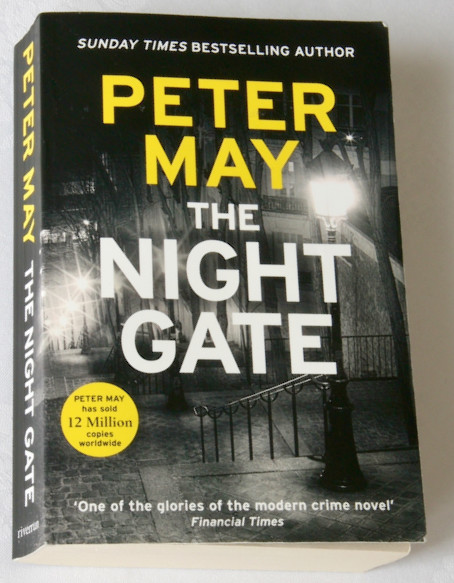
Another skill he excels at is evoking different places in different countries. In The Night Gate, we flip from Scotland to France to Germany by means of deft descriptions and a few local words. From the desolate windy shores of the Outer Hebrides to the dusty heat and rural charm of the Occitanie region in SW France, we’re in the hands of a writer who knows where he is.
By now, Macleod is officially retired, but missing the challenge and buzz of his old job. So he can’t resist a request to consult on two murders which have been discovered in a tiny medieval village, Carennac, on the banks of the river Dordogne. One is 75 years or more old: a storm has uprooted a tree and its roots have lifted a tangle of bones and leather and assorted remains of a ranking officer of the Luftwaffe with a bullet hole in his skull. The other is contemporary: it’s the 2020s, pandemic time, and Emile Narcisse, an art dealer from Paris, is found with his throat cut in the rustic kitchen of an elderly woman, Anny Lavigne, in the same village as the WW2 German’s body was discovered.
Immediately suspect for the fresh murder is Hans Bauer, a young German in his twenties, director of a small private art gallery in Germany, who has a history of violent outbursts, and is known to have visted the old lady that day. And incriminating evidence is indeed found placing him at the scene of the murder. But just what is his connection to both these bodies? It all seems too coincidental, and Enzo hates coincidences. So he begins to dig deeper.
The dead man, Narcisse, he discovers, was phenomenally wealthy, a huge name in the world of international art, who came to public recognition when he uncovered a haul of looted Nazi art in an apartment in Geneva, Switzerland. He’d done all he could to return the priceless works to their rightful owners, and where no heirs existed, sell them to museums and art galleries or private collectors. So what had brought a man such as Narcisse to the modest home of an old lady in a tiny backwater village in south-west France?
It’s Anny Lavigne who provides valuable insights which fill in the backstory to the historic case. She tells Enzo so much about what happened in occupied France in the 1940s; a story she’d heard time and again from her mother. How Hitler commandeered an art historian, Paul Lange, to procure the most famous painting in the world, the Mona Lisa, and hide it somewhere until after the war, when it would be given pride of place in the museum Hitler planned to have built in his hometown Linz in Austria. How General de Gaulle knew of this plan and enlisted the help of another art historian, half-French Georgette Pignal, who had personally helped to pack the precious painting and send it into the country for safekeeping from the Germans. Now she was being given full responsibility for guarding it, but she was to tell no one.
 So she’s shocked to discover that Paul Lange, now a German officer, knows exactly what her mission is. She feels nothing but hostility towards him, but he appears unoffended, even mildly amused by her blatant venom and embarassment at being seen in his company. However, her bosses instruct her not to cause any offence to the Germans, so she reluctantly agrees to being wined and dined every Friday night by Lange. He proves himself to be always the gentleman, making no effort to seduce her, and gradually she learns to trust him.
But others too have designs on the famous painting and we get sucked into an increasingly complex vortex of desire and greed and subterfuge. Who will acquire it? And at what cost to those who thwart them?
The fact that so much of the backstory is historically accurate gives added heft and credibility to this tale: the evacuation of art from the Louvre during WW2 to various chateaux around France; the appropriation of countless works of art by the Germans, including burning some of the canvasses; the courage of named individuals in cataloguing the stolen paintings and tracking them down in order to restore them to their rightful owners after the war; the bravery of the resistance fighters. And the cost in lives.
The plotting is tightly and unerringly woven like an underground map with tracks and links and connections steering the reader to a powerful conclusion. And through it all Peter May drops his trademark literary gems which make his writing sing.
Leaves fell like snow in his headlights. September was stating its case for an early winter.
Depression fell over her like a shroud shaken free of its folds, black and all-enveloping.
Moonlight bled through stained glass to sprinkle dead light among the pews.
Compelling, thrilling, and one to haunt me for some time to come.
Forensic science close up
I suspect I’m not alone in sometimes railing against the time taken for real-life cases to come to court, or the release of dangerous criminals on technical grounds, or the vast sums spent on enquiries long after the event. How can people really recall events accurately years later? How can the judiciary live with the knowledge someone else was assaulted or kidnapped or died because they didn’t keep a criminal behind bars? How much money is wasted by the protracted goings on in our justice system? …

I occasionally dip into programmes like Forensics: the real CSI, or Silent Witness, or Professor Sue Black in action, and find the science fascinating. But I was brought up short in a more intense way by a detailed book about the work of the scientists whose job it is to provide evidence that will be robust enough to stand up in a court of law against other scientists and lawyers doing their damnedest to get the criminal off. Conscience duly smitten. How dare I criticise these people? The only wonder now is how those involved cope with the exhaustion, frustration and criticism, and keep persisting case after case after case. Some take years and years of meticulous investigation; some are never solved. Forget needle in a haystack; we’re talking a single hair or thread in a whole crime scene, a minute particle of a chemical in the bones of a whole nation.
 The book is Shallow Graves, by forensic scientist Ray Fysh, (well, actually written for him by James Nally) – a fascinating insider’s view into the demanding work of gathering evidence. Fysh was a working class lad from South East London. Back in 1970, at the time he joined the Met Police, forensic investigation was seen as a niche area for geeks and boffins, but Ray and his team set about transforming it into an essential and integral part of police investigations. He progressed from being a toxicologist to become specialist advisor on all areas of forensic evidence gathering, helping to solve cases and stop violence, a key player in reducing murder rates and saving lives and minimising traumatic loss to families. No mean feat, huh?
So highly prized was his expertise, that he became the go-to man for many major investigations, cases indeed that strike a cold dread into the hearts of anyone who read or heard about them – the murders of Sarah Payne and Damilola Taylor and Billie-Jo Jenkins; London’s 7/7 and 21/7 transport bombings; the poisoning of Alexander Litvinenko – that kind of level.
The detailed descriptions of what happened and how tiny factors like a thread or a hair or a shoe print or a radio-active isotope could clinch a case, make mesmerising reading. So, for example, in the case of Billie-Jo Jenkins in 1997, it was the pattern of pinprick blood spatter and minute skin particles on her foster-father’s clothing that eventually convicted him of the murder. Imagine the sheer impotence of the team, then, when seven years after her death, Sion Jenkin’s team successfully appealed against this incriminating evidence on the say-so or another expert, resulting in him walking out of prison a free man.
Who could ever forget the abduction and killing of 8-year-old Sarah Payne in 2000; those haunting photos of her beautiful innocent little face, and the devastation of her family? It took 7 months and 5 days to convict and charge Roy Whiting – months and months of sifting through a vast collection of items from Whiting’s white van and her makeshift burial site, constantly bearing in mind the mantra: Every contact leaves a trace. Then a black child’s shoe was found on the road; 350 fibres were extracted from the velcro strap; a few proved it was Sarah’s, worn on the day of her abduction; others were indistinguishable from fibres from a red sweatshirt on the front seat of Whiting’s van. And on that sweatshirt was a hair from Sarah’s head – bearing her DNA.
The scale of the case remains unparalleled. Police received over 35,000 calls from the public. Eight hundred premises, waterways and agricultural complexes were searched across five counties. More than sixty miles of roads were combed for clues. The case involved 910 police officers and 112 support staff, costing the taxpayer over £2 million. in all, counting everyone involved, 136,941 hours have been put in – which equates to 5,705 days, or 15.6 years.
And yet Whiting’s conviction ultimately came down to the discovery of a few fibres and a single blonde hair …
You can’t put a price on a moral imperative like getting justice for Sarah Payne and her family.
It took 25 years to catch David Fuller for the so-called ‘Bedsit murders’ in Kent; 34 years until he was sentenced. And again it was forensic evidence that convicted him. But in those intervening years he had been busy. Police found in his home a massive collection of written and filmed evidence of 10 years of violating 102 deceased females aged between 9 and 100 in mortuaries in Kent and Sussex hospitals where he worked as an electrician with access to all areas – crimes committed while the police were methodically looking for evidence for the bedsit murders.
The discovery of a tiny torso wearing bright orange shorts in the Thames was a huge challenge to Ray Fysh and the team. No child had been reported missing. There was no face to use in appeals to the public. Desperate to give this little boy some dignity in death, using applied science, they made amazing strides in tracking across continents to try to identify him, discovering that he was from West Africa, the victim of people trafficking for human sacrifices to appease African deities. No one was ever charged for his murder but the relentless pursuit of answers led to the development of ground-breaking techniques in familial DNA searches and geological mapping to identify where someone had lived – techniques since used to solve countless crimes. Ray sees this progress as the investigative team’s tribute to the little lad whose name they were unable to discover. They themselves assumed the role of his family and gave him a dignified farewell.
The constant struggle to find water-tight forensic evidence even in cases of blatant crime was so clearly evident in the case of the serial rapist who committed 8 such attacks in the space of a year, 4 of them in less than a month. He brazenly seized females aged from 10 to 52, dragging them into more secluded spots to carry out his sexual assaults. And when the evidence is deemed to be insufficient, the team must watch in horror those responsible either go free or be allowed out on parole or prematurely released. Their exhausted impotence surely knocks my semi-detached anger off the bottom of the scale.
The Night Stalker terrorised south London for 17 years, going on sprees of burglary and sexual assault and then lying low. He targetted elderly people who lived alone and attacked at least 98 victims – mostly elderly women but a few men, aged between 68-93. Though thousands of names were added to the ‘possible’-list based on forensic factors, somehow the real villain had been erroneously eliminated from enquiries early on, which meant he was thereafter not considered a possible suspect. Bizarrely investigators actually had his DNA, they knew about his shoe size, his accent, his smell, his MO, his Carribean origins. They suspected he was a carer of some kind, with a religious background, but again and again he eluded them. In the end it was his car which identified him, and the Jamaican taxi driver who had cared for his wife with MS and been a Jehovah’s Witness was finally arrested after 17 years of diligent work involving state-of-the-art equipment and countless experts.

The stories individually and collectively catalogue the colossal amount of work, the eye-watering costs, much of it not bringing results, which these skilled and patient people carry out. They show the huge hurdles to be overcome to get a conviction in court even where no-one is in any doubt as to guilt. I have a new respect for their stamina and dogged determination, and I am moved by their sheer humanity in wanting to give closure and dignity and a sense of justice to the families as well as the deceased. It’s a sad end to this tale that the government decided to cease funding this service which was the envy of the world on the grounds of cost.
Apologies for this long post … I’ll make it super brief next week!
A festival of good things
Well, our beautiful city has vanished under a welter of posters and stalls and people on stilts and tourists and tents and coffee booths and … well, pretty much anything you can think of. Even a loo for the exclusive use of authors!
Me, I’m lurking with intent amidst the marquees in Charlotte Square, (where the International Book Festival is held every year) and in the true spirit of the Olympics, wearing my ‘medals’ with pride!! I have open access to the Press Pod but am rather intimidated by the real journalists who swagger in, laden with cameras sporting enormous lenses, who know everything there is to know about wifi, and type at breakneck speed. I periodically stroll in and out in a nonchalant way, as if this is all run-of-the-mill stuff for me, and that I’m preoccupied with the wording of my next scintillating copy, but then scuttle home to type up my blog on my own computer in the privacy of my own office where no one can see my cack-handed way of negotiating a keyboard. I mean, at least look the part!
Star experience-of-the-week for me goes to a personal first. My novels – MINE! – have featured in the 3for2 sections in Blackwell’s. How grown up is that? I’ve often wandered around these central aisles wondering what authors or their publishers did to get these coveted slots. Now here I am! Cool or what? As to the events I’ve attended, well, I don’t think I’ve ever laughed so much at a Festival event as on Tuesday afternoon when I listened to ‘tartan noir’ crime writer, Val McDermid, and the Director of the Centre for Anatomy and Human Identification at Dundee University, Professor Sue Black, who has a wealth of experience in the identification of bodies in places like war-torn Kosovo, in Sierra Leone, in Thailand after the tsunami. They are obviously great friends and sparring partners, and we had a fantastically entertaining as well as instructive hour.
Forensic science may be a regular part of our popular culture, thanks to novels, television and films, but developments in the world of pathology, and understanding of DNA, and related technology, proceed apace. Weaving today’s possibilities into a novel can make it out of date tomorrow. Even the criminals catch up and learn how to avoid incriminating behaviours. So how do authors keep up?
Sue Black may be a top-of-her-tree professor but she has a remarkable facility for reducing complex science to understandable and graphic images and language. We learned so many astonishing facts. Did you know that an embalmed pubic scalp looks like ‘tinned tuna with hairs on it’? Or that a body retrieved from a bog after 200 years resembles a ‘leather bag with a face on it‘? Or that the back of one’s hand is as unique as a fingerprint? Or that it is possible to tell from bones and teeth where in the world your mother was when she was pregnant with you? Or that when someone gets a tattoo, some of the dye is deposited in the lymph nodes, so that even if the limb is cut off, it’s possible to say unequivocally, this person had a tattoo which was X, Y and Z colours? Well, you do now!
I was impressed too by the lengths McDermid goes to to authenticate her stories. She sees it as something she ‘owes to the dead‘ – an unexpected and moving notion from such a flamboyant character. But recently she’s been given an opportunity to give something back for all the help the forensic scientists have given to crime writers. Dundee University needs a new state-of-the-art morgue, where bodies can be embalmed using modern techniques to keep them flexible. The professor was promised a £million if she could raise a second million. She turned to her crime-writing friend for help. McDermid’s approach is robust: we shall almost all require surgery at some stage in our lives; we want the surgeon to be as nifty with the knife as possible; let’s give him excellent corpses to learn on, not something that ‘resembles a three-day-old turkey’. Together they are campaigning to raise that sum – details at http://www.millionforamorgue.com/. For £1 you can vote for the new institution to be named after your favourite crime writer (anyone but Lee Child ‘because you can’t have a Child’s Morgue’!).
Another star turn was Professor Michael Sandel on Monday. He’s been described as a ‘rockstar morallist’, and he is hugely charismatic with a most engaging style of drawing the audience in to discussion as he explores difficult ethical and philosophical issues, forcing them to confront their own assumptions, biases, and lazy thinking. This week it was: What is the proper role of markets, where are the boundaries, and how can we protect the moral and civic goods that money cannot buy? Based on his latest book, What Money Can’t Buy.
He brought the subject to life within seconds with his accessible tales of cash incentives to drug-addict mothers, inducements of room-upgrades to prisoners, advertisements for Viagra. Clear, immediate and humane. He outlined actual examples of financial incentives being used: to overweight people to get them to diet and eat healthily; to a Swiss mountain village to encourage them to accept the dumping of nuclear waste close by; to homeless people to get them to queue and boost sales of different commodities; to children to encourage them to get good grades or read books or write letters of thanks.
And through the entertainment of these exercises, Sandel teased out important philosophical issues, demonstrating that money can change the value of the goods being exchanged – for example, the concept of gratitude behind a letter of thanks; or a kidney donated by a poor peasant in India to a wealthy American businessman; or a prostitute fuelling her drug addiction. Cash incentives can crowd out higher motivations like civic duty, family welfare. Society, he concluded, must ask how important these core intrinsic values are, and then decide where market incentives fit in.
Sorry, this is an extra long blog this week – and I could go on about all the other amazing events I’ve attended, but enough’s enough. I’m having a ball, keeping up to date with the official blogging, (Genotype), and amazingly it’s been dry almost all the time – a rarity for this Festival! What more could a body ask for?