occupied France
The Night Gate: Peter May
I do love a main protagonist in a series to exhibit unusual characteristics. Peter May‘s forensic expert, Enzo Macleod, has a white stripe in his dark hair running back from one side of his forehead, and one brown eye, one blue eye – both physical manifestations of Waardenburg syndrome. The faulty gene has skipped a generation but reappeared in one of his grandsons as hearing issues. What kind of a mind conjures up something as obscure as that?! Love it. And it’s only one of many trademarks that single this author out as exceptional. I’m a big fan.
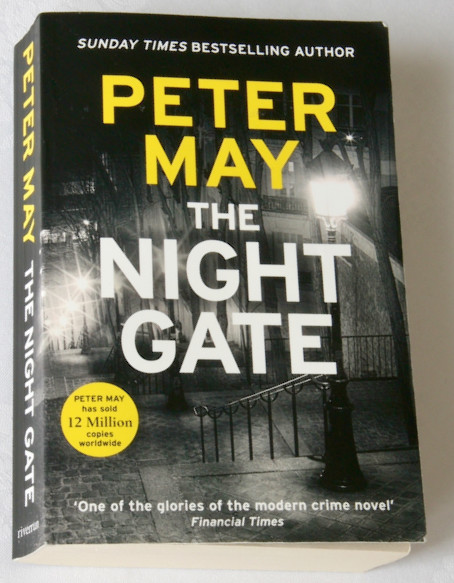
Another skill he excels at is evoking different places in different countries. In The Night Gate, we flip from Scotland to France to Germany by means of deft descriptions and a few local words. From the desolate windy shores of the Outer Hebrides to the dusty heat and rural charm of the Occitanie region in SW France, we’re in the hands of a writer who knows where he is.
By now, Macleod is officially retired, but missing the challenge and buzz of his old job. So he can’t resist a request to consult on two murders which have been discovered in a tiny medieval village, Carennac, on the banks of the river Dordogne. One is 75 years or more old: a storm has uprooted a tree and its roots have lifted a tangle of bones and leather and assorted remains of a ranking officer of the Luftwaffe with a bullet hole in his skull. The other is contemporary: it’s the 2020s, pandemic time, and Emile Narcisse, an art dealer from Paris, is found with his throat cut in the rustic kitchen of an elderly woman, Anny Lavigne, in the same village as the WW2 German’s body was discovered.
Immediately suspect for the fresh murder is Hans Bauer, a young German in his twenties, director of a small private art gallery in Germany, who has a history of violent outbursts, and is known to have visted the old lady that day. And incriminating evidence is indeed found placing him at the scene of the murder. But just what is his connection to both these bodies? It all seems too coincidental, and Enzo hates coincidences. So he begins to dig deeper.
The dead man, Narcisse, he discovers, was phenomenally wealthy, a huge name in the world of international art, who came to public recognition when he uncovered a haul of looted Nazi art in an apartment in Geneva, Switzerland. He’d done all he could to return the priceless works to their rightful owners, and where no heirs existed, sell them to museums and art galleries or private collectors. So what had brought a man such as Narcisse to the modest home of an old lady in a tiny backwater village in south-west France?
It’s Anny Lavigne who provides valuable insights which fill in the backstory to the historic case. She tells Enzo so much about what happened in occupied France in the 1940s; a story she’d heard time and again from her mother. How Hitler commandeered an art historian, Paul Lange, to procure the most famous painting in the world, the Mona Lisa, and hide it somewhere until after the war, when it would be given pride of place in the museum Hitler planned to have built in his hometown Linz in Austria. How General de Gaulle knew of this plan and enlisted the help of another art historian, half-French Georgette Pignal, who had personally helped to pack the precious painting and send it into the country for safekeeping from the Germans. Now she was being given full responsibility for guarding it, but she was to tell no one.
 So she’s shocked to discover that Paul Lange, now a German officer, knows exactly what her mission is. She feels nothing but hostility towards him, but he appears unoffended, even mildly amused by her blatant venom and embarassment at being seen in his company. However, her bosses instruct her not to cause any offence to the Germans, so she reluctantly agrees to being wined and dined every Friday night by Lange. He proves himself to be always the gentleman, making no effort to seduce her, and gradually she learns to trust him.
But others too have designs on the famous painting and we get sucked into an increasingly complex vortex of desire and greed and subterfuge. Who will acquire it? And at what cost to those who thwart them?
The fact that so much of the backstory is historically accurate gives added heft and credibility to this tale: the evacuation of art from the Louvre during WW2 to various chateaux around France; the appropriation of countless works of art by the Germans, including burning some of the canvasses; the courage of named individuals in cataloguing the stolen paintings and tracking them down in order to restore them to their rightful owners after the war; the bravery of the resistance fighters. And the cost in lives.
The plotting is tightly and unerringly woven like an underground map with tracks and links and connections steering the reader to a powerful conclusion. And through it all Peter May drops his trademark literary gems which make his writing sing.
Leaves fell like snow in his headlights. September was stating its case for an early winter.
Depression fell over her like a shroud shaken free of its folds, black and all-enveloping.
Moonlight bled through stained glass to sprinkle dead light among the pews.
Compelling, thrilling, and one to haunt me for some time to come.
Charlotte Gray
Oh the joy of sinking into beautifully written fiction and gripping narrative! Particularly so as I’ve been wading through a couple of texts on moral philosophy, and started a novel that was so uninspiring and ‘so-what-ish’ that I abandoned it half way through – a rare thing for me. I shan’t bore you with references to the former, or name and shame the latter, but I will share the magnificent work which has brightened my week.
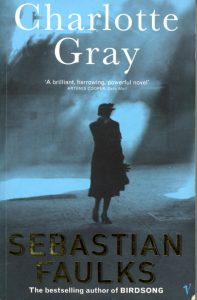 It’s Charlotte Gray by Sebastian Faulks. I loved the delicacy and skill of his Birdsong, so it comes as no surprise that in Charlotte Gray Faulks evokes the same emotions. A tender, tentative, love story between two flawed people in wartime – urgent because of the uncertainty of life; enduring because of the desire to find anchors and permanence in the face of imminent extinction.
The year is 1942. Peter Gregory, fighter pilot/airman, secret agent, is used to feeling vulnerable, flying in ‘nothing more than a few pieces of airborne metal and wood … a few inches from his eyes was a fuel tank waiting to explode‘. He knows all too well that on his low-level raids there are anti-aircraft guns waiting to blast him out of the sky, he is haunted by the premature deaths of so many young colleagues, and yet he seeks further danger, perhaps even to die himself.
Charlotte Gray, a child of the war years, is from the Highlands originally, more recently living in Edinburgh. She’s fluent in French, with a degree in French and Italian. During her formative years she spent time in the country, both on exchange visits and with her father going to visit the war graves occupied by his old comrades. Charlotte is only dimly aware of how damaged by his experiences her father is, but the hovering sensation of betrayal and violation is partially resurrected by the psychiatric evaluation she undergoes before going to France again.
Instant mutual attraction brings Peter aka Greg and Charlotte together when they meet at a literary party in London, but it’s a fragile relationship, laden with baggage from the past, the urgency of the present, and the uncertainties of the future. Both are determined to contribute meaningfully to the war effort, knowing each parting may be their last.
And then Greg goes missing on a secret mission. Information is hard to come by.
Charlotte redoubles her efforts to get to occupied France on military business, where she can employ her own fluency with the language to find out what has happened to him. The process of preparing to be a courier is rigorous but she passes with distinction. She’s given a new French identity, a new cover story. The attention to detail in transforming her is impressive – not only hair style and colour altered radically, every shred of clothing French, but dust from the right area of France lining her pockets. Even her fillings are drilled out and replaced by a heavy gold French mixture. Only one tiny detail is overlooked … pubic hair!!
Being active liberates her, and gives value to her life, but she is still driven by her desire to find Greg. So, having successfully completed her first mission, she takes an unauthorised extension to start the search. But life in the country with which she has always felt such an affinity is very different under enemy occupation. Suspicion and fear are everywhere. Who can be trusted?
She finds shelter with a young man, Julien Levade, aka Octave, also working as part of the resistance movement. But an aura of danger surrounds Julien, himself three eighths Jewish, who has already rescued two young Jewish boys whose parents have been deported. However, his eccentric father needs a housekeeper, so Charlotte, under an assumed name, takes on this post to give her additional cover and credibility.
 In places the story is so harrowing I had to go away and do something mundane – as when someone betrays the whereabouts of those two little French boys and we watch them being transported in cattle trucks to Poland, and then accompany them to the very door of the gas chamber – two tiny naked figures, heads shorn, clutching a tin soldier in one clenched fist. The weight of sadness feels unbearable.
Without drama, without hyperbole, Faulks somehow maintains suspense subtly but effectively, whether it’s the tension of parachuting into a foreign country, moving around under an assumed identity, making contact with unknown people, navigating unknown towns, delivering people and packages, keeping secret assignations, facing betrayal. He captures the incongruities of things people will do under extreme stress or duress. He writes with such delicacy of the emotions of those snatching at passing opportunities, all too aware of the fleeting nature of life.
Charlotte Gray is a powerful backdrop to some of the most heinous crimes committed against humanity whilst gently exploring the power of love to transcend such blackness. A brilliantly written book.
Unsung heroism; disturbing challenges
I guess a lot of us have had more time for reflection and introspection during the last six months. I certainly have. So this was exactly the right time for me to read the kind of book that challenges me to think about my own moral compass and motivation and limits.
Under what circumstances would I, as a wife and mother, risk my life, or more importantly, my child’s life, to save a stranger? Would I let my young daughter starve to prove my loyalty to my country? Would I endure terrible deprivation, face imminent execution, to uphold my ideals? Would my faith in God survive seeing men, women and children being massacred needlessly; a whole race systematically eradicated? Could I live a life which meant I must lie to everyone I love, and always be afraid, never feel safe?
My kind of questions, you might think. But actually this was the kind of thinking that prompted Kristin Hannah to write her novel, The Nightingale.
 She was researching World War II stories, and became fascinated by the women who had put themselves in harm’s way in order to save Jewish children, or downed airmen, some of whom paid a terrible, unimaginable price for their heroism. She simply couldn’t look away, and felt the underlying questions to be as relevant today as they were 70 years ago. As indeed they are.
Vianne and Isabelle Rossignol lose their mother to TB when 14 and 4 respectively. Consumed by his own grief, their father abandons them to the care of others. Outspoken Isabelle rebels everywhere she goes, is expelled from several schools, refusing to be either contained or controlled, and aged just 19, joins the resistance movement, initially delivering propaganda, then risking her life over and over again, escorting British and American downed airmen out of France across the Pyrenees to safety. Her code name is The Nightingale. Quieter Vianne marries her childhood sweetheart, Antoine, and after three miscarriages, gives birth to her daughter Sophie. She becomes a schoolteacher, and in the face of an ugly war and occupation of her beloved town in France, finds a courage of her own, rescuing Jewish children even whilst billeting German officers in her home.

We’ve all heard so much about the atrocities committed by the Nazis; much less of the heroism of the women of France. This book sees the 1940s through the prism of one family – totally harrowing, profoundly moving, reducing me to tears. And by homing in on the intensely personal, it seems somehow to shine a spotlight on the enormity of the whole monstrous period in history. It captures poignantly the contrast between the pain and suffering and barbarity, and the bravery and compassion, loyalty and selflessness of these courageous women, so often unseen and unsung.
The war forced people to look deep inside themselves; to examine who they were and what sacrifices they were prepared to make, what would break them. Asking ourselves those same questions 70+ years on is a challenging exercise. Even drinking a delicious cup of real coffee, knowing these women were enduring a vile brew made from acorns, made me feel chastened. Smiling and chatting to people I met out in the street felt like a luxury, when these women could trust no one – not even relatives and friends. Would I have had the courage to do the honourable thing? Or would I have found a way to argue that I had a greater duty to protect my own? I don’t know.
What I do know is that this book is a compelling read, though certainly not a comfortable one. At no stage can we have any confidence that there will be happy endings. Children die, women kill, men betray, families are ripped apart, suspicion is rife, humans behave barbarically. ‘Grief, like regret, settles into our DNA and remains forever a part of us.’
The Nightingale is superbly written, and I loved the occasional flashes forward to the present when one of the sisters is returning to Paris for a reunion of her compatriots who worked for the resistance, accompanied by her son who knows nothing of her past. We don’t know which one has survived, so this nicely preserves the tension. Whatever the outcome, these valiant women and those they represent, have my profound admiration and respect.