the Louvre
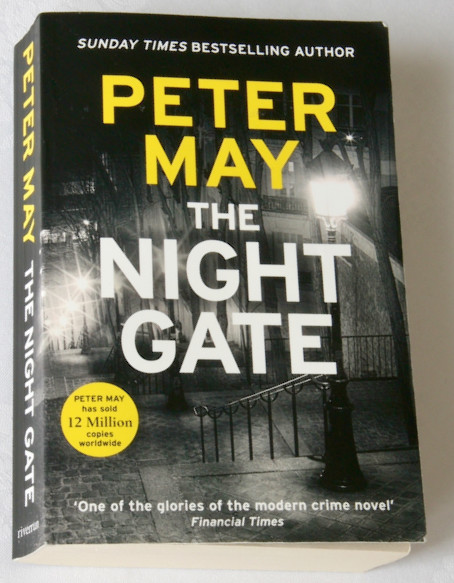
The Night Gate: Peter May
I do love a main protagonist in a series to exhibit unusual characteristics. Peter May‘s forensic expert, Enzo Macleod, has a white stripe in his dark hair running back from one side of his forehead, and one brown eye, one blue eye – both physical manifestations of Waardenburg syndrome. The faulty gene has skipped a generation but reappeared in one of his grandsons as hearing issues. What kind of a mind conjures up something as obscure as that?! Love it. And it’s only one of many trademarks that single this author out as exceptional. I’m a big fan.
Another skill he excels at is evoking different places in different countries. In The Night Gate, we flip from Scotland to France to Germany by means of deft descriptions and a few local words. From the desolate windy shores of the Outer Hebrides to the dusty heat and rural charm of the Occitanie region in SW France, we’re in the hands of a writer who knows where he is.
By now, Macleod is officially retired, but missing the challenge and buzz of his old job. So he can’t resist a request to consult on two murders which have been discovered in a tiny medieval village, Carennac, on the banks of the river Dordogne. One is 75 years or more old: a storm has uprooted a tree and its roots have lifted a tangle of bones and leather and assorted remains of a ranking officer of the Luftwaffe with a bullet hole in his skull. The other is contemporary: it’s the 2020s, pandemic time, and Emile Narcisse, an art dealer from Paris, is found with his throat cut in the rustic kitchen of an elderly woman, Anny Lavigne, in the same village as the WW2 German’s body was discovered.
Immediately suspect for the fresh murder is Hans Bauer, a young German in his twenties, director of a small private art gallery in Germany, who has a history of violent outbursts, and is known to have visted the old lady that day. And incriminating evidence is indeed found placing him at the scene of the murder. But just what is his connection to both these bodies? It all seems too coincidental, and Enzo hates coincidences. So he begins to dig deeper.
The dead man, Narcisse, he discovers, was phenomenally wealthy, a huge name in the world of international art, who came to public recognition when he uncovered a haul of looted Nazi art in an apartment in Geneva, Switzerland. He’d done all he could to return the priceless works to their rightful owners, and where no heirs existed, sell them to museums and art galleries or private collectors. So what had brought a man such as Narcisse to the modest home of an old lady in a tiny backwater village in south-west France?
It’s Anny Lavigne who provides valuable insights which fill in the backstory to the historic case. She tells Enzo so much about what happened in occupied France in the 1940s; a story she’d heard time and again from her mother. How Hitler commandeered an art historian, Paul Lange, to procure the most famous painting in the world, the Mona Lisa, and hide it somewhere until after the war, when it would be given pride of place in the museum Hitler planned to have built in his hometown Linz in Austria. How General de Gaulle knew of this plan and enlisted the help of another art historian, half-French Georgette Pignal, who had personally helped to pack the precious painting and send it into the country for safekeeping from the Germans. Now she was being given full responsibility for guarding it, but she was to tell no one.
 So she’s shocked to discover that Paul Lange, now a German officer, knows exactly what her mission is. She feels nothing but hostility towards him, but he appears unoffended, even mildly amused by her blatant venom and embarassment at being seen in his company. However, her bosses instruct her not to cause any offence to the Germans, so she reluctantly agrees to being wined and dined every Friday night by Lange. He proves himself to be always the gentleman, making no effort to seduce her, and gradually she learns to trust him.
But others too have designs on the famous painting and we get sucked into an increasingly complex vortex of desire and greed and subterfuge. Who will acquire it? And at what cost to those who thwart them?
The fact that so much of the backstory is historically accurate gives added heft and credibility to this tale: the evacuation of art from the Louvre during WW2 to various chateaux around France; the appropriation of countless works of art by the Germans, including burning some of the canvasses; the courage of named individuals in cataloguing the stolen paintings and tracking them down in order to restore them to their rightful owners after the war; the bravery of the resistance fighters. And the cost in lives.
The plotting is tightly and unerringly woven like an underground map with tracks and links and connections steering the reader to a powerful conclusion. And through it all Peter May drops his trademark literary gems which make his writing sing.
Leaves fell like snow in his headlights. September was stating its case for an early winter.
Depression fell over her like a shroud shaken free of its folds, black and all-enveloping.
Moonlight bled through stained glass to sprinkle dead light among the pews.
Compelling, thrilling, and one to haunt me for some time to come.