French Resistance
Jackdaws
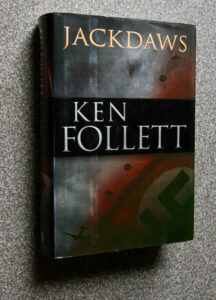 Having enjoyed Ken Follett’s novel Whiteout way more than expected, I raked another one from the back of my shelves: Jackdaws. A hefty 450 page hardback so not for the faint-hearted. It was well worth the effort.
The story is set in the dangerous final days of the Second World War. D-day is approaching and for one of Britain’s most effective operatives in northern France, senior agent Major Felicity (Flick) Clairet, the stakes have never been higher. She’s responsible for sabotage behind enemy lines and is no stranger to fear and danger, but she’s ruthless, clear-thinking, and paranoid about security; one of the survivors.
The centre of the proposed action is a large telephone exchange sited in a beautiful chateau near Reims which the Germans have enlarged to provide connections between the French and German communication systems, and a base for the Gestapo regional headquarters. It’s of enormously significant strategic importance; if it were destroyed, German communications would be crippled.
But when Flick and her husband, Michel – a Resistance leader – try a direct head-on assault, things go horribly wrong. On this occasion the intelligence supplied by MI6, had been inaccurate. Her team is destroyed, lives are lost, her husband is missing, confidence is temporarily shaken. But she remains resolute in her determination not to let the sacrifices be in vain.
Time is not on her side. She assembles a small group of women: a flirt, a murderess, a safe-breaker, a female impersonator, two aristocrats, one awkward, the other entitled – all unprofessional, but each with certain skills Flick needs. Code-named Jackdaws, these six women will attempt a daring infiltration under the very noses of the Germans, impersonating cleaning staff. An agents’ course normally takes three months; Flick has just two days to teach this motley band of women basic security rules: how to parachute, how to use weapons, and how to kill people without making a noise. Then they will be parachuted into France to blow up the telephone exchange.

Terrific tension is created by parallel accounts of the British team preparing to take out the telephone exchange and the German Major Deiter Franck infiltrating the French Resistance, as the countdown days are ticked off one by one. The descriptions of torture techniques, and the brutality of war, are both vivid and sickening, but the enormous courage of those who worked in enemy territory is breathtaking. It’s a shockingly mesmerising and totally gripping tale, bringing with it a fearful awareness of the price that was paid for the peace we take for granted.
Exactly 50 women were sent into France as secret agents during WWII; of these 36 survived. The other 14 gave their lives in service. This book is dedicated to them.