secret agents
Jackdaws
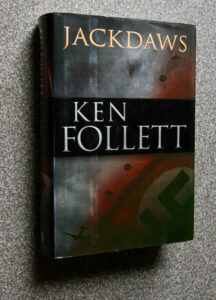 Having enjoyed Ken Follett’s novel Whiteout way more than expected, I raked another one from the back of my shelves: Jackdaws. A hefty 450 page hardback so not for the faint-hearted. It was well worth the effort.
The story is set in the dangerous final days of the Second World War. D-day is approaching and for one of Britain’s most effective operatives in northern France, senior agent Major Felicity (Flick) Clairet, the stakes have never been higher. She’s responsible for sabotage behind enemy lines and is no stranger to fear and danger, but she’s ruthless, clear-thinking, and paranoid about security; one of the survivors.
The centre of the proposed action is a large telephone exchange sited in a beautiful chateau near Reims which the Germans have enlarged to provide connections between the French and German communication systems, and a base for the Gestapo regional headquarters. It’s of enormously significant strategic importance; if it were destroyed, German communications would be crippled.
But when Flick and her husband, Michel – a Resistance leader – try a direct head-on assault, things go horribly wrong. On this occasion the intelligence supplied by MI6, had been inaccurate. Her team is destroyed, lives are lost, her husband is missing, confidence is temporarily shaken. But she remains resolute in her determination not to let the sacrifices be in vain.
Time is not on her side. She assembles a small group of women: a flirt, a murderess, a safe-breaker, a female impersonator, two aristocrats, one awkward, the other entitled – all unprofessional, but each with certain skills Flick needs. Code-named Jackdaws, these six women will attempt a daring infiltration under the very noses of the Germans, impersonating cleaning staff. An agents’ course normally takes three months; Flick has just two days to teach this motley band of women basic security rules: how to parachute, how to use weapons, and how to kill people without making a noise. Then they will be parachuted into France to blow up the telephone exchange.

Terrific tension is created by parallel accounts of the British team preparing to take out the telephone exchange and the German Major Deiter Franck infiltrating the French Resistance, as the countdown days are ticked off one by one. The descriptions of torture techniques, and the brutality of war, are both vivid and sickening, but the enormous courage of those who worked in enemy territory is breathtaking. It’s a shockingly mesmerising and totally gripping tale, bringing with it a fearful awareness of the price that was paid for the peace we take for granted.
Exactly 50 women were sent into France as secret agents during WWII; of these 36 survived. The other 14 gave their lives in service. This book is dedicated to them.
Charlotte Gray
Oh the joy of sinking into beautifully written fiction and gripping narrative! Particularly so as I’ve been wading through a couple of texts on moral philosophy, and started a novel that was so uninspiring and ‘so-what-ish’ that I abandoned it half way through – a rare thing for me. I shan’t bore you with references to the former, or name and shame the latter, but I will share the magnificent work which has brightened my week.
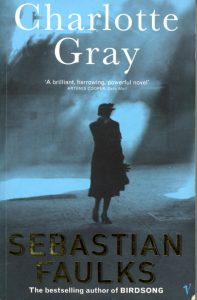 It’s Charlotte Gray by Sebastian Faulks. I loved the delicacy and skill of his Birdsong, so it comes as no surprise that in Charlotte Gray Faulks evokes the same emotions. A tender, tentative, love story between two flawed people in wartime – urgent because of the uncertainty of life; enduring because of the desire to find anchors and permanence in the face of imminent extinction.
The year is 1942. Peter Gregory, fighter pilot/airman, secret agent, is used to feeling vulnerable, flying in ‘nothing more than a few pieces of airborne metal and wood … a few inches from his eyes was a fuel tank waiting to explode‘. He knows all too well that on his low-level raids there are anti-aircraft guns waiting to blast him out of the sky, he is haunted by the premature deaths of so many young colleagues, and yet he seeks further danger, perhaps even to die himself.
Charlotte Gray, a child of the war years, is from the Highlands originally, more recently living in Edinburgh. She’s fluent in French, with a degree in French and Italian. During her formative years she spent time in the country, both on exchange visits and with her father going to visit the war graves occupied by his old comrades. Charlotte is only dimly aware of how damaged by his experiences her father is, but the hovering sensation of betrayal and violation is partially resurrected by the psychiatric evaluation she undergoes before going to France again.
Instant mutual attraction brings Peter aka Greg and Charlotte together when they meet at a literary party in London, but it’s a fragile relationship, laden with baggage from the past, the urgency of the present, and the uncertainties of the future. Both are determined to contribute meaningfully to the war effort, knowing each parting may be their last.
And then Greg goes missing on a secret mission. Information is hard to come by.
Charlotte redoubles her efforts to get to occupied France on military business, where she can employ her own fluency with the language to find out what has happened to him. The process of preparing to be a courier is rigorous but she passes with distinction. She’s given a new French identity, a new cover story. The attention to detail in transforming her is impressive – not only hair style and colour altered radically, every shred of clothing French, but dust from the right area of France lining her pockets. Even her fillings are drilled out and replaced by a heavy gold French mixture. Only one tiny detail is overlooked … pubic hair!!
Being active liberates her, and gives value to her life, but she is still driven by her desire to find Greg. So, having successfully completed her first mission, she takes an unauthorised extension to start the search. But life in the country with which she has always felt such an affinity is very different under enemy occupation. Suspicion and fear are everywhere. Who can be trusted?
She finds shelter with a young man, Julien Levade, aka Octave, also working as part of the resistance movement. But an aura of danger surrounds Julien, himself three eighths Jewish, who has already rescued two young Jewish boys whose parents have been deported. However, his eccentric father needs a housekeeper, so Charlotte, under an assumed name, takes on this post to give her additional cover and credibility.
 In places the story is so harrowing I had to go away and do something mundane – as when someone betrays the whereabouts of those two little French boys and we watch them being transported in cattle trucks to Poland, and then accompany them to the very door of the gas chamber – two tiny naked figures, heads shorn, clutching a tin soldier in one clenched fist. The weight of sadness feels unbearable.
Without drama, without hyperbole, Faulks somehow maintains suspense subtly but effectively, whether it’s the tension of parachuting into a foreign country, moving around under an assumed identity, making contact with unknown people, navigating unknown towns, delivering people and packages, keeping secret assignations, facing betrayal. He captures the incongruities of things people will do under extreme stress or duress. He writes with such delicacy of the emotions of those snatching at passing opportunities, all too aware of the fleeting nature of life.
Charlotte Gray is a powerful backdrop to some of the most heinous crimes committed against humanity whilst gently exploring the power of love to transcend such blackness. A brilliantly written book.